
Theyre Just Playing Busting the Myth Melissa Sudduth
“They’re Just Playing!” Busting the Myth Melissa Sudduth, MS, CFLE The University of Alabama Department of Human Development & Family Studies
Think About Playdough • What can you do with it? • What skills does it require? • Is it difficult or tedious? Is it joyful and engaging? • How is it helpful for school readiness? Play is the glue that makes learning “stick”!
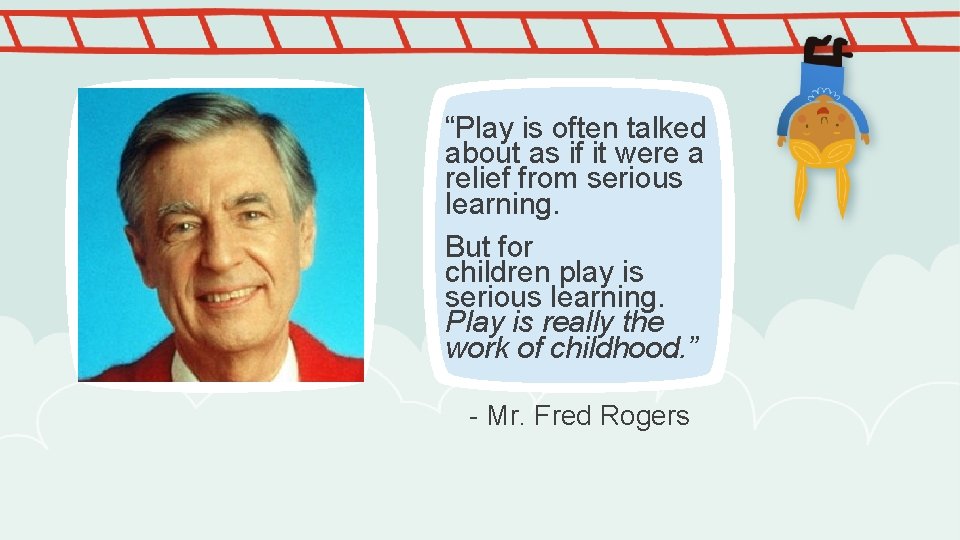
“Play is often talked about as if it were a relief from serious learning. But for children play is serious learning. Play is really the work of childhood. ” - Mr. Fred Rogers
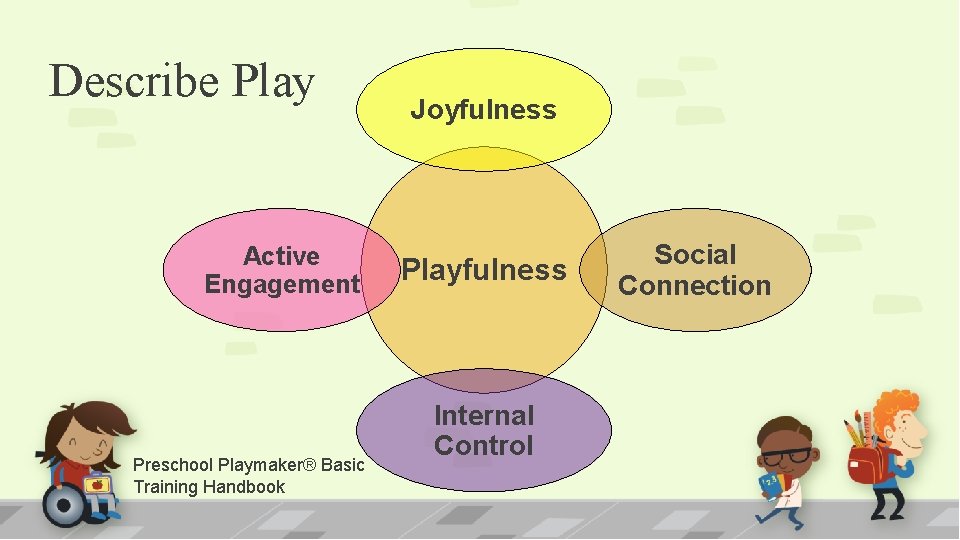
Describe Play Active Engagement Preschool Playmaker® Basic Training Handbook Joyfulness Playfulness Internal Control Social Connection
Piaget’s Theory – Constructivism • Children construct their knowledge by acting on the environment • Sensorimotor Period (birth – 2 years) • Children learn through senses and movement • Preoperational Period (2 years – 6 years) • Children think magically then symbolically • Animism • Egocentrism • 4 years – Theory of Mind
Theory of Mind • Awareness that other people think and feel differently than we do • Putting ourselves in another’s shoes • The foundation for empathy • Explored through dramatic play
Free Play • Children are able, for the most part to select: • What they play with • Who they play with • Where they play • How they play • The rules of play • Children manage free play, adults observe • Requires time – to establish roles, rules, stories…
Recess • Primary school classes easier to manage • Reduces risk of childhood obesity • Potential to increase standardized test scores • Embodied cognition – the body’s position, comfort, and overall health contribute to thoughts and learning • An active body promotes learning!
Meaningful Play Children have access to enough materials to carry out complex play • Doll, stroller, clothes… • Blocks, cars, people, animals… • Pretend food, shopping basket, money… • Sand, sifts, shovels, cups… • Loose parts!
Play-Based Learning • Designed and led by the adult • Requires following a set of directions • Has a predetermined end or final product • Uses components children may enjoy • Music, dancing, paint, manipulatives, group involvement, movement, non-traditional learning materials…
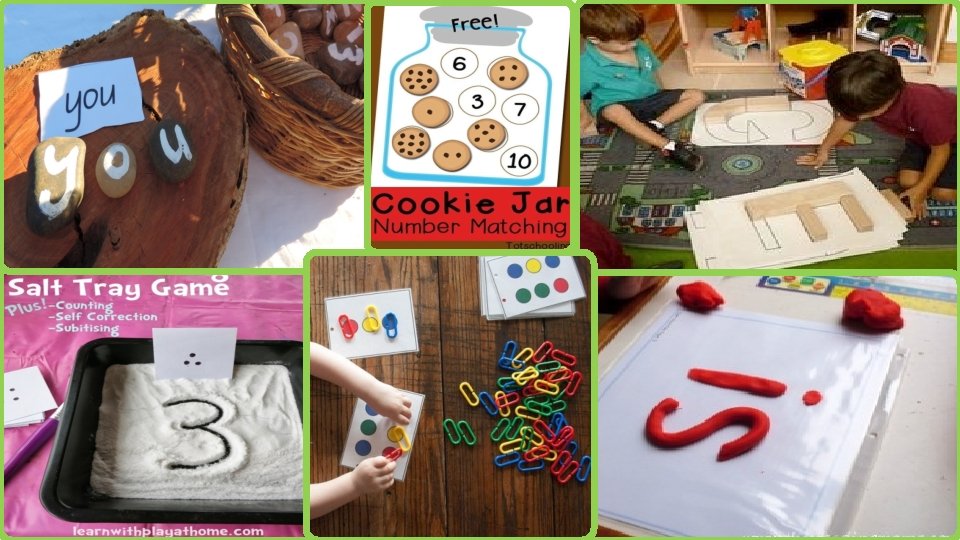
Skills Learned & Refined Through Play Fine motor • Playdough • Writing & coloring • Lacing beads & cards • Cutting with scissors • Manipulatives (links & gears) • Tying shoes & fastening buttons & zippers • Puzzles • Twisting off lids & caps • Tearing • Doll clothes & dress-up clothes • Pretend cooking/eating utensils • Blocks, Duplos, Legos…
Skills Learned & Refined Through Play Science & Math • Simple science experiments • Cause & effect • Blocks • Trial & error • Cars & ramps • Observation • Prisms & color paddles • Developing hypotheses • Identifying patterns • Magnifying glasses and objects to examine • Counting • Balances & weights • Measurements • Sand & water • Pretend food & money…
Skills Learned & Refined Through Play Literacy • Board books • Left to right, front to back orientation, & page turning • Vinyl books • Associating print with images and spoken word • Foster a love of literacy through play with books, being read to, & making up stories • Cloth books • Paperback books • Hardback books • “Indestructible” books • Homemade books • Books on tape…
Skills Learned & Refined Through Play Social skills • Recognize emotions in themselves & others • View things from another person’s perspective • Negotiate, create & follow rules • Take turns • Build foundation of sharing
“The Wolves at the Door” The concerned people who want to know what children are doing all day “They desire a rationale for flubber, the developmentally appropriateness of ooblick, the reason for the hokey pokey…an overall justification for the importance of what we might call play. ” A Crash Course in the Language of Wolves by Lisa Murphy – The Ooey Gooey Lady!
Who are the Wolves? • Parents & Grandparents • Funding Agency Personnel • K – 12 School Teachers and Staff • Government Officials – local, state, & federal • Random tax payers! • Director or Coworkers! • Maybe Even Ourselves!
“Wolf Words” & Phrases • Refining pre-writing skills • Spatial awareness • Visual tracking • Symbolic thinking • Inquiry & developing hypotheses • Cause & effect • Density, mass, surface tension, & suspension • Non-Newtonian fluid • Cooperation, collaboration, problem solving, & decision making • Self-awareness & self-expression • Angles, incline, decline, & velocity • Estimating & making projections • Quantity, weight, & volume • Compare & contrast • Tactile awareness • Discovering • Autonomy
Today the Children… • explored perspective taking as they took on the roles of letter writer, postal worker, and postmaster (dramatic play and playing with writing tools) • experimented with cadence and rhythm as they used maracas, tone blocks, and rhythm sticks (musical play) • practiced balancing, measuring height, using spatial awareness, and recognizing shapes to lay the foundation for understanding geometry (block play) • appreciated nature as they observed the anatomy of a grasshopper, made illustrations of the insect, and presented their findings to the class (watching a bug, drawing it, and sharing it!) • acquired new vocabulary, negotiated a dilemma, and improved their linguistic and social skills (talking and working with another child!) • made observations of saturation, density, temperature, texture, and states of matter while exploring a non-Newtonian fluid (? )
Keys to using “Wolf Words” & Phrases • Knowledge! • Intentionality! • Confidence! • Persistence! • Patience!
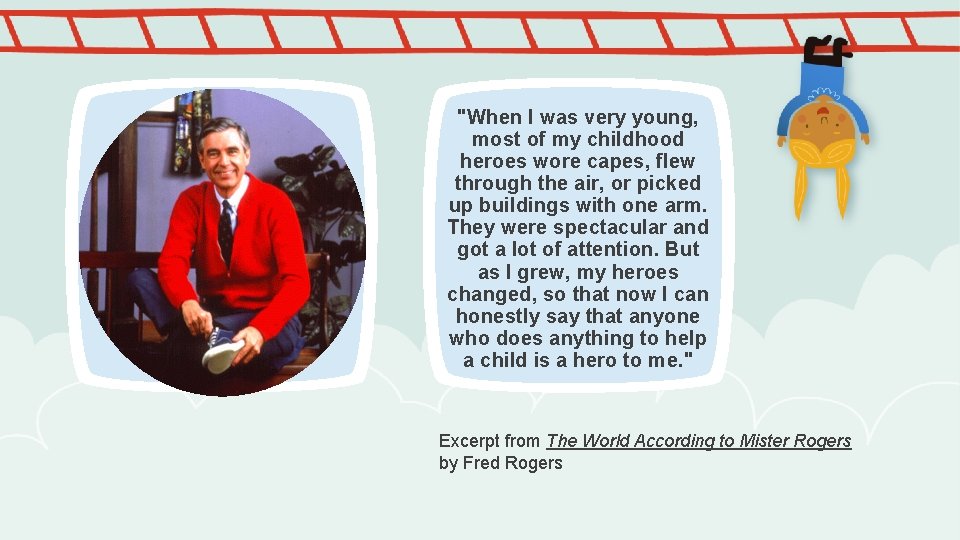
"When I was very young, most of my childhood heroes wore capes, flew through the air, or picked up buildings with one arm. They were spectacular and got a lot of attention. But as I grew, my heroes changed, so that now I can honestly say that anyone who does anything to help a child is a hero to me. " Excerpt from The World According to Mister Rogers by Fred Rogers
Resources - Websites • Lisa Murphy. Ooey Gooey® Inc. A Crash Course in the Language of Wolves www. ooeygooey. com/handouts/crashcourse. pdf • Fred Rogers Center for Early Learning and Children’s Media www. fredrogerscenter. org/ • Preschool Playmaker® Basic Training https: //content. lifeisgood. com/kidsfoundation/
Resources - Websites • NAEYC. Ten Things Every Parent Should Know About Play. https: //www. naeyc. org/our-work/families/10 things-every-parent-play
Resources - Books • Play by Lisa Murphy • The Ooey Gooey Handbook by Lisa Murphy • Ooey Gooey Tooey by Lisa Murphy
- Slides: 24