
Thesis Proposal Zachary Kurmas v 4 0 24
- Slides: 64
Thesis Proposal Zachary Kurmas (v 4. 0– 24 April 03) 1
Outline • • Motivation and discussion of problem Overview of of solution Contributions Proposal Future Work Timeline Details of solution (time permitting) 2
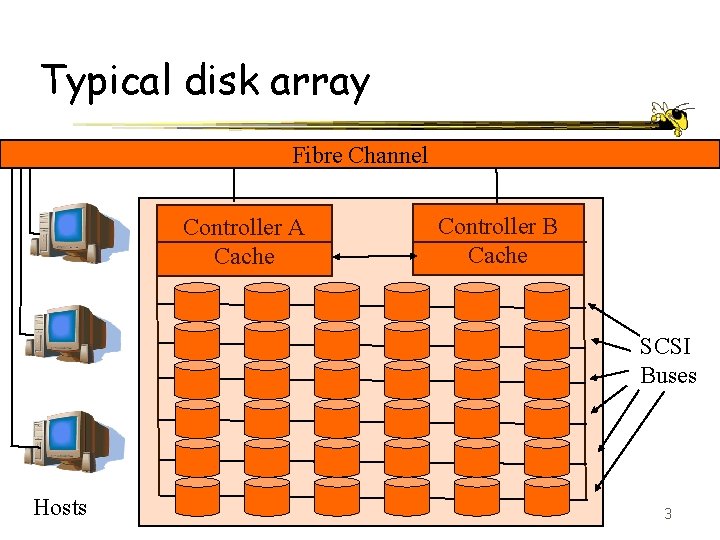
Typical disk array Fibre Channel Controller A Cache Controller B Cache SCSI Buses Hosts 3
Motivation • Potential storage system designs and automated configuration algorithms must be evaluated with respect to some set of workloads. • Ideally, these workloads are actual production workloads. • This is usually impossible • Two alternatives • Replay traces of production workloads • Construct and use synthetic workload 4
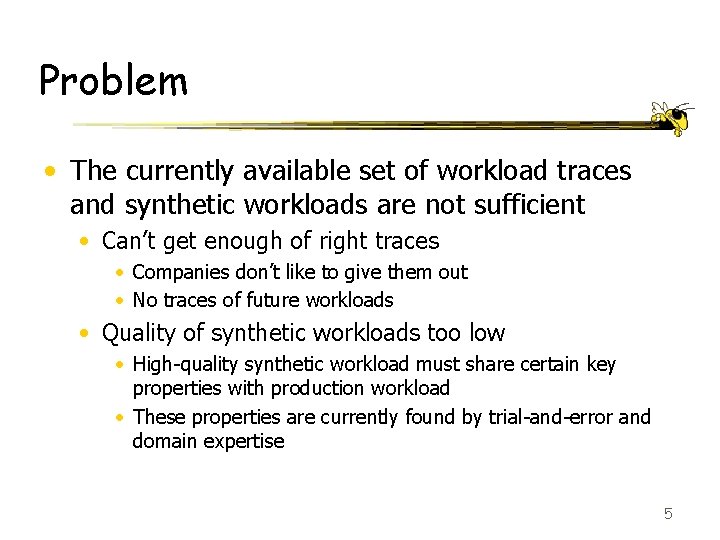
Problem • The currently available set of workload traces and synthetic workloads are not sufficient • Can’t get enough of right traces • Companies don’t like to give them out • No traces of future workloads • Quality of synthetic workloads too low • High-quality synthetic workload must share certain key properties with production workload • These properties are currently found by trial-and-error and domain expertise 5
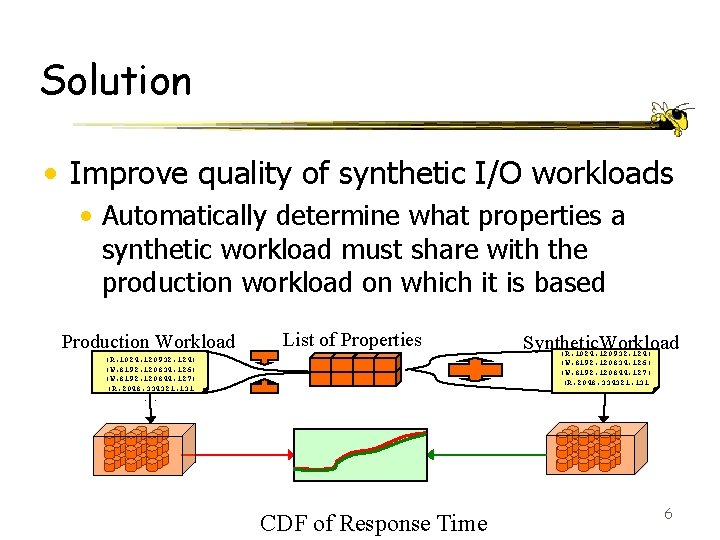
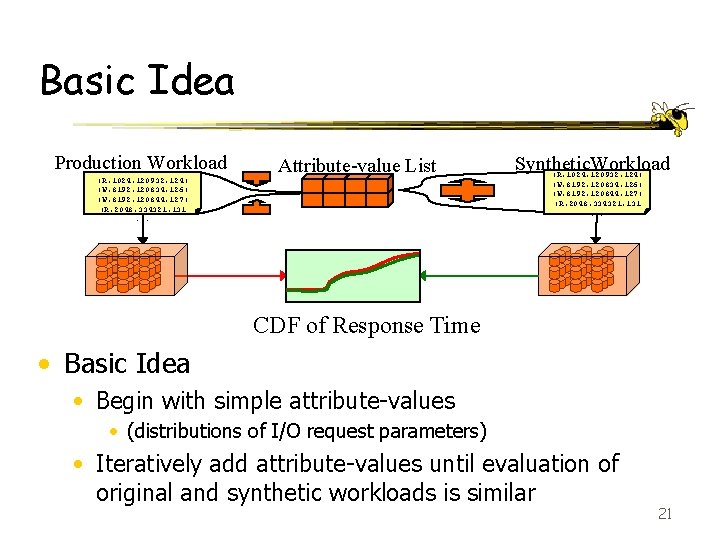
Solution • Improve quality of synthetic I/O workloads • Automatically determine what properties a synthetic workload must share with the production workload on which it is based Production Workload List of Properties (R, 1024, 120932, 124) (W, 8192, 120834, 126) (W, 8192, 120844, 127) (R, 2048, 334321, 131. . . CDF of Response Time Synthetic. Workload (R, 1024, 120932, 124) (W, 8192, 120834, 126) (W, 8192, 120844, 127) (R, 2048, 334321, 131. . . 6
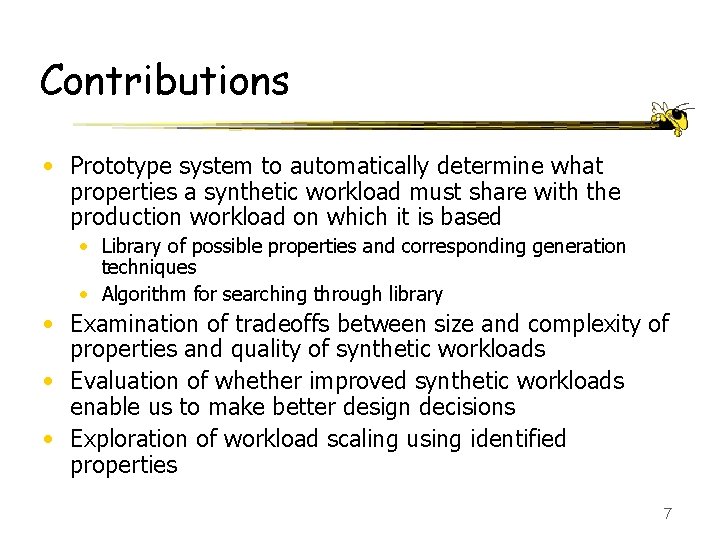
Contributions • Prototype system to automatically determine what properties a synthetic workload must share with the production workload on which it is based • Library of possible properties and corresponding generation techniques • Algorithm for searching through library • Examination of tradeoffs between size and complexity of properties and quality of synthetic workloads • Evaluation of whether improved synthetic workloads enable us to make better design decisions • Exploration of workload scaling using identified properties 7
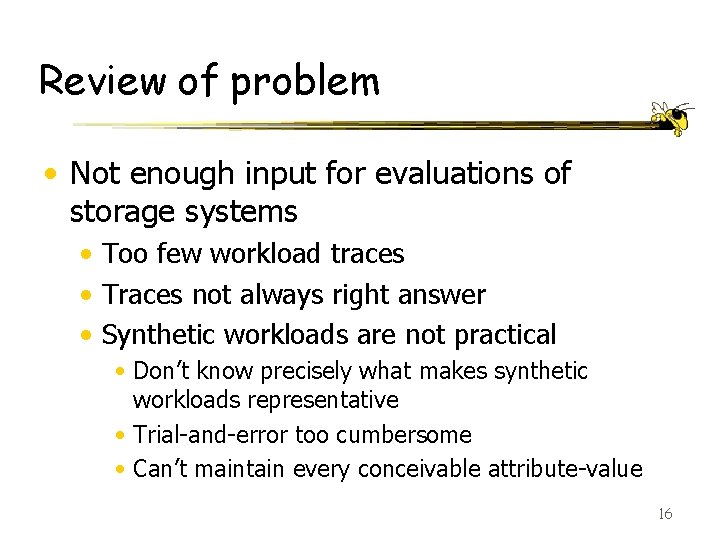
Review of problem • Not enough input for evaluations of storage systems • Too few workload traces • Traces not always right answer • Synthetic workloads are not practical • Don’t know precisely what makes synthetic workloads representative • Trial-and-error too cumbersome • Can’t maintain every conceivable attribute-value 16
Outline • • Discussion of problem Overview of of solution Contributions Proposal Future Work Timeline Details of solution (time permitting) 17
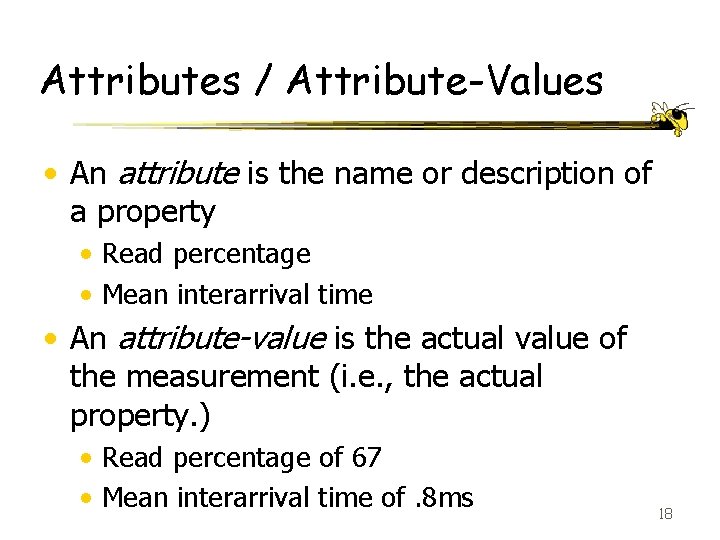
Attributes / Attribute-Values • An attribute is the name or description of a property • Read percentage • Mean interarrival time • An attribute-value is the actual value of the measurement (i. e. , the actual property. ) • Read percentage of 67 • Mean interarrival time of. 8 ms 18
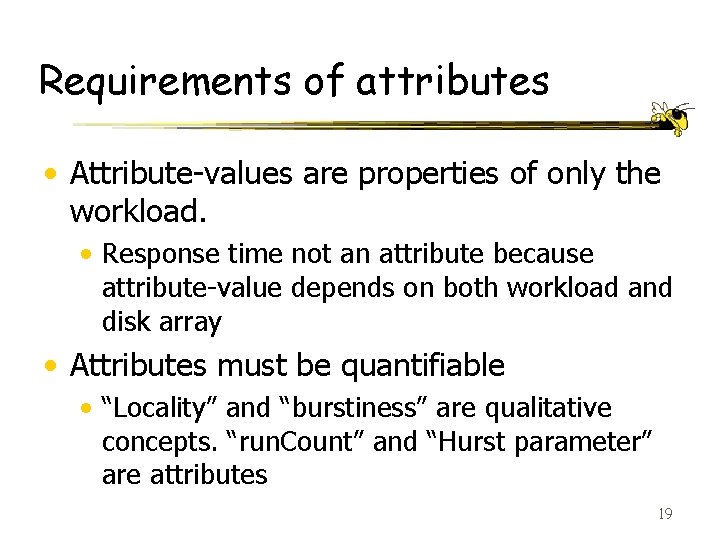
Requirements of attributes • Attribute-values are properties of only the workload. • Response time not an attribute because attribute-value depends on both workload and disk array • Attributes must be quantifiable • “Locality” and “burstiness” are qualitative concepts. “run. Count” and “Hurst parameter” are attributes 19
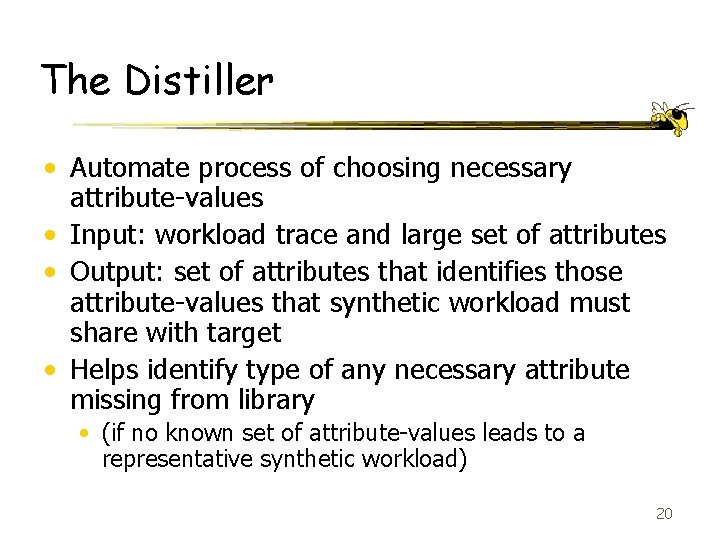
The Distiller • Automate process of choosing necessary attribute-values • Input: workload trace and large set of attributes • Output: set of attributes that identifies those attribute-values that synthetic workload must share with target • Helps identify type of any necessary attribute missing from library • (if no known set of attribute-values leads to a representative synthetic workload) 20
Basic Idea Production Workload (R, 1024, 120932, 124) (W, 8192, 120834, 126) (W, 8192, 120844, 127) (R, 2048, 334321, 131. . . Attribute-value List Synthetic. Workload (R, 1024, 120932, 124) (W, 8192, 120834, 126) (W, 8192, 120844, 127) (R, 2048, 334321, 131. . . CDF of Response Time • Basic Idea • Begin with simple attribute-values • (distributions of I/O request parameters) • Iteratively add attribute-values until evaluation of original and synthetic workloads is similar 21
Challenges: Which attribute to add • Each iteration takes many minutes; therefore, we must limit the number of iterations • Addition of necessary attribute-values does not always result immediately in improvement • Fewer attributes better • Smaller compact representation • Less complex generation techniques • Generation techniques for some attributes can interfere with each other • E. g. , distribution of location and jump distance 23
Outline • Discussion of problem • Overview of of solution • Contributions • The Distiller itself • An analysis of the key attributes for many different workloads • A an analysis of the potential uses of synthetic workloads • • Proposal Future Work Timeline Details of solution (time permitting) 26
The Distiller itself • Distiller makes generating representative synthetic workloads practical • Encourage companies to make evaluation workloads available • More accurate / relevant research results • Basis for “what-if” evaluations • Future estimations • Stability estimates • Improved relevance of old evaluation workloads (possibly) • Distiller provides library of attributes and corresponding generation techniques 27
Analysis of key attributes for many workloads • Attribute-values that lead to representative synthetic workloads describe what makes the workload behave like or unlike other workloads • The “essence” of the workload • Possible to study essence of many different (workload, storage system) pairs and look for interesting trends or patterns 28
Potential benefits of analyses • Help us learn about how workloads and storage systems interact • Attribute-values contain all info necessary to predict behavior • Focus researchers’ attention on concentrated information • Help development of analytical models • Identify potential areas of improvement q 29
Outline • • Discussion of problem Overview of of solution Contributions Proposal • Evaluate the correctness of the Distiller • Examine the attributes chosen for different workload/storage system pairs • Show that the resulting synthetic workloads are useful • Future Work • Timeline • Details of solution (time permitting) 30
Evaluate correctness of Distiller • Show that the Distiller works for: • One definition of “representative”: response time distribution • Up to three storage systems: FC-60, FC-30, and JBOD (Just a Bunch Of Disks) • Several artificial workloads • Five production workloads: Open Mail, TPC-C, TPC-H, file system trace • Stopping Condition: • Distiller can correctly identify key attributes for artificial workloads 31
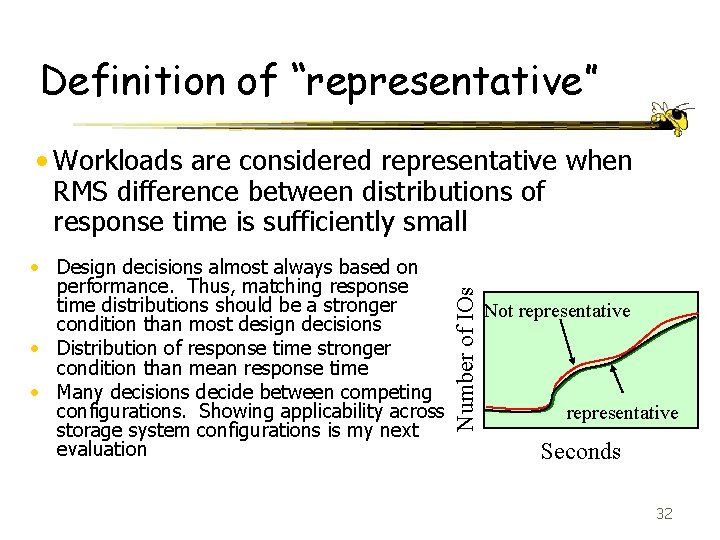
Definition of “representative” • Design decisions almost always based on performance. Thus, matching response time distributions should be a stronger condition than most design decisions • Distribution of response time stronger condition than mean response time • Many decisions decide between competing configurations. Showing applicability across storage system configurations is my next evaluation Number of IOs • Workloads are considered representative when RMS difference between distributions of response time is sufficiently small Not representative Seconds 32
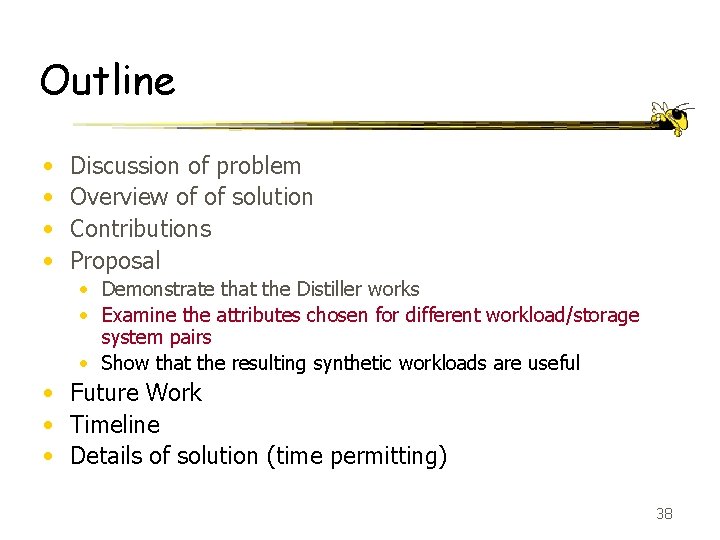
Outline • • Discussion of problem Overview of of solution Contributions Proposal • Demonstrate that the Distiller works • Examine the attributes chosen for different workload/storage system pairs • Show that the resulting synthetic workloads are useful • Future Work • Timeline • Details of solution (time permitting) 38
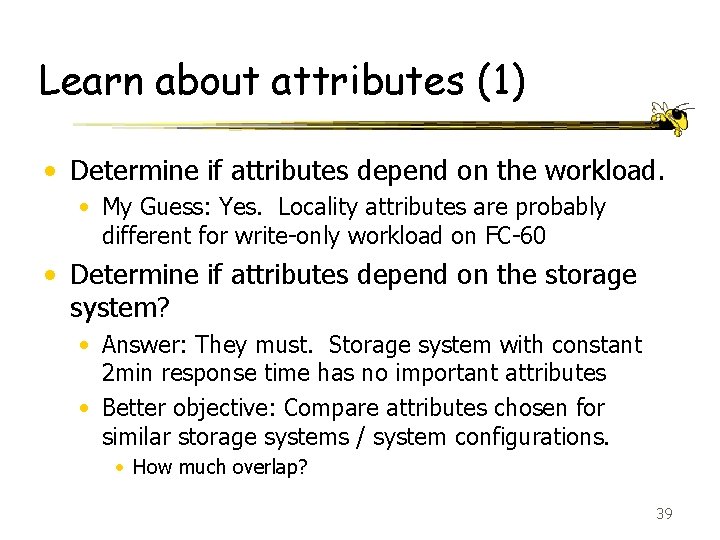
Learn about attributes (1) • Determine if attributes depend on the workload. • My Guess: Yes. Locality attributes are probably different for write-only workload on FC-60 • Determine if attributes depend on the storage system? • Answer: They must. Storage system with constant 2 min response time has no important attributes • Better objective: Compare attributes chosen for similar storage systems / system configurations. • How much overlap? 39
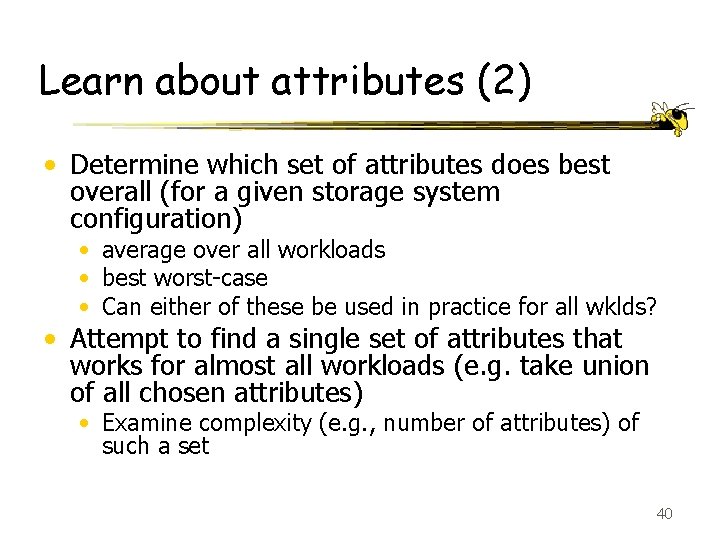
Learn about attributes (2) • Determine which set of attributes does best overall (for a given storage system configuration) • average over all workloads • best worst-case • Can either of these be used in practice for all wklds? • Attempt to find a single set of attributes that works for almost all workloads (e. g. take union of all chosen attributes) • Examine complexity (e. g. , number of attributes) of such a set 40
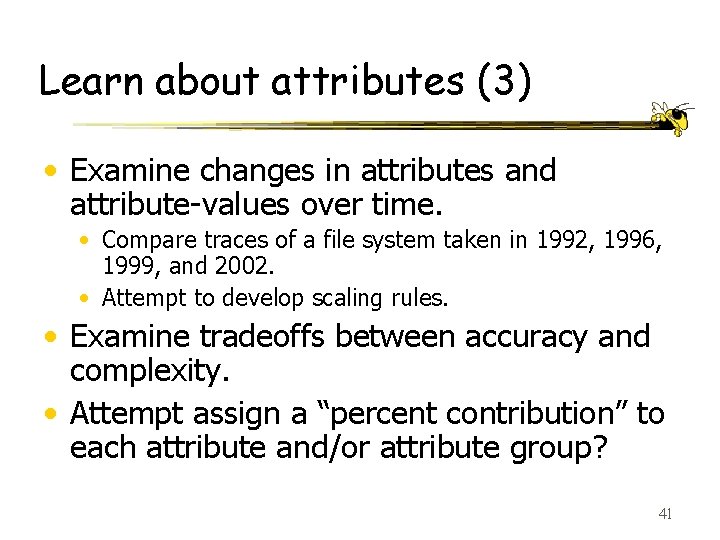
Learn about attributes (3) • Examine changes in attributes and attribute-values over time. • Compare traces of a file system taken in 1992, 1996, 1999, and 2002. • Attempt to develop scaling rules. • Examine tradeoffs between accuracy and complexity. • Attempt assign a “percent contribution” to each attribute and/or attribute group? 41
Outline • • Discussion of problem Overview of of solution Contributions Proposal • Demonstrate that the Distiller works • Examine the attributes chosen for different workload/storage system pairs • Show that the resulting synthetic workloads are useful • Future Work • Timeline • Details of solution (time permitting) 42
Apply to real life • Show that synthetic workloads can be used to make design decisions • Show that currently available traces not adequate • Show usefulness of “knobs” 43
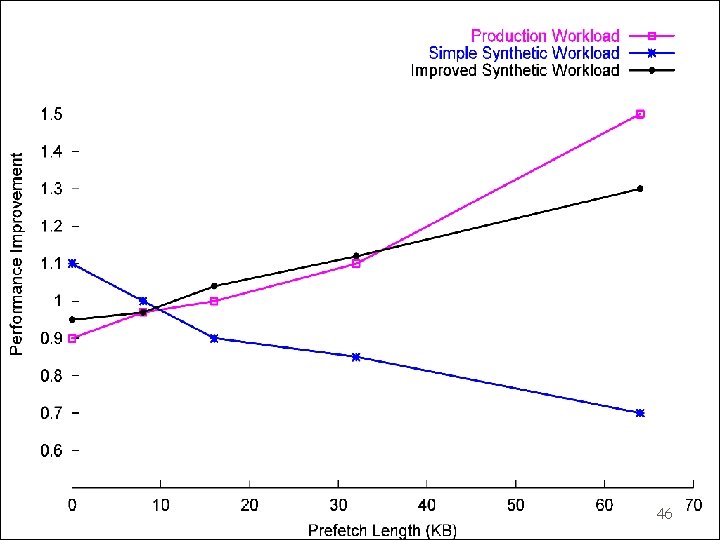
Synthetic workloads useful • Show that synthetic workloads can be used in place of real workloads to make simple design decision • Cache size • Prefetch length • High-water mark of write-back cache • Complex design decisions basis for entire Ph. D. theses. Can’t practically reproduce at Tech. • Use Pantheon disk simulator to simulate effects of changing above parameters 44
Synthetic workloads useful (2) • • • Take production workload trace Simulate performance given different prefetch lengths. Choose best Take synthetic workload based on production workload Simulate performance given different prefetch lengths Compare best to best for production workload • For cache size, find best performance/$ mark. 45
46
Show available traces inadequate • Use Pantheon disk simulator to show that using the cello 92 and cello 02 traces to evaluate simple design decisions results in different answers. • From this we infer that using cello 92 traces to justify more complex design decisions also produces incorrect answer 47
Turning “knobs” useful • Show that turning “knobs” of compact representation better than ad-hoc modifications to workload traces • Show that turning arrival time knob better than contracting interarrival times • Show that turning request size knob better than ad-hoc doubling of request size and location values. • Evaluate turning of knobs versus removing ½ of cello I/Os based on process ID 48
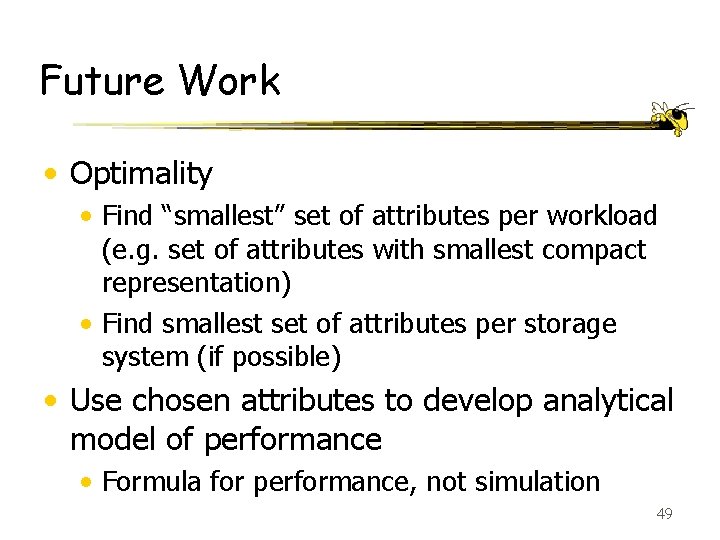
Future Work • Optimality • Find “smallest” set of attributes per workload (e. g. set of attributes with smallest compact representation) • Find smallest set of attributes per storage system (if possible) • Use chosen attributes to develop analytical model of performance • Formula for performance, not simulation 49
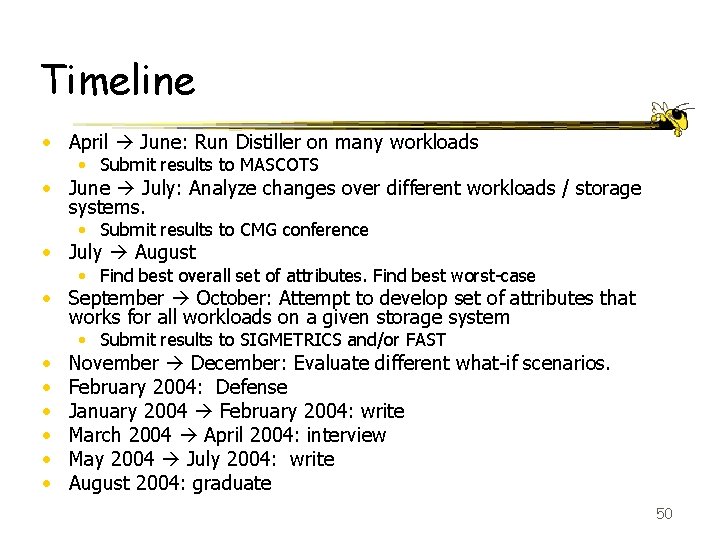
Timeline • April June: Run Distiller on many workloads • Submit results to MASCOTS • June July: Analyze changes over different workloads / storage systems. • Submit results to CMG conference • July August • Find best overall set of attributes. Find best worst-case • September October: Attempt to develop set of attributes that works for all workloads on a given storage system • • Submit results to SIGMETRICS and/or FAST November December: Evaluate different what-if scenarios. February 2004: Defense January 2004 February 2004: write March 2004 April 2004: interview May 2004 July 2004: write August 2004: graduate 50
Outline • • Discussion of problem Overview of of solution Contributions Proposal Future Work Timeline Details of solution (time permitting) 51
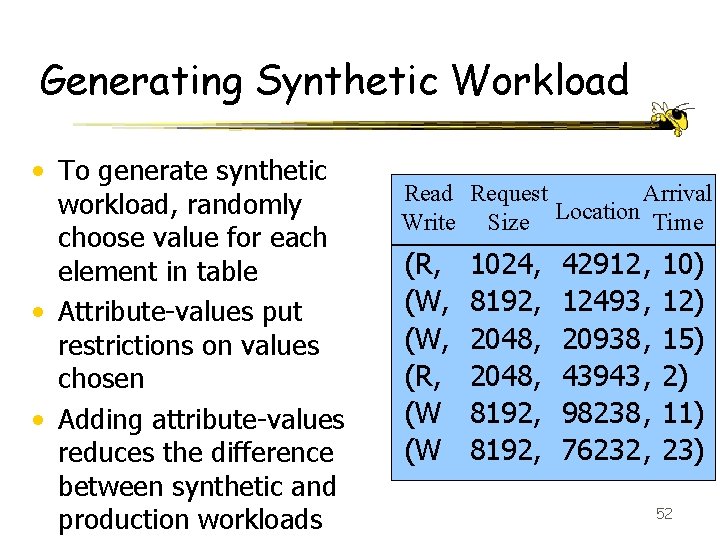
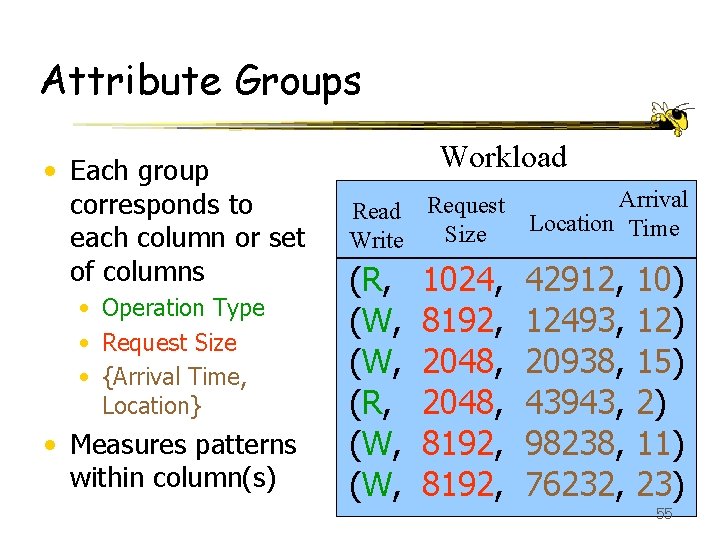
Generating Synthetic Workload • To generate synthetic workload, randomly choose value for each element in table • Attribute-values put restrictions on values chosen • Adding attribute-values reduces the difference between synthetic and production workloads Read Request Arrival Write Size Location Time (R, (W, (R, (W (W 1024, 8192, 2048, 8192, 42912, 12493, 20938, 43943, 98238, 76232, 10) 12) 15) 2) 11) 23) 52
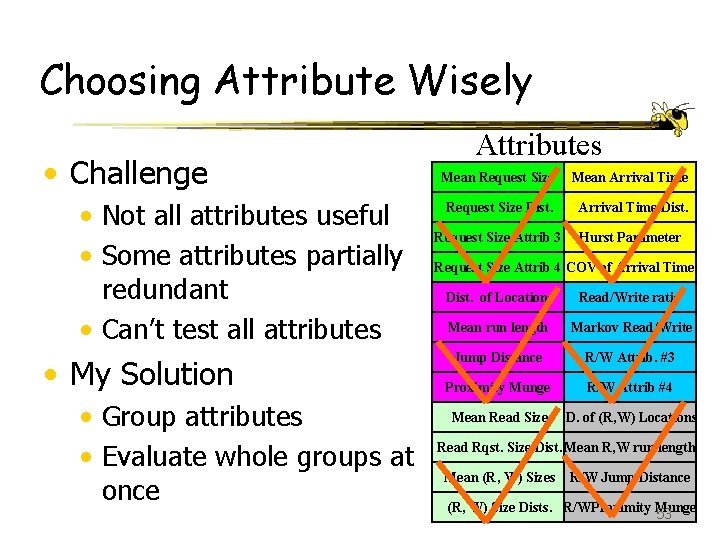
Choosing Attribute Wisely • Challenge • Not all attributes useful • Some attributes partially redundant • Can’t test all attributes • My Solution • Group attributes • Evaluate whole groups at once Attributes Mean Request Size Mean Arrival Time Request Size Dist. Arrival Time Dist. Request Size Attrib 3 Hurst Parameter Request Size Attrib 4 COV of Arrival Time Dist. of Locations Read/Write ratio Mean run length Markov Read/Write Jump Distance R/W Attrib. #3 Proximity Munge R/W Attrib #4 Mean Read Size D. of (R, W) Locations Read Rqst. Size Dist. Mean R, W run length Mean (R, W) Sizes R/W Jump Distance (R, W) Size Dists. R/WProximity Munge 53
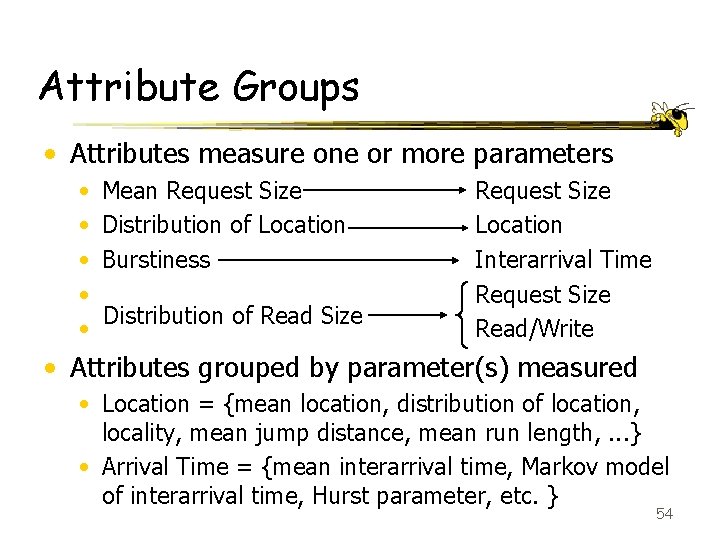
Attribute Groups • Attributes measure one or more parameters • • • Mean Request Size Distribution of Location Burstiness Distribution of Read Size Request Size Location Interarrival Time Request Size Read/Write • Attributes grouped by parameter(s) measured • Location = {mean location, distribution of location, locality, mean jump distance, mean run length, . . . } • Arrival Time = {mean interarrival time, Markov model of interarrival time, Hurst parameter, etc. } 54
Attribute Groups • Each group corresponds to each column or set of columns • Operation Type • Request Size • {Arrival Time, Location} • Measures patterns within column(s) Workload Request Size Write Arrival Location Time (R, (W, (W, 42912, 12493, 20938, 43943, 98238, 76232, 1024, 8192, 2048, 8192, 10) 12) 15) 2) 11) 23) 55
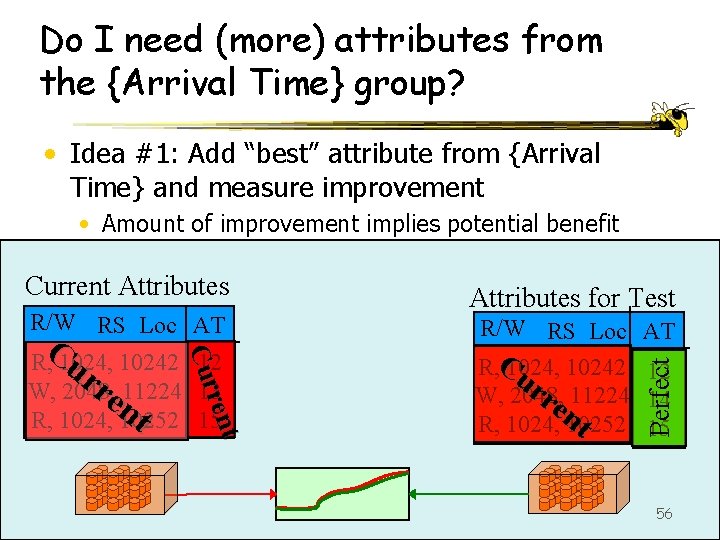
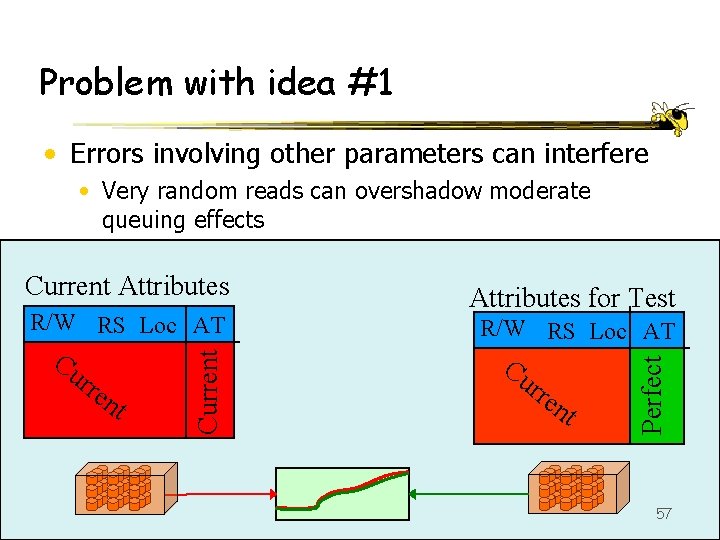
Do I need (more) attributes from the {Arrival Time} group? • Idea #1: Add “best” attribute from {Arrival Time} and measure improvement • Amount of improvement implies potential benefit R/W RS Loc AT 12 13 15 t ren Cur C R, 1024, ur 10242 re 11224 W, 2048, nt R, 1024, 10252 Attributes for Test R/W RS Loc R, C 1024, ur 10242 W, 2048, re 11224 R, 1024, n 10252 t AT 12 14 15 Perfect Current Attributes 56
Problem with idea #1 • Errors involving other parameters can interfere • Very random reads can overshadow moderate queuing effects Cu rre nt Current R/W RS Loc AT Attributes for Test R/W RS Loc AT Cu rre nt Perfect Current Attributes 57
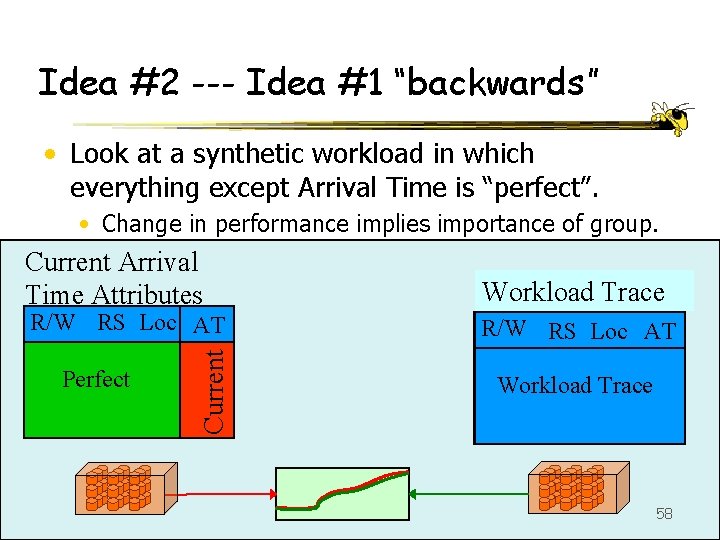
Idea #2 --- Idea #1 “backwards” • Look at a synthetic workload in which everything except Arrival Time is “perfect”. • Change in performance implies importance of group. Current Arrival Time Attributes Perfect Current R/W RS Loc AT Everything Workload Trace Perfect R/W RS Loc AT Workload Production Trace Perfect Workload 58
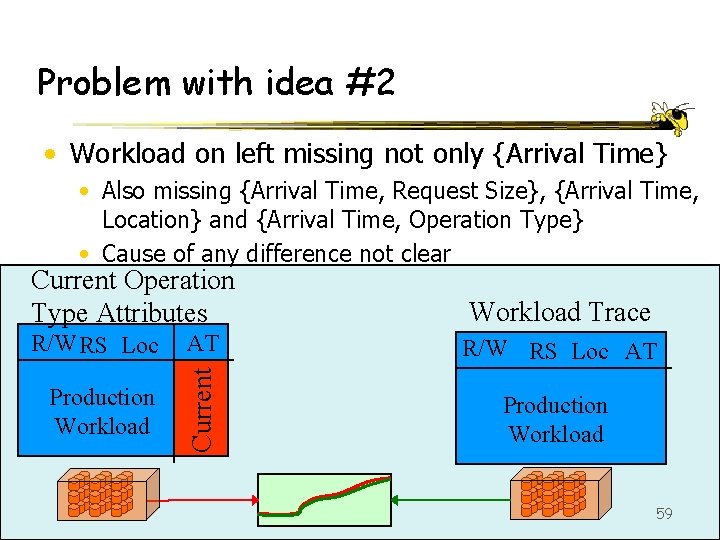
Problem with idea #2 • Workload on left missing not only {Arrival Time} • Also missing {Arrival Time, Request Size}, {Arrival Time, Location} and {Arrival Time, Operation Type} • Cause of any difference not clear Workload Trace R/W RS Loc AT Production Workload Current Operation Type Attributes Production Workload 59
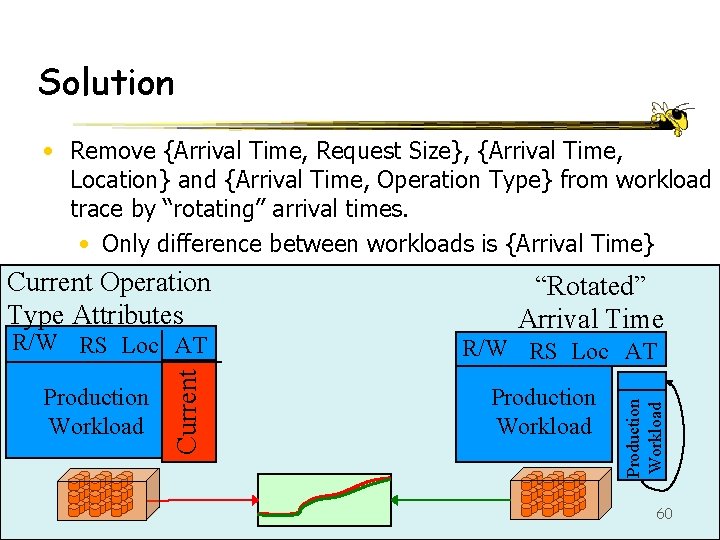
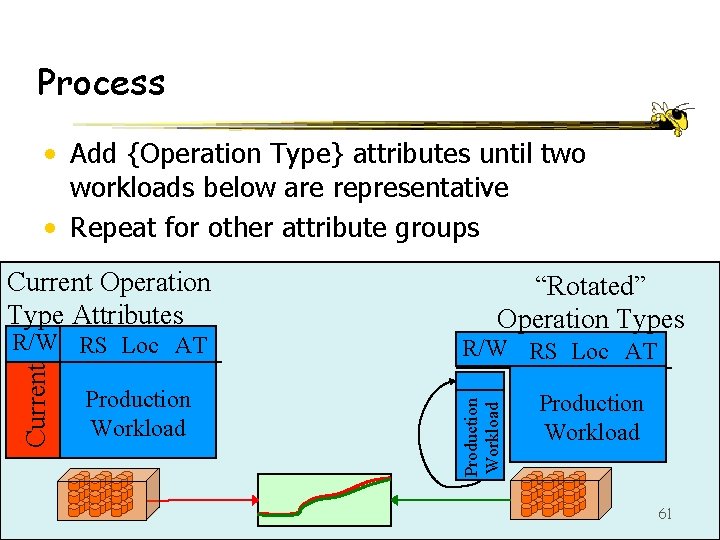
Solution • Remove {Arrival Time, Request Size}, {Arrival Time, Location} and {Arrival Time, Operation Type} from workload trace by “rotating” arrival times. • Only difference between workloads is {Arrival Time} Production Workload Current R/W RS Loc AT “Rotated” Arrival Time R/W RS Loc AT Production Workload Current Operation Type Attributes 60
Process • Add {Operation Type} attributes until two workloads below are representative • Repeat for other attribute groups Current R/W RS Loc AT Production Workload “Rotated” Operation Types R/W RS Loc AT Production Workload Current Operation Type Attributes Production Workload 61
Hints • If Distiller is unable to find attributes for a particular group, it identifies the deficiency • Helps people develop new attributes • Attributes for multi-parameter groups must be compatible with single parameter groups • {Operation Type, Location} attribute must maintain same properties as chosen {Operation Type} and {Location} parameters 62
End Of Talk 63
Problem: • Lack of traces for researchers • …. Papers use same … traces • Traces used may or may not be representative of actual production workloads • When traces not sufficient, really bad synthetic workloads used instead • We don’t know how to easily produce representative synthetic workload • Lack of synthetic workload generation ability suggests lack of understanding of disk array and storage system interactions 64
Proposed Solution • Improve our ability to generate synthetic workloads • (Discuss previous work) 65
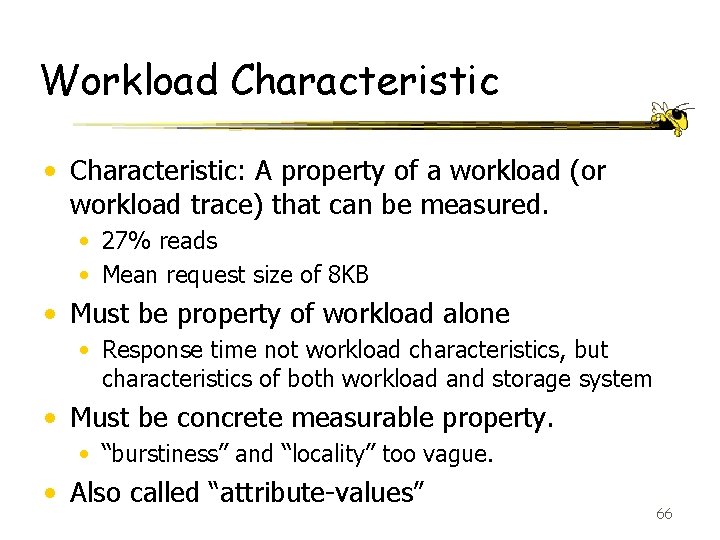
Workload Characteristic • Characteristic: A property of a workload (or workload trace) that can be measured. • 27% reads • Mean request size of 8 KB • Must be property of workload alone • Response time not workload characteristics, but characteristics of both workload and storage system • Must be concrete measurable property. • “burstiness” and “locality” too vague. • Also called “attribute-values” 66
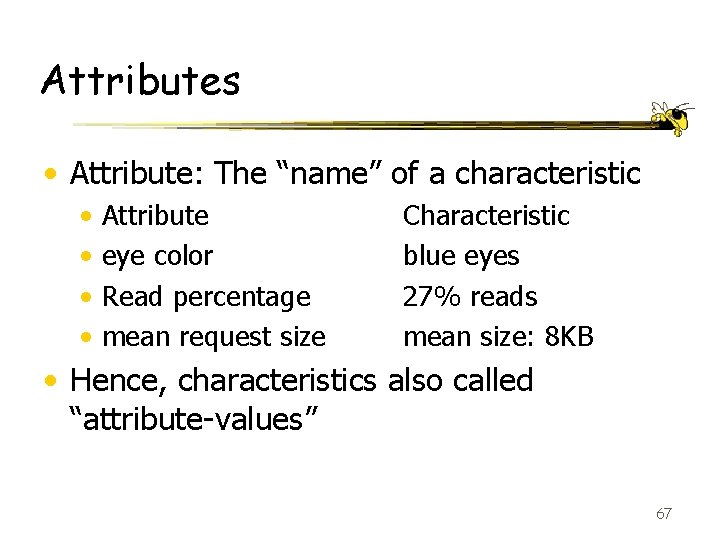
Attributes • Attribute: The “name” of a characteristic • • Attribute eye color Read percentage mean request size Characteristic blue eyes 27% reads mean size: 8 KB • Hence, characteristics also called “attribute-values” 67
How the Distiller works • Partition known attributes into groups • All characteristics in each group contain similar information • Choose a “complete” set of characteristics from each group. • i. e. choose a set of characteristics that contains all the necessary information from the group 68
$21, 000 question • What attribute-values must a synthetic workload should share with the production workload in order to be representative? • Do the attributes depend on the workload? • Do the attributes depend on the storage system? • If so, how can we find them easily? • If not, what are they? 69
Trivial “solution” doesn’t work • Trivial solution: Use many attribute-values • Problems with trivial solution • Many attribute-values contain irrelevant info. • Many attribute-values contain duplicate info. • High-level description too large and complex • Negates advantages of synthetic workload • Generating synthetic workload too difficult • Obvious algorithms for generating attribute-values often interfere with each other. 70
Challenges of Useful Solution • Solution: Choose small set of “important” attribute-values • That is, attribute-values that have the most impact on evaluation • Challenges • Estimating impact of single attribute-value on evaluation • Finding small set of attribute-value with “disjoint” information 71
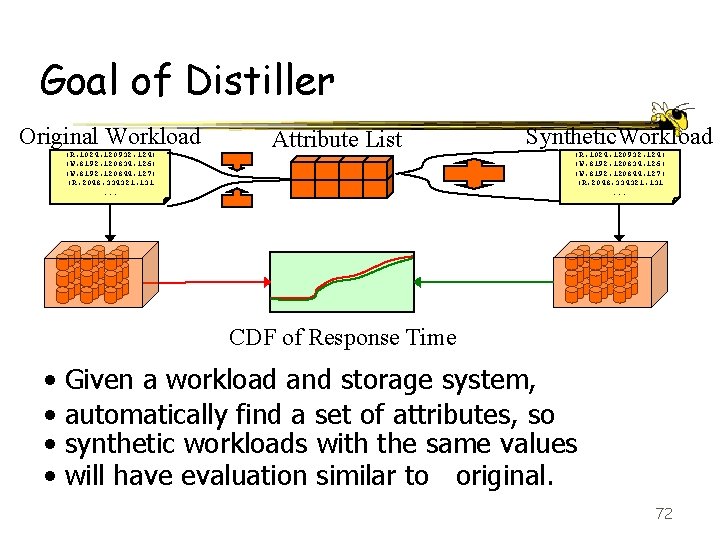
Goal of Distiller Original Workload (R, 1024, 120932, 124) (W, 8192, 120834, 126) (W, 8192, 120844, 127) (R, 2048, 334321, 131. . . Attribute List Synthetic. Workload (R, 1024, 120932, 124) (W, 8192, 120834, 126) (W, 8192, 120844, 127) (R, 2048, 334321, 131. . . CDF of Response Time • • Given a workload and storage system, automatically find a set of attributes, so synthetic workloads with the same values will have evaluation similar to original. 72
High-level approach • Divide and Conquer • Partition attributes into groups according to “type of information” • Recall some attributes describe similar info. • Find a set of attribute-values that contains all the information for a particular group • (No, its not that simple …) 73
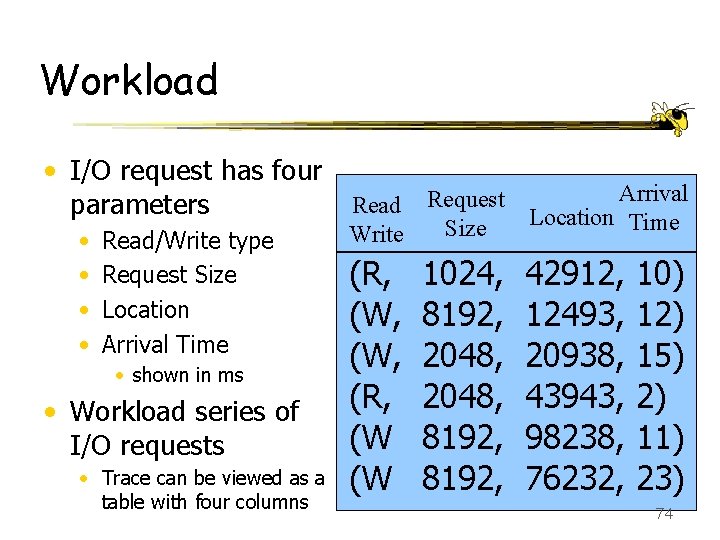
Workload • I/O request has four parameters • • Read/Write type Request Size Location Arrival Time • shown in ms • Workload series of I/O requests • Trace can be viewed as a table with four columns Read Request Size Write Arrival Location Time (R, (W, (R, (W (W 42912, 12493, 20938, 43943, 98238, 76232, 1024, 8192, 2048, 8192, 10) 12) 15) 2) 11) 23) 74
“Engineering” Contributions • Finding representative synthetic workloads becomes practical • Basis for evaluations when traces are unavailable • Basis for “what-if” evaluations • Provides basis for workload similarity metric • “Table-based” models • Highlight what workload features a storage system handles best • Help configure storage system for new workload 75
76
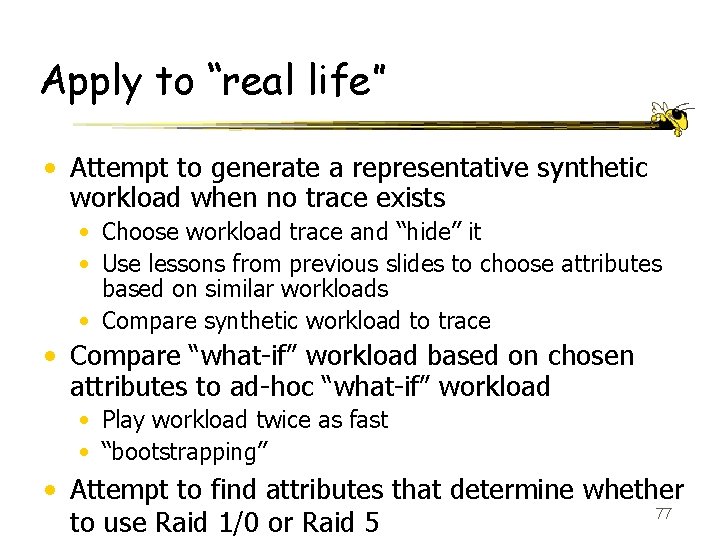
Apply to “real life” • Attempt to generate a representative synthetic workload when no trace exists • Choose workload trace and “hide” it • Use lessons from previous slides to choose attributes based on similar workloads • Compare synthetic workload to trace • Compare “what-if” workload based on chosen attributes to ad-hoc “what-if” workload • Play workload twice as fast • “bootstrapping” • Attempt to find attributes that determine whether 77 to use Raid 1/0 or Raid 5
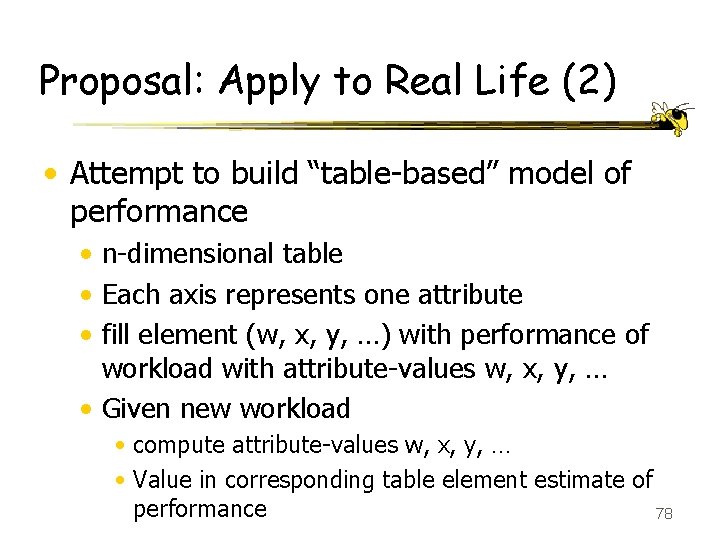
Proposal: Apply to Real Life (2) • Attempt to build “table-based” model of performance • n-dimensional table • Each axis represents one attribute • fill element (w, x, y, …) with performance of workload with attribute-values w, x, y, … • Given new workload • compute attribute-values w, x, y, … • Value in corresponding table element estimate of performance 78
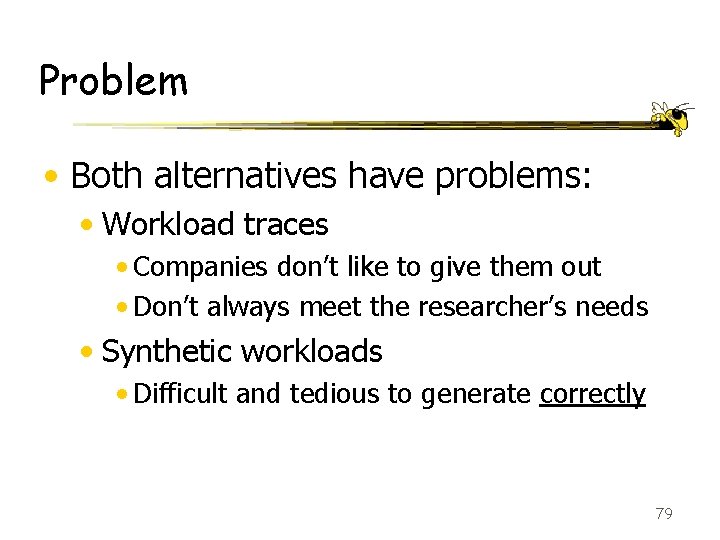
Problem • Both alternatives have problems: • Workload traces • Companies don’t like to give them out • Don’t always meet the researcher’s needs • Synthetic workloads • Difficult and tedious to generate correctly 79
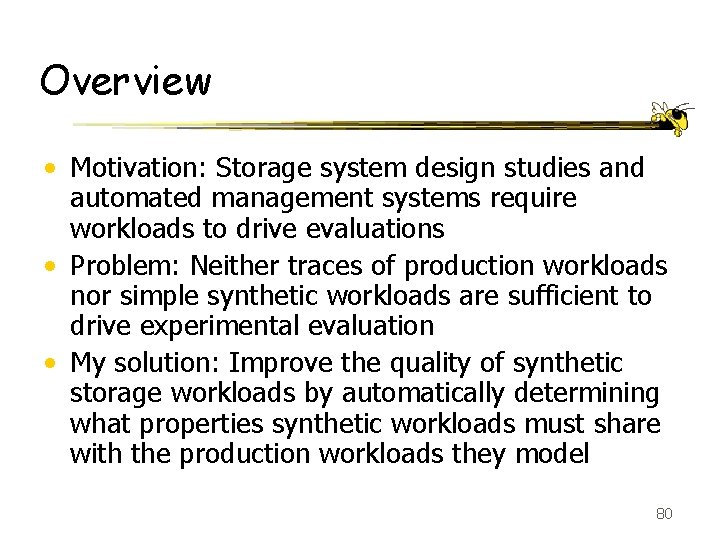
Overview • Motivation: Storage system design studies and automated management systems require workloads to drive evaluations • Problem: Neither traces of production workloads nor simple synthetic workloads are sufficient to drive experimental evaluation • My solution: Improve the quality of synthetic storage workloads by automatically determining what properties synthetic workloads must share with the production workloads they model 80