
Thermoregulation Chapter 8 Homeostasis of body temperature and
Thermoregulation Chapter 8 Homeostasis of body temperature and body fluids © 2010 Mc. Graw-Hill Australia
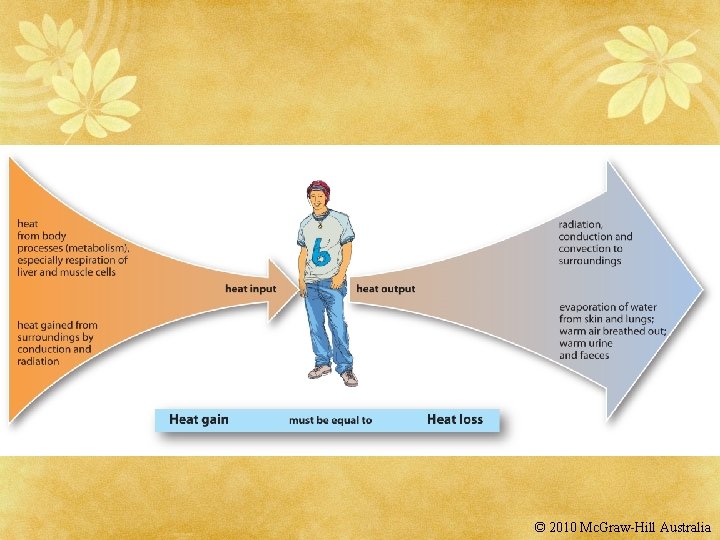
Humans In humans, body temperature is relatively constant The usual body temperature is 36. 8 C In the body, heat gained = heat lost This process is called thermoregulation, a term used to describe the processes which maintain the balance between heat production and heat loss © 2010 Mc. Graw-Hill Australia
© 2010 Mc. Graw-Hill Australia
Why Thermoregulate? Chemical reactions occurring in cells are very heat-sensitive Enzymes that control cellular activity are heatsensitive © 2010 Mc. Graw-Hill Australia
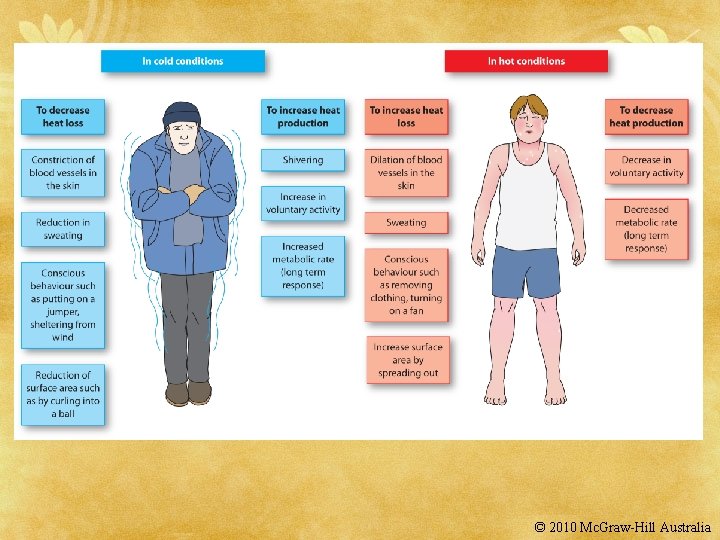
Rising Body Temperature Rising body temperature prompts heat loss in the body through: v blood flow to the skin v metabolic rate v behavioural responses v sweating © 2010 Mc. Graw-Hill Australia
Blood Flow to Skin Vasodilation: v in response to rising temperature, the body increases blood flow to the skin v is controlled by the autonomic nervous system v results in an increase in blood flow to the skin, allowing heat loss via radiation, conduction, convection and evaporation v prompts cooling of the blood that is flowing through the skin © 2010 Mc. Graw-Hill Australia
Metabolic Rate The metabolic rate changes through a reduction in the secretion of thyroxine This results in a decrease in metabolic rate The decrease in metabolic rate causes less heat to be produced in the body © 2010 Mc. Graw-Hill Australia
Behavioural Responses We change our behavioural responses by: staying still (decreasing activity) staying in the shade air conditioning wearing less clothing © 2010 Mc. Graw-Hill Australia
Sweat is controlled by the sympathetic nervous system It is secreted from sweat glands to skin Sweat contains sodium chloride, urea, lactic acid and potassium ions Sweat cools by evaporating from the body Sweat doesn’t work in a humid environment Environmental temperature > body temp for sweating to be effective © 2010 Mc. Graw-Hill Australia
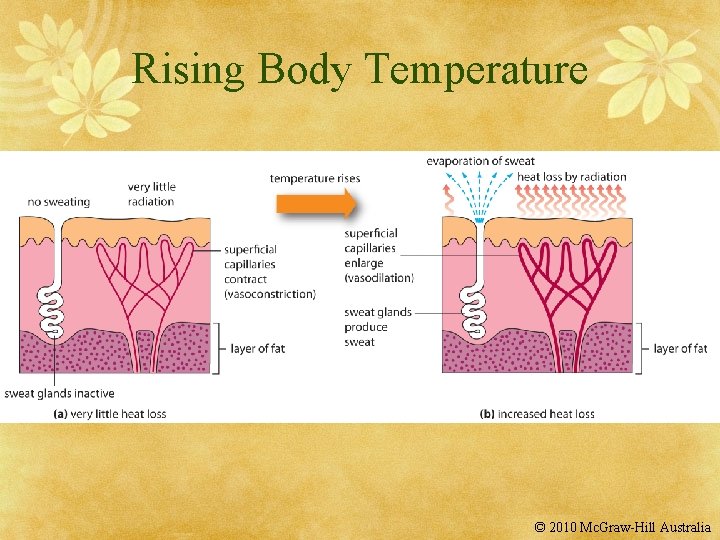
Rising Body Temperature © 2010 Mc. Graw-Hill Australia
Falling Body Temperature Falling body temperature prompts: changes in blood flow to the skin changes in metabolic rate shivering behavioural responses © 2010 Mc. Graw-Hill Australia
Blood Flow to Skin In response to falling temperatures, the body restricts blood flow to the skin. This process is called vasoconstriction Vasoconstriction: v is controlled by the sympathetic nervous system v decreases blood flow to the skin from internal organs, which • decreases the transfer of heat from the internal body organs to the skin • allows less heat to be lost from the body surface • cools the skin © 2010 Mc. Graw-Hill Australia
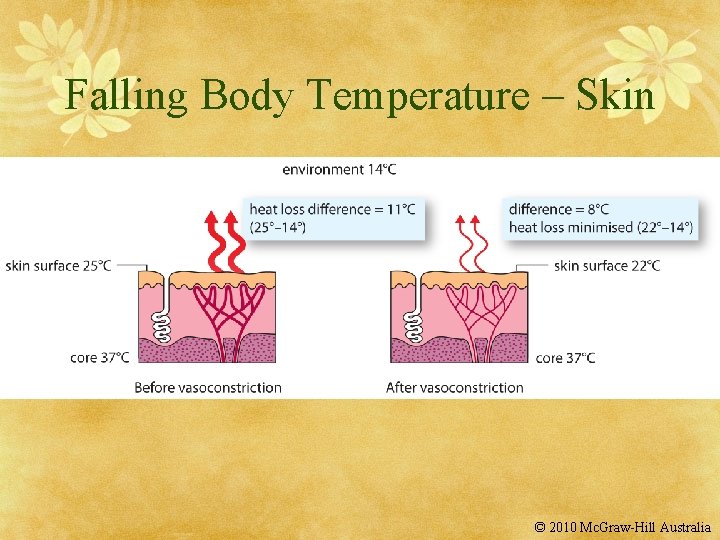
Falling Body Temperature – Skin © 2010 Mc. Graw-Hill Australia
The Hypothalamus and the Adrenal Medulla The hypothalamus stimulates the adrenal medulla via sympathetic nerves The medulla secretes adrenaline and noradrenaline into the blood This increases cellular metabolism, increasing heat production This process helps maintain internal body temperature © 2010 Mc. Graw-Hill Australia

The Hypothalamus and the Anterior Pituitary The hypothalamus also stimulates the anterior lobe of the pituitary The anterior pituitary secretes thyroid stimulating hormone (TSH) TSH acts on the thyroid gland The thyroid gland releases thyroxine into the blood This increases metabolic rate, increasing body temperature © 2010 Mc. Graw-Hill Australia
Shivering is actually rhythmic muscle tremors occurring at a rate of around ten to twenty per second The hypothalamus stimulates parts of the brain that increase skeletal muscle tone This increases body heat production © 2010 Mc. Graw-Hill Australia
Behavioural Responses We change our behavioural responses by: huddling curling into a ball putting on more clothes using a heating device © 2010 Mc. Graw-Hill Australia
© 2010 Mc. Graw-Hill Australia
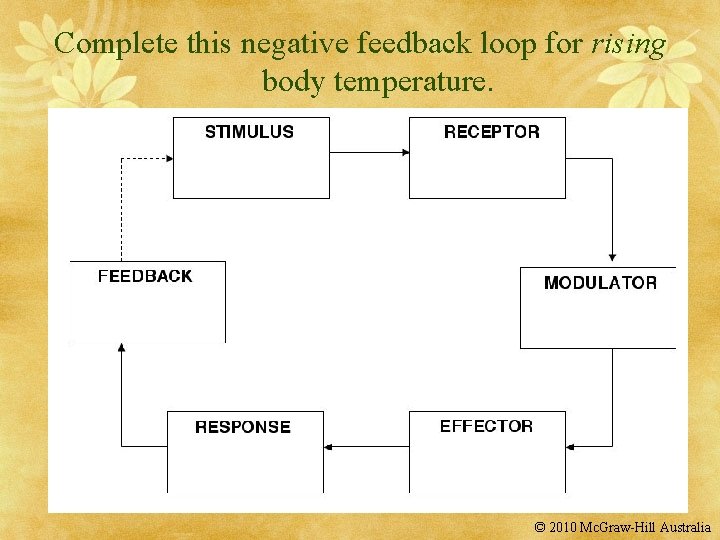
Complete this negative feedback loop for rising body temperature. © 2010 Mc. Graw-Hill Australia
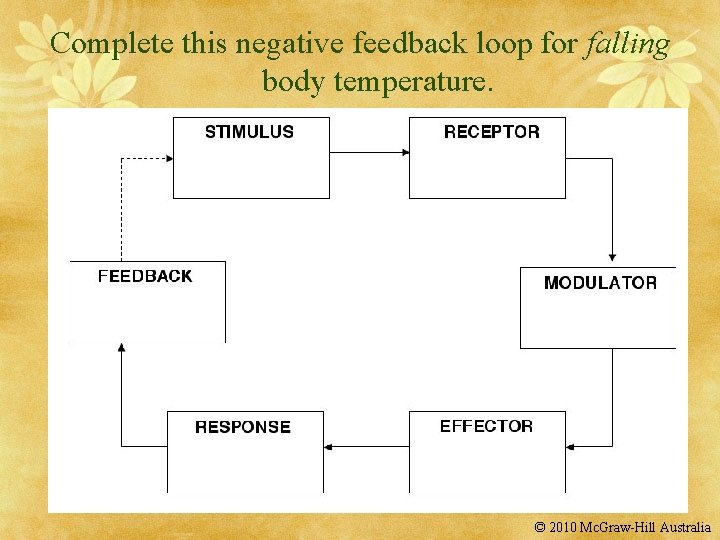
Complete this negative feedback loop for falling body temperature. © 2010 Mc. Graw-Hill Australia
- Slides: 20