
ThermoHydraulic Design of Shellandtube Heat Exchangers P M

Thermo-Hydraulic Design of Shell-and-tube Heat Exchangers P M V Subbarao Professor Mechanical Engineering Department I I T Delhi Simplified Procedures using Semi. Empirical Correlations. ….
Knowledge for Solving True Industrial Problems : Donald Q Kern • True believer of providing knowledge for use of solving run-of-the-mill problems. • Donald Q. Kern Award: AICh. E. • In honor of Donald Q. Kern, pioneer in process heat transfer, the Division recognizes an individual's expertise in a given field of heat transfer or energy conversion. • There is no true flow area by which the shell-side mass velocity can be computed. • Fictitious values for equivalent diameter and mass velocity are to be defined. • These are borne out by experiment.
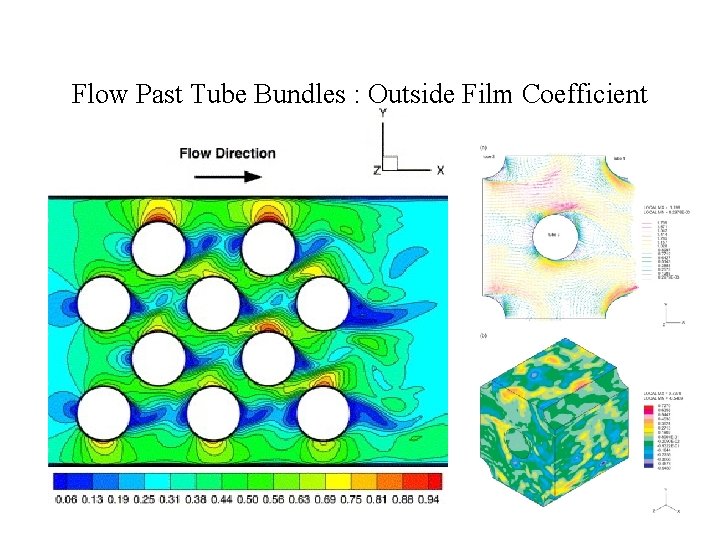
Flow Past Tube Bundles : Outside Film Coefficient
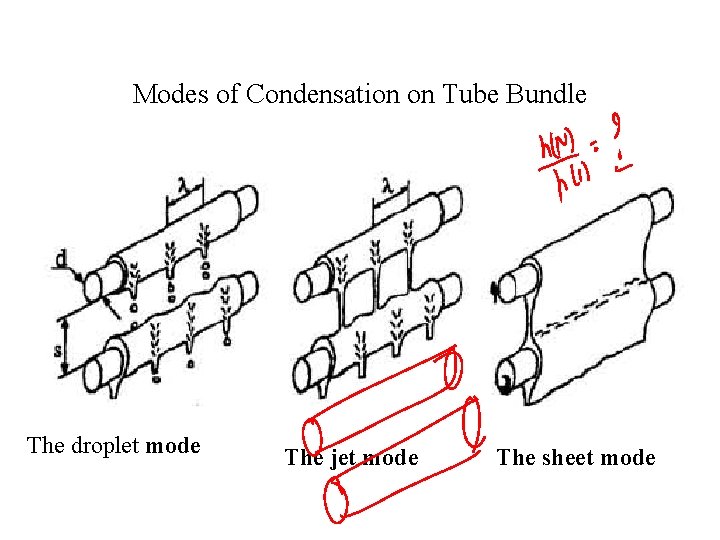
Modes of Condensation on Tube Bundle The droplet mode The jet mode The sheet mode
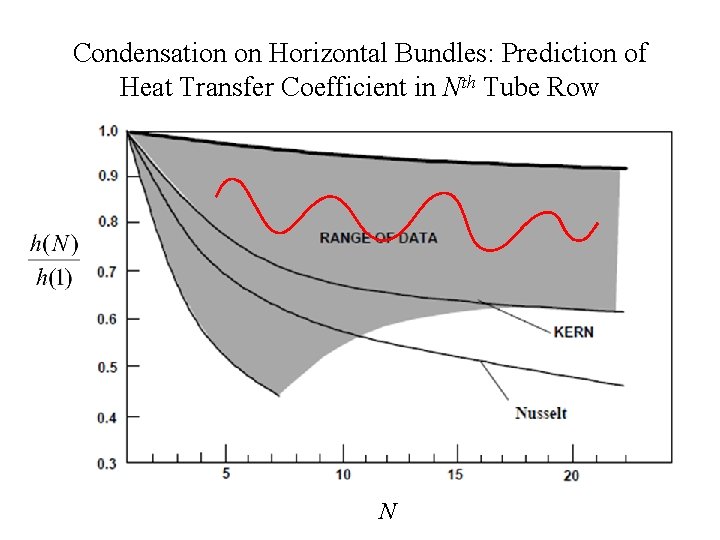
Condensation on Horizontal Bundles: Prediction of Heat Transfer Coefficient in Nth Tube Row N

Options for Shell-Side Thermal Analysis • Kern's integral method • Bell-Delaware method • Stream analysis method • Recent Methods
Major Steps in Design • • • Initial Decisions. Tube side Thermal Analysis. Thermal analysis for Shell side flow. Overall Heat Transfer coefficient. Hydraulic Analysis of Tube side. Hydraulic Analysis of Shell side.

Fluid Allocation : Tube Side • • • Tube side is preferred under these circumstances: Fluids which are prone to foul The higher velocities will reduce buildup Mechanical cleaning is also much more practical for tubes than for shells. Corrosive fluids are usually best in tubes Tubes are cheaper to fabricate from exotic & high temperature resistant materials Toxic fluids to increase containment Streams with low flow rates to obtain increased velocities and turbulence High pressure streams since tubes are less expensive to build strong. Streams with a low allowable pressure drop

Fluid Allocation : Shell Side • Shell side is preferred under these circumstances: • Viscous fluids go on the shell side, since this will usually improve the rate of heat transfer. • On the other hand, placing them on the tube side will usually lead to lower pressure drops. Judgment is needed. • Low heat transfer coefficient: • Stream which has an inherently low heat transfer coefficient (such as low pressure gases or viscous liquids). • This stream is preferentially put on the shell-side so that extended surface may be used to reduce the total cost of the heat exchanger.
Kern Method of SHELL-AND-TUBE HEAT EXCHANGER Analysis

Kern’s Integral Method • The initial attempts to provide methods for calculating shellside pressure drop and heat transfer coefficient were those in which correlations were developed based on experimental data for typical heat exchangers. • One of these methods is the well-known Kern method, which was an attempt to correlate data for standard exchangers by a simple equation analogous to equations for flow in tubes. • This method is restricted to a fixed baffle cut (25%) and cannot adequately account for baffle-to-shell and tube-to-baffle leakages. • Although the Kern equation is not particularly accurate, it does allow a very simple and rapid calculation of shell-side coefficients and pressure drop to be carried out
- Slides: 11