
Thermodynamics Relationships Between Heat and Work Heat Work
Thermodynamics Relationships Between Heat and Work
Heat, Work, and Internal Energy • As long as a substance does not change phase, its internal energy will increase as long as its temperature increases • Work can transfer energy to a substance – Results in an increase in internal energy • Can be transferred to another substance as heat • Energy can be transferred to a substance as heat and from the substance as work
Heat, Work, and Internal Energy • Heat and work are both energy transferred to or from a system – System – a collection of matter within a clearly defined boundary across which no matter passes – Environment – everything outside a system that can affect or be affected by the system’s behavior • Also called the surroundings • All the parts of a system are in thermal equilibrium with each other both before and after a process adds or removes energy
Heat, Work, and Internal Energy • Pressure is the force per unit area acting on an object • Pressure = force / area • P=F/A • Measured in Pascal's = N/m 2 – Other units are atmospheres (atm), millimeters of mercury (mm. Hg), bars (bar), pounds per square inch (psi), technical atmospheres (at), or torr (Torr) • Caused by particle collisions
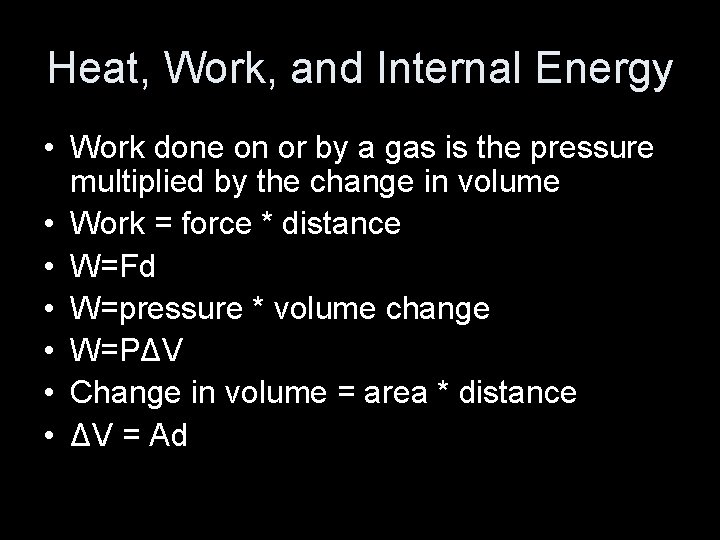
Heat, Work, and Internal Energy • Work done on or by a gas is the pressure multiplied by the change in volume • Work = force * distance • W=Fd • W=pressure * volume change • W=PΔV • Change in volume = area * distance • ΔV = Ad
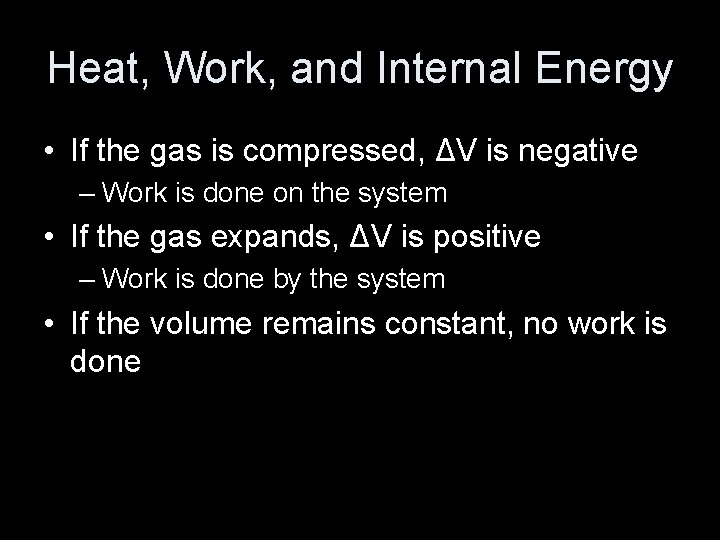
Heat, Work, and Internal Energy • If the gas is compressed, ΔV is negative – Work is done on the system • If the gas expands, ΔV is positive – Work is done by the system • If the volume remains constant, no work is done
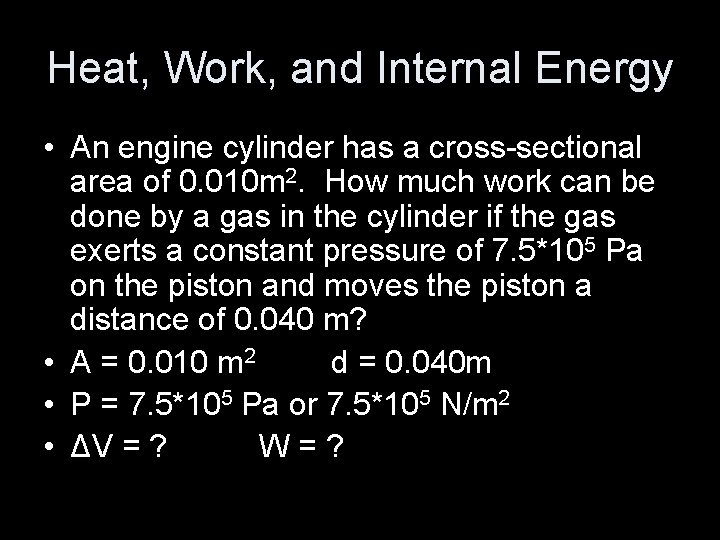
Heat, Work, and Internal Energy • An engine cylinder has a cross-sectional area of 0. 010 m 2. How much work can be done by a gas in the cylinder if the gas exerts a constant pressure of 7. 5*105 Pa on the piston and moves the piston a distance of 0. 040 m? • A = 0. 010 m 2 d = 0. 040 m • P = 7. 5*105 Pa or 7. 5*105 N/m 2 • ΔV = ? W=?
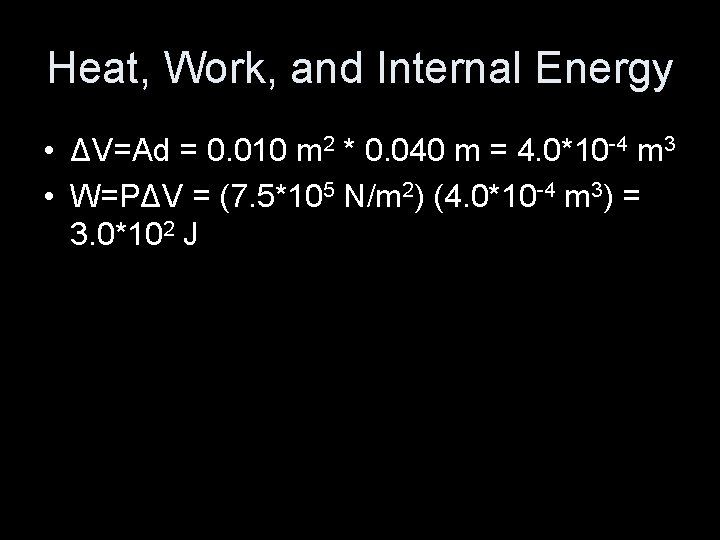
Heat, Work, and Internal Energy • ΔV=Ad = 0. 010 m 2 * 0. 040 m = 4. 0*10 -4 m 3 • W=PΔV = (7. 5*105 N/m 2) (4. 0*10 -4 m 3) = 3. 0*102 J
Thermodynamic Processes • Work, internal energy, and heat are all related – Not every one of these is present in all ideal thermodynamic processes • No work is done in constant-volume processes – Called isovolumetric – a thermodynamic process that takes place at constant volume so that no work is done on or by the system • Often take place in a bomb calorimeter
Thermodynamic Processes • Internal energy is constant in a constanttemperature process • Isothermal process – a thermodynamic process that takes place at constant temperature and in which the internal energy of a system remains unchanged – Similar to a balloon expanding as the pressure drops before a storm hits • The balloon expands to keep pressure equal with the environment
Thermodynamic Processes • Energy is not transferred as heat during an adiabatic process – A thermodynamic process during which work is done on or by the system but no energy is transferred to or from the system as heat – Rapid compression or expansion of gases in insulated containers (refrigerators, internal combustion engines)
- Slides: 11