
Thermodynamics of surface and interfaces Define Consider to
- Slides: 25
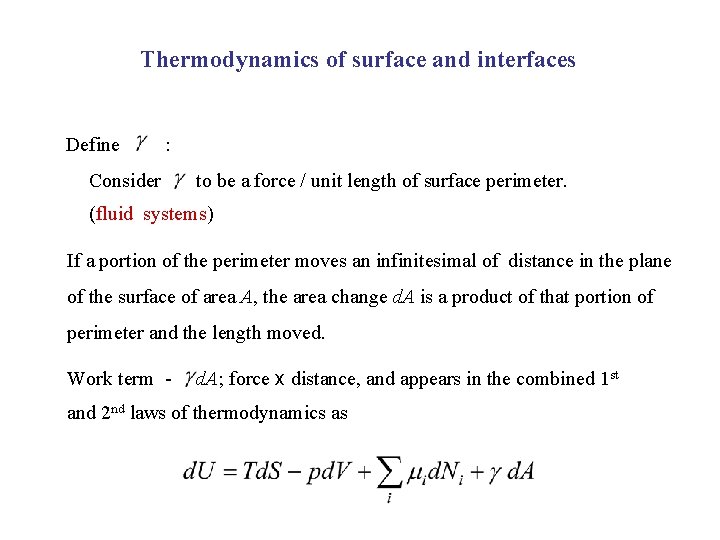
Thermodynamics of surface and interfaces Define : Consider to be a force / unit length of surface perimeter. (fluid systems) If a portion of the perimeter moves an infinitesimal of distance in the plane of the surface of area A, the area change d. A is a product of that portion of perimeter and the length moved. Work term - d. A; force x distance, and appears in the combined 1 st and 2 nd laws of thermodynamics as
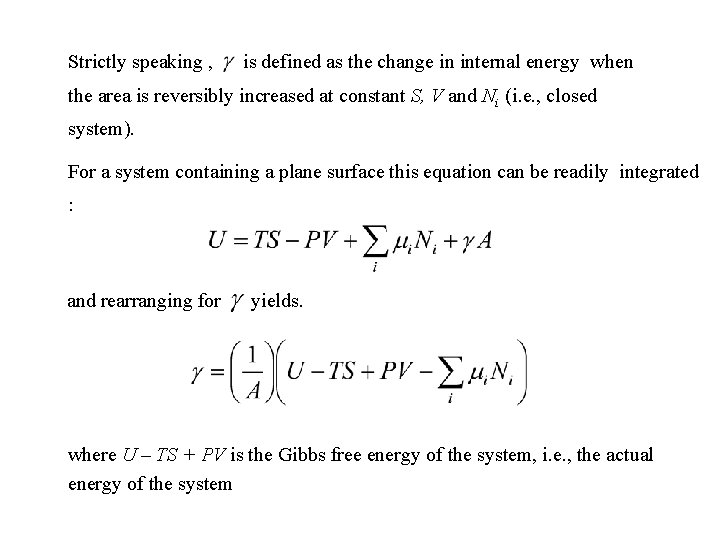
Strictly speaking , is defined as the change in internal energy when the area is reversibly increased at constant S, V and Ni (i. e. , closed system). For a system containing a plane surface this equation can be readily integrated : and rearranging for yields. where U – TS + PV is the Gibbs free energy of the system, i. e. , the actual energy of the system
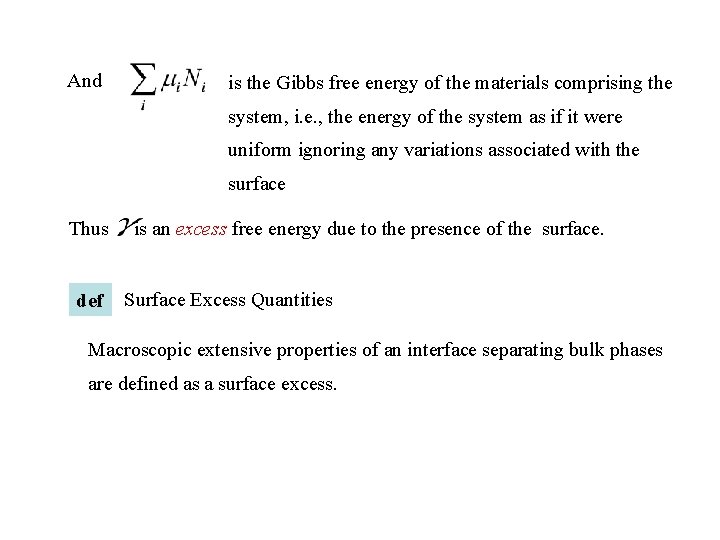
And is the Gibbs free energy of the materials comprising the system, i. e. , the energy of the system as if it were uniform ignoring any variations associated with the surface Thus def is an excess free energy due to the presence of the surface. Surface Excess Quantities Macroscopic extensive properties of an interface separating bulk phases are defined as a surface excess.
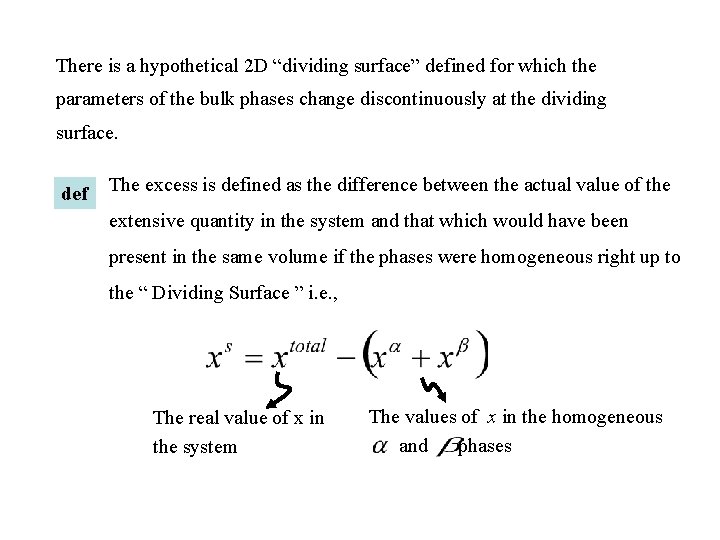
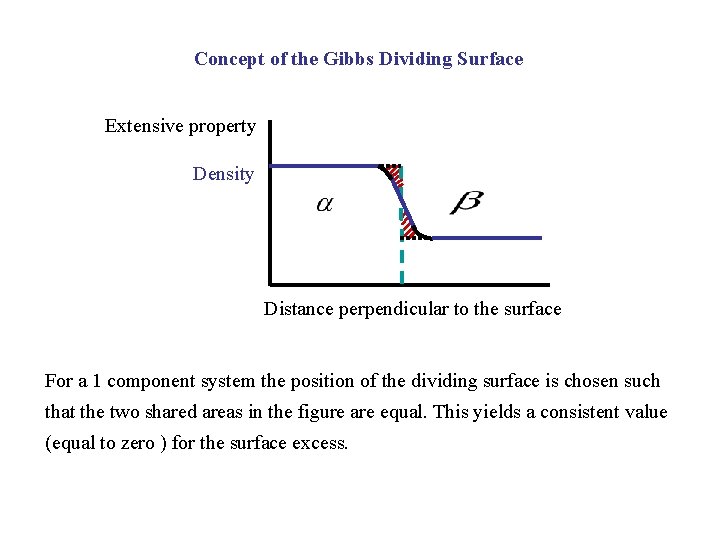
There is a hypothetical 2 D “dividing surface” defined for which the parameters of the bulk phases change discontinuously at the dividing surface. def The excess is defined as the difference between the actual value of the extensive quantity in the system and that which would have been present in the same volume if the phases were homogeneous right up to the “ Dividing Surface ” i. e. , The real value of x in the system The values of x in the homogeneous and phases
Concept of the Gibbs Dividing Surface Extensive property Density Distance perpendicular to the surface For a 1 component system the position of the dividing surface is chosen such that the two shared areas in the figure are equal. This yields a consistent value (equal to zero ) for the surface excess.
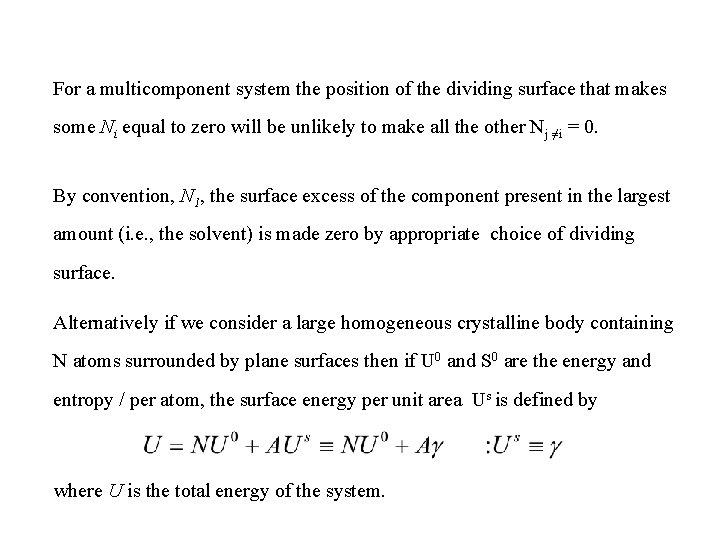
For a multicomponent system the position of the dividing surface that makes some Ni equal to zero will be unlikely to make all the other Nj ≠i = 0. By convention, N 1, the surface excess of the component present in the largest amount (i. e. , the solvent) is made zero by appropriate choice of dividing surface. Alternatively if we consider a large homogeneous crystalline body containing N atoms surrounded by plane surfaces then if U 0 and S 0 are the energy and entropy / per atom, the surface energy per unit area Us is defined by where U is the total energy of the system.
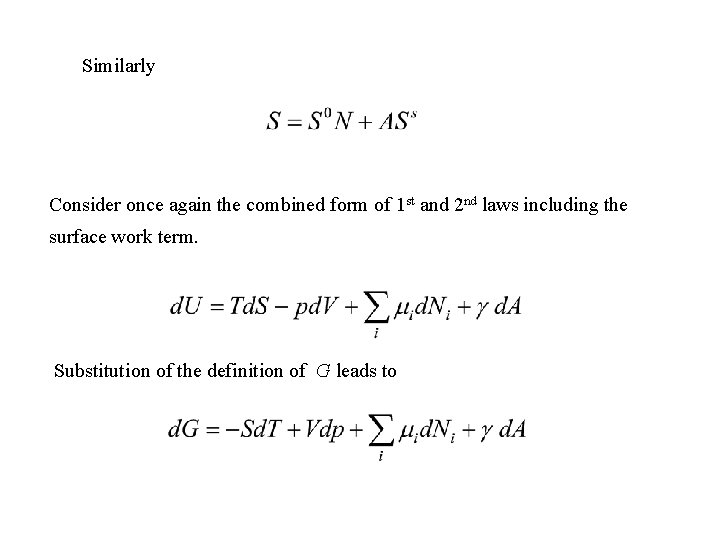
Similarly Consider once again the combined form of 1 st and 2 nd laws including the surface work term. Substitution of the definition of G leads to
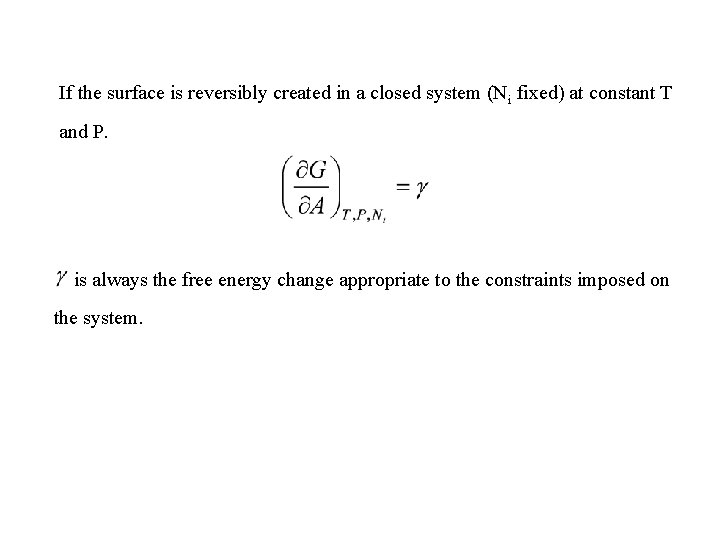
If the surface is reversibly created in a closed system (Ni fixed) at constant T and P. is always the free energy change appropriate to the constraints imposed on the system.
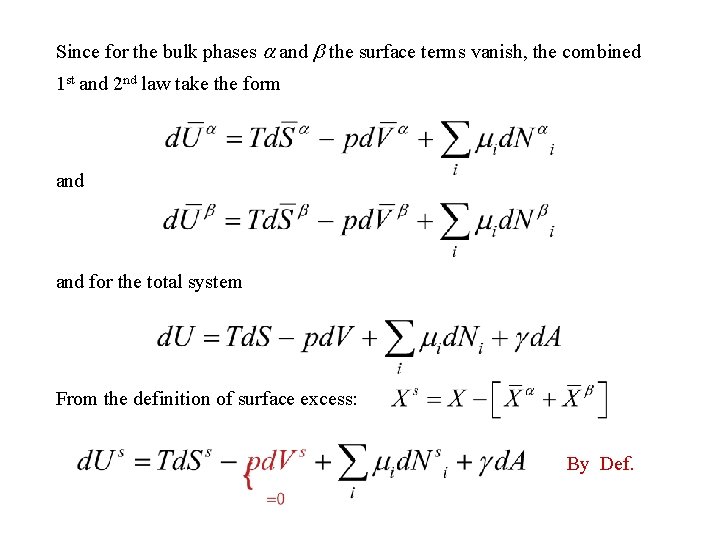
Since for the bulk phases a and b the surface terms vanish, the combined 1 st and 2 nd law take the form and for the total system From the definition of surface excess: By Def.
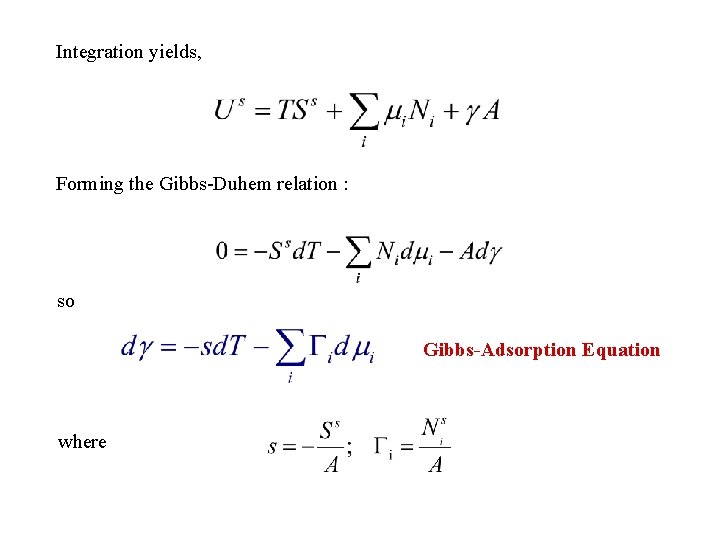
Integration yields, Forming the Gibbs-Duhem relation : so Gibbs-Adsorption Equation where
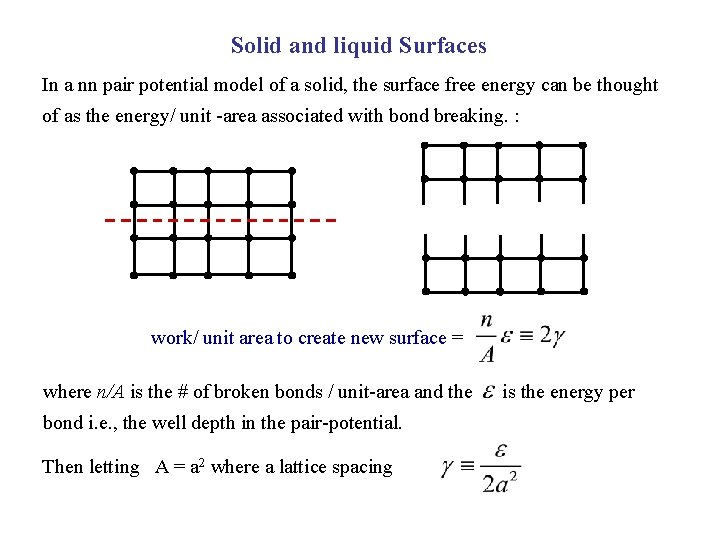
Solid and liquid Surfaces In a nn pair potential model of a solid, the surface free energy can be thought of as the energy/ unit -area associated with bond breaking. : work/ unit area to create new surface = where n/A is the # of broken bonds / unit-area and the bond i. e. , the well depth in the pair-potential. Then letting A = a 2 where a lattice spacing is the energy per
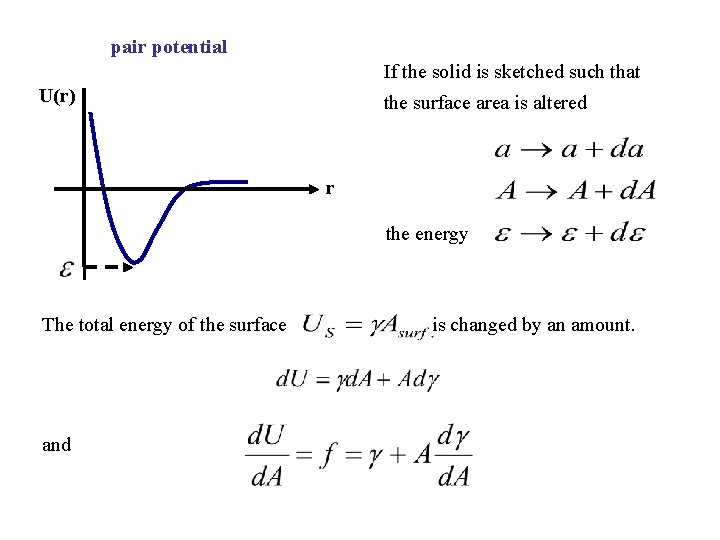
pair potential If the solid is sketched such that U(r) the surface area is altered r the energy The total energy of the surface and is changed by an amount.
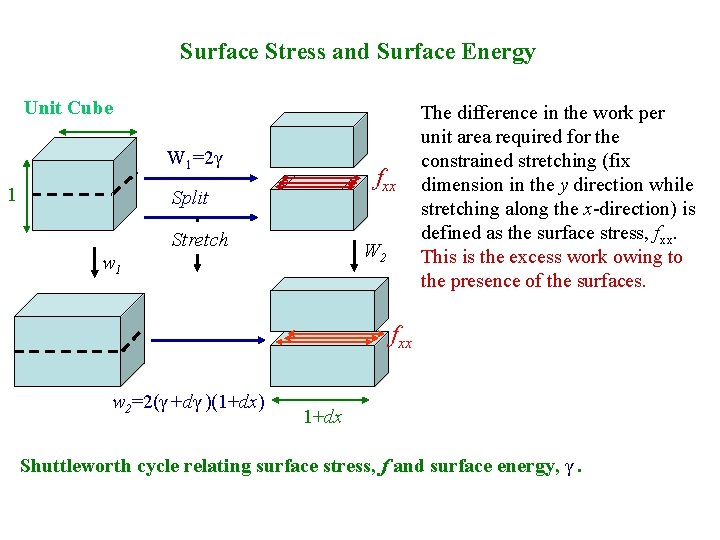
Surface Stress and Surface Energy Unit Cube W 1=2γ 1 fxx Split Stretch W 2 w 1 The difference in the work per unit area required for the constrained stretching (fix dimension in the y direction while stretching along the x-direction) is defined as the surface stress, fxx. This is the excess work owing to the presence of the surfaces. fxx w 2=2(γ +dγ )(1+dx) 1+dx Shuttleworth cycle relating surface stress, f and surface energy, γ.
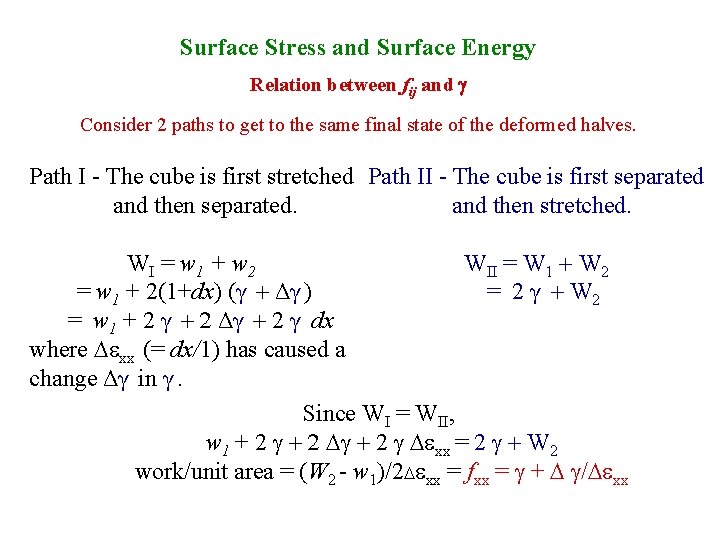
Surface Stress and Surface Energy Relation between fij and g Consider 2 paths to get to the same final state of the deformed halves. Path I - The cube is first stretched Path II - The cube is first separated and then separated. and then stretched. WI = w 1 + w 2 WII = W 1 + W 2 = w 1 + 2(1+dx) (γ + Δγ ) = 2 γ + W 2 = w 1 + 2 γ + 2 Δγ + 2 γ dx where xx (= dx/1) has caused a change Δγ in γ. Since WI = WII, w 1 + 2 xx = 2 + W 2 work/unit area = (W 2 - w 1)/2 xx = fxx = + / xx
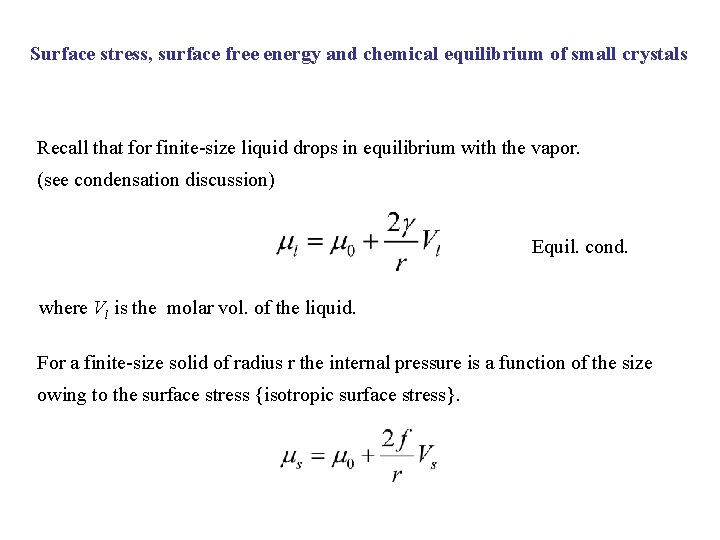
Surface stress, surface free energy and chemical equilibrium of small crystals Recall that for finite-size liquid drops in equilibrium with the vapor. (see condensation discussion) Equil. cond. where Vl is the molar vol. of the liquid. For a finite-size solid of radius r the internal pressure is a function of the size owing to the surface stress {isotropic surface stress}.
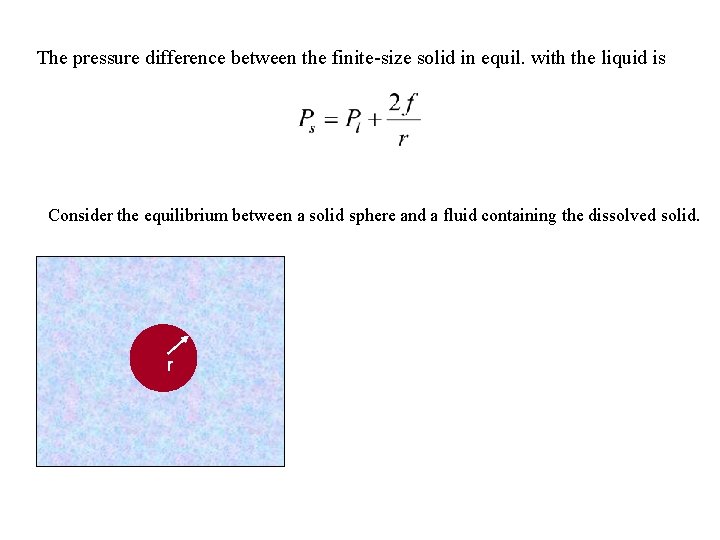
The pressure difference between the finite-size solid in equil. with the liquid is Consider the equilibrium between a solid sphere and a fluid containing the dissolved solid. r
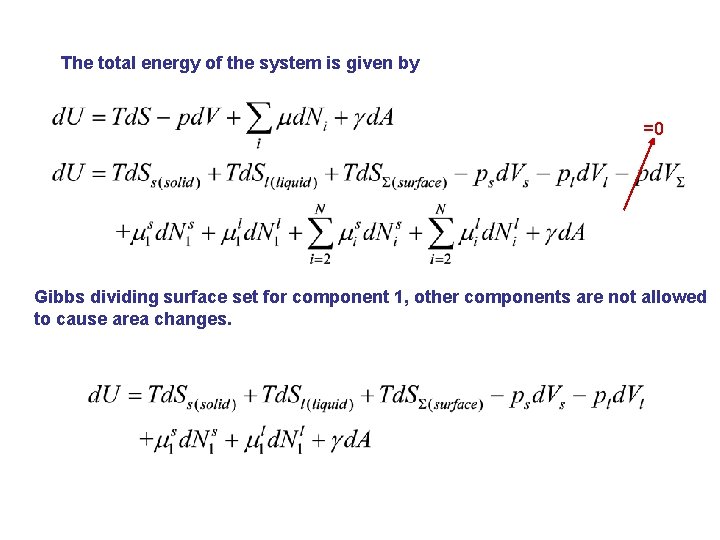
The total energy of the system is given by =0 Gibbs dividing surface set for component 1, other components are not allowed to cause area changes.
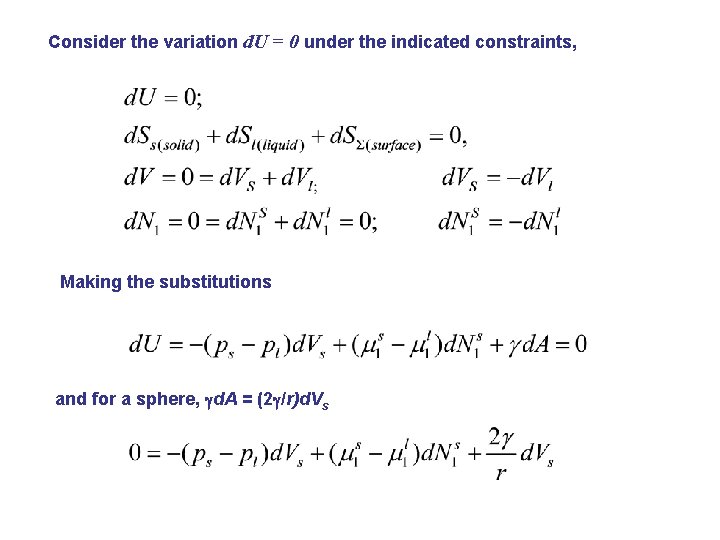
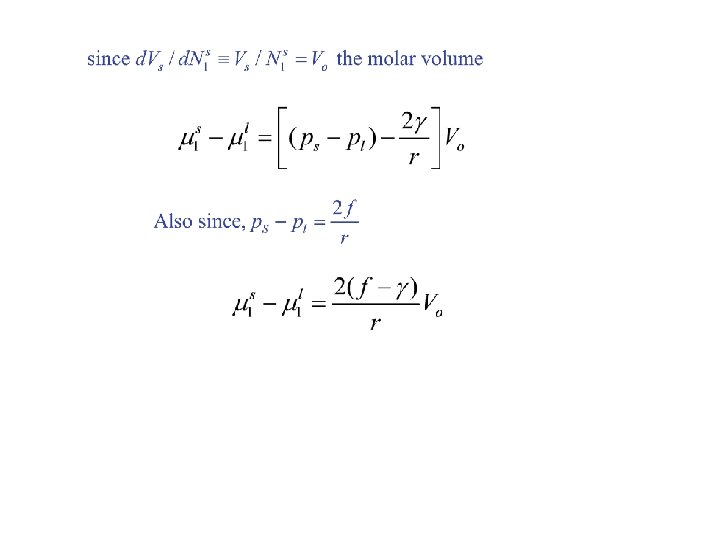
Consider the variation d. U = 0 under the indicated constraints, Making the substitutions and for a sphere, gd. A = (2 g/r)d. Vs
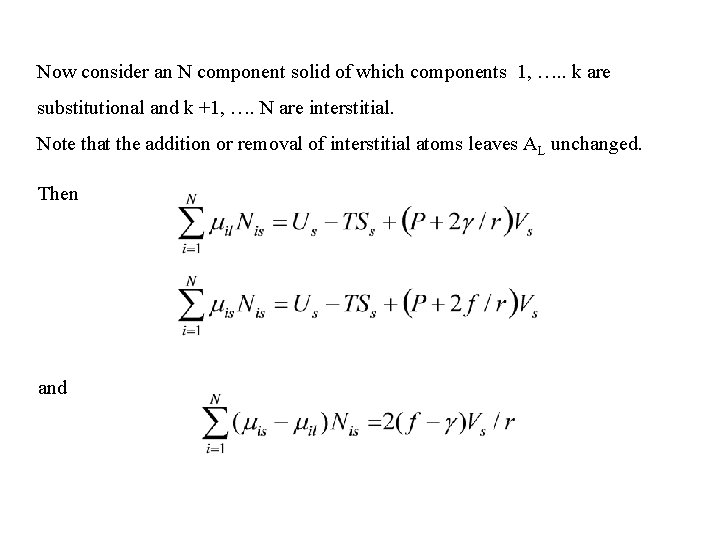
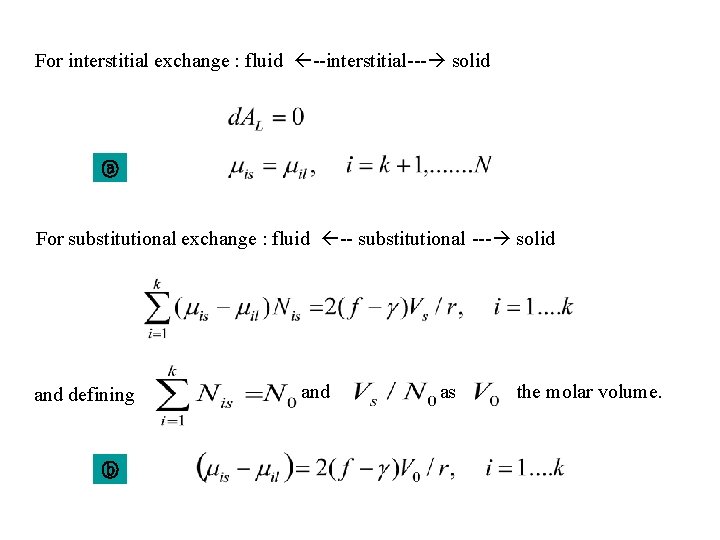
Now consider an N component solid of which components 1, …. . k are substitutional and k +1, …. N are interstitial. Note that the addition or removal of interstitial atoms leaves AL unchanged. Then and
For interstitial exchange : fluid --interstitial--- solid ⓐ For substitutional exchange : fluid -- substitutional --- solid and defining ⓑ and as the molar volume.
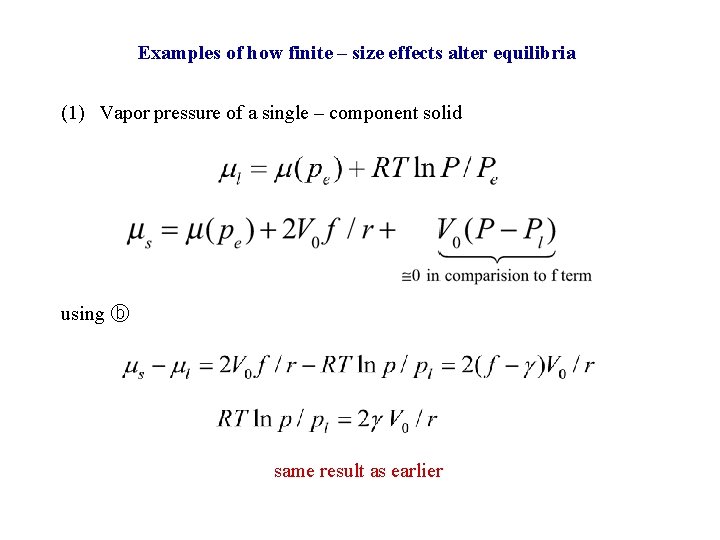
Examples of how finite – size effects alter equilibria (1) Vapor pressure of a single – component solid using ⓑ same result as earlier
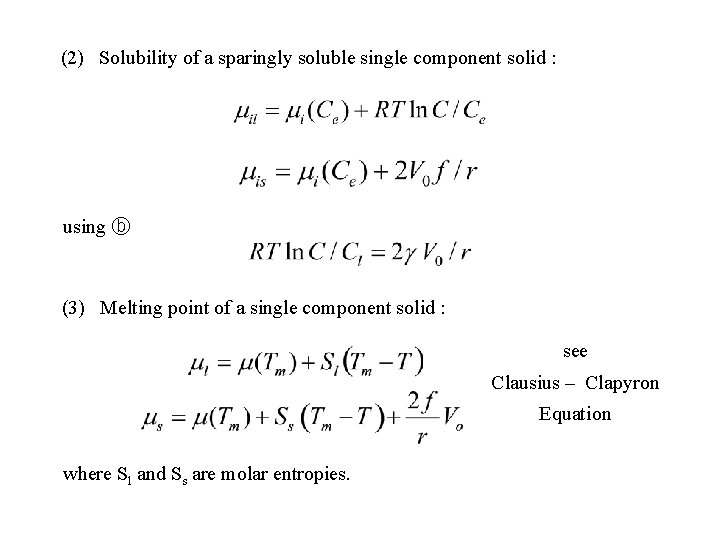
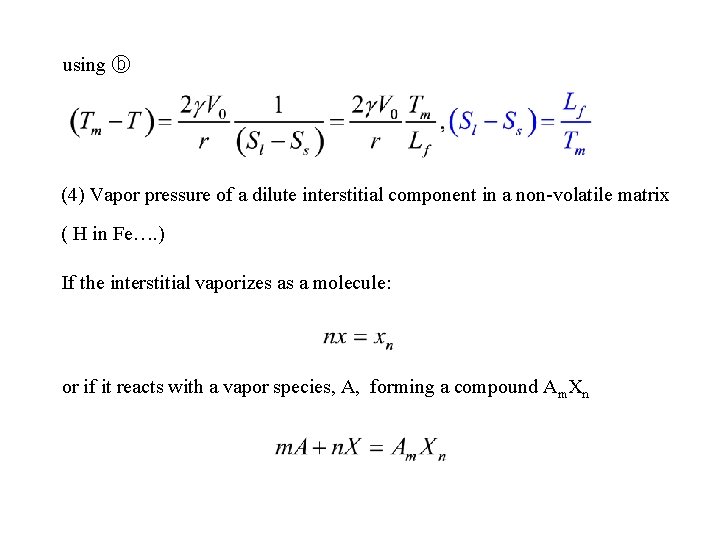
(2) Solubility of a sparingly soluble single component solid : using ⓑ (3) Melting point of a single component solid : see Clausius – Clapyron Equation where Sl and Ss are molar entropies.
using ⓑ (4) Vapor pressure of a dilute interstitial component in a non-volatile matrix ( H in Fe…. ) If the interstitial vaporizes as a molecule: or if it reacts with a vapor species, A, forming a compound Am. Xn
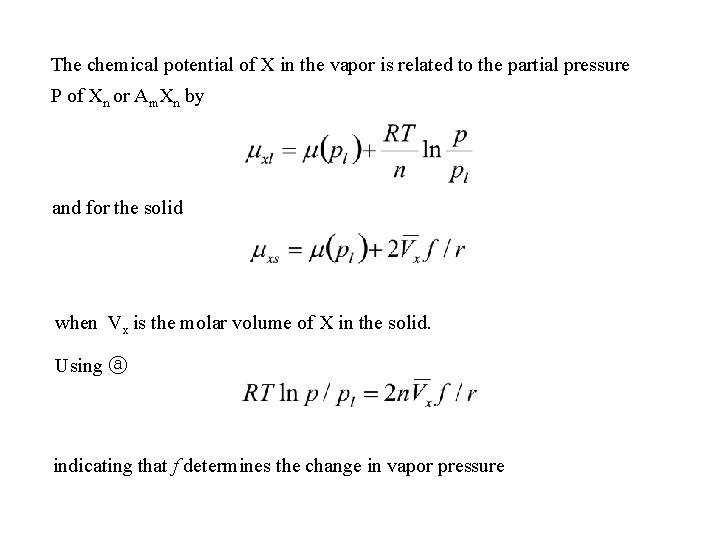
The chemical potential of X in the vapor is related to the partial pressure P of Xn or Am. Xn by and for the solid when Vx is the molar volume of X in the solid. Using ⓐ indicating that f determines the change in vapor pressure