
Thermodynamics of Ideal Processes P M V Subbarao
Thermodynamics of Ideal Processes P M V Subbarao Professor Mechanical Engineering Department Entropy View of Theoretical Processes …. .
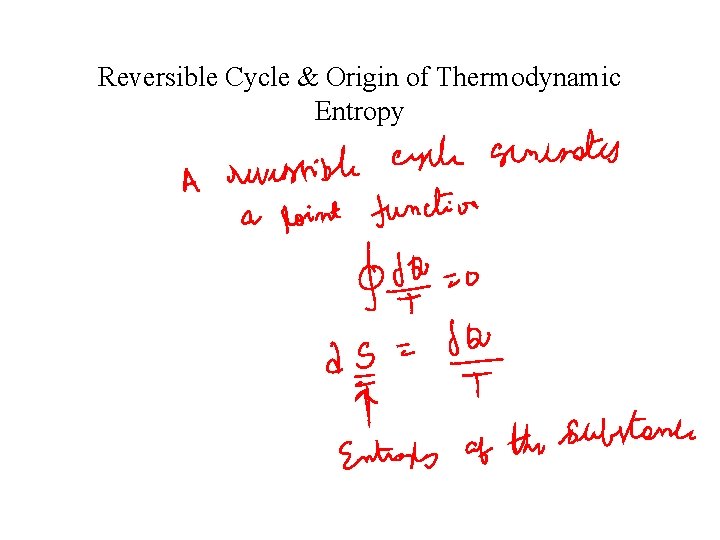
Reversible Cycle & Origin of Thermodynamic Entropy
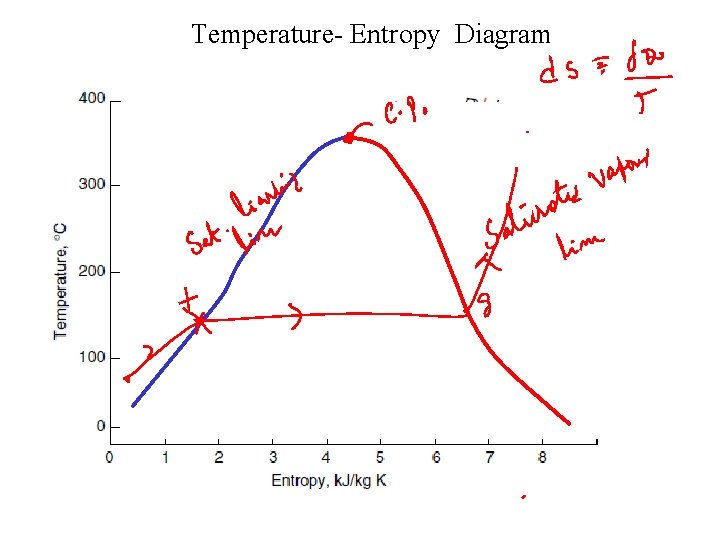
Temperature- Entropy Diagram
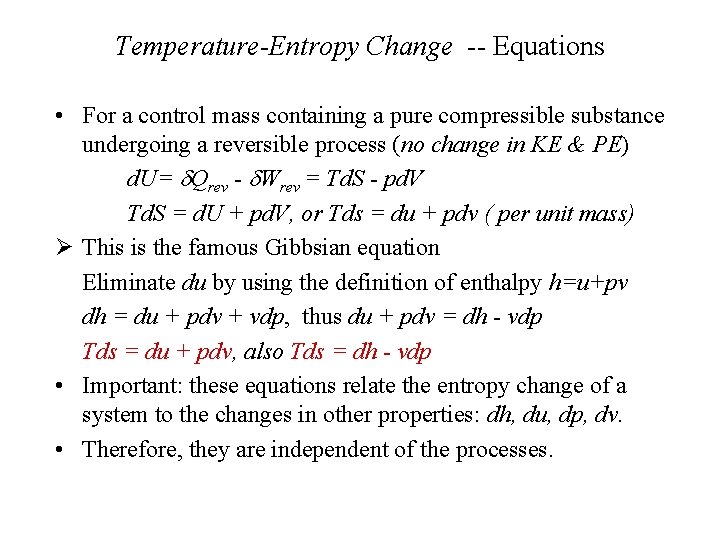
Temperature-Entropy Change -- Equations • For a control mass containing a pure compressible substance undergoing a reversible process (no change in KE & PE) d. U= Qrev - Wrev = Td. S - pd. V Td. S = d. U + pd. V, or Tds = du + pdv ( per unit mass) Ø This is the famous Gibbsian equation Eliminate du by using the definition of enthalpy h=u+pv dh = du + pdv + vdp, thus du + pdv = dh - vdp Tds = du + pdv, also Tds = dh - vdp • Important: these equations relate the entropy change of a system to the changes in other properties: dh, du, dp, dv. • Therefore, they are independent of the processes.
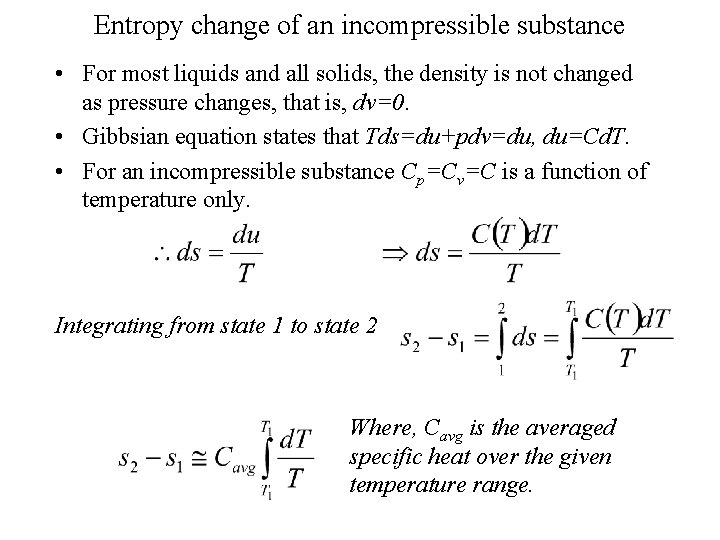
Entropy change of an incompressible substance • For most liquids and all solids, the density is not changed as pressure changes, that is, dv=0. • Gibbsian equation states that Tds=du+pdv=du, du=Cd. T. • For an incompressible substance Cp=Cv=C is a function of temperature only. Integrating from state 1 to state 2 Where, Cavg is the averaged specific heat over the given temperature range.
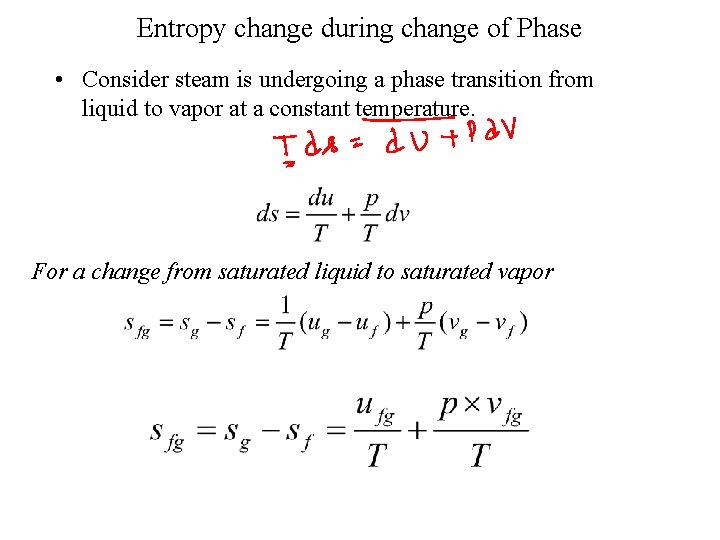
Entropy change during change of Phase • Consider steam is undergoing a phase transition from liquid to vapor at a constant temperature. For a change from saturated liquid to saturated vapor
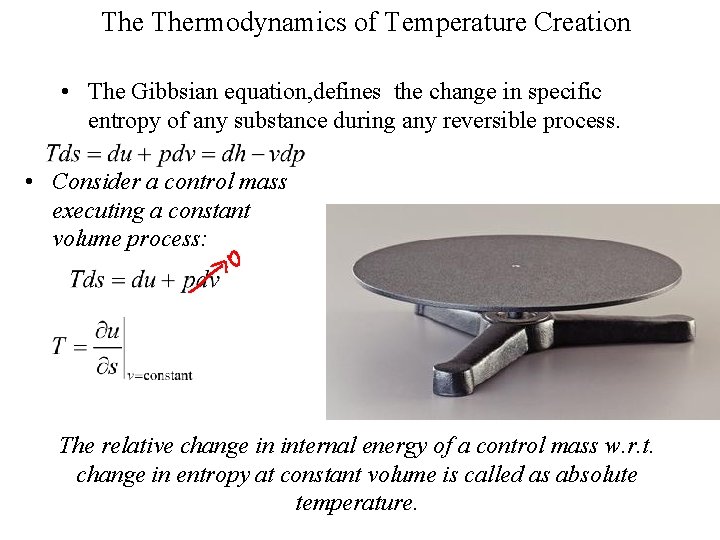
The Thermodynamics of Temperature Creation • The Gibbsian equation, defines the change in specific entropy of any substance during any reversible process. • Consider a control mass executing a constant volume process: The relative change in internal energy of a control mass w. r. t. change in entropy at constant volume is called as absolute temperature.
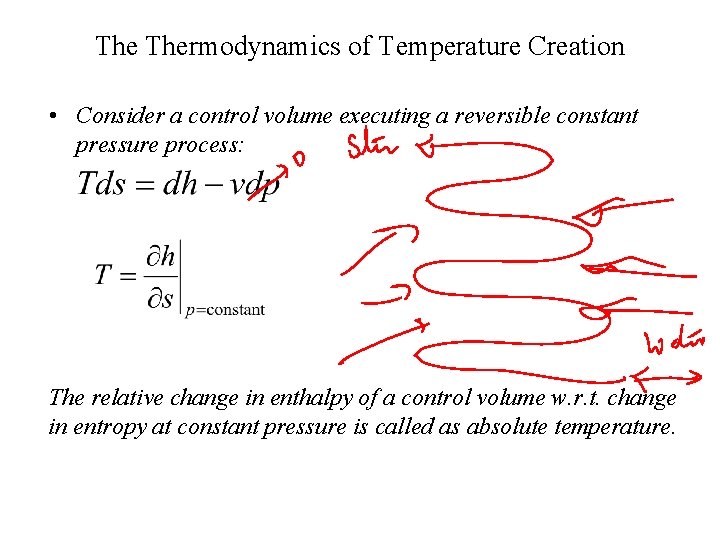
The Thermodynamics of Temperature Creation • Consider a control volume executing a reversible constant pressure process: The relative change in enthalpy of a control volume w. r. t. change in entropy at constant pressure is called as absolute temperature.
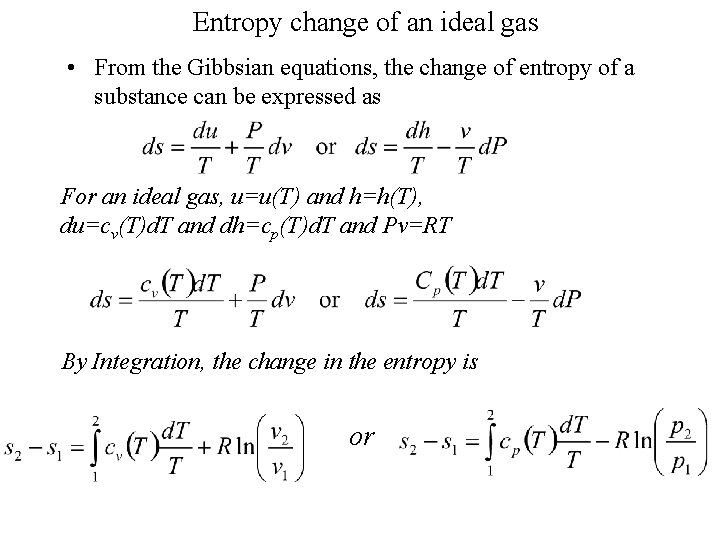
Entropy change of an ideal gas • From the Gibbsian equations, the change of entropy of a substance can be expressed as For an ideal gas, u=u(T) and h=h(T), du=cv(T)d. T and dh=cp(T)d. T and Pv=RT By Integration, the change in the entropy is or
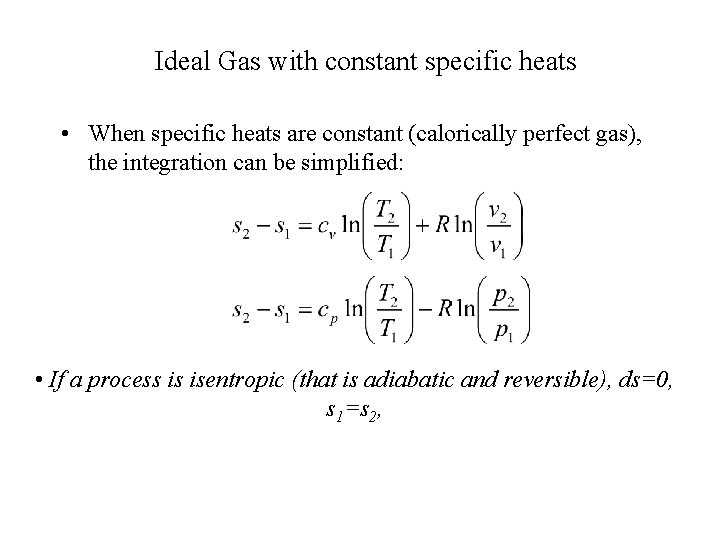
Ideal Gas with constant specific heats • When specific heats are constant (calorically perfect gas), the integration can be simplified: • If a process is isentropic (that is adiabatic and reversible), ds=0, s 1=s 2,
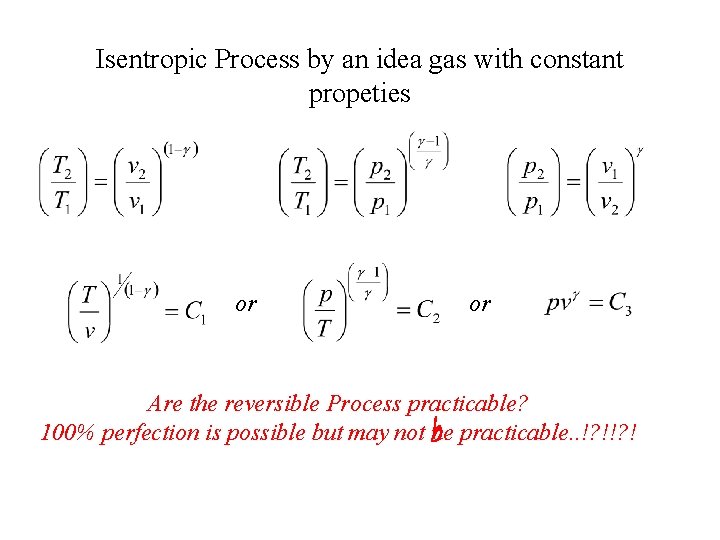
Isentropic Process by an idea gas with constant propeties or or Are the reversible Process practicable? 100% perfection is possible but may not ne practicable. . !? !
- Slides: 11