
Thermodynamics KineticMolecular Theory of Heat Molecules in motion
- Slides: 40
Thermodynamics • Kinetic-Molecular Theory of Heat– Molecules in motion produce heat • Molecules moving quickly- produce more heat (higher temp, feel warmer) • Molecules moving slower- produce less heat-(lower temp, feel cooler)
Nature of Thermal Energy • We measure the energy produced by the molecules in motion rather than “heat” because “heat” is a subjective property. • When we measure “heat” we are assuming the sum of the system’s energies (this will be an average) – internal energies cannot be measured
Temperature • “heat” is a subjective property and differs from person to person, so we have to measure “heat” by making it objective and therefore we measure TEMPERATURE • Temperature is measured in dimensional units called degree (⁰)
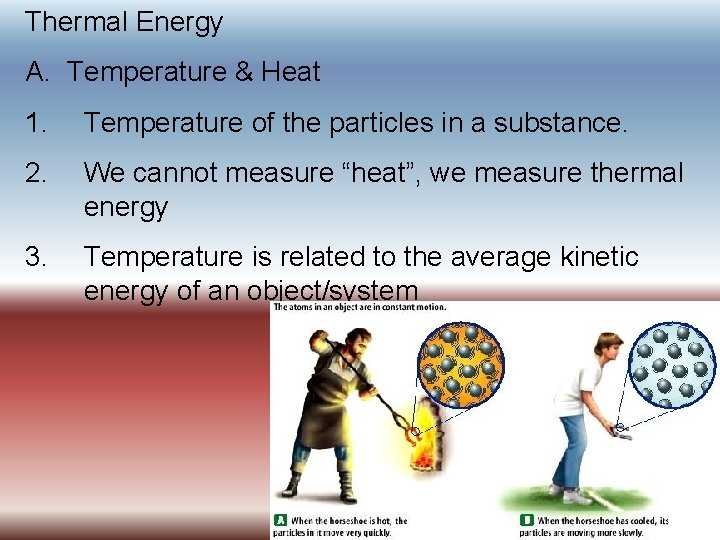
Thermal Energy A. Temperature & Heat 1. Temperature of the particles in a substance. 2. We cannot measure “heat”, we measure thermal energy 3. Temperature is related to the average kinetic energy of an object/system
Temperature • Thermometer- is an instrument used to measure temperature • Thermometric properties- those properties affected by temperature – Expansion – Electrical properties/charges
Temperature Scales • Fahrenheit • Celsius • Kelvin- absolute, meaning it cannot be negative • Fiducial Points- fixed calibrations; each scale is defined individually-meaning 1⁰C is not equal to 1⁰F
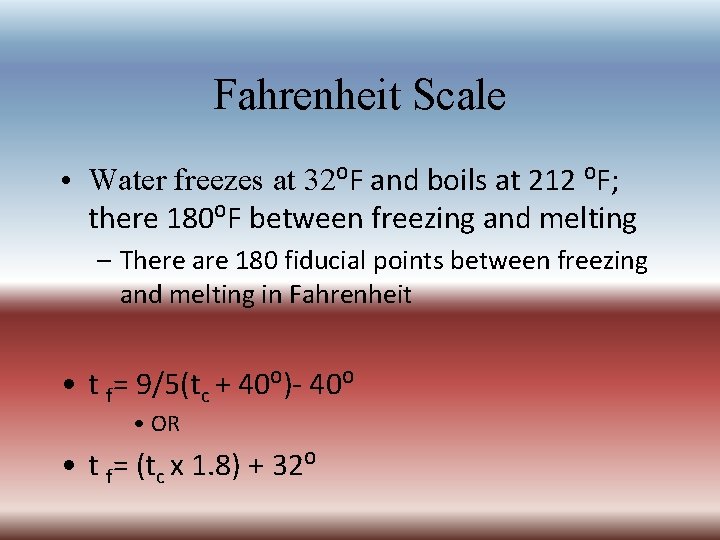
Fahrenheit Scale • Water freezes at 32⁰F and boils at 212 ⁰F; there 180⁰F between freezing and melting – There are 180 fiducial points between freezing and melting in Fahrenheit • t f= 9/5(tc + 40⁰)- 40⁰ • OR • t f= (tc x 1. 8) + 32⁰
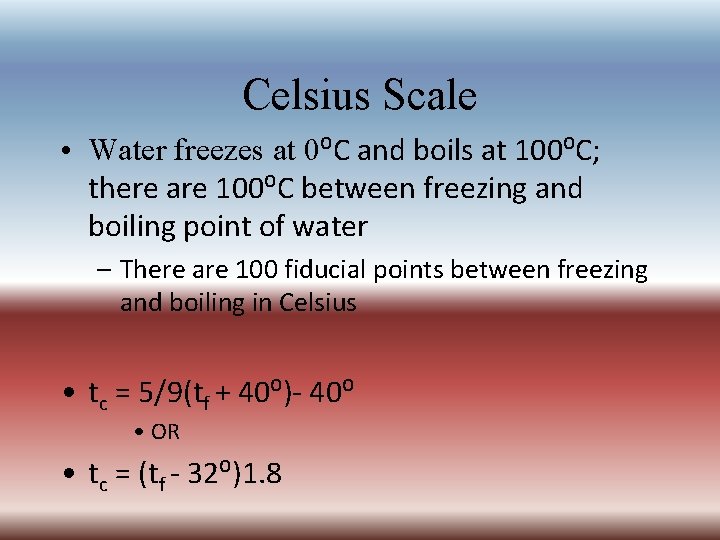
Celsius Scale • Water freezes at 0⁰C and boils at 100⁰C; there are 100⁰C between freezing and boiling point of water – There are 100 fiducial points between freezing and boiling in Celsius • tc = 5/9(tf + 40⁰)- 40⁰ • OR • tc = (tf - 32⁰)1. 8
• SI unit for temp. is the Kelvin • Kelvin is an absolute temperature scale; it cannot be negative a. K = C + 273 (10 C = 283 K) b. C = K – 273 (10 K = -263 C)
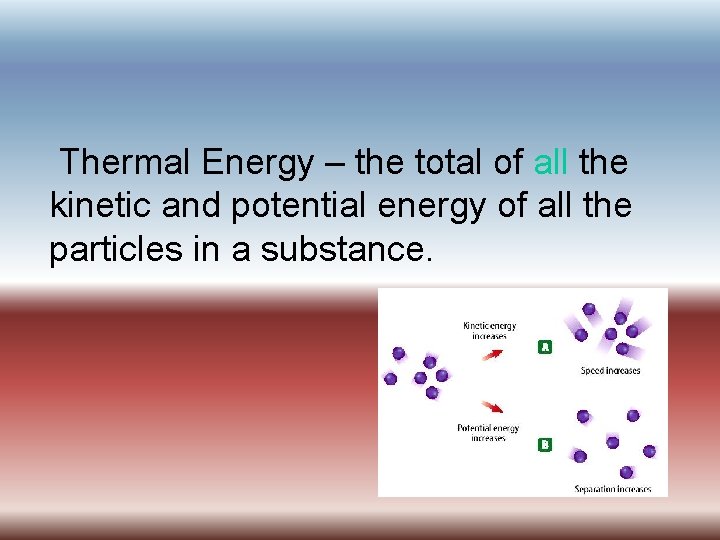
Thermal Energy – the total of all the kinetic and potential energy of all the particles in a substance.
4. Thermal energy relationships a. As temperature increases, so does thermal energy (because the kinetic energy of the particles increased). b. Even if the temperature doesn’t change, thermal energy in a more massive substance is higher (because it is a total measure of energy).
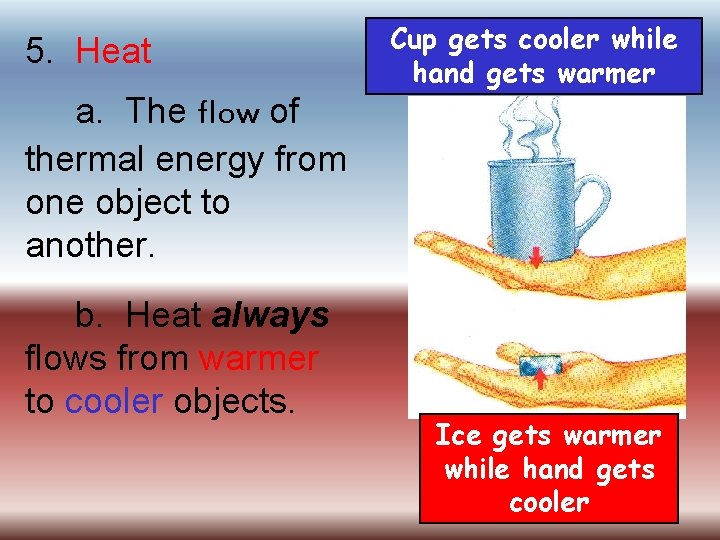
5. Heat Cup gets cooler while hand gets warmer a. The flow of thermal energy from one object to another. b. Heat always flows from warmer to cooler objects. Ice gets warmer while hand gets cooler
Understanding Heat Transfer, Conduction, Convection and Radiation
Heat Transfer • Heat always moves from a warmer place to a cooler place. • Hot objects in a cooler room will cool to room temperature. • Cold objects in a warmer room will heat up to room temperature.
Question • If a cup of coffee and a red popsickle were left on the table in this room what would happen to them? Why? • The cup of coffee will cool until it reaches room temperature. The popsickle will melt and then the liquid will warm to room temperature.
Heat Transfer Methods • Heat transfers in three ways: – Conduction – Convection – Radiation
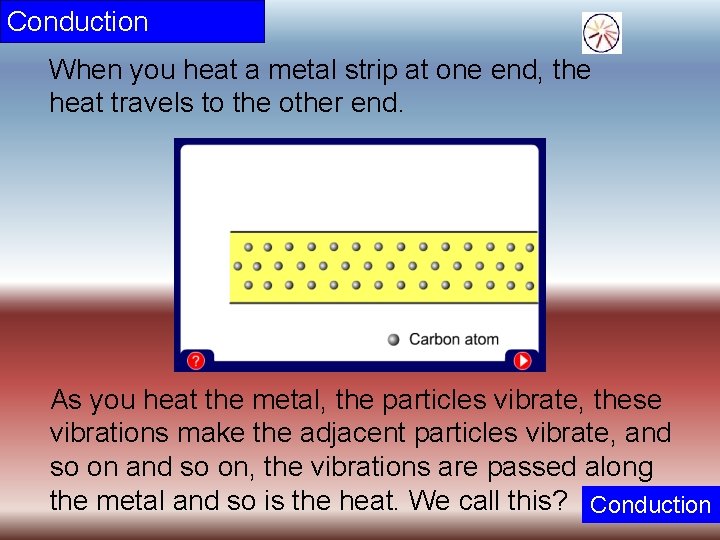
Conduction When you heat a metal strip at one end, the heat travels to the other end. As you heat the metal, the particles vibrate, these vibrations make the adjacent particles vibrate, and so on, the vibrations are passed along the metal and so is the heat. We call this? Conduction
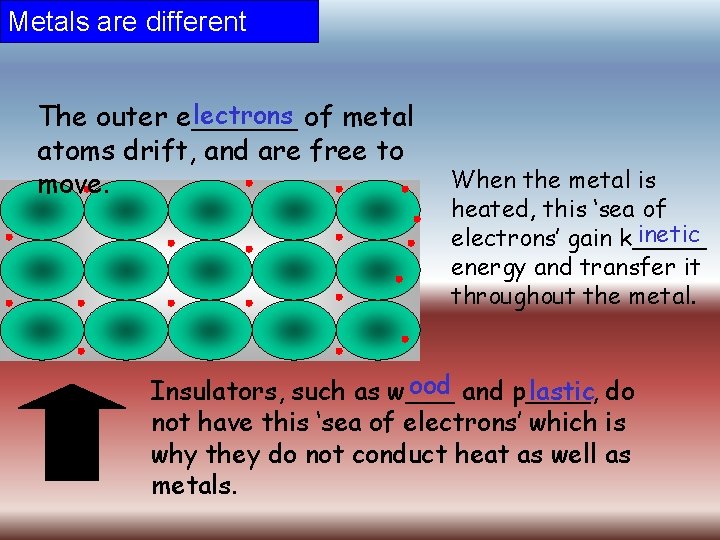
Metals are different lectrons of metal The outer e______ atoms drift, and are free to move. When the metal is heated, this ‘sea of inetic electrons’ gain k_____ energy and transfer it throughout the metal. ood and p____, Insulators, such as w___ lastic do not have this ‘sea of electrons’ which is why they do not conduct heat as well as metals.
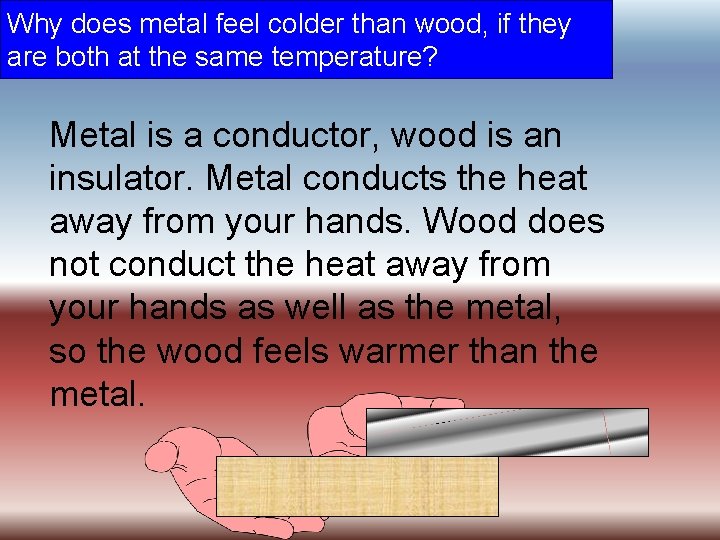
Why does metal feel colder than wood, if they are both at the same temperature? Metal is a conductor, wood is an insulator. Metal conducts the heat away from your hands. Wood does not conduct the heat away from your hands as well as the metal, so the wood feels warmer than the metal.
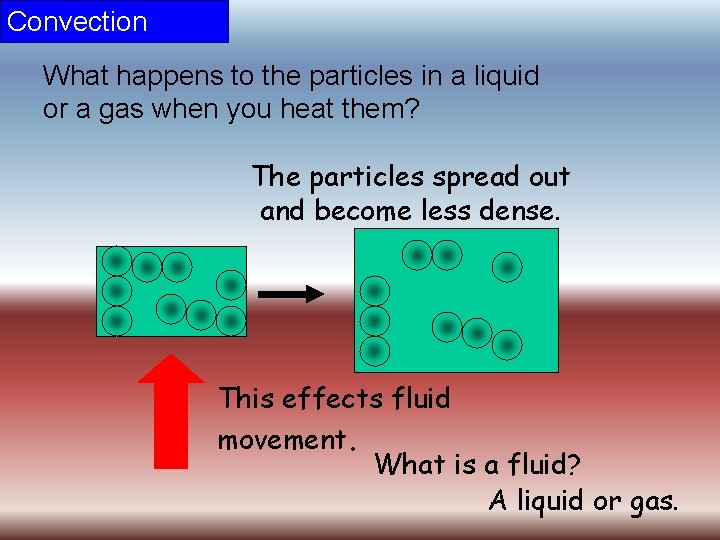
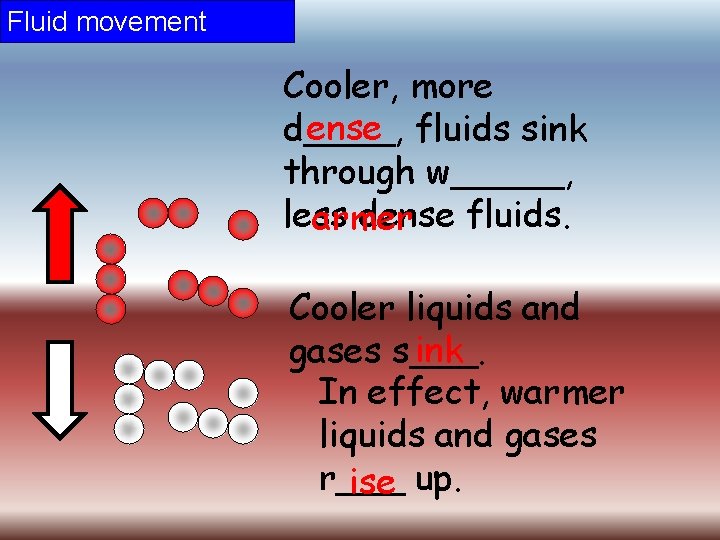
Convection What happens to the particles in a liquid or a gas when you heat them? The particles spread out and become less dense. This effects fluid movement. What is a fluid? A liquid or gas.
Fluid movement Cooler, more ense fluids sink d____, through w_____, less dense fluids. armer Cooler liquids and ink gases s___. In effect, warmer liquids and gases r___ ise up.
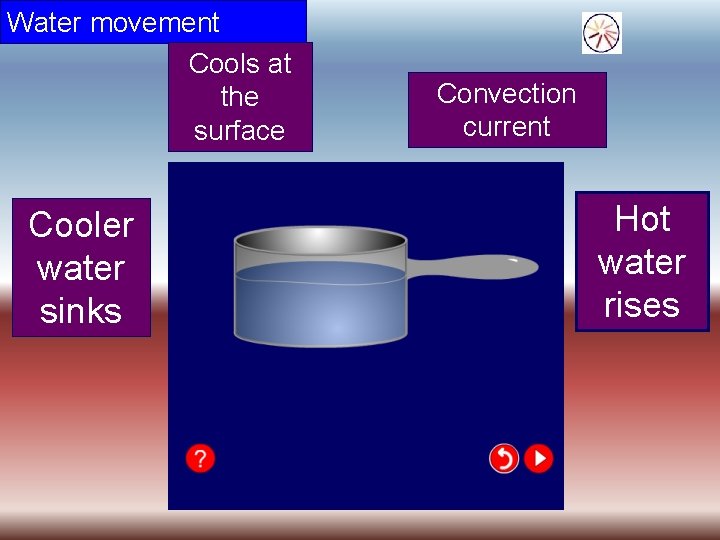
Water movement Cools at the surface Cooler water sinks Convection current Hot water rises
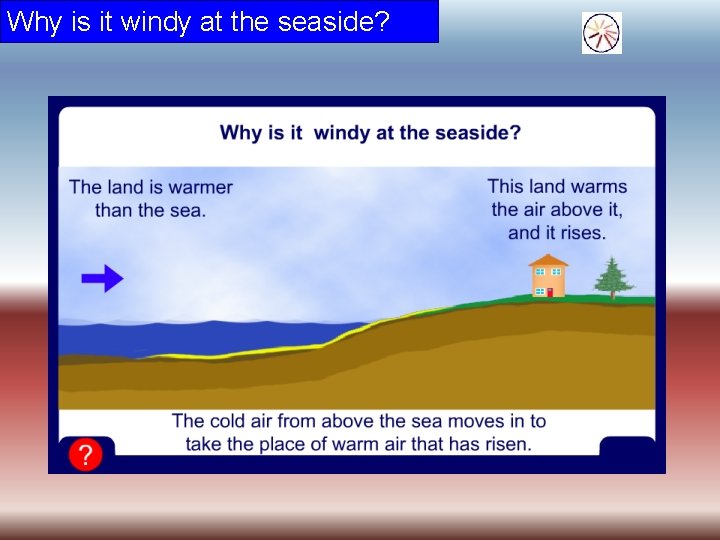
Why is it windy at the seaside?
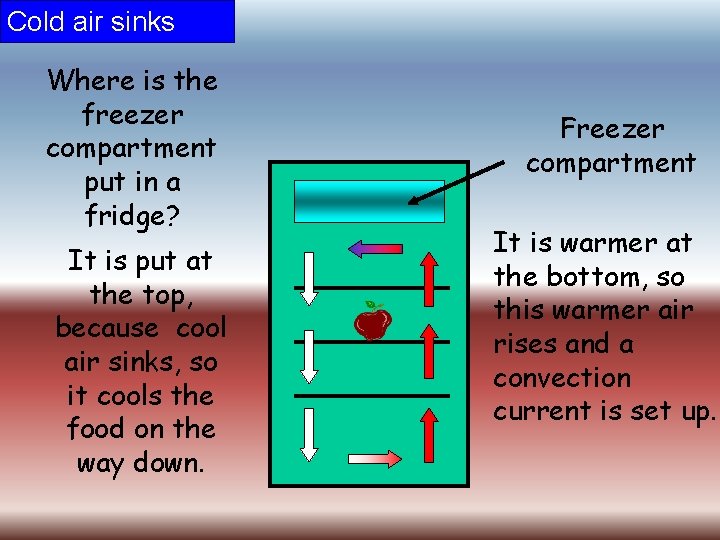
Cold air sinks Where is the freezer compartment put in a fridge? It is put at the top, because cool air sinks, so it cools the food on the way down. Freezer compartment It is warmer at the bottom, so this warmer air rises and a convection current is set up.
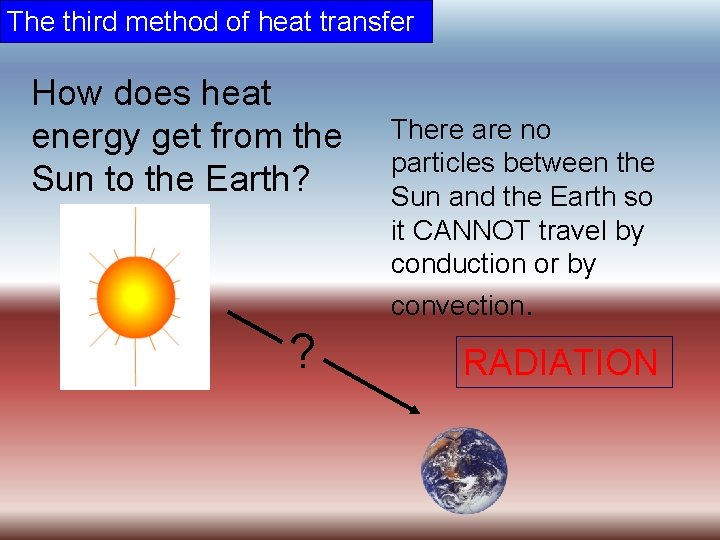
The third method of heat transfer How does heat energy get from the Sun to the Earth? ? There are no particles between the Sun and the Earth so it CANNOT travel by conduction or by convection. RADIATION
Radiation travels in straight lines True/False Radiation can travel through a vacuum True/False Radiation requires particles to travel True/False
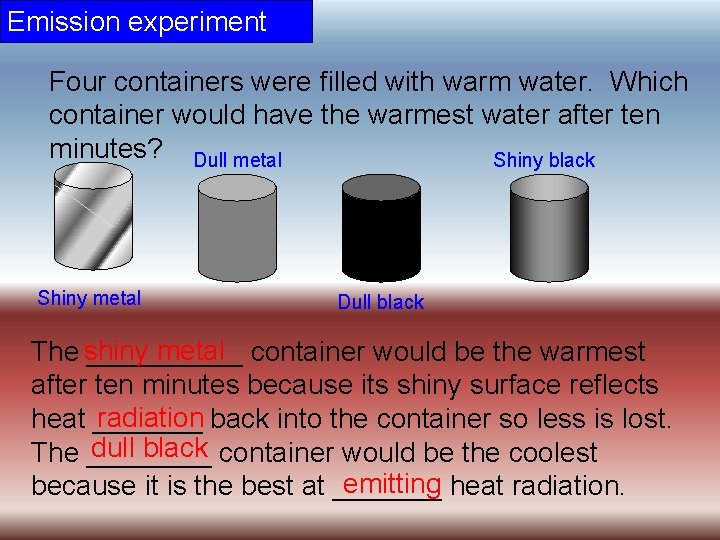
Emission experiment Four containers were filled with warm water. Which container would have the warmest water after ten minutes? Dull metal Shiny black Shiny metal Dull black metal container would be the warmest The shiny _____ after ten minutes because its shiny surface reflects radiation back into the container so less is lost. heat _______ dull black container would be the coolest The ____ emitting heat radiation. because it is the best at _______
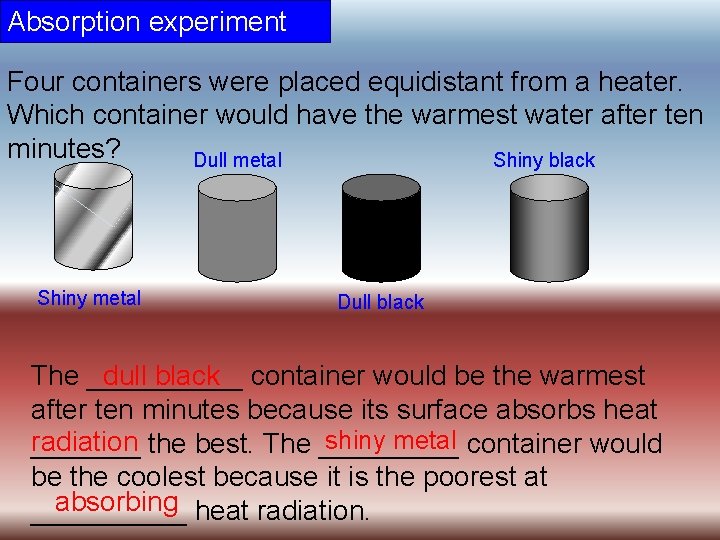
Absorption experiment Four containers were placed equidistant from a heater. Which container would have the warmest water after ten minutes? Dull metal Shiny black Shiny metal Dull black dull black container would be the warmest The _____ after ten minutes because its surface absorbs heat shiny metal container would radiation _______ the best. The _____ be the coolest because it is the poorest at absorbing heat radiation. _____
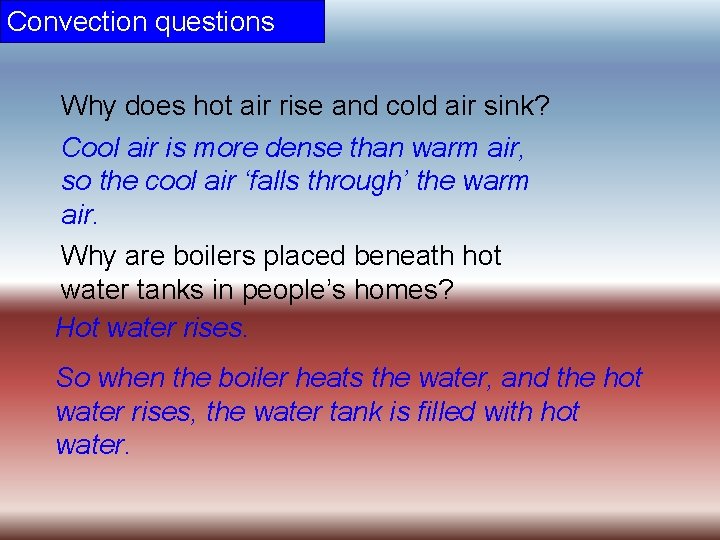
Convection questions Why does hot air rise and cold air sink? Cool air is more dense than warm air, so the cool air ‘falls through’ the warm air. Why are boilers placed beneath hot water tanks in people’s homes? Hot water rises. So when the boiler heats the water, and the hot water rises, the water tank is filled with hot water.
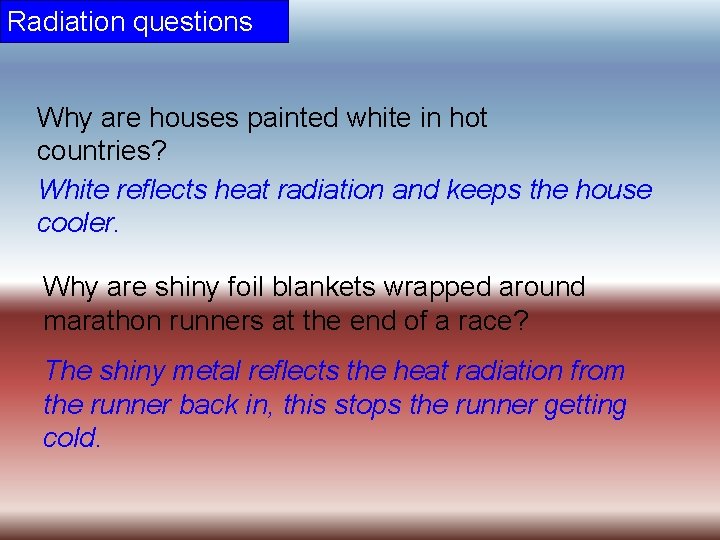
Radiation questions Why are houses painted white in hot countries? White reflects heat radiation and keeps the house cooler. Why are shiny foil blankets wrapped around marathon runners at the end of a race? The shiny metal reflects the heat radiation from the runner back in, this stops the runner getting cold.
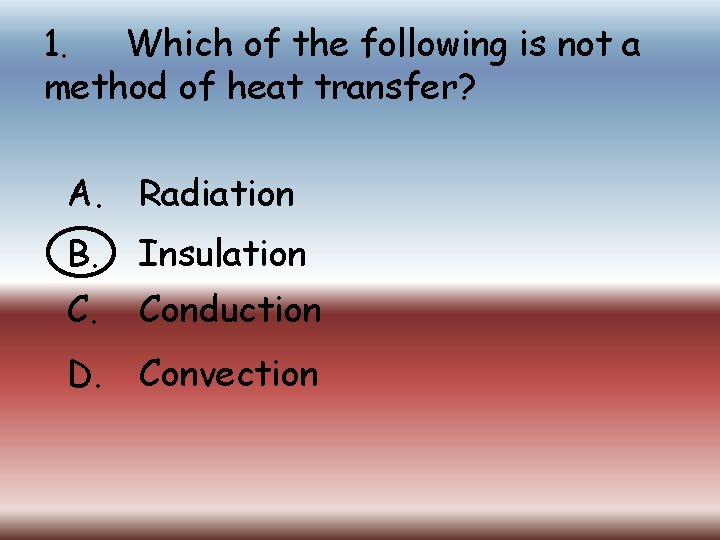
1. Which of the following is not a method of heat transfer? A. Radiation B. Insulation C. Conduction D. Convection
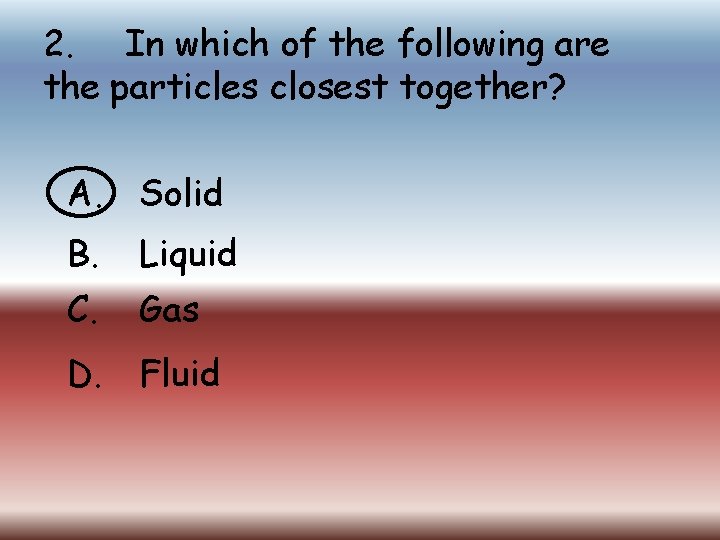
2. In which of the following are the particles closest together? A. Solid B. Liquid C. Gas D. Fluid
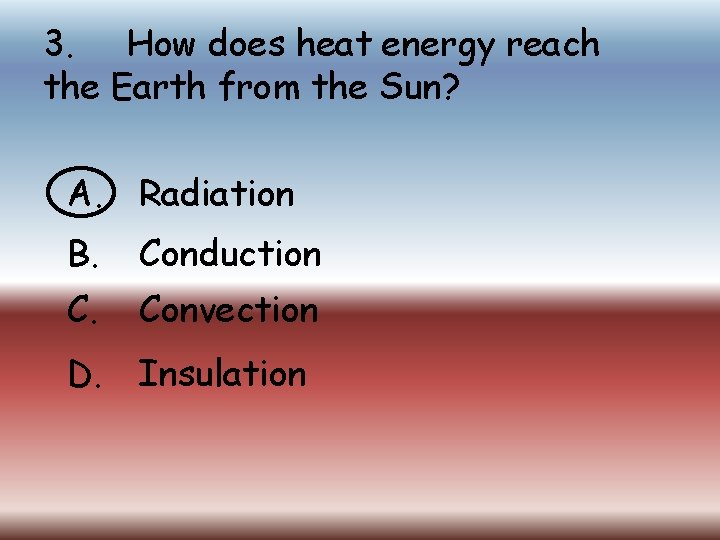
3. How does heat energy reach the Earth from the Sun? A. Radiation B. Conduction C. Convection D. Insulation
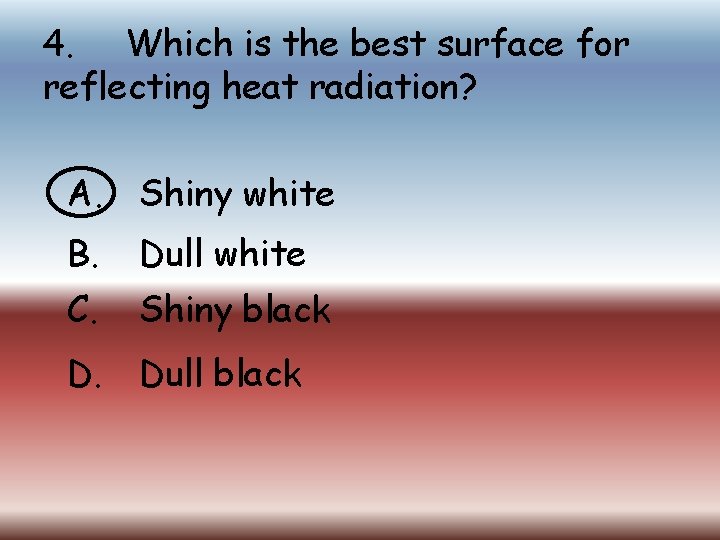
4. Which is the best surface for reflecting heat radiation? A. Shiny white B. Dull white C. Shiny black D. Dull black
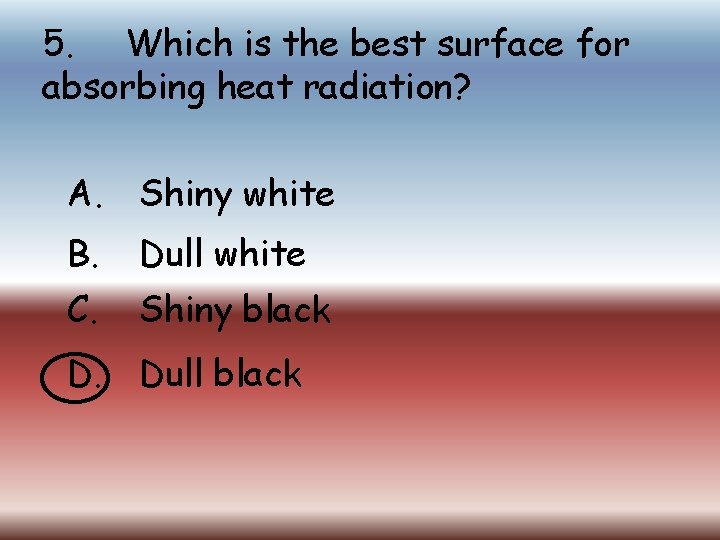
5. Which is the best surface for absorbing heat radiation? A. Shiny white B. Dull white C. Shiny black D. Dull black
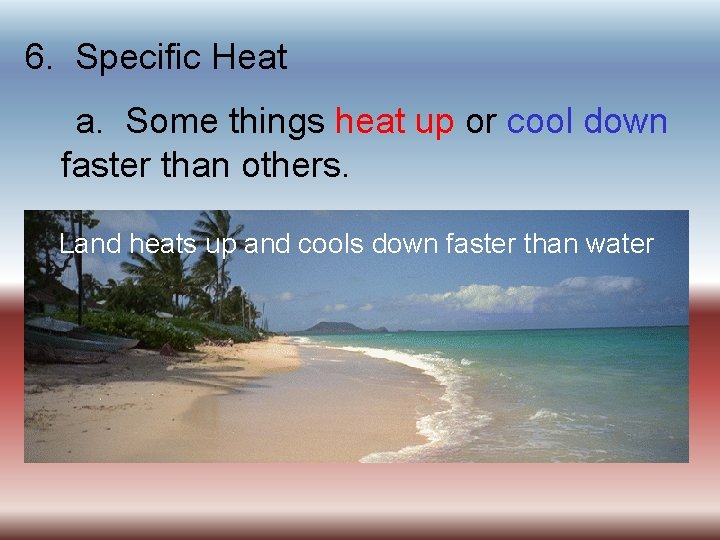
6. Specific Heat a. Some things heat up or cool down faster than others. Land heats up and cools down faster than water
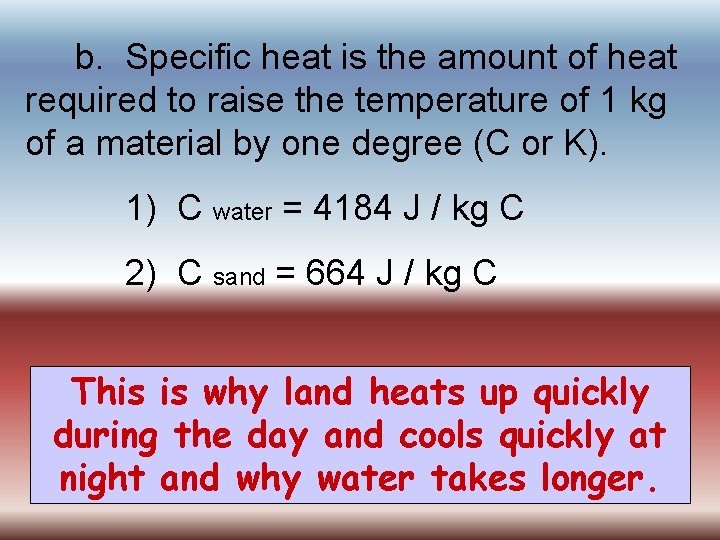
b. Specific heat is the amount of heat required to raise the temperature of 1 kg of a material by one degree (C or K). 1) C water = 4184 J / kg C 2) C sand = 664 J / kg C This is why land heats up quickly during the day and cools quickly at night and why water takes longer.
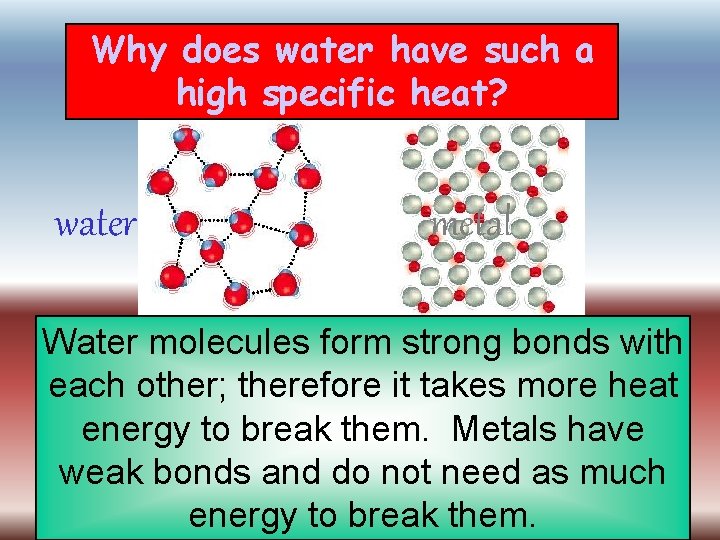
Why does water have such a high specific heat? water metal Water molecules form strong bonds with each other; therefore it takes more heat energy to break them. Metals have weak bonds and do not need as much energy to break them.
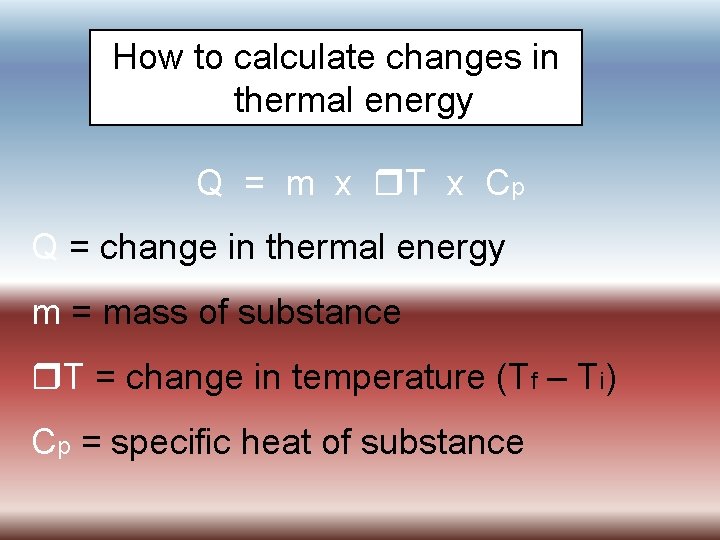
How to calculate changes in thermal energy Q = m x T x Cp Q = change in thermal energy m = mass of substance T = change in temperature (Tf – Ti) Cp = specific heat of substance
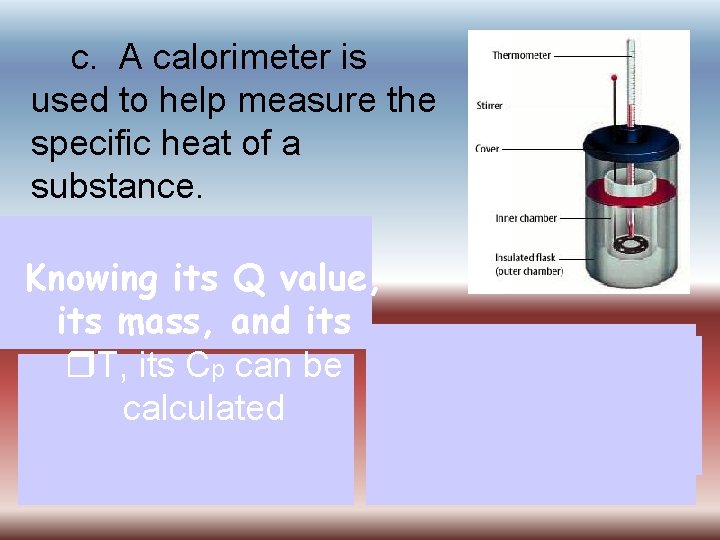
c. A calorimeter is used to help measure the specific heat of a substance. First, mass and Knowing its Q value, temperature of its mass, and its water are measured Then heated This gives the T, its Cp can be T is measured sample is put heat lost by the calculated for water to help inside and heat substance get its heat gain flows into water