
Thermodynamics I Chapter 3 Energy Heat and Work
![HEAT, Q [J, k. J] Heat - Energy that is being transferred due to](https://slidetodoc.com/presentation_image_h/e9fdd3bdbd7d15e06bdf727e097ed7ab/image-8.jpg "HEAT, Q [J, k. J] Heat - Energy that is being transferred due to")
![WORK, W [J, k. J] Work -–Energy that is crossing the boundary other than](https://slidetodoc.com/presentation_image_h/e9fdd3bdbd7d15e06bdf727e097ed7ab/image-10.jpg "WORK, W [J, k. J] Work -–Energy that is crossing the boundary other than")


- Slides: 16
Thermodynamics I Chapter 3 Energy, Heat and Work Mohsin Mohd Sies Fakulti Kejuruteraan Mekanikal, Universiti Teknologi Malaysia
Energy, Heat and Work (Motivation) A system changes due to interaction with its surroundings. Energy interaction is a major factor. This chapter studies the nature of energy and its various forms and transfers so that we are able to follow its interaction with a system.
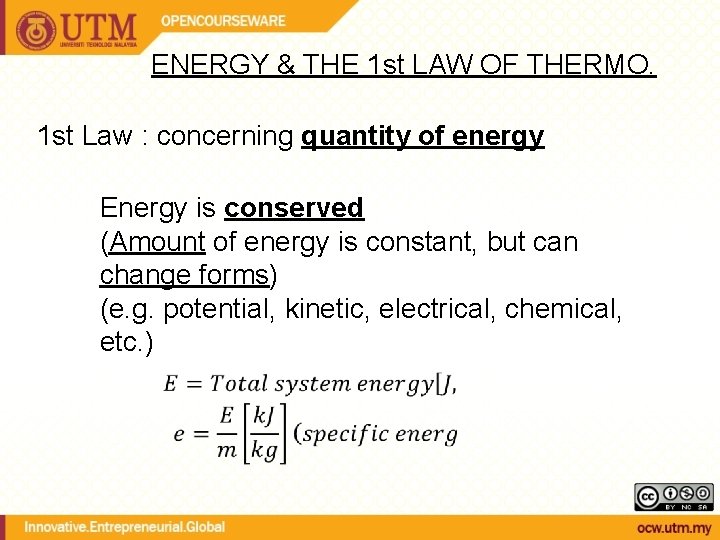
ENERGY & THE 1 st LAW OF THERMO. 1 st Law : concerning quantity of energy Energy is conserved (Amount of energy is constant, but can change forms) (e. g. potential, kinetic, electrical, chemical, etc. )
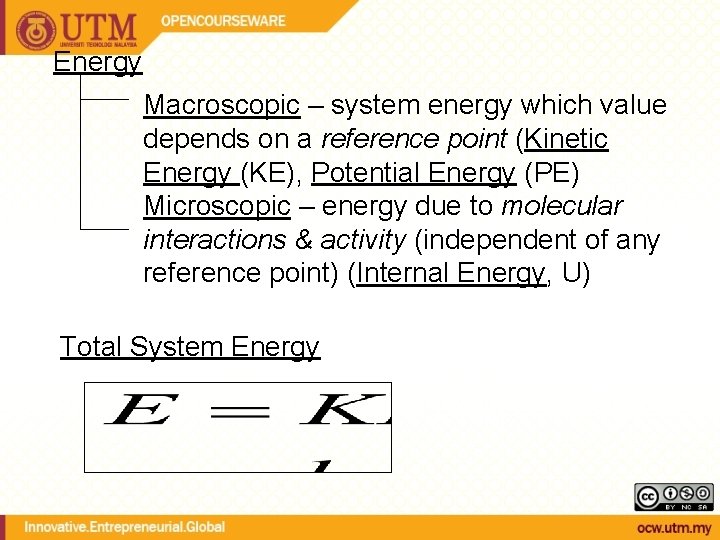
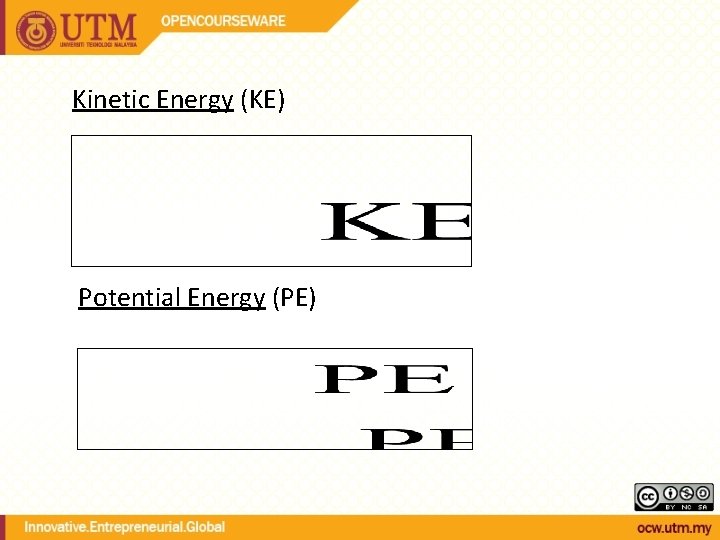
Energy Macroscopic – system energy which value depends on a reference point (Kinetic Energy (KE), Potential Energy (PE) Microscopic – energy due to molecular interactions & activity (independent of any reference point) (Internal Energy, U) Total System Energy
Kinetic Energy (KE) Potential Energy (PE)
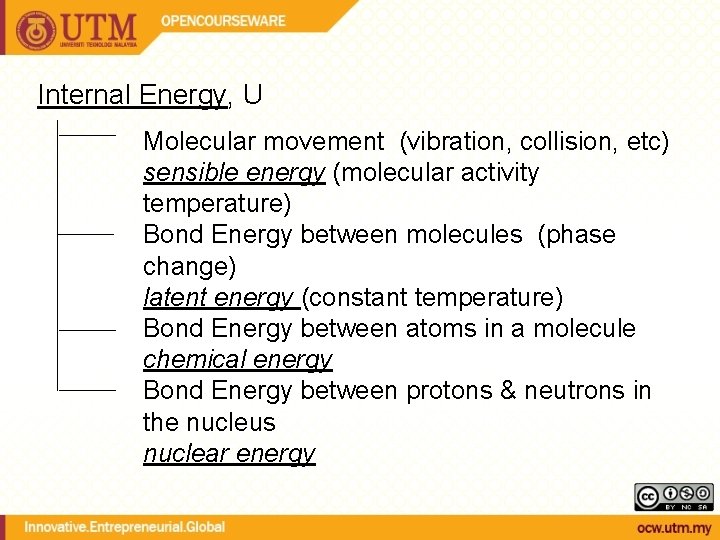
Internal Energy, U Molecular movement (vibration, collision, etc) sensible energy (molecular activity temperature) Bond Energy between molecules (phase change) latent energy (constant temperature) Bond Energy between atoms in a molecule chemical energy Bond Energy between protons & neutrons in the nucleus nuclear energy
Modes of Energy Transfer Energy Interaction between System and Surrounding Energy can cross the boundary (transferred) of a closed system by 2 methods; HEAT & WORK
HEAT, Q [J, k. J] Heat - Energy that is being transferred due to a temperature difference • Heat is a mode of energy transfer • Heat is not a property • Energy is related to states (property) • Heat is related to processes (not a property, depends on the path) = rate of heat transfer Amount of heat transferred during a process (depends on the path)
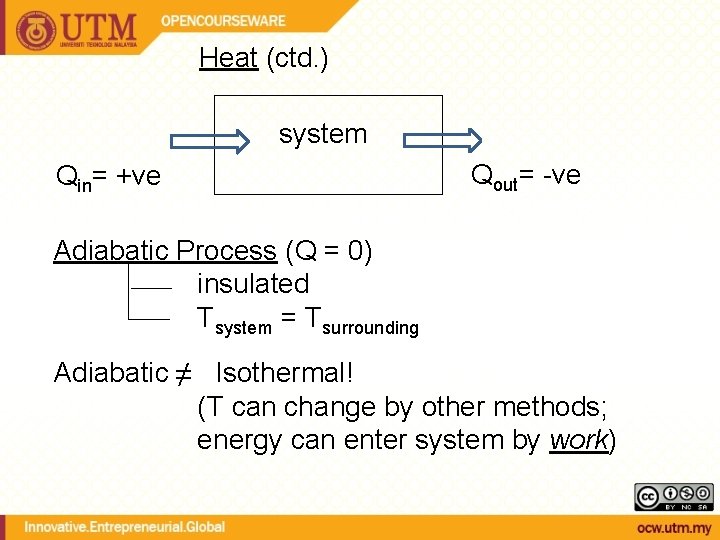
Heat (ctd. ) system Qin= +ve Qout= -ve Adiabatic Process (Q = 0) insulated Tsystem = Tsurrounding Adiabatic ≠ Isothermal! (T can change by other methods; energy can enter system by work)
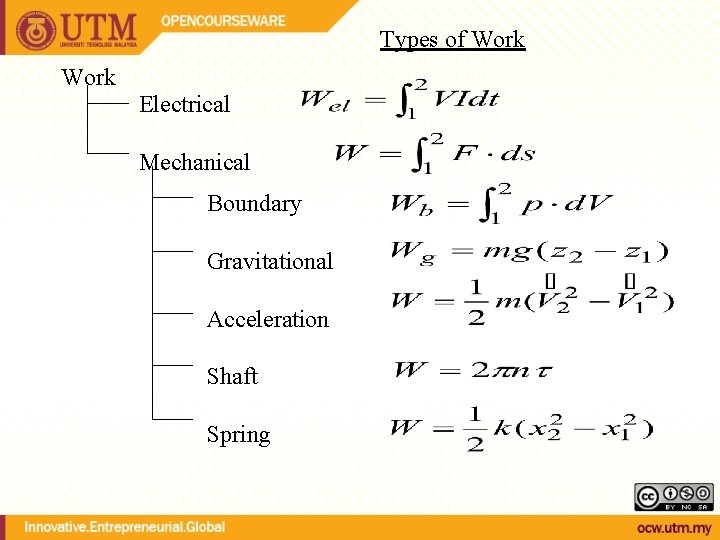
WORK, W [J, k. J] Work -–Energy that is crossing the boundary other than heat (electrical, stirrer, shaft, moving piston, etc. ) -Not a property (related to process) -Mode of energy transfer Win= -ve system Wout= +ve = rate of work = power Depends on path
Types of Work Electrical Mechanical Boundary Gravitational Acceleration Shaft Spring
Boundary Work for Polytropic Processes Boundary Work Area under P-v graph General Polytropic Work (n 1) Const. Pressure Work (n=0) Isothermal Work (n=1) ideal gas Const. Volume Work (dv=0)
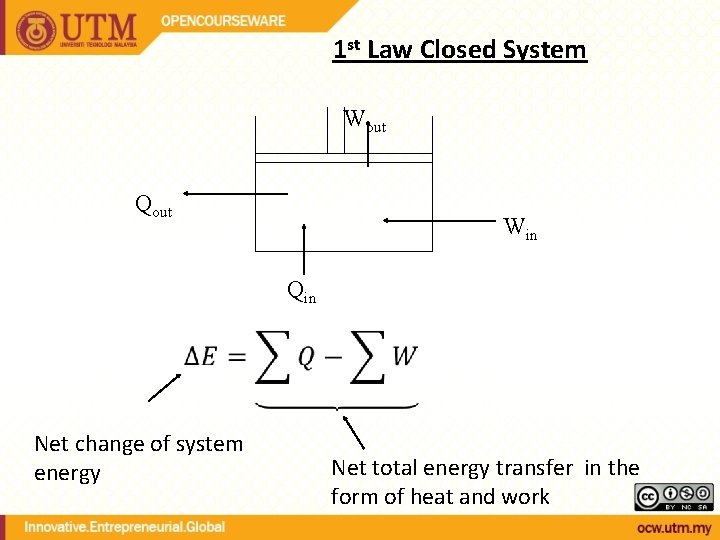
1 st Law Closed System Wout Qout Win Qin Net change of system energy Net total energy transfer in the form of heat and work
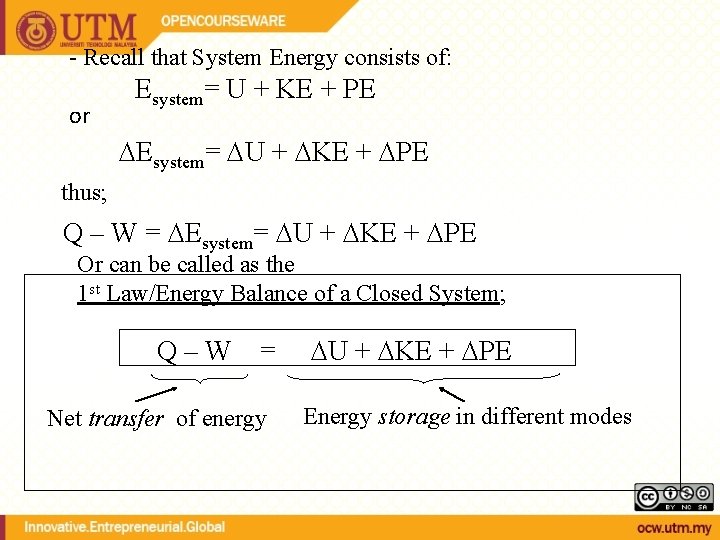
- Recall that System Energy consists of: or Esystem= U + KE + PE thus; Q – W = Esystem= U + KE + PE Or can be called as the 1 st Law/Energy Balance of a Closed System; Q–W = Net transfer of energy U + KE + PE Energy storage in different modes
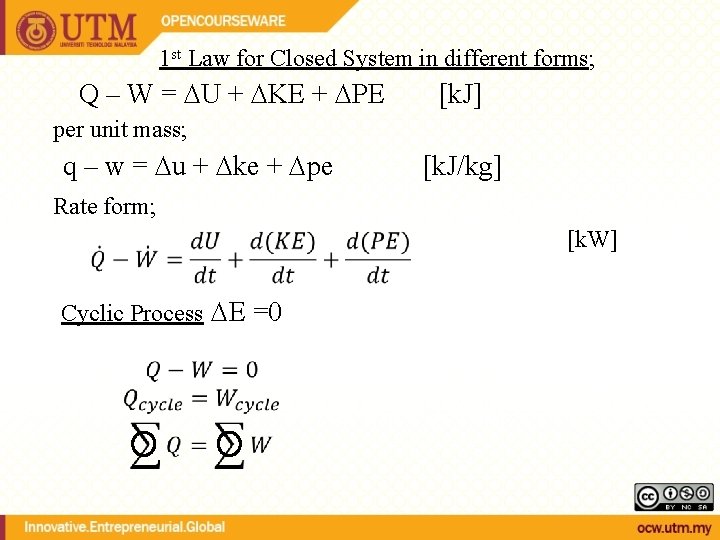
1 st Law for Closed System in different forms; Q – W = U + KE + PE [k. J] per unit mass; q – w = u + ke + pe [k. J/kg] Rate form; [k. W] Cyclic Process E =0
summary; Q – W = U + KE + PE mg(z 2 -z 1) m(u 2 -u 1) water (Table) m. Cv(T 2 -T 1) ideal gas Electrical Mechanical Boundary etc…