
Thermodynamics I Chapter 1 Basic Concepts Tutorial Assoc
Thermodynamics I Chapter 1 Basic Concepts Tutorial Assoc. Prof. Sommai Priprem Department of Mechanical Engineering Chapter 1 Tutorial 1 Khon Kaen University
1 -2 c Why does a bicyclist pick up speed on a down hill road even when he is not pedaling? Does this violate the conservation of energy principle? 1 -8 Determine the mass and weight of the air contained in a room whose dimensions are 6 m x 8 m. Assume the density of the air is 1. 16 kg/m 3. (334. 1 kg, 3277 N) Chapter 1 Tutorial 2
1 -14 c A large fraction of thermal energy generated in the engine of a car is rejected to the air by the radiator through the circulating water. Should the radiator be analyzed as a closed system or as an open system? Explain? 1 -15 c A can of soft drink at room temperature is put into the refrigerator so that it will cool. Would you model the can of soft drink as a closed system or as an open system? Explain? Chapter 1 Tutorial 3

1 -20 c What is the state postulate? 1 -33 c What is the difference between gage pressure and absolute pressure? 1 -35 c Someone claims that the absolute pressure in a liquid of constant density doubles when the depth is doubled. Do you agree? Explain? Chapter 1 Tutorial 4
1 -41 Determine the atmospheric pressure at a location where the barometric reading is 750 mm Hg. Take the density of mercury to be 13, 600 kg/m 3. 1 -47 A vacuum gage connected to a tank reads 15 k. Pa at a location where the barometric reading is 750 mm Hg. Determine the absolute pressure in the tank. Take ρHg = 13, 590 kg/m 3. Chapter 1 Tutorial 5
1 -54*** A gas is contained in a vertical, frictionless piston-cylinder device. The piston has a mass of 4 kg and a crosssectional area of 35 cm 2. A compressed spring above the piston exerts a force of 60 N on the piston. If the atmospheric pressure is 95 k. Pa, determine the pressure inside the cylinder. (123. 4 k. Pa) Chapter 1 Tutorial 6
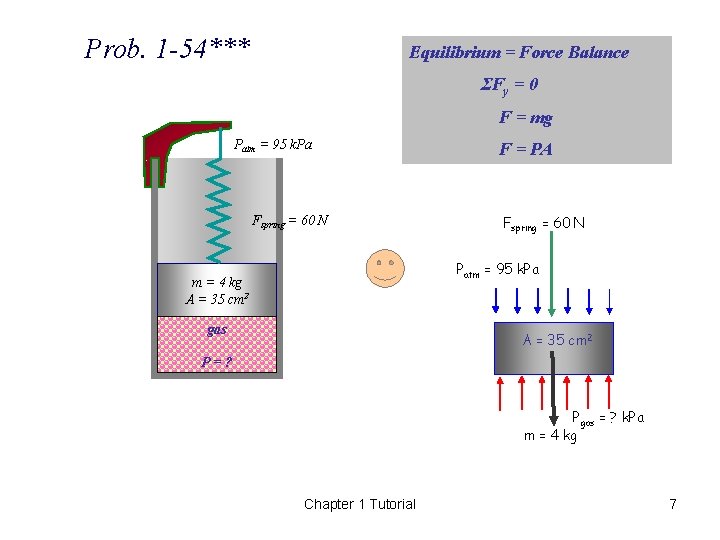
Prob. 1 -54*** Equilibrium = Force Balance ΣFy = 0 F = mg Patm = 95 k. Pa Fspring = 60 N F = PA Fspring = 60 N Patm = 95 k. Pa m = 4 kg A = 35 cm 2 gas A = 35 cm 2 P=? Pgas = ? k. Pa m = 4 kg Chapter 1 Tutorial 7
1 -81*** A vertical piston-cylinder device contains a gas at a pressure of 100 k. Pa. The piston has a mass of 5 kg and a diameter of 12 cm. Pressure of the gas is to be increased by placing some weights on the piston. Determine the local atmospheric pressure and the mass of the weights that will double the pressure of the gas inside the cylinder. ( 95. 7 k. Pa, 115. 3 kg) Chapter 1 Tutorial 8
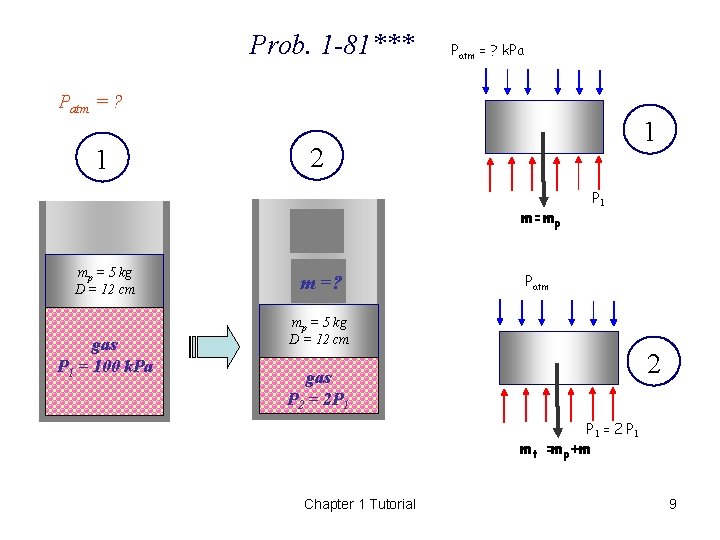
Prob. 1 -81*** Patm = ? k. Pa Patm = ? 1 1 2 P 1 m=mp mp = 5 kg D = 12 cm gas P 1 = 100 k. Pa m =? Patm mp = 5 kg D = 12 cm 2 gas P 2 = 2 P 1 = 2 P 1 mt =mp+m Chapter 1 Tutorial 9
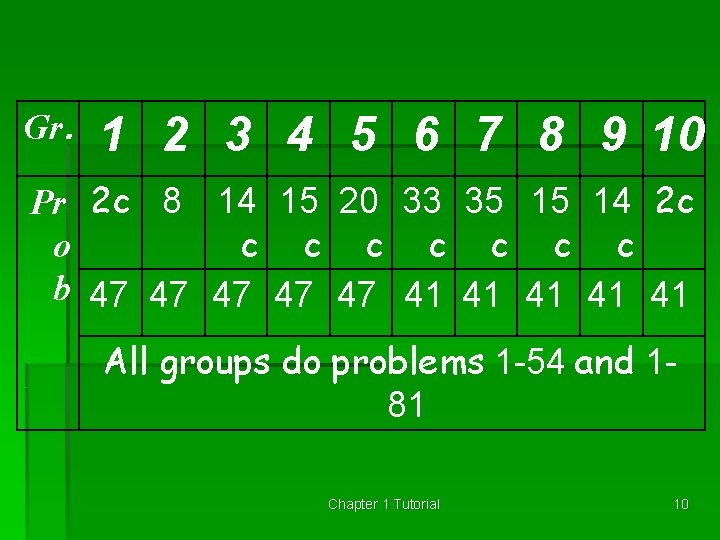
Gr. 1 2 3 4 5 6 7 8 9 10 Pr 2 c 8 14 15 20 33 35 15 14 2 c c c c o b 47 47 47 41 41 41 All groups do problems 1 -54 and 181 Chapter 1 Tutorial 10
- Slides: 10