
Thermodynamics Chapter 18 Thermodynamics is The study of

- Slides: 10
Thermodynamics Chapter 18
Thermodynamics is… � The study of heat and its transformation to mechanical energy. � The science of thermodynamics was developed in the 19 th century, before the atomic and molecular theory of matter was understood.
The foundation of thermodynamics � The conservation of energy � The fact that heat flows spontaneously from hot to cold
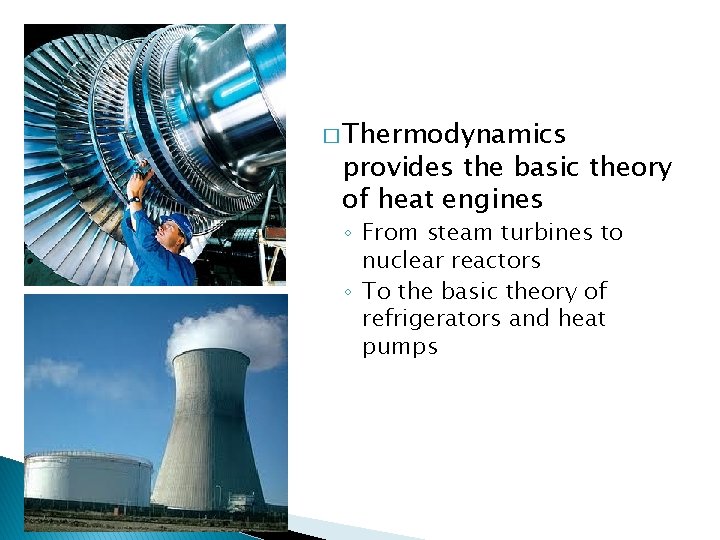
� Thermodynamics provides the basic theory of heat engines ◦ From steam turbines to nuclear reactors ◦ To the basic theory of refrigerators and heat pumps
Absolute Zero
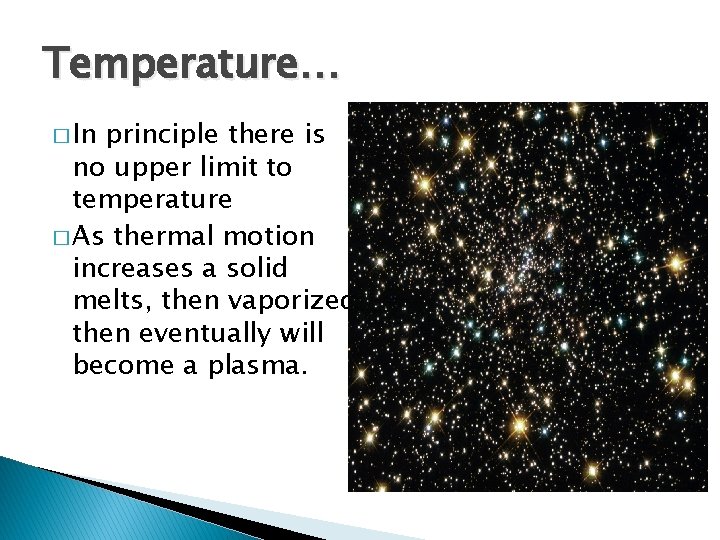
Temperature… � In principle there is no upper limit to temperature � As thermal motion increases a solid melts, then vaporized, then eventually will become a plasma.
� However, there is a definite limit to how cold something can be. � What is absolute zero? � Where does that number come from?
In the 19 th Century Experiments Found… � That all gases, regardless of their initial pressures or volumes, change by 1/273 of their volume of 0 C for each degree Celsius change in temperature, provided the pressure is held constant. � So if a gas at 0 C were cooled down by 173 C, it would contract according to this rule by 273/273 of its volume and be reduced to zero. � Therefore a gas in a container of fixed volume cooled to 273 C below zero would have no pressure whatsoever.
� When atoms and molecules lose all available kinetic energy, they reach absolute zero of temperature ◦ Remember that temperature is a measure of the kinetic movement of atoms and molecules. ◦ If no more energy can be extracted from a substance, then no further lowering of its temperature is possible.
The Kelvin Scale � The absolute temperature scale � Named after 19 th Scottish physicist William Thomson, the 1 st Baron Kelvin