
Thermodynamics and the Phase Rule GLY 4200 Fall
- Slides: 19
Thermodynamics and the Phase Rule GLY 4200 Fall, 2012 1
Thermodynamic Background • System: The portion of the universe that is being studied • Surroundings: The part of the universe not included in the system 2
Free Energy • Any change in the system involves a transfer of energy • All chemical systems tend naturally toward states of minimum Gibbs free energy 3
Gibbs Free Energy • G = H - TS • Where: § § G = Gibbs Free Energy H = Enthalpy (heat content) T = Temperature in Kelvin S = Entropy (a measure of randomness) 4
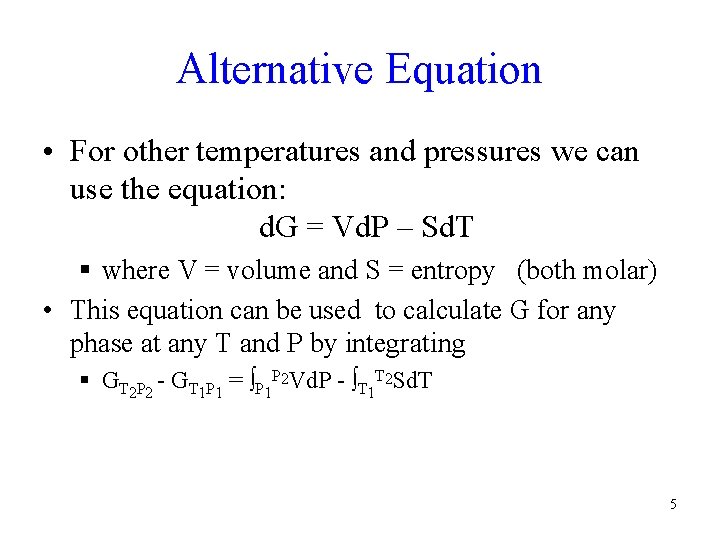
Alternative Equation • For other temperatures and pressures we can use the equation: d. G = Vd. P – Sd. T § where V = volume and S = entropy (both molar) • This equation can be used to calculate G for any phase at any T and P by integrating § GT 2 P 2 - GT 1 P 1 = ∫P 1 P 2 Vd. P - ∫T 1 T 2 Sd. T 5
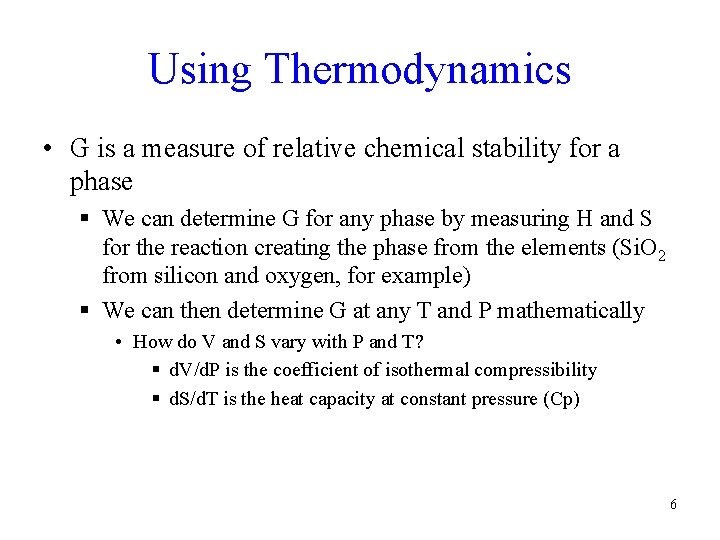
Using Thermodynamics • G is a measure of relative chemical stability for a phase § We can determine G for any phase by measuring H and S for the reaction creating the phase from the elements (Si. O 2 from silicon and oxygen, for example) § We can then determine G at any T and P mathematically • How do V and S vary with P and T? § d. V/d. P is the coefficient of isothermal compressibility § d. S/d. T is the heat capacity at constant pressure (Cp) 6
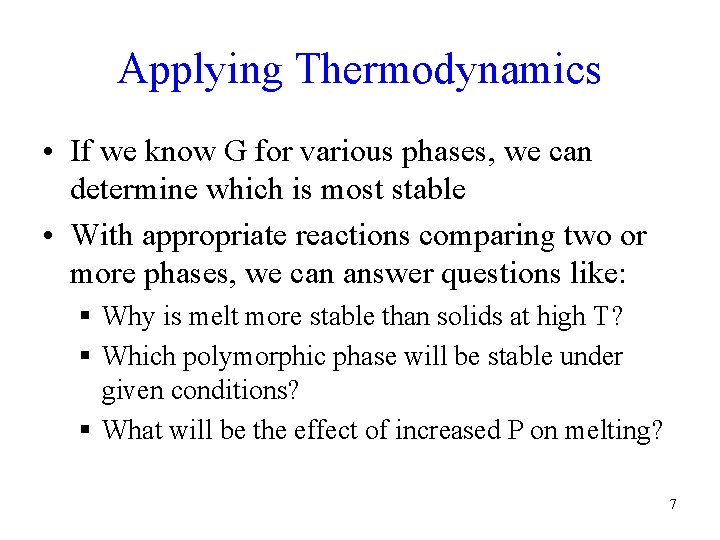
Applying Thermodynamics • If we know G for various phases, we can determine which is most stable • With appropriate reactions comparing two or more phases, we can answer questions like: § Why is melt more stable than solids at high T? § Which polymorphic phase will be stable under given conditions? § What will be the effect of increased P on melting? 7
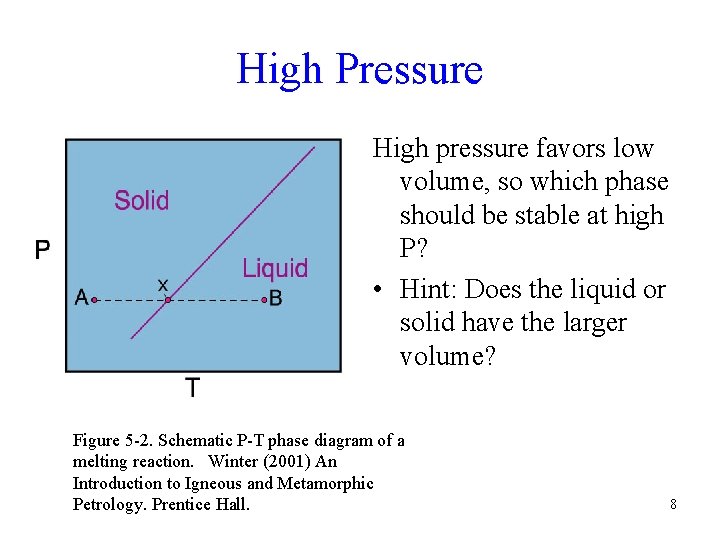
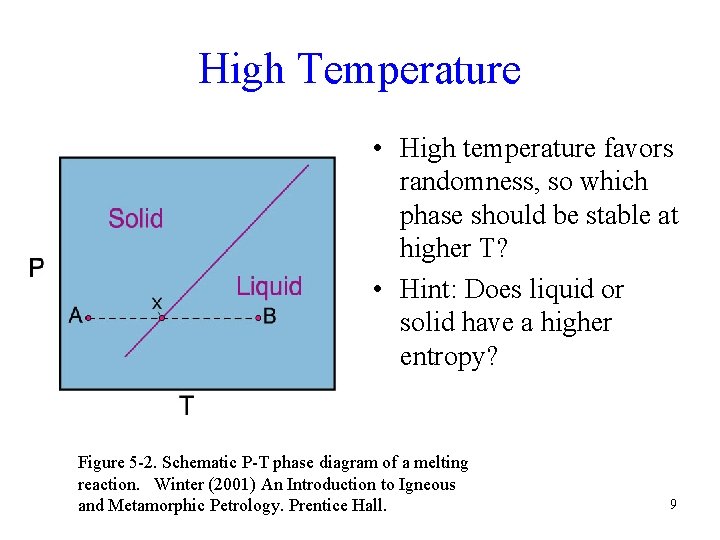
High Pressure High pressure favors low volume, so which phase should be stable at high P? • Hint: Does the liquid or solid have the larger volume? Figure 5 -2. Schematic P-T phase diagram of a melting reaction. Winter (2001) An Introduction to Igneous and Metamorphic Petrology. Prentice Hall. 8
High Temperature • High temperature favors randomness, so which phase should be stable at higher T? • Hint: Does liquid or solid have a higher entropy? Figure 5 -2. Schematic P-T phase diagram of a melting reaction. Winter (2001) An Introduction to Igneous and Metamorphic Petrology. Prentice Hall. 9
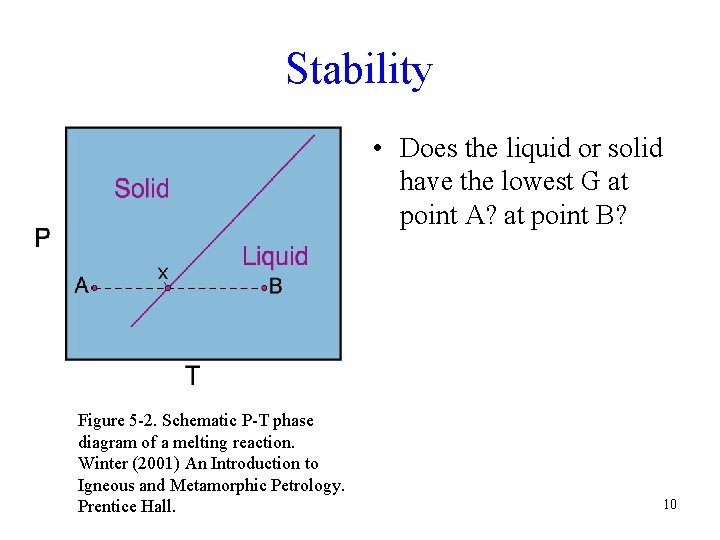
Stability • Does the liquid or solid have the lowest G at point A? at point B? Figure 5 -2. Schematic P-T phase diagram of a melting reaction. Winter (2001) An Introduction to Igneous and Metamorphic Petrology. Prentice Hall. 10
Intensive Property • An intensive property does not depend on the amount of material present § Examples: Temperature, density, electric or magnetic field strength 11
Phase • Phase: Any homogeneous region, characterized by certain intensive properties, and separated from other phases by discontinuities in one or more of those intensive properties § Solid, often a mineral § Liquid § Vapor • Note: # of regions is not important, just the # of kinds of regions 12
Reaction • Some change in the nature or types of phases in a system 13
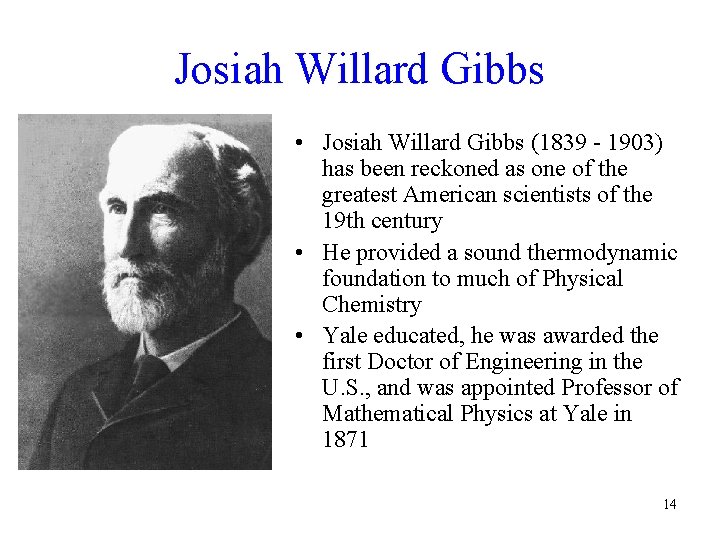
Josiah Willard Gibbs • Josiah Willard Gibbs (1839 - 1903) has been reckoned as one of the greatest American scientists of the 19 th century • He provided a sound thermodynamic foundation to much of Physical Chemistry • Yale educated, he was awarded the first Doctor of Engineering in the U. S. , and was appointed Professor of Mathematical Physics at Yale in 1871 14
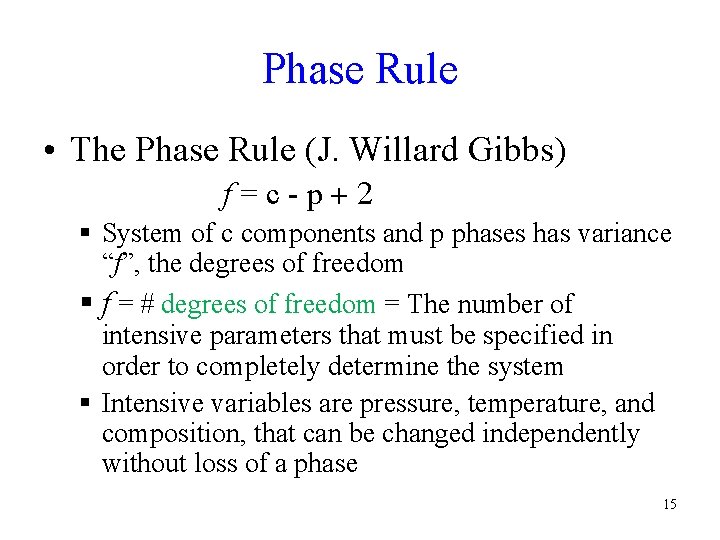
Phase Rule • The Phase Rule (J. Willard Gibbs) f=c-p+2 § System of c components and p phases has variance “f”, the degrees of freedom § f = # degrees of freedom = The number of intensive parameters that must be specified in order to completely determine the system § Intensive variables are pressure, temperature, and composition, that can be changed independently without loss of a phase 15
Phase Rule 2 § p =number of phases • phases are mechanically separable constituents § c = minimum number of components, which are chemical constituents that must be specified in order to define all phases 16
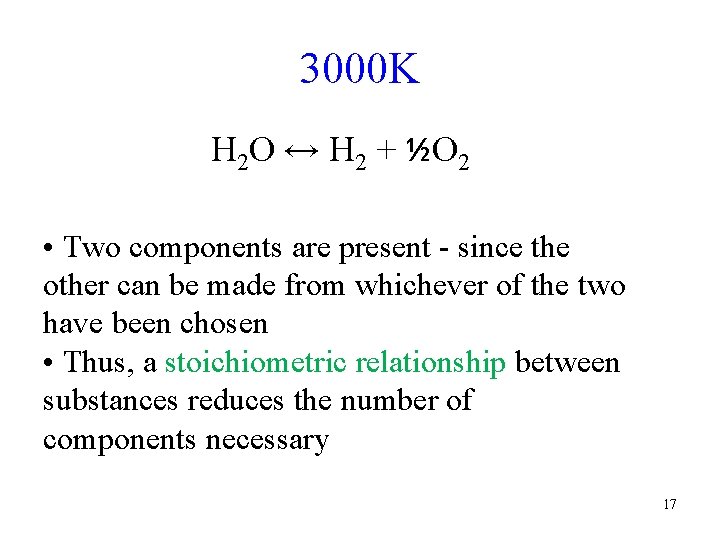
3000 K H 2 O ↔ H 2 + ½O 2 • Two components are present - since the other can be made from whichever of the two have been chosen • Thus, a stoichiometric relationship between substances reduces the number of components necessary 17
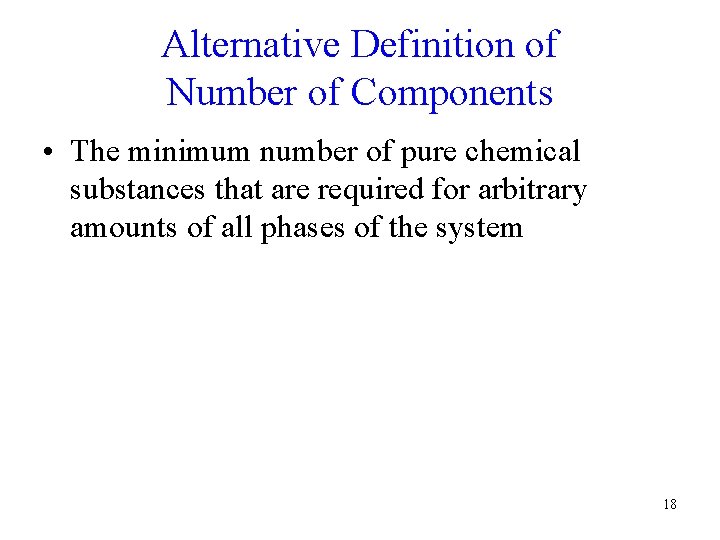
Alternative Definition of Number of Components • The minimum number of pure chemical substances that are required for arbitrary amounts of all phases of the system 18
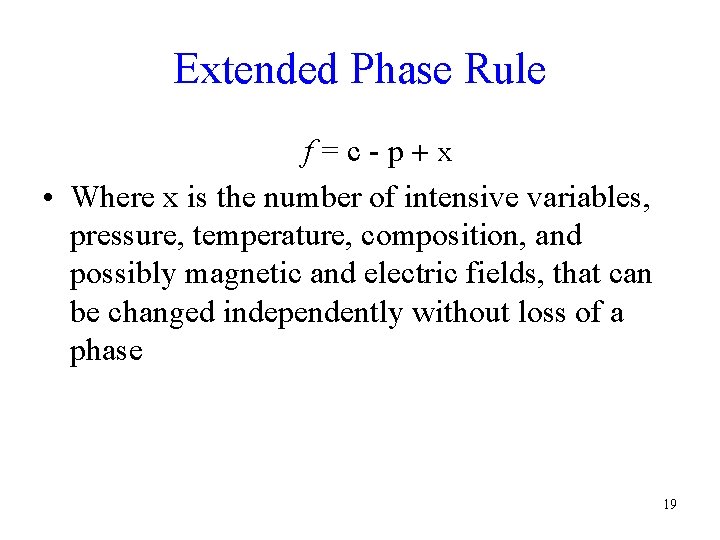
Extended Phase Rule f=c-p+x • Where x is the number of intensive variables, pressure, temperature, composition, and possibly magnetic and electric fields, that can be changed independently without loss of a phase 19