
Thermodynamics 10182021 RAT 11 10182021 Class Objectives Be

Thermodynamics 10/18/2021

RAT 11 10/18/2021
Class Objectives Ø Be able to define: Øthermodynamics Øtemperature, pressure, density, equilibrium, amount of substance Østates of matter and define them in the context of a phase diagram Øgas laws
Thermodynamics Ø Thermodynamics: “Therme” meaning heat, and “Dynamics” meaning strength Thermodynamics is the science of what is possible and impossible Ø Major limitation: Cannot predict how long the process takes Ø (This is the subject of rate processes)
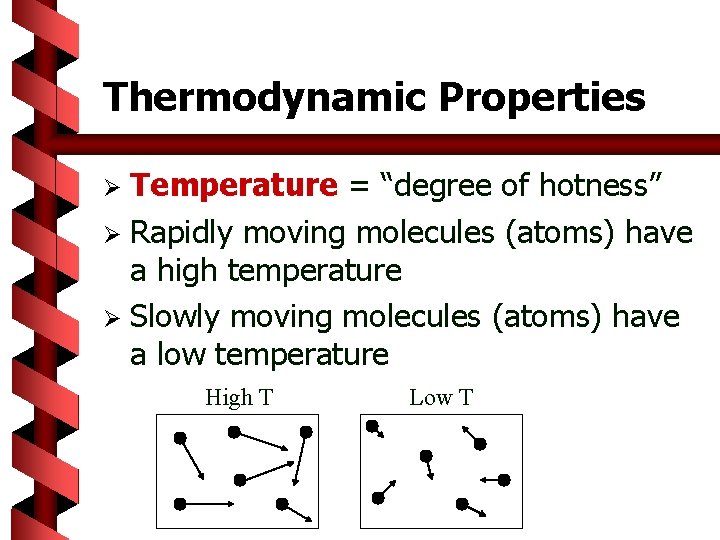
Thermodynamic Properties Temperature = “degree of hotness” Ø Rapidly moving molecules (atoms) have a high temperature Ø Slowly moving molecules (atoms) have a low temperature Ø High T Low T
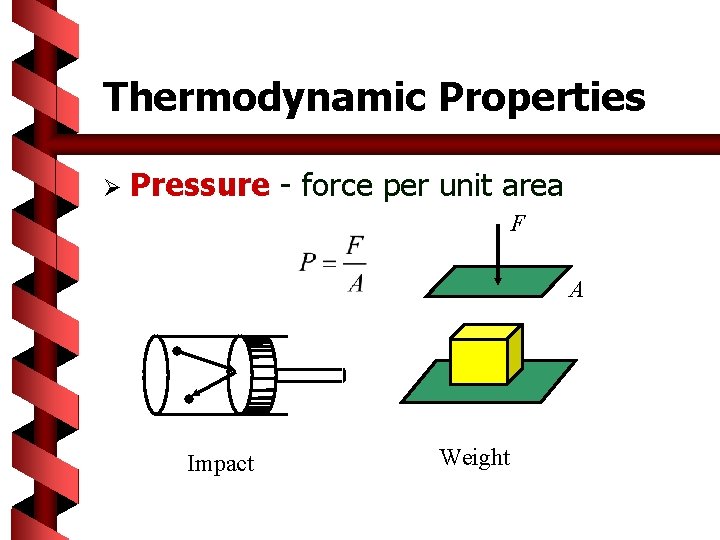
Thermodynamic Properties Ø Pressure - force per unit area F A Impact Weight
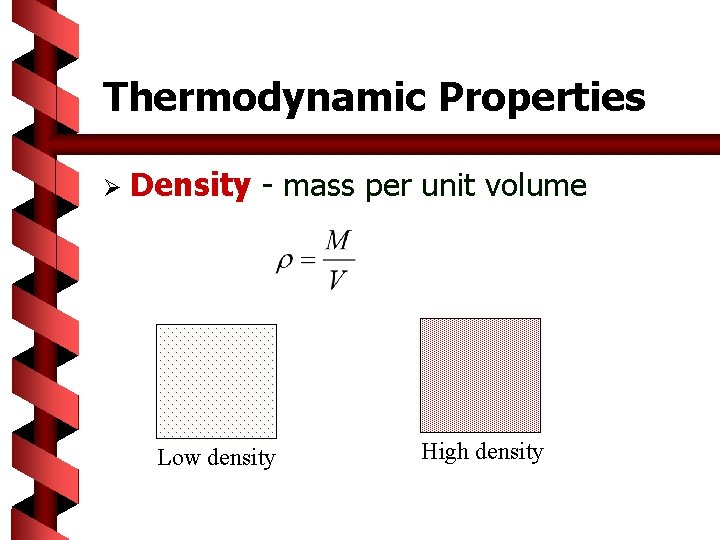
Thermodynamic Properties Ø Density - mass per unit volume Low density High density
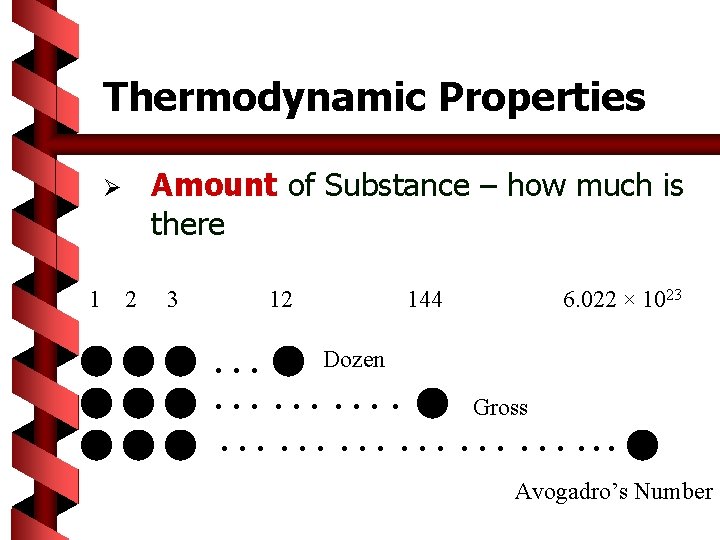
Thermodynamic Properties Amount of Substance – how much is there Ø 1 2 3 12 144 6. 022 × 1023 … ………………. . . Dozen Gross Avogadro’s Number
Pair Exercise 1 Ø A cube of osmium measures 0. 2 m on a side. It sits on a table. At the contact between the table and osmium, calculate the pressure (N/m 2). Note: Densities may be found in Table 11. 1 Foundations of Engineering
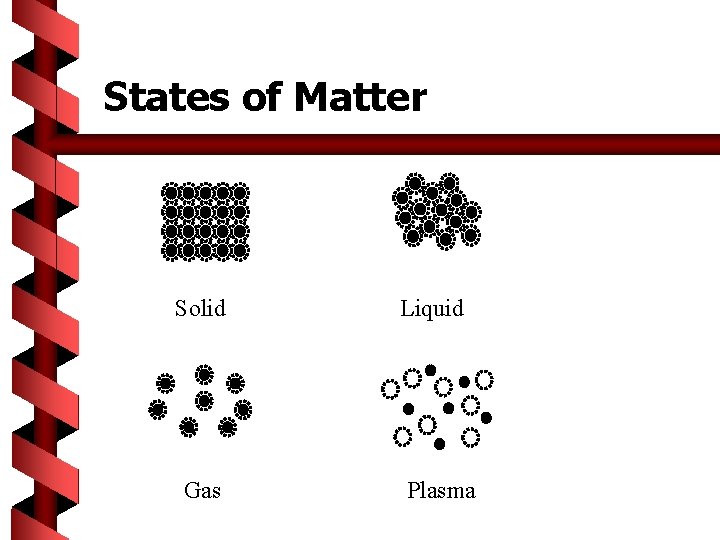
States of Matter Solid Gas Liquid Plasma
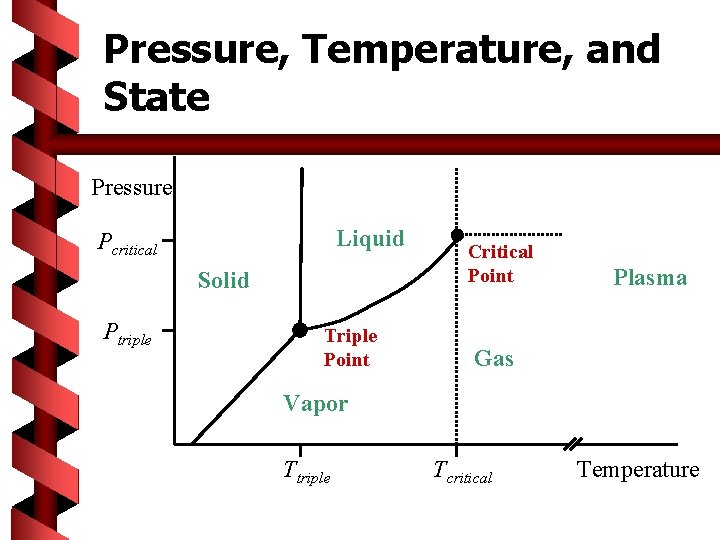
Pressure, Temperature, and State Pressure Liquid Pcritical Solid Ptriple Triple Point Critical Point Plasma Gas Vapor Ttriple Tcritical Temperature
Gas Laws apply only to perfect (ideal) gases Ø Boyle’s Law Ø Charles’ Law Ø Gay-Lussac’s Law Ø Mole Proportionality Law Ø
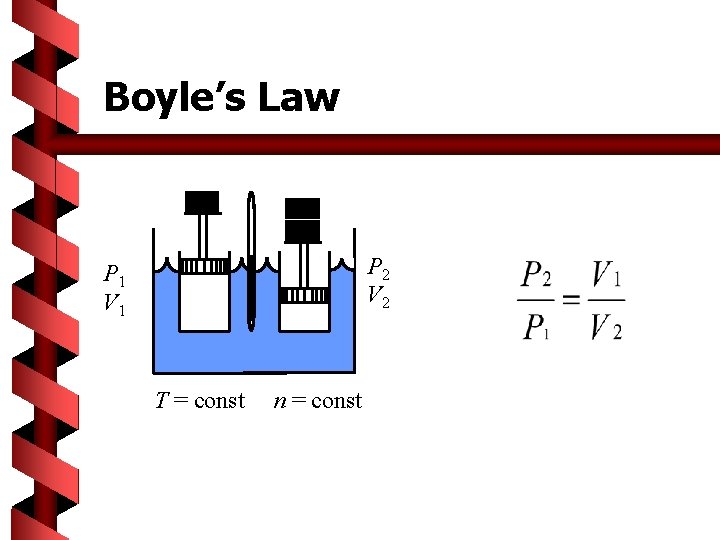
Boyle’s Law P 2 V 2 P 1 V 1 T = const n = const
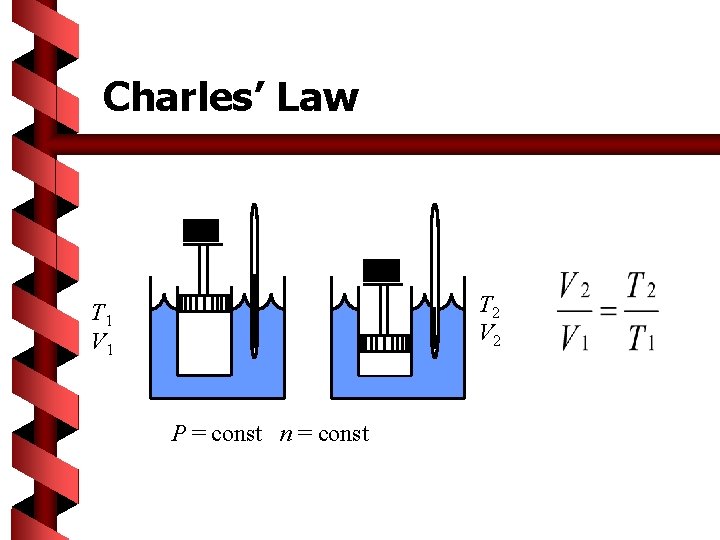
Charles’ Law T 2 V 2 T 1 V 1 P = const n = const
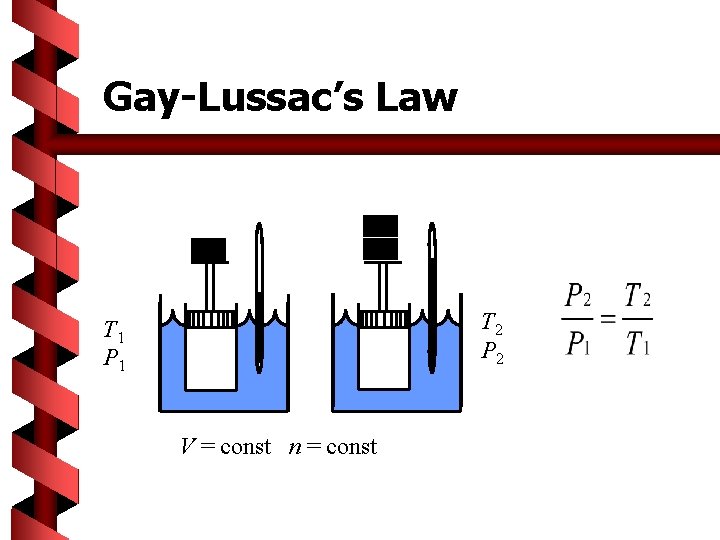
Gay-Lussac’s Law T 2 P 2 T 1 P 1 V = const n = const
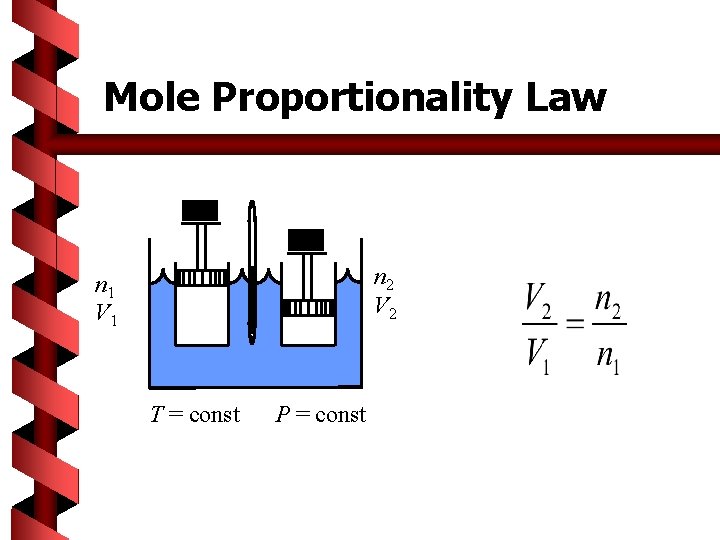
Mole Proportionality Law n 2 V 2 n 1 V 1 T = const P = const
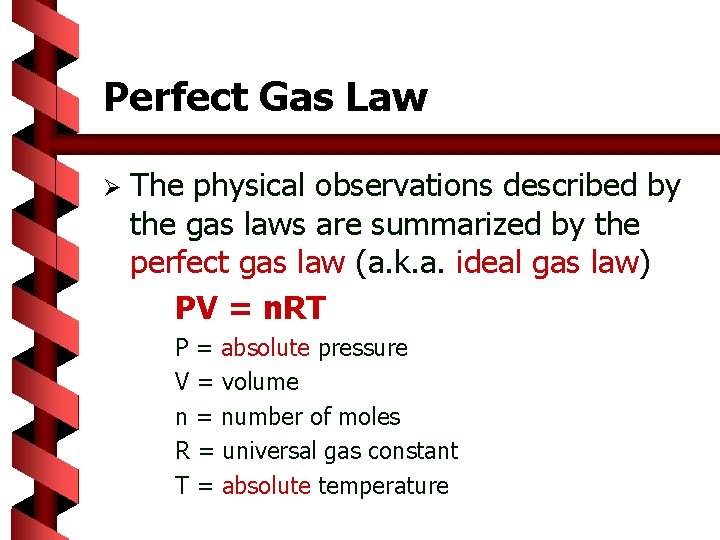
Perfect Gas Law Ø The physical observations described by the gas laws are summarized by the perfect gas law (a. k. a. ideal gas law) PV = n. RT P = absolute pressure V = volume n = number of moles R = universal gas constant T = absolute temperature
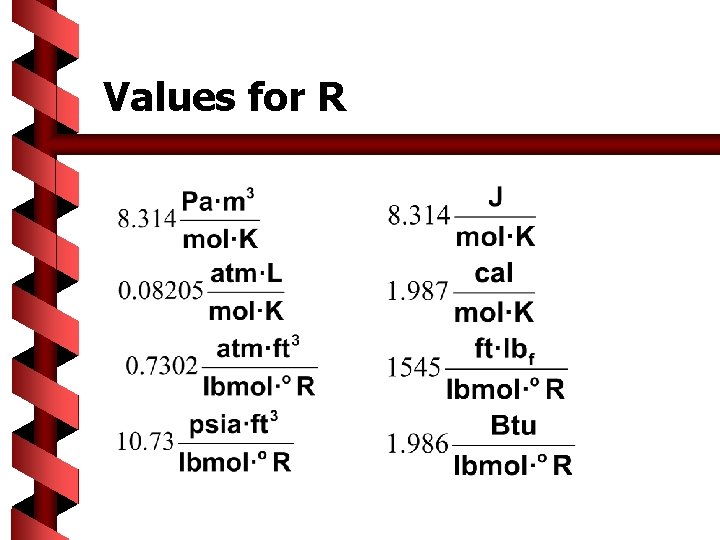
Values for R
Pair Exercise 2 A balloon is filled with air to a pressure of 1. 1 atm. The filled balloon has a diameter of 0. 3 m. Ø A diver takes the balloon underwater to a depth where the pressure in the balloon is 2. 3 atm. Ø If the temperature of the balloon does not change, what is the new diameter of the balloon? Ø
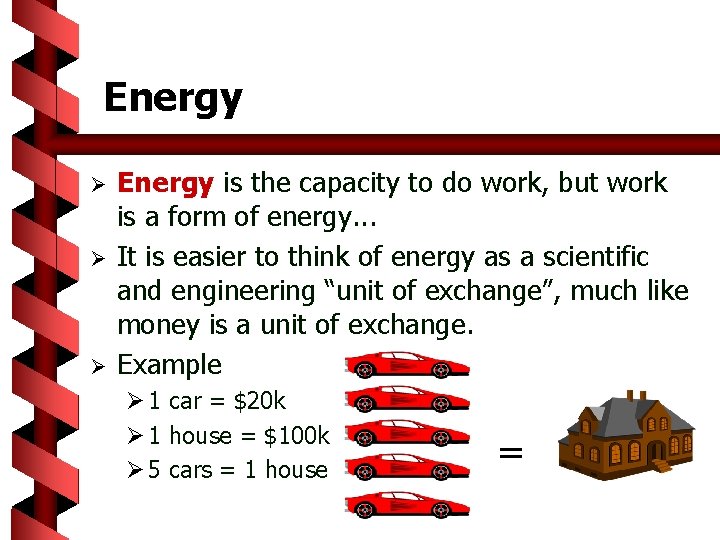
Energy Ø Ø Ø Energy is the capacity to do work, but work is a form of energy. . . It is easier to think of energy as a scientific and engineering “unit of exchange”, much like money is a unit of exchange. Example Ø 1 car = $20 k Ø 1 house = $100 k Ø 5 cars = 1 house =
Energy Equivalents A case for nuclear power? Ø 1 kg coal = 42, 000 joules Ø 1 kg uranium = 82, 000, 000 joules (82 x 1012) Ø 1 kg uranium = 2, 000 kg coal!!
Heat is the energy flow resulting from a temperature difference. Ø NOTE: HEAT AND TEMPERATURE ARE NOT THE SAME! Ø
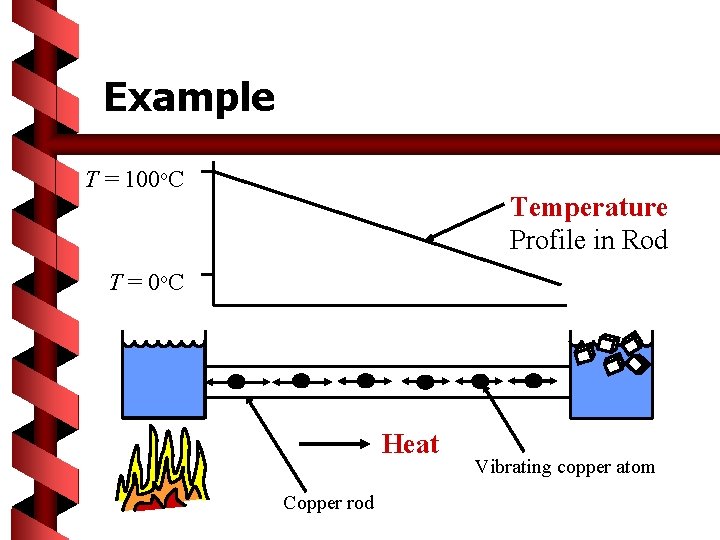
Example T = 100 o. C Temperature Profile in Rod T = 0 o. C Heat Copper rod Vibrating copper atom
Work Heat flows due to a temperature “driving force” Ø Work is the energy flow from any other driving force Ø
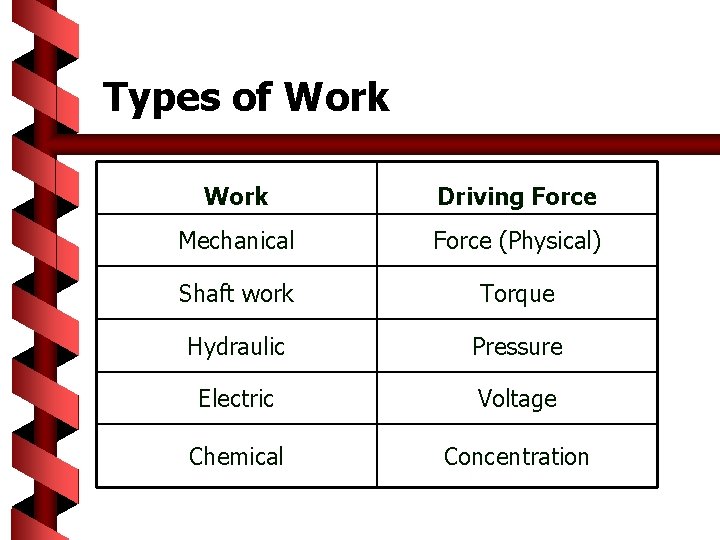
Types of Work Driving Force Mechanical Force (Physical) Shaft work Torque Hydraulic Pressure Electric Voltage Chemical Concentration
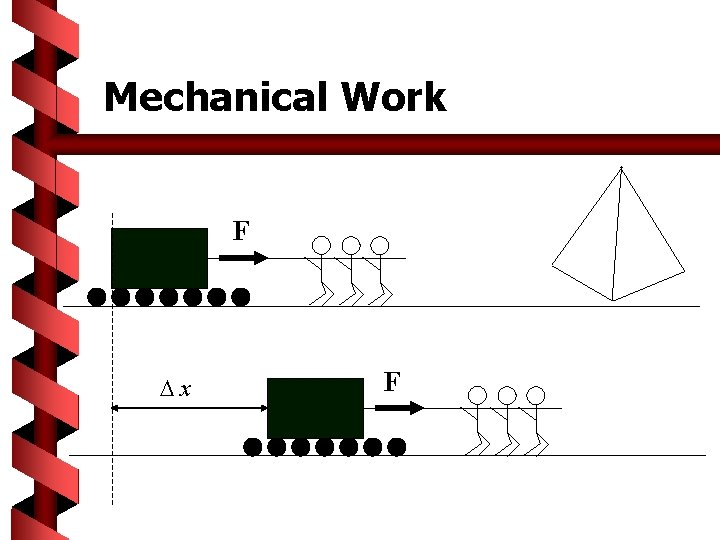
Mechanical Work F Dx F
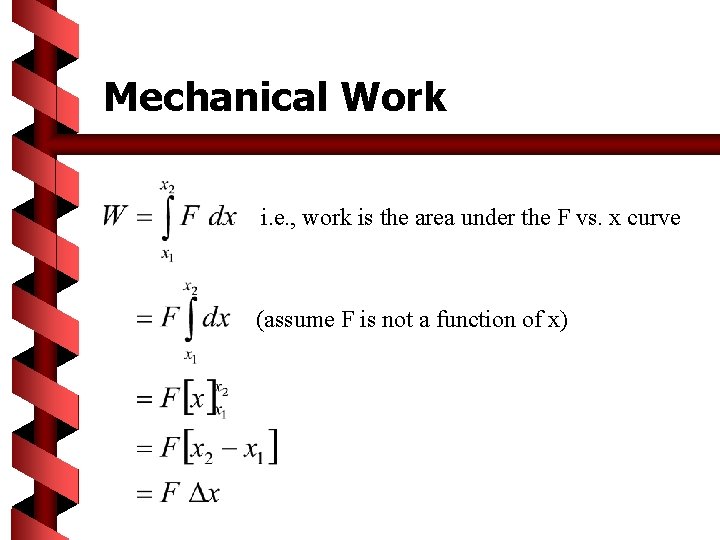
Mechanical Work i. e. , work is the area under the F vs. x curve (assume F is not a function of x)
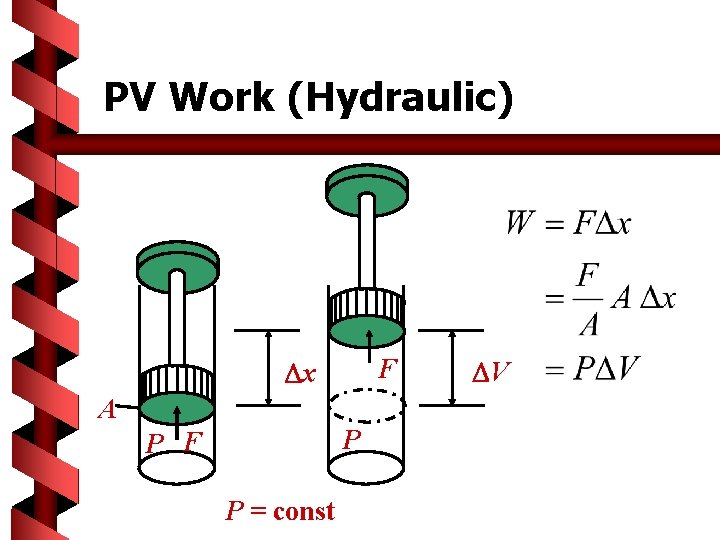
PV Work (Hydraulic) F Dx A P P F P = const DV
Pair Exercise 3 An ideal gas is contained in a closed system. Under constant pressure, the container is compressed from V 1 to V 2 (volume). Derive the equation for work in terms of the universal gas constant and temperature.
- Slides: 29