
THERMOCHEMISTRY Thermodynamics The study of Heat and Work
- Slides: 30
THERMOCHEMISTRY Thermodynamics The study of Heat and Work and State Functions Chemical Thermodynamics
Energy & Chemistry ENERGY is the capacity to do work or transfer heat. HEAT is the form of energy that flows between 2 objects because of their difference in temperature. Other forms of energy — • light • electrical • kinetic and potential Chemical Thermodynamics
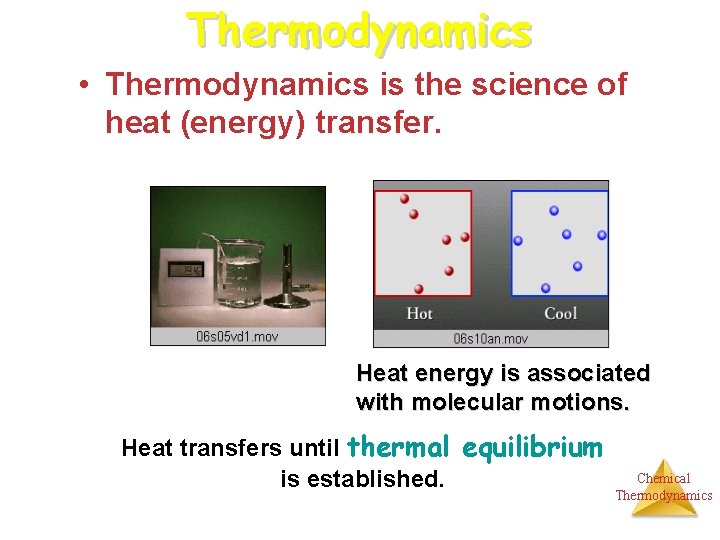
Thermodynamics • Thermodynamics is the science of heat (energy) transfer. Heat energy is associated with molecular motions. Heat transfers until thermal equilibrium is established. Chemical Thermodynamics
Thermochemistry System: A part of the universe which is under observation is called the system OR The part of the world in which we have interest. e. g. reaction vessel, calorimeter, and so on. Surroundings: The remaining portion of the universe which is not a part of the system is called the surroundings. e. g. rooms, buildings around etc. Open system: A type of system in which both mass and energy can move (enter or exit) freely. Example: a reaction vessel, or a beaker with Chemical reagents. Thermodynamics
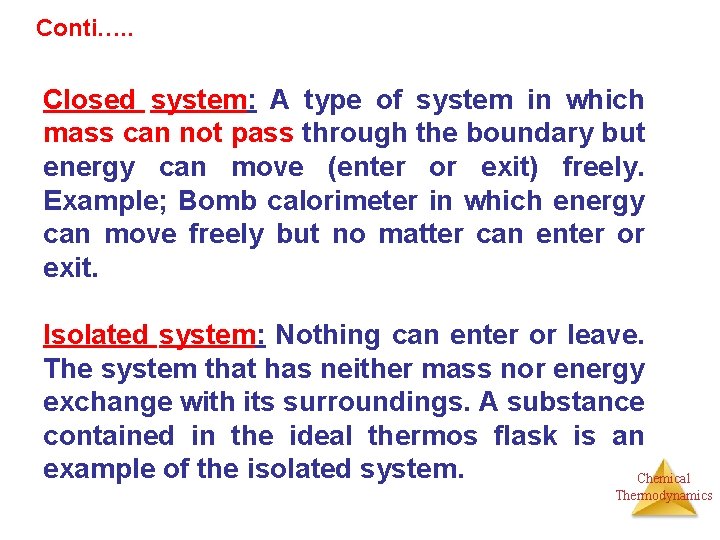
Conti…. . Closed system: A type of system in which mass can not pass through the boundary but energy can move (enter or exit) freely. Example; Bomb calorimeter in which energy can move freely but no matter can enter or exit. Isolated system: Nothing can enter or leave. The system that has neither mass nor energy exchange with its surroundings. A substance contained in the ideal thermos flask is an example of the isolated system. Chemical Thermodynamics
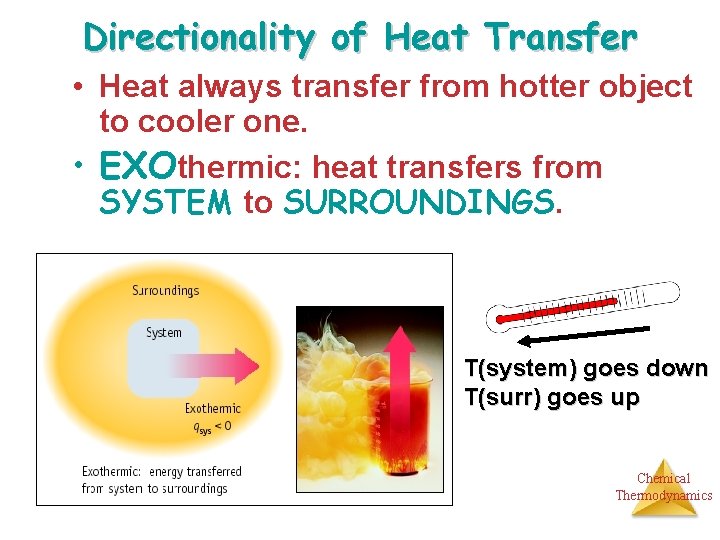
Directionality of Heat Transfer • Heat always transfer from hotter object to cooler one. • EXOthermic: heat transfers from SYSTEM to SURROUNDINGS. T(system) goes down T(surr) goes up Chemical Thermodynamics
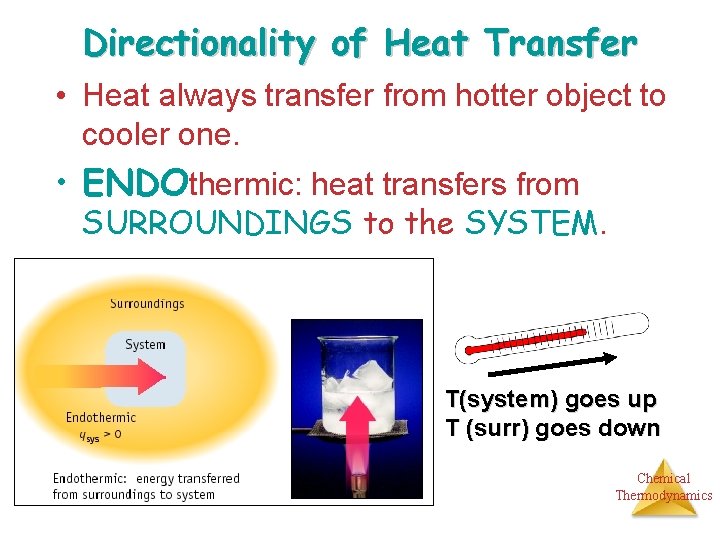
Directionality of Heat Transfer • Heat always transfer from hotter object to cooler one. • ENDOthermic: heat transfers from SURROUNDINGS to the SYSTEM. T(system) goes up T (surr) goes down Chemical Thermodynamics
Chemical Thermodynamics The chemistry that deals with the energy and entropy changes and the spontaneity of a chemical process. First Law of Thermodynamics “Energy cannot be created nor destroyed. Therefore, the total energy of the universe is a constant”. Energy can, however, be converted from one form to another or transferred from a system to the surroundings or vice versa. Chemical Thermodynamics
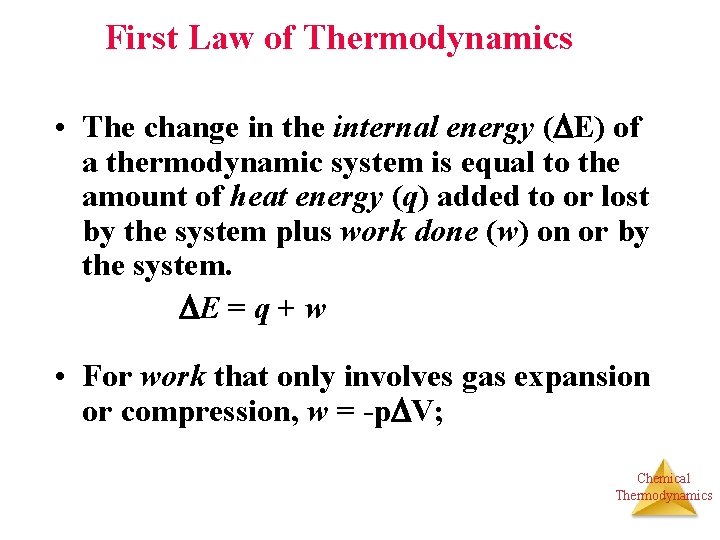
First Law of Thermodynamics • The change in the internal energy ( E) of a thermodynamic system is equal to the amount of heat energy (q) added to or lost by the system plus work done (w) on or by the system. E = q + w • For work that only involves gas expansion or compression, w = -p V; Chemical Thermodynamics
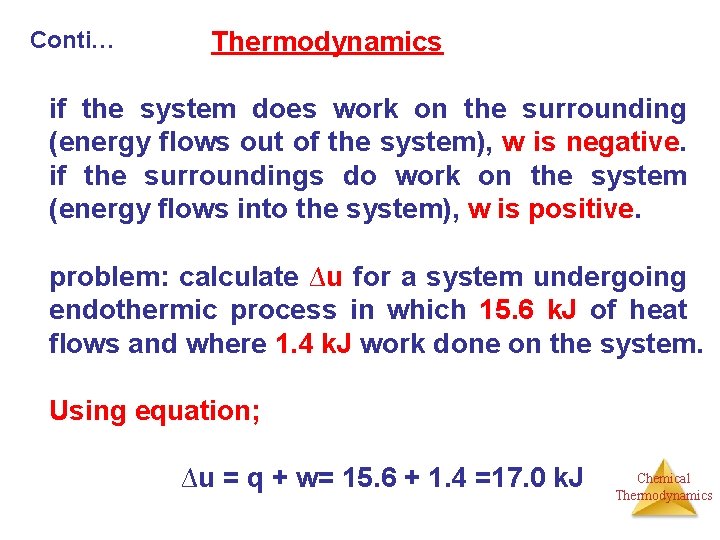
Conti… Thermodynamics if the system does work on the surrounding (energy flows out of the system), w is negative. if the surroundings do work on the system (energy flows into the system), w is positive. problem: calculate ∆u for a system undergoing endothermic process in which 15. 6 k. J of heat flows and where 1. 4 k. J work done on the system. Using equation; ∆u = q + w= 15. 6 + 1. 4 =17. 0 k. J Chemical Thermodynamics
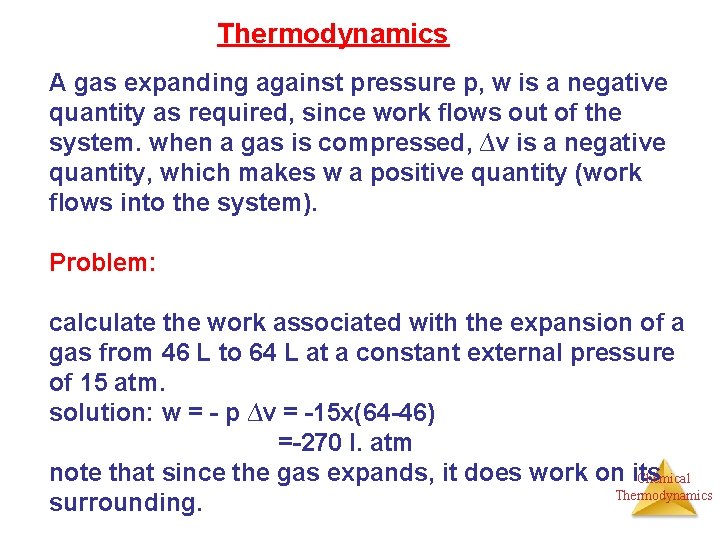
Thermodynamics A gas expanding against pressure p, w is a negative quantity as required, since work flows out of the system. when a gas is compressed, ∆v is a negative quantity, which makes w a positive quantity (work flows into the system). Problem: calculate the work associated with the expansion of a gas from 46 L to 64 L at a constant external pressure of 15 atm. solution: w = - p ∆v = -15 x(64 -46) =-270 l. atm note that since the gas expands, it does work on its Chemical Thermodynamics surrounding.
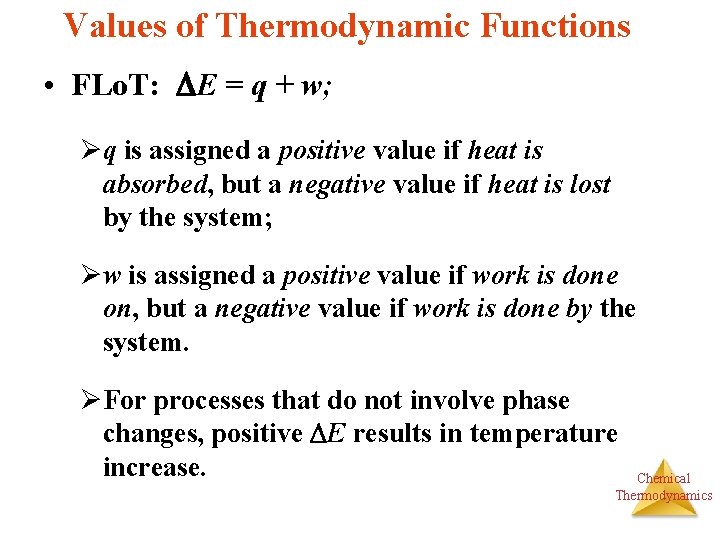
Values of Thermodynamic Functions • FLo. T: E = q + w; Øq is assigned a positive value if heat is absorbed, but a negative value if heat is lost by the system; Øw is assigned a positive value if work is done on, but a negative value if work is done by the system. ØFor processes that do not involve phase changes, positive E results in temperature increase. Chemical Thermodynamics
Second Law of Thermodynamics • Energy tends to flow from a high energy concentration to a dispersed energy state; • Energy dispersion or diffusion is a spontaneous process. • Dispersed or diffused energy is called entropy • According to SLo. T, a process/reaction is spontaneous if the entropy of the universe (system + surrounding) increases. Chemical Thermodynamics
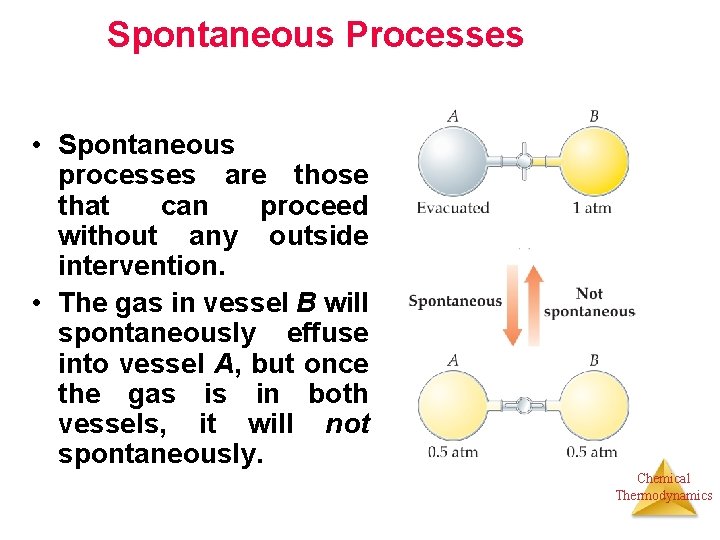
Spontaneous Processes • Spontaneous processes are those that can proceed without any outside intervention. • The gas in vessel B will spontaneously effuse into vessel A, but once the gas is in both vessels, it will not spontaneously. Chemical Thermodynamics
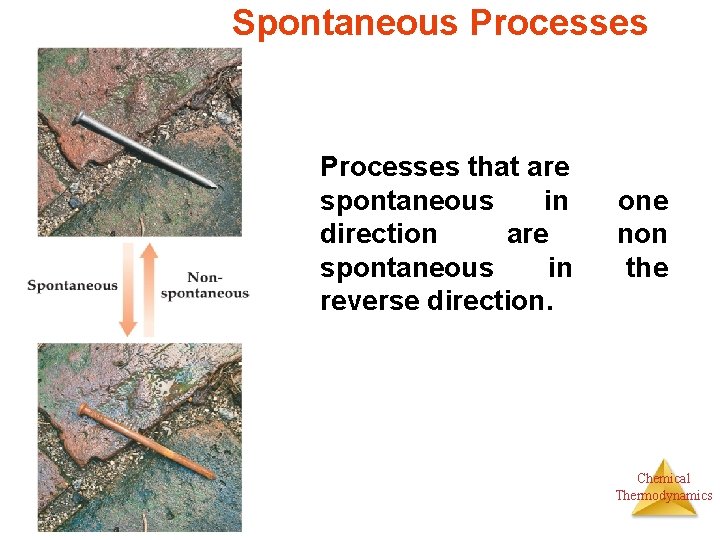
Spontaneous Processes that are spontaneous in direction are spontaneous in reverse direction. one non the Chemical Thermodynamics
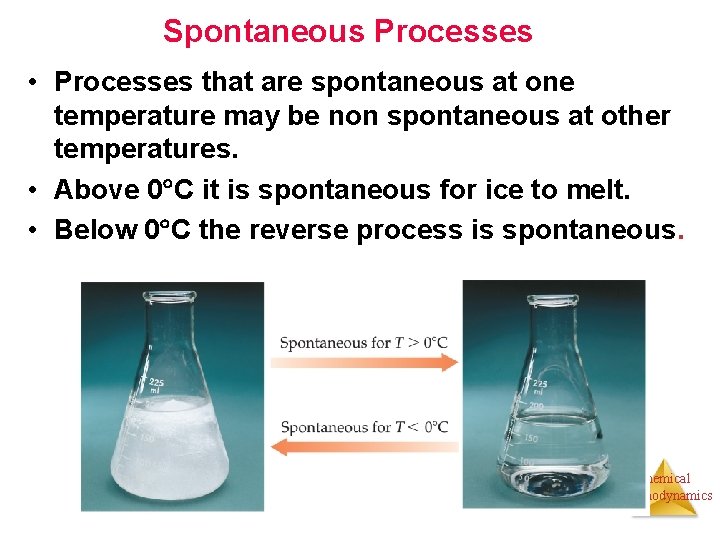
Spontaneous Processes • Processes that are spontaneous at one temperature may be non spontaneous at other temperatures. • Above 0 C it is spontaneous for ice to melt. • Below 0 C the reverse process is spontaneous. Chemical Thermodynamics
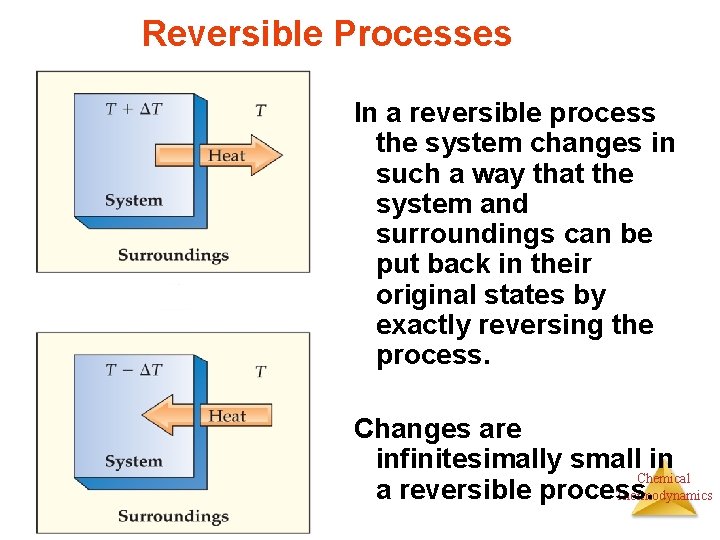
Reversible Processes In a reversible process the system changes in such a way that the system and surroundings can be put back in their original states by exactly reversing the process. Changes are infinitesimally small in Chemical a reversible process. Thermodynamics
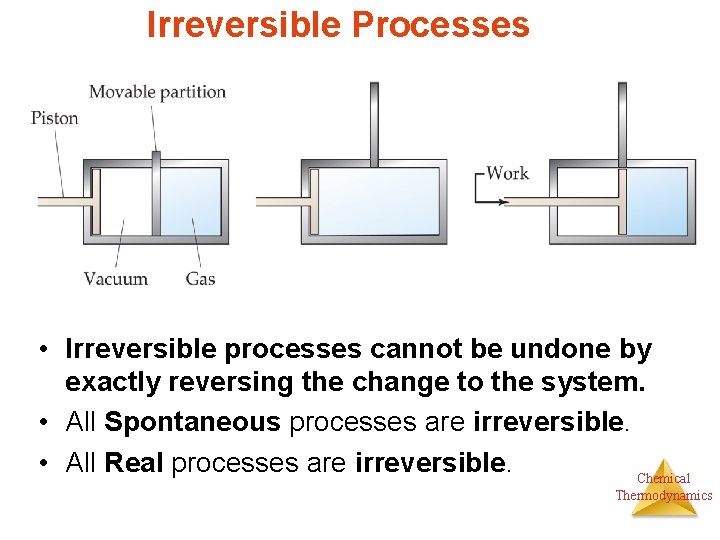
Irreversible Processes • Irreversible processes cannot be undone by exactly reversing the change to the system. • All Spontaneous processes are irreversible. • All Real processes are irreversible. Chemical Thermodynamics
What is Entropy? • A thermodynamic (energy) function that describes the degree of randomness or probability of existence. • As a state function – entropy change depends only on the initial and final states, but not on how the change occurs. Chemical Thermodynamics
What is the significance of entropy? • Nature spontaneously proceeds toward the state that has the highest probability of (energy) existence – highest entropy • Entropy is used to predict whether a given process/reaction is thermodynamically possible; Chemical Thermodynamics
Relative Entropy of Substances • Entropy: Øincreases from solid to liquid to vapor/gas; Øincreases as temperature increases; Øof gas increases as its volume increases at constant temperature; Øincreases when gases are mixed. Øof elements increases down the group in the periodic table; Øof compound increases as its structure becomes more complex. Chemical Thermodynamics
o Standard Entropy, S • The entropy of a substance in its most stable state at 1 atm and 25 o. C. • The entropy of an ionic species in 1 M solution at 25 o. C. Chemical Thermodynamics
Entropy and Second Law of Thermodynamics • The second law of thermodynamics states that all spontaneous processes are accompanied by increase in the entropy of the universe. ØUniverse = System + Surrounding; ØSystem: the process/reaction whose thermodynamic change is being studied; ØSurrounding: the part of the universe that Chemical interacts with the system. Thermodynamics
Entropy (S) is a term coined by Rudolph Clausius in the 19 th century. Clausius was convinced of the significance of the ratio of heat delivered and the temperature at which it is delivered, S= q T • Entropy can be thought of as a measure of the randomness of a system. • It is related to the various modes of motion in molecules. Chemical Thermodynamics
Third Law of Thermodynamics • The entropy of a perfect crystalline substance is zero at absolute zero temperature (0. 0 K) • Is absolute zero temperature achievable? • -273. 15 o. C. • It is the lowest temperature which is theoretically possible, at which the motion of molecules that constitute heat would be minimum (no thermal energy-they are completely at rest. Chemical Thermodynamics
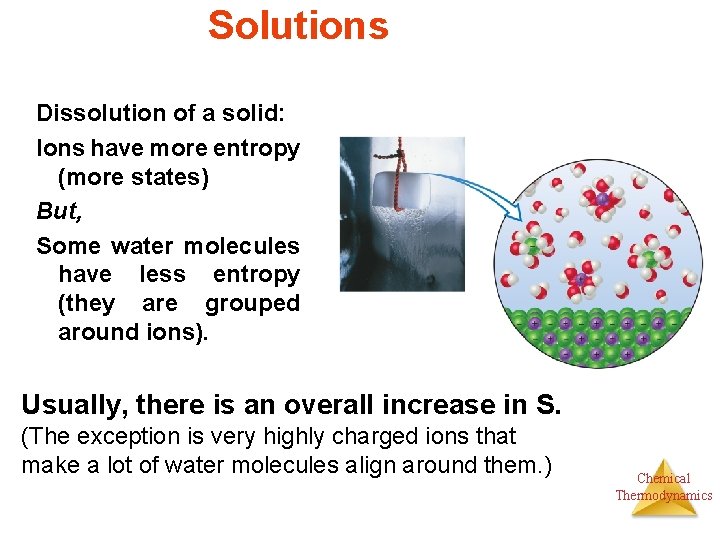
Solutions Dissolution of a solid: Ions have more entropy (more states) But, Some water molecules have less entropy (they are grouped around ions). Usually, there is an overall increase in S. (The exception is very highly charged ions that make a lot of water molecules align around them. ) Chemical Thermodynamics
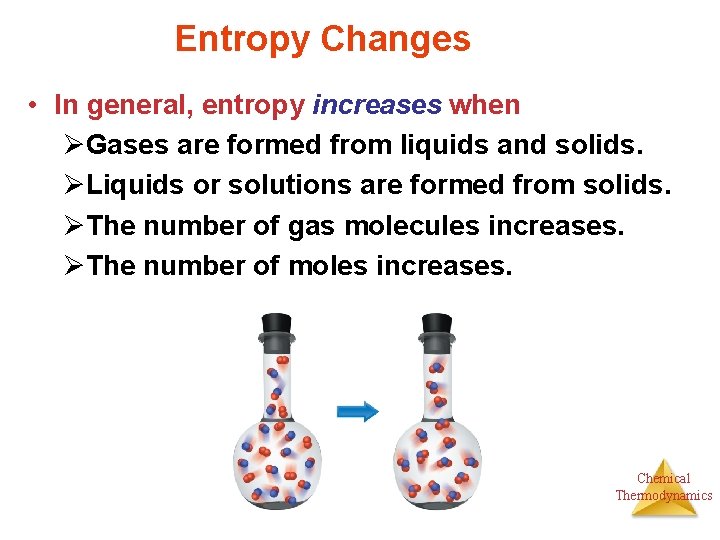
Entropy Changes • In general, entropy increases when ØGases are formed from liquids and solids. ØLiquids or solutions are formed from solids. ØThe number of gas molecules increases. ØThe number of moles increases. Chemical Thermodynamics
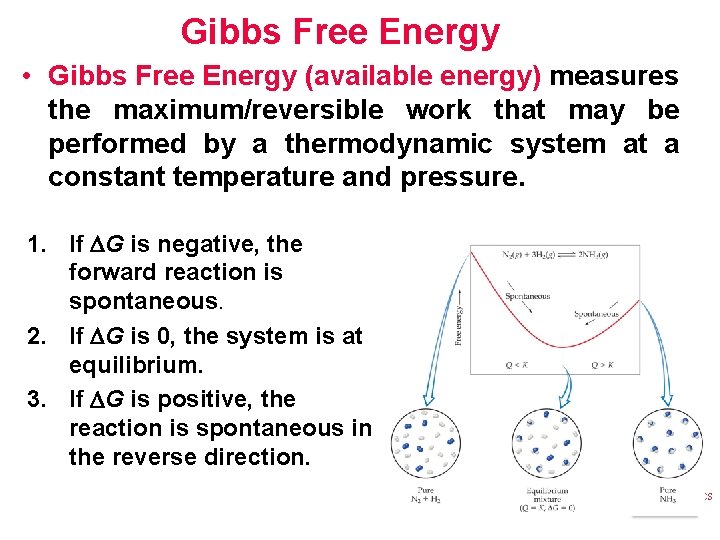
Gibbs Free Energy • Gibbs Free Energy (available energy) measures the maximum/reversible work that may be performed by a thermodynamic system at a constant temperature and pressure. 1. If G is negative, the forward reaction is spontaneous. 2. If G is 0, the system is at equilibrium. 3. If G is positive, the reaction is spontaneous in the reverse direction. Chemical Thermodynamics
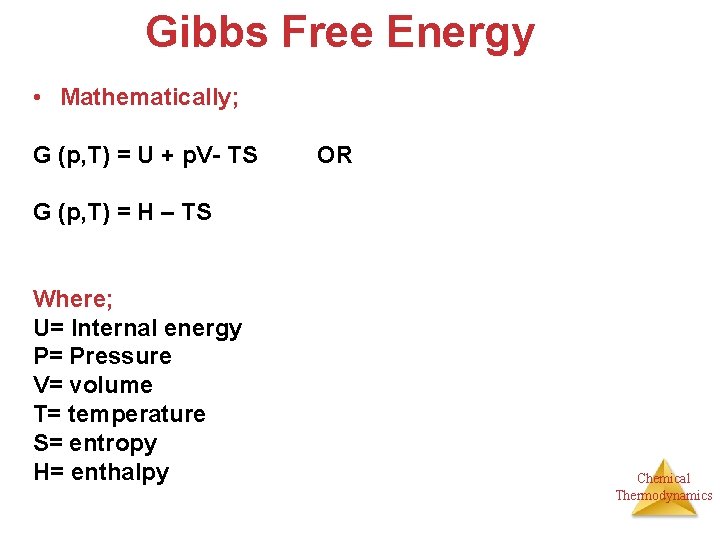
Gibbs Free Energy • Mathematically; G (p, T) = U + p. V- TS OR G (p, T) = H – TS Where; U= Internal energy P= Pressure V= volume T= temperature S= entropy H= enthalpy Chemical Thermodynamics
THE END Chemical Thermodynamics