
Thermochemistry Potential Energy Diagrams Rates of Reactions Enthalpy

- Slides: 18
Thermochemistry Potential Energy Diagrams Rates of Reactions
Enthalpy Changes • Chemists and scientists are most interested in the change of energy in a reaction, not necessarily how much total energy is left at the end. This is referred to as ΔH, or enthalpy. • Δ is the Greek letter “delta” and means “change” • H refers to “heat” or “energy” • Measured in k. J, or kilojoules (pronounced “kilo-jewels”) • You can have a ΔH for phase changes as well as chemical reactions, because heat can be transferred in BOTH.
Endothermic or Exothermic? • Endothermic means that heat/energy is gained or absorbed …………. so the ΔH would be positive This means a positive change in enthalpy • Examples: baking bread, cooking an egg, photosynthesis • Exothermic means that heat/energy is released or lost …………. so the ΔH would be negative This means a negative change in enthalpy • Examples: burning a candle, rusting iron, nuclear fission
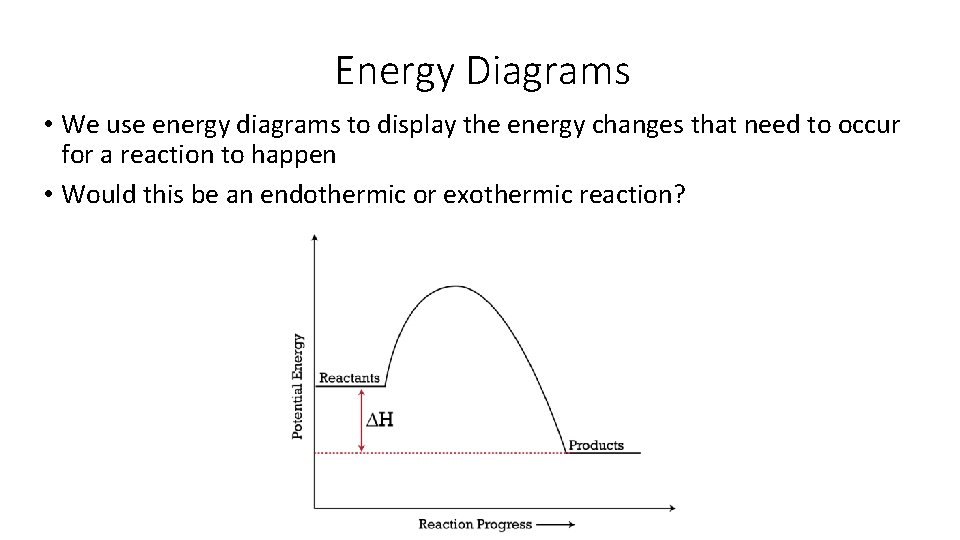
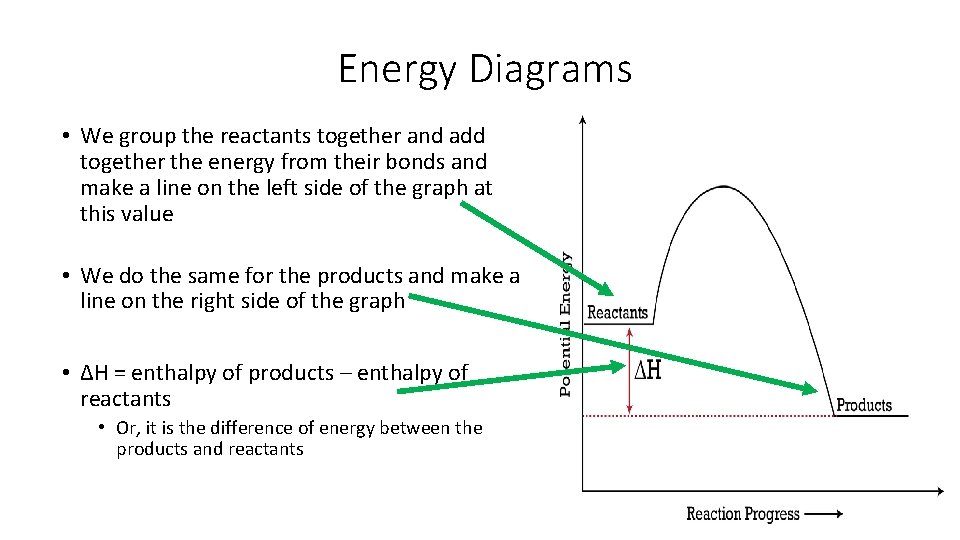
Energy Diagrams • We use energy diagrams to display the energy changes that need to occur for a reaction to happen • Would this be an endothermic or exothermic reaction?
Energy Diagrams • We group the reactants together and add together the energy from their bonds and make a line on the left side of the graph at this value • We do the same for the products and make a line on the right side of the graph • ΔH = enthalpy of products – enthalpy of reactants • Or, it is the difference of energy between the products and reactants
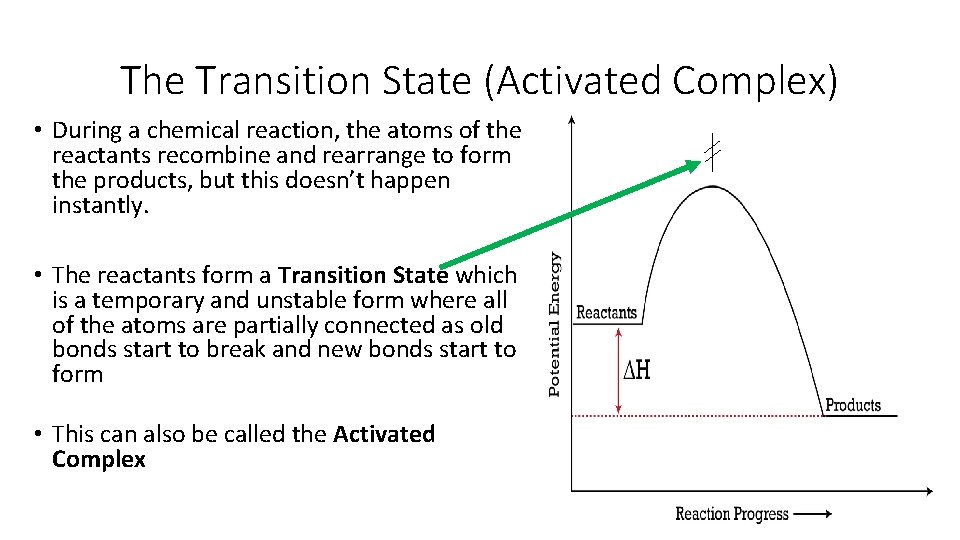
The Transition State (Activated Complex) • During a chemical reaction, the atoms of the reactants recombine and rearrange to form the products, but this doesn’t happen instantly. • The reactants form a Transition State which is a temporary and unstable form where all of the atoms are partially connected as old bonds start to break and new bonds start to form • This can also be called the Activated Complex
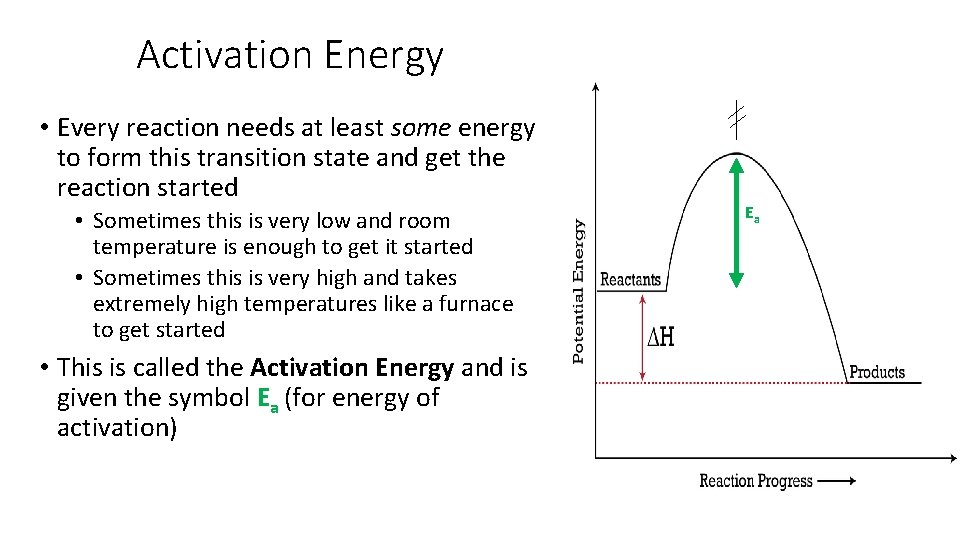
Activation Energy • Every reaction needs at least some energy to form this transition state and get the reaction started • Sometimes this is very low and room temperature is enough to get it started • Sometimes this is very high and takes extremely high temperatures like a furnace to get started • This is called the Activation Energy and is given the symbol Ea (for energy of activation) Ea
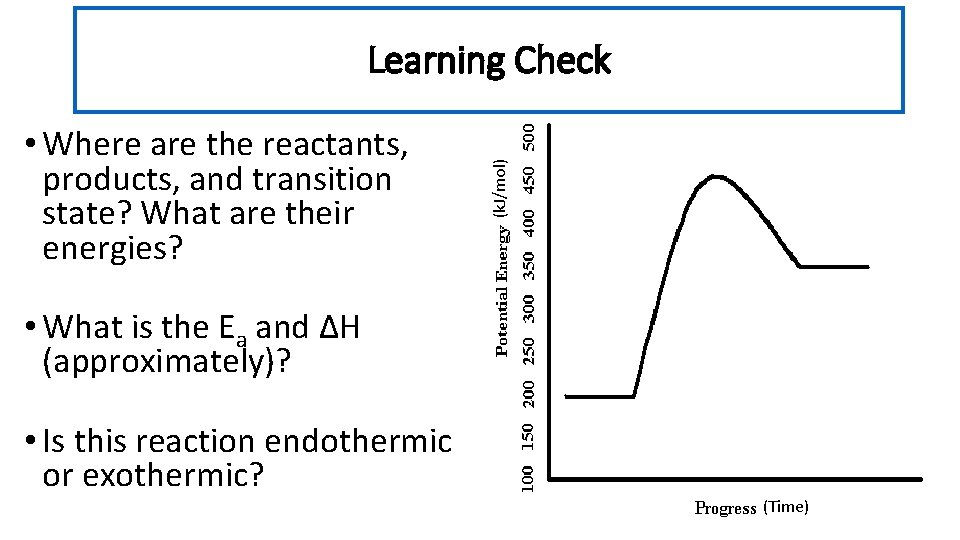
• Where are the reactants, products, and transition state? What are their energies? (k. J/mol) Learning Check • What is the Ea and ΔH (approximately)? • Is this reaction endothermic or exothermic? (Time)
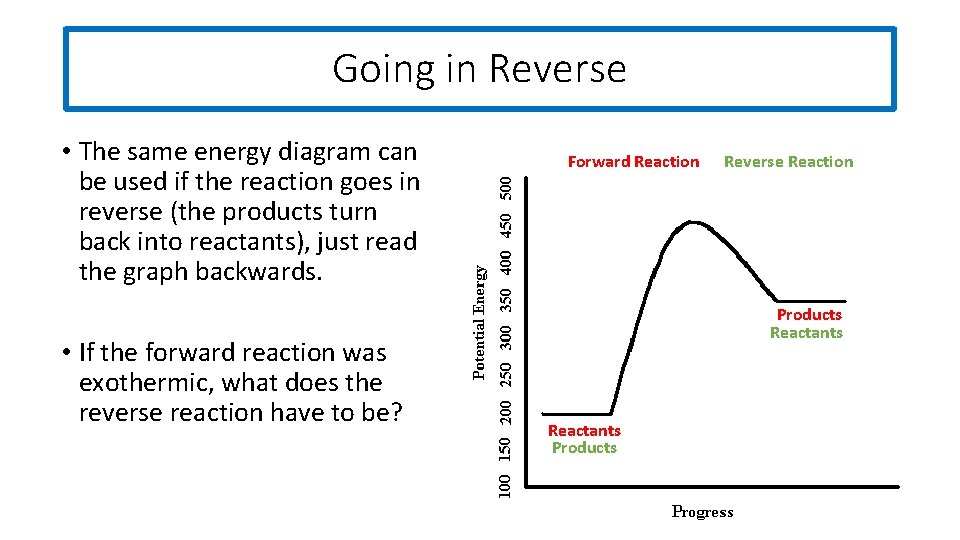
Going in Reverse • The same energy diagram can be used if the reaction goes in reverse (the products turn back into reactants), just read the graph backwards. • If the forward reaction was exothermic, what does the reverse reaction have to be? Forward Reaction Reverse Reaction Products Reactants Products
Speeding up Reactions Discuss: What can be done to a reaction to make it go faster? Gizmo. Yo.
Factors that affect the speed of reaction: The following actions speed up the rate of reactions because they increase collisions! • Temperature • By adding heat, reactants move faster and have more energy to start with. This means that collisions are more likely to be successful because they are closer to reaching the activation energy • Concentration • More chemicals in the reaction means it is more likely they will collide for a reaction.
Factors that affect the speed of reaction • Stirring/Agitation • By stirring a reaction, you are increasing the amount of contact that the different reactants have with each other, making it more likely to collide and react • Surface Area • Reactions can only happen on the surface of a solid where two reactants can collide. By increasing the surface area by using small particles or powder, there is more surface to react.
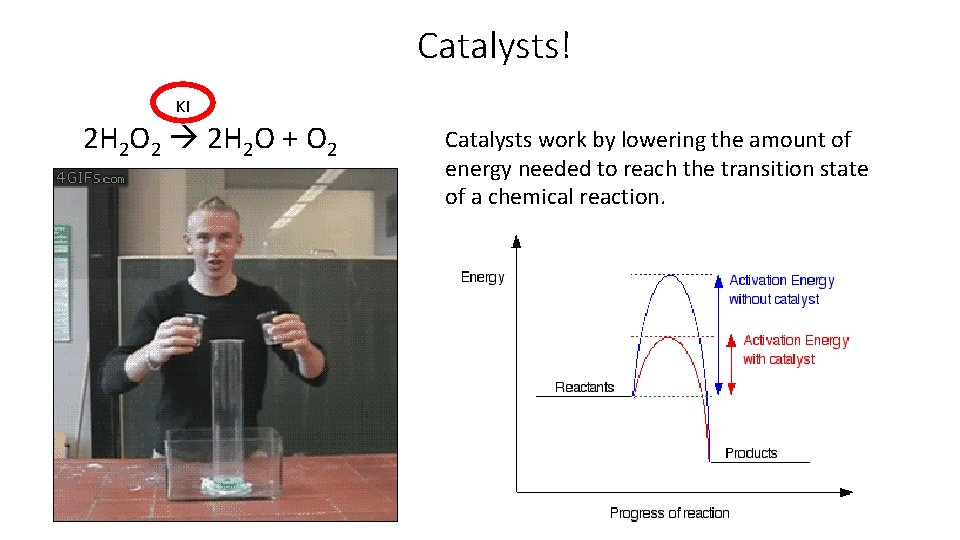
And…. . Catalysts! A catalyst is a substance that speeds up a reaction • It does this by lowering the activation energy of a chemical reaction. A catalyst is never changed, or never used up. • Think of it as a tool (like a pipette) Each catalyst has ONE SPECIFIC JOB. • Each catalyst can only be used for a single purpose (like a lock and key). This is incredibly important in biological functions and medicine! Catalysts do not affect the ΔH of the reaction since the energy of the reactants and product doesn’t change.
Catalysts! KI 2 H 2 O 2 2 H 2 O + O 2 Catalysts work by lowering the amount of energy needed to reach the transition state of a chemical reaction.
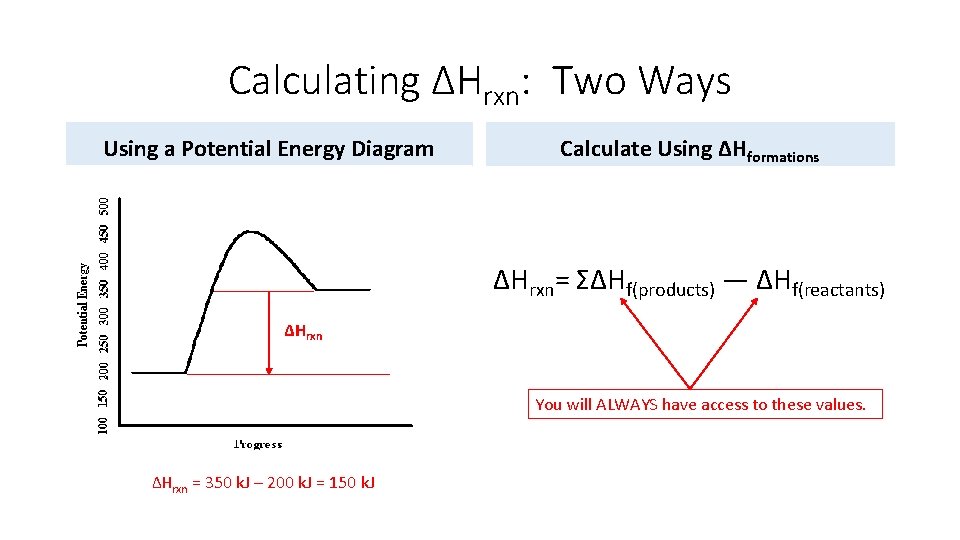
Calculating ΔHrxn: Two Ways Using a Potential Energy Diagram Calculate Using ΔHformations ΔHrxn= ΣΔHf(products) — ΔHf(reactants) ΔHrxn You will ALWAYS have access to these values. ΔHrxn = 350 k. J – 200 k. J = 150 k. J
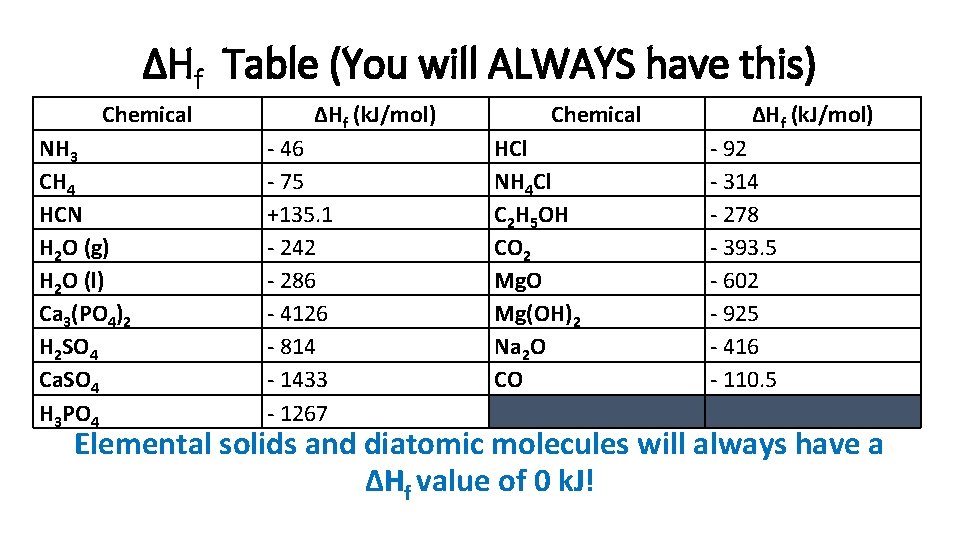
ΔHf Table (You will ALWAYS have this) Chemical NH 3 CH 4 HCN H 2 O (g) H 2 O (l) Ca 3(PO 4)2 H 2 SO 4 Ca. SO 4 H 3 PO 4 ΔHf (k. J/mol) - 46 - 75 +135. 1 - 242 - 286 - 4126 - 814 - 1433 - 1267 Chemical HCl NH 4 Cl C 2 H 5 OH CO 2 Mg. O Mg(OH)2 Na 2 O CO ΔHf (k. J/mol) - 92 - 314 - 278 - 393. 5 - 602 - 925 - 416 - 110. 5 Elemental solids and diatomic molecules will always have a ΔHf value of 0 k. J!
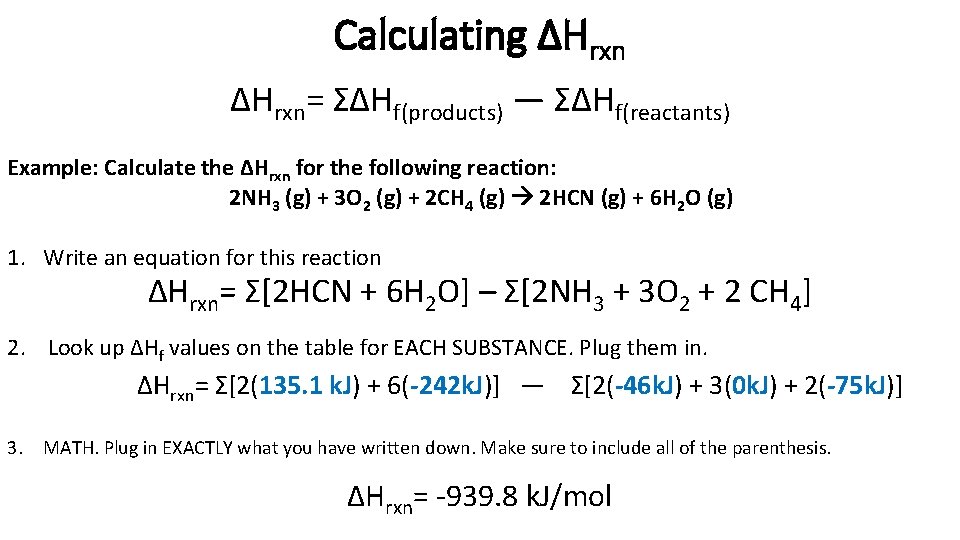
Calculating ΔHrxn= ΣΔHf(products) — ΣΔHf(reactants) Example: Calculate the ΔHrxn for the following reaction: 2 NH 3 (g) + 3 O 2 (g) + 2 CH 4 (g) 2 HCN (g) + 6 H 2 O (g) 1. Write an equation for this reaction ΔHrxn= Σ[2 HCN + 6 H 2 O] – Σ[2 NH 3 + 3 O 2 + 2 CH 4] 2. Look up ΔHf values on the table for EACH SUBSTANCE. Plug them in. ΔHrxn= Σ[2(135. 1 k. J) + 6(-242 k. J)] — Σ[2(-46 k. J) + 3(0 k. J) + 2(-75 k. J)] 3. MATH. Plug in EXACTLY what you have written down. Make sure to include all of the parenthesis. ΔHrxn= -939. 8 k. J/mol
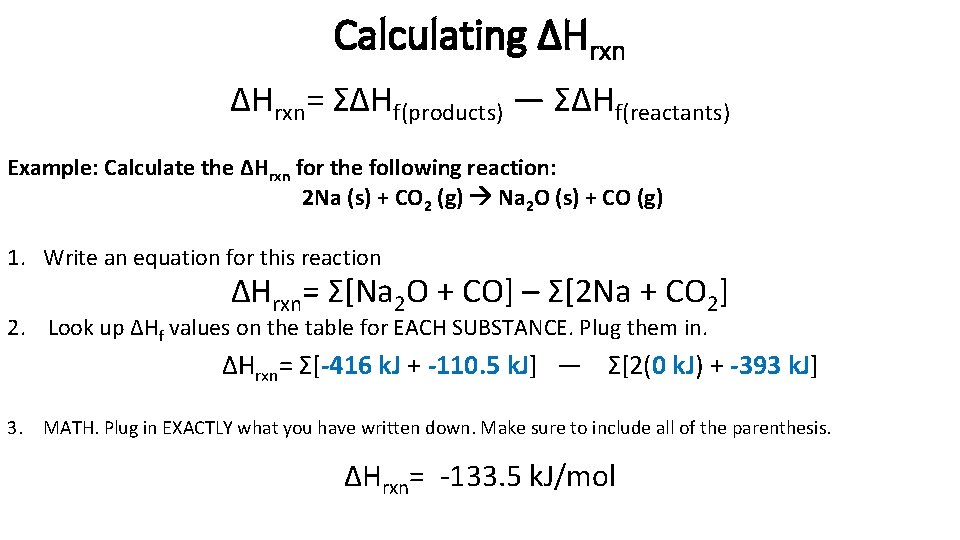
Calculating ΔHrxn= ΣΔHf(products) — ΣΔHf(reactants) Example: Calculate the ΔHrxn for the following reaction: 2 Na (s) + CO 2 (g) Na 2 O (s) + CO (g) 1. Write an equation for this reaction ΔHrxn= Σ[Na 2 O + CO] – Σ[2 Na + CO 2] 2. Look up ΔHf values on the table for EACH SUBSTANCE. Plug them in. ΔHrxn= Σ[-416 k. J + -110. 5 k. J] — Σ[2(0 k. J) + -393 k. J] 3. MATH. Plug in EXACTLY what you have written down. Make sure to include all of the parenthesis. ΔHrxn= -133. 5 k. J/mol