
THERMO ANALYTICAL METHODS what is thermal analysis In


- Slides: 54
THERMO ANALYTICAL METHODS what is thermal analysis? Ø In thermal analysis substances are heated they undergo physical and chemical changes. These changes are recorded as a function of time or temperature. Ø The two important thermal analyses are Ø 1. Thermogravimetric analysis Ø 2. Differential thermal analysis.
principle involved in thermo gravimetric analysis v The substance is heated or cooled in a given environment at a controlled rate. The weight of the substance is recorded as a function of time or temperature. v. A graph is plotted between weight change and temperature or time v. We get a thermogravimetric curve or TG curve or thermogram. v on heating a substance various physical and chemical bonds are formed or broken resulting in a change in weight. v A weight loss indicates the formation and a subsequent escape of a volatile product or the formation of some other product. 2
principle involved in differential thermal analysis ØThe substance to be analysed an inert reference material like αalumina are heated or cooled in a given environment and at a controlled rate. Ø whenever the substances to be analysed undergoes an endothermic change , like when it melts or when it is dehydrated the temperature of the substances will be lower than that of the reference material. ØIf the substance to be analysed undergoes an exothermic change its temperature will be higher than that of the reference material. ØWhen the substance under observation doesnot undergo any heat change, there will be no difference in temperature between the sample and reference material. ØThese temperature difference ∆TS are plotted against temperature. 3
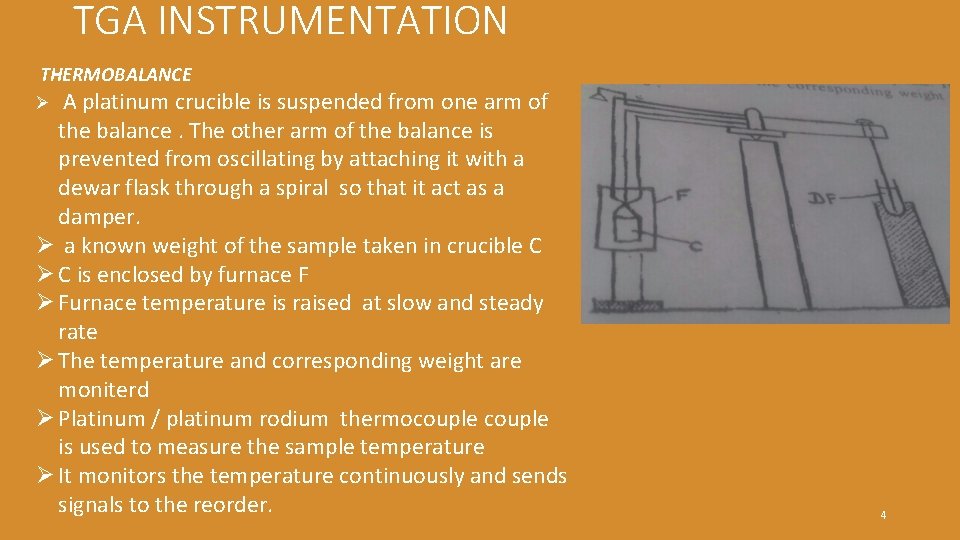
TGA INSTRUMENTATION THERMOBALANCE A platinum crucible is suspended from one arm of the balance. The other arm of the balance is prevented from oscillating by attaching it with a dewar flask through a spiral so that it act as a damper. Ø a known weight of the sample taken in crucible C Ø C is enclosed by furnace F Ø Furnace temperature is raised at slow and steady rate Ø The temperature and corresponding weight are moniterd Ø Platinum / platinum rodium thermocouple is used to measure the sample temperature Ø It monitors the temperature continuously and sends signals to the reorder. Ø 4
• Changes in weight are recorded from the beam deflection with the help of detectors • Detectors contain a sensing element which detects deviation of the balance beam from its null position. • Detectors consists of photocells , a slotted flag connected to the balance arm and lamp. • Any change in sample weight causes balance to rotate. • This moves the flag so that light falling on each photo cell is no longer equal. • The resulting signal is amplified and fed as current to motor to restore the balance to equilibrium. • This current is proportional to the weight change which is recorded by the recoder. 5
In another type of detector , a helical spring is used to detect the weight change. The spring undergoes contraction or elongation with weight change This movement is detected by movement of an attached core in a linear variable differential transformer. RECODER It is device with a pen and graph sheets. It records the weight change in y-axis. It records signals from thermocouple, on the x- axis , we 6
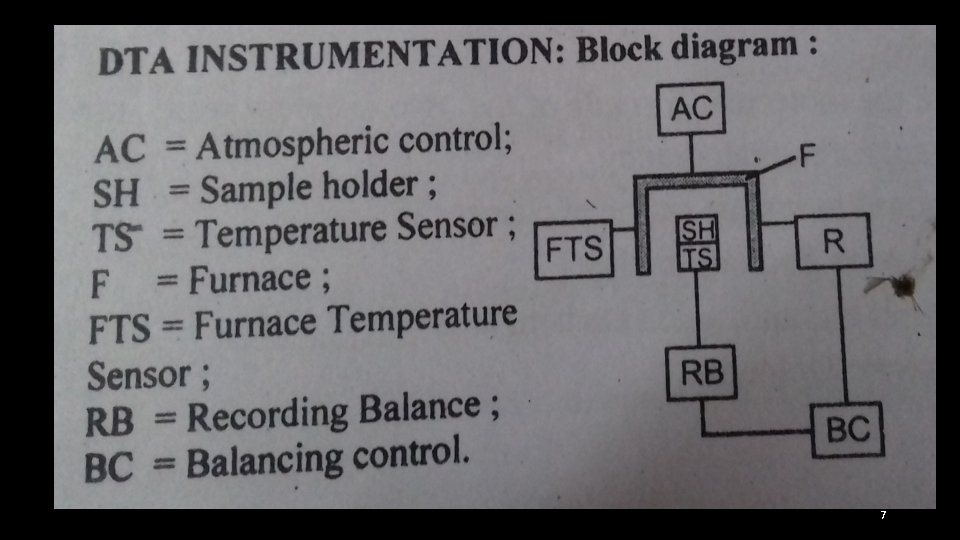
7
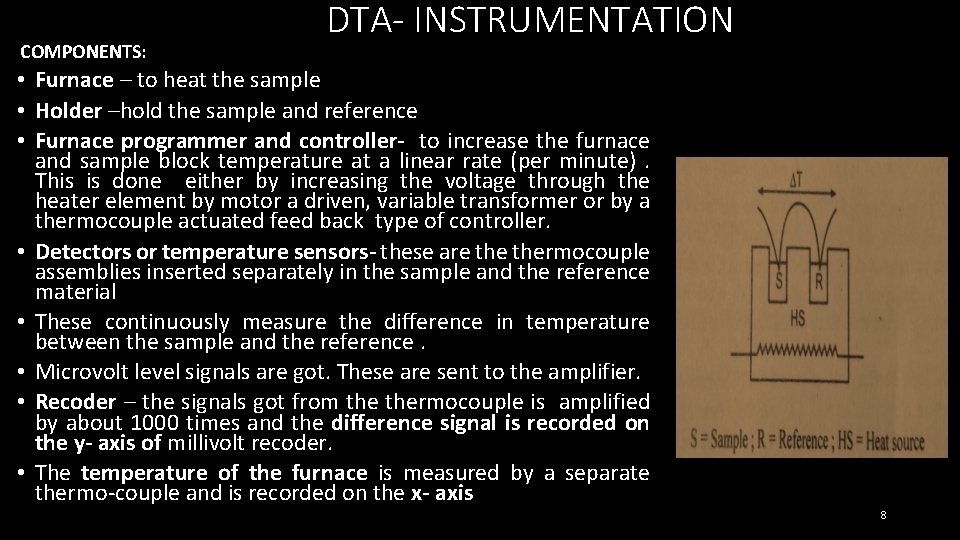
COMPONENTS: DTA- INSTRUMENTATION • Furnace – to heat the sample • Holder –hold the sample and reference • Furnace programmer and controller- to increase the furnace and sample block temperature at a linear rate (per minute). This is done either by increasing the voltage through the heater element by motor a driven, variable transformer or by a thermocouple actuated feed back type of controller. • Detectors or temperature sensors- these are thermocouple assemblies inserted separately in the sample and the reference material • These continuously measure the difference in temperature between the sample and the reference. • Microvolt level signals are got. These are sent to the amplifier. • Recoder – the signals got from thermocouple is amplified by about 1000 times and the difference signal is recorded on the y- axis of millivolt recoder. • The temperature of the furnace is measured by a separate thermo-couple and is recorded on the x- axis 8
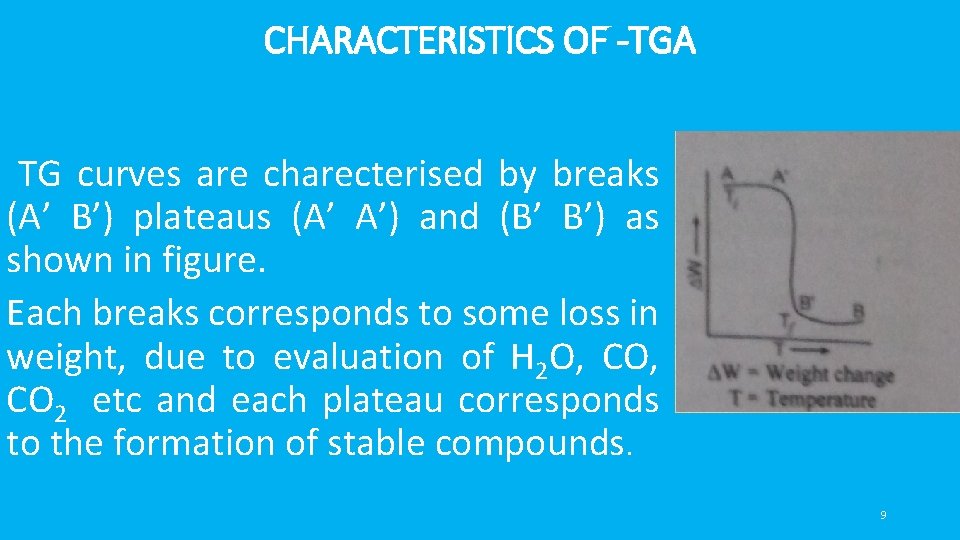
CHARACTERISTICS OF -TGA TG curves are charecterised by breaks (A’ B’) plateaus (A’ A’) and (B’ B’) as shown in figure. • Each breaks corresponds to some loss in weight, due to evaluation of H 2 O, CO 2 etc and each plateau corresponds to the formation of stable compounds. 9
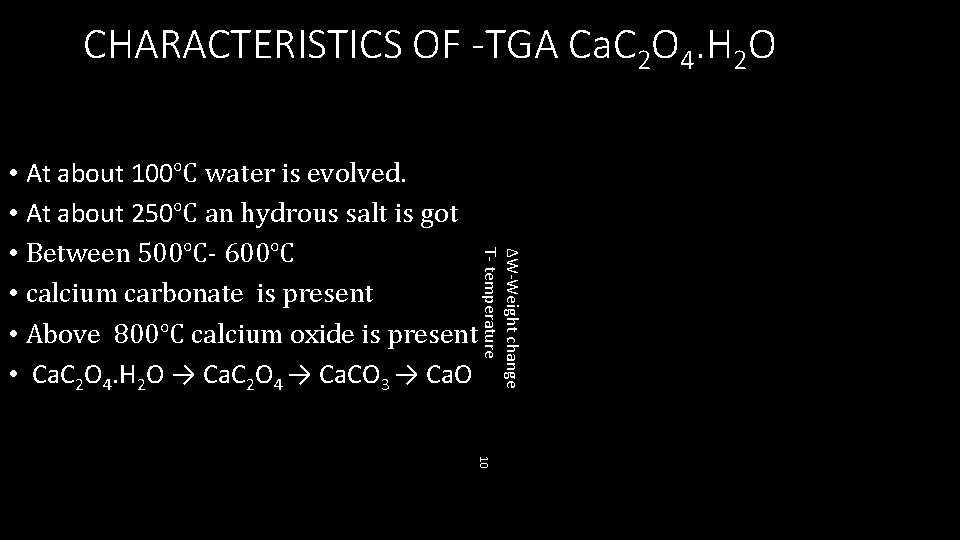
CHARACTERISTICS OF -TGA Ca. C 2 O 4. H 2 O ∆W-Weight change T- temperature • At about 100℃ water is evolved. • At about 250℃ an hydrous salt is got • Between 500℃- 600℃ • calcium carbonate is present • Above 800℃ calcium oxide is present • Ca. C 2 O 4. H 2 O → Ca. C 2 O 4 → Ca. CO 3 → Ca. O 10
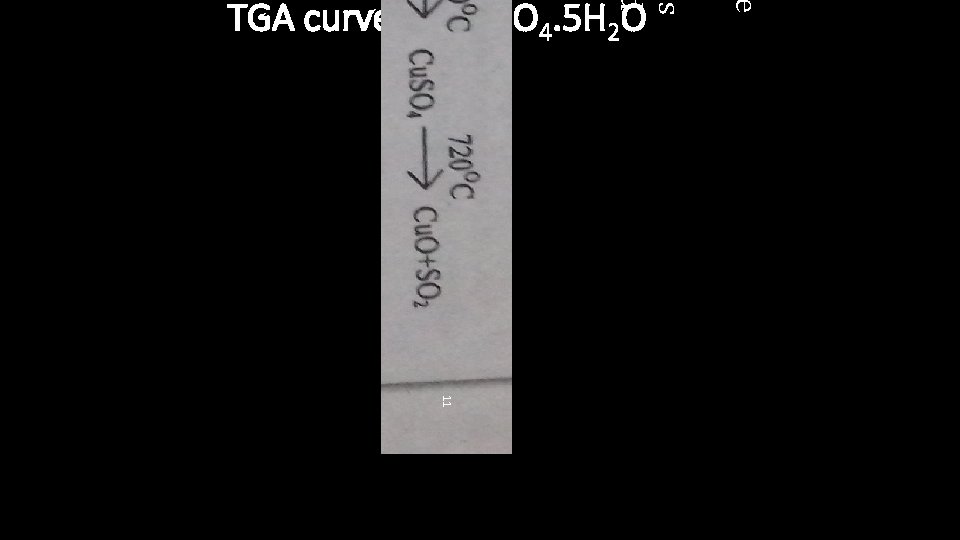
e es d TGA curve of Cu. SO 4. 5 H 2 O 11
APPLICATIONS OF TG - CURVE • The TG curve is quantitative so stoichiometric calculations can be done at any given temperature. • The correct drying temperature of preciptates in gravimetric analysis can be determined. • Thermogravimetry is used to find out suitable analytical standard substances. Eg. , EDTA, Na. F etc • Thermobalance is used to determine the purity of various substances • The following information can be drawn from the TG Curves • The thermal stability of the material can be known. ( from the horizontal portions) • The weight loss, when the sample is heated to a given temperature Is known. This helps to determine the composition of the compound • The thermodynamics kinetics of various chemical reactions , reaction mechanisms and the intermediate and final reaction products can be studied 12
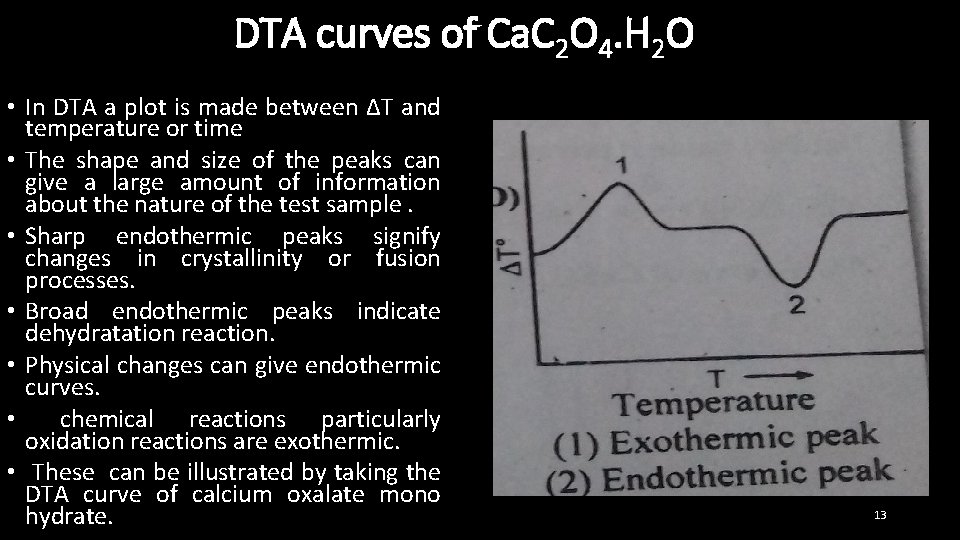
DTA curves of Ca. C 2 O 4. H 2 O • In DTA a plot is made between ∆T and temperature or time • The shape and size of the peaks can give a large amount of information about the nature of the test sample. • Sharp endothermic peaks signify changes in crystallinity or fusion processes. • Broad endothermic peaks indicate dehydratation reaction. • Physical changes can give endothermic curves. • chemical reactions particularly oxidation reactions are exothermic. • These can be illustrated by taking the DTA curve of calcium oxalate mono hydrate. 13
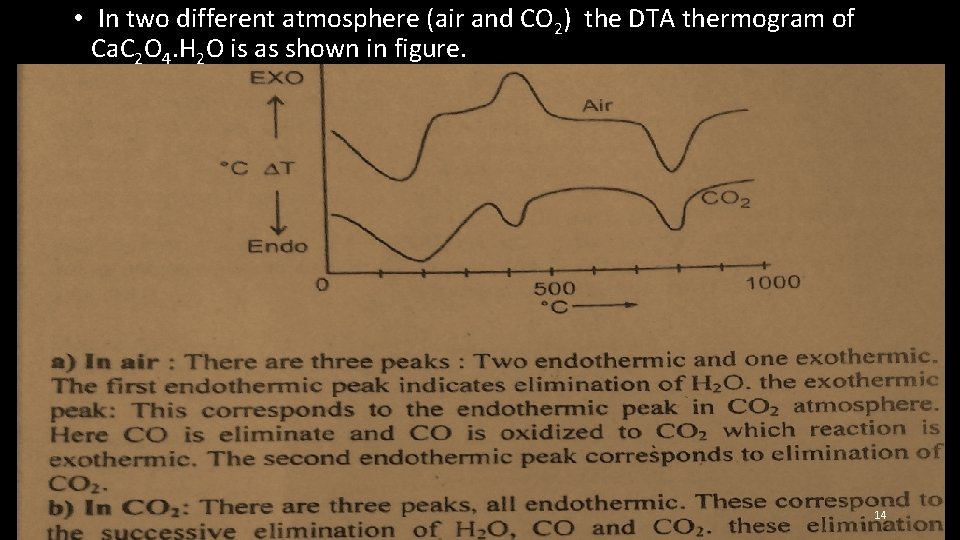
• In two different atmosphere (air and CO 2) the DTA thermogram of Ca. C 2 O 4. H 2 O is as shown in figure. 14
APPLICATIONS OF DTA 15
16
17
18
19
20
THERMOMETRIC TITRATION Thermometric titration In which the change in temperature of the reaction mixture is observed and plotted against the volume of the titrant added and thereby the analyte is estimated. Principle • All chemical reactions are accompanied by heat changes. • These will be accompanied by temperature changes. • So the course of a titration may be followed by measuring the changes in T. • At the equivalence point the temperature changed will be maximum. Example : Titration of HCL against Na. OH 21
Need for thermometric titrations other method of titrations are based on decrease in free energy ie negative G and hence an equilibrium constant K. • There are reactions in which G is very low or even zero or in some case positive. • example: For the neutralisation reaction of boric acid ∆G= -6 • For such reactions ordinary titration which depend on PH are not useful, for such reaction thermometric titrations are useful, here ∆H is measured in terms of ∆T. • 22
Conditions for thermometric titrations • 1. The heat change accompanying the reaction to be studied by thermometric titrations • 3. The reaction must be simple, one step reaction. • Heat exchange between the titration. vessel must be and its surrounding avoided. i. e. , The titration should be conducted under adiabatic conditions. 23
• The apparatus for Thermometric Titration: • i) Motor driven burette, • ii) An adiabatic titration chamber, • Iii) Small Dewar flask. • Iv) Thermistor assembly and a recorder. 24
• The titrant is added from burette in to a thermally insulated vessel. The temprature change after every addition is recorded. A sharp break in the curve gjves the end point. • Example: Titrationof HCI Vs Na. OH: A known volume of HCI to be estimated is taken in an adiabatic chamber (Dewar flask). Na. OH is added from a burette. • The temperature change afer each addition is recorded. A sharp break in the curve gives the end point. • The thermometric titration curve between HCl and Na. OH is as shown below 25
26
• A- Before titrant is added. • ABC Titrant (base) is being added, • C-The titration is complete (end point) • Applications: i) Determination of the concentration of an unknown • Substance. 1 i) Determination of thermodynamic quantities like ∆H • etc. 27
ANALYTICAL ELECTROCHEMISTRY 28
• ELECTROLYTIC SEPARATIONS • When the applied EMF at cach electrode is equal to the reversible polential of the electrode, discharge of ions takes place. • When a constant current is passed through a solution • Containing two or more electroytes, the clectrochemical process with the most positive reduction potential will occur first at the cathode followed by the next most positive electrochemical process etc. Thus we can etfect electrolytic separations. Depending on the nature of the constitutents of the mixture of electrotytes to be separated, we adopt different techniques. 29
• To separate two electrolytes having electrode potentials with • opposite signs : (Constant current electrolysis technique) • E. g. Separation of Cu 2+ and Cd 2+ ions. The reduction potential of Cu 2+ is 0. 340 v while that of Cd 2+ is - 0. 402 v. • Thus if a constant current is passed through a solution containing copper, hydrogen and cadmium ions, copper will be deposited first at the cathode. As the copper deposits, the electrode 30
• potential decreases, When the potential is cqual to that of hydrogen • ions hydrogen gas will form at the cathode. The potential at the • cathode will remain-constant as long as hydrogen is evolved. This • takes place until all the water is electrolysed. • The potential of the cathode cannot become sufficienty • negative to cause the deposition of cadmium ions. Thus metal ions • with positive reduction potential may be separated from metal ions • having negative reduction potentials. 31
• In this technique cathode potential during electroysis need not be measured. After Cu gets deposited, only hydrogen will be evolved. There is no possibility ofthe second metal getting deposited over the first. So a constant current is pased during electrolysis by adjusting the applied voltage. 32
• To separate two electrolytes having electrode potentials with same signs : (Constant cathode potential electrolysis technique To separate two electrolytes having electrode potentials with same sign their initial deposition potentials should differ by atleast. 25 v 33
• Eg. Separation of Ag 2+ and Cu 2+ ions. • The reduction potential of Ag is O. 79 v while that of Cu 2+ is 0. 340 v. Thus if a current is passed through a solution containing Agt and Cu? silver will be deposited first at the cathode quantitatively. Then copper deposition commences. Thus they may be separted. • In this method, as two metals are going to be deposited at two different electrode potentials, measurement of cathode potential becomes necessary. • This is done by connecting the cathode to a reference electrode like calomel electrode. Thus the cathode potential is continuously measured. 34
• The potential is first adjusted to a value • corresponding to the deposition potential of the metal with higher • reduction potential so that it is first deposited. The cathode potential • is maintained at the same value till one metal is deposited completely. • Then the cathode is changed and the potential is also changed suitably to deposit the second metal 35
• To separate two electrolytes having electrode potentials that are • very close to each other : (Constant cathode potential electrolysis • technique): When the standard potentials of the two metals differ only slightly, the electrolytic separation is more difficult. • The obvious method is to alter the electrode potential of one of the metals in some way. This is achieved by decreasing the ionic concentration of the ion being discharged by incorporating it in a complex ion of large stability constant. 36
• The deposition potential of the metal forming a complex ion is thus raised. Further, the overpotential at the small ionic concentration is also increased. As a result of the change in potential the metal which is in simple ionic solution is liberated at a lower voltage. E. g. Separation of copper and bismuth. These two metals cannot be separated electrolytically from a solution of their salts. • If cyanide is added, the copper ion forms a cyano complex, and bismuth remains unchanged. So, bismuth deposits first. 37
ELECTRO DEPOSITION When the applied EMF at each electrode is equal to the reversible electrode , discharge of ions take place. ie depositions ocuur. The electro depositions is governed by the Faraday’s Laws of electrolysis. The amount of substance deposited or evolved at electrode is proportional to the quantity of electricity passed through the solution. 38
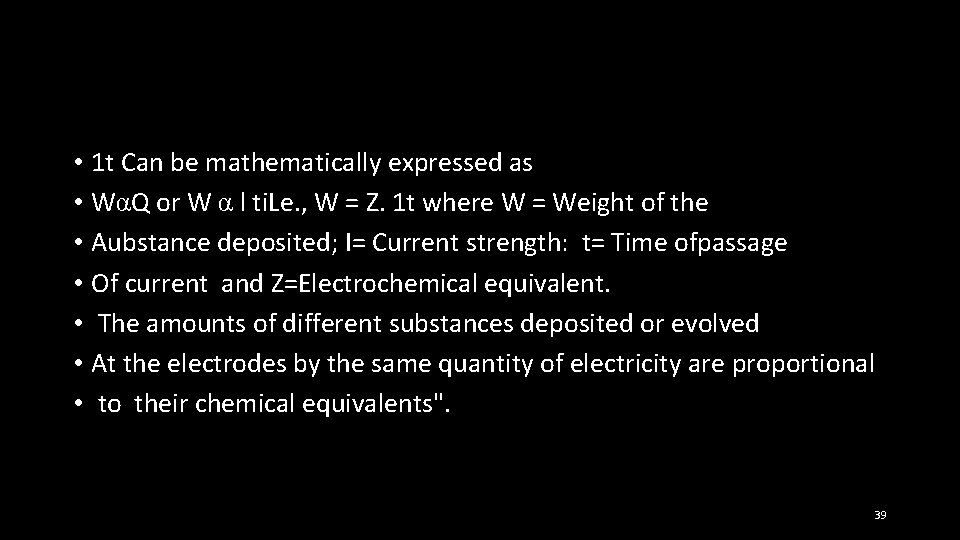
• 1 t Can be mathematically expressed as • WαQ or W α l ti. Le. , W = Z. 1 t where W = Weight of the • Aubstance deposited; I= Current strength: t= Time ofpassage • Of current and Z=Electrochemical equivalent. • The amounts of different substances deposited or evolved • At the electrodes by the same quantity of electricity are proportional • to their chemical equivalents". 39
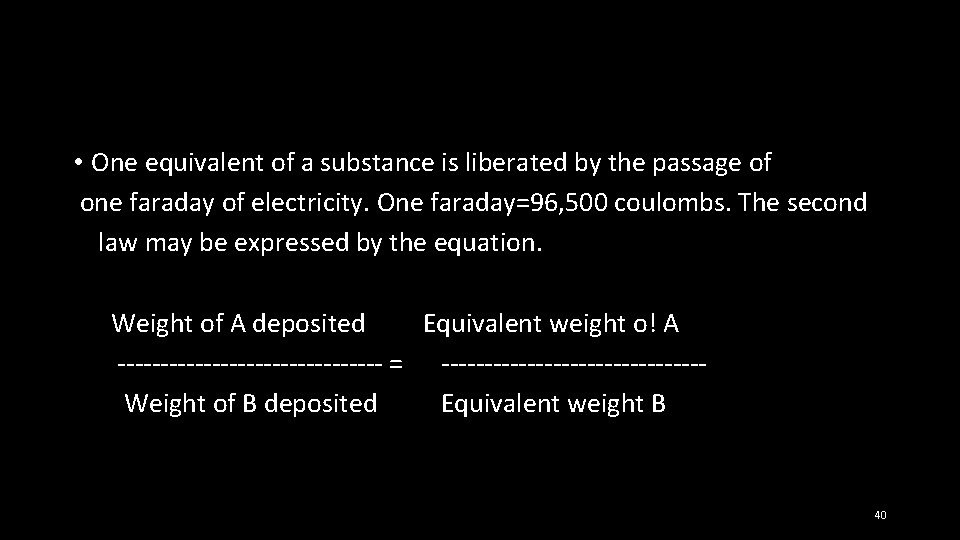
• One equivalent of a substance is liberated by the passage of one faraday of electricity. One faraday=96, 500 coulombs. The second law may be expressed by the equation. Weight of A deposited Equivalent weight o! A ---------------- = ---------------Weight of B deposited Equivalent weight B 40
• Conditions for electro deposition of metals : i) • a) For current to flow through a solution, i. e. , to cause continous electrolysis, a minimum voltage is required. • This is called the decomposition potential. The applied EMF should exceed this decomposition potential. • b) The cathodic potential should exceed the reversible reduction potential of the metal to be deposited. 41
• The metal should be above hydrogen in electrochemical series, • i. e. , with a positive value for its reduction potential or if the metal has a negative value for its reduction potential, • if must have a high value for its hydrogen over voltage so that the metal is deposited without causing evolution of hydrogen. 42
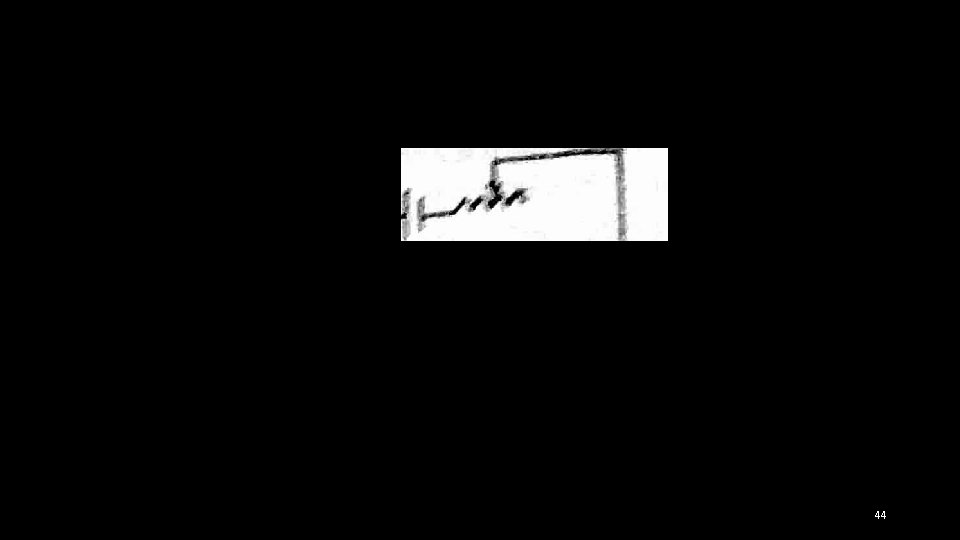
• ELECTROGRAVIMETRY • What is it ? It is a technique used to determine the amount of a metal present in its solution by electrodepositing it and weighing it. • Principle: It is based on quantitative electro deposition ofmetals • from their solutions on a cathode. The cathode is weighed before • and after electrolysis. From the increase in weight, the concentration • Of metal ion in solution is calculated. The process of deposition is 43
44
• Conditions: • The depositions of the substance to be analysed should be complete • The deposited metal should not undergo any change in its weight during the process of electrolysis. • The deposited metal must be attached to the electrode firmly so that there is no weightr loss during rising drying and weighing. • 45
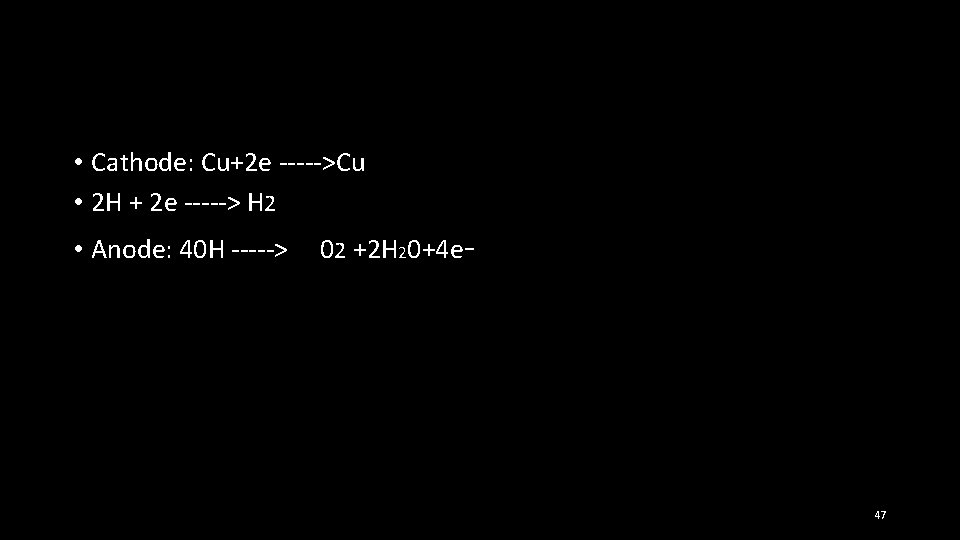
• Estímation of copper • Principle: Copper may be deposited from either sulphuric acid or nitric acid solution But, usually, a mixture of the two acids is used • If such 2 solution is electrolysed with an emf of 2 to 3 volts. • following reactions occur. 46
• Cathode: Cu+2 e -----˃Cu • 2 H + 2 e -----˃ H 2 • Anode: 40 H -----˃ 02 +2 H 20+4 e- 47
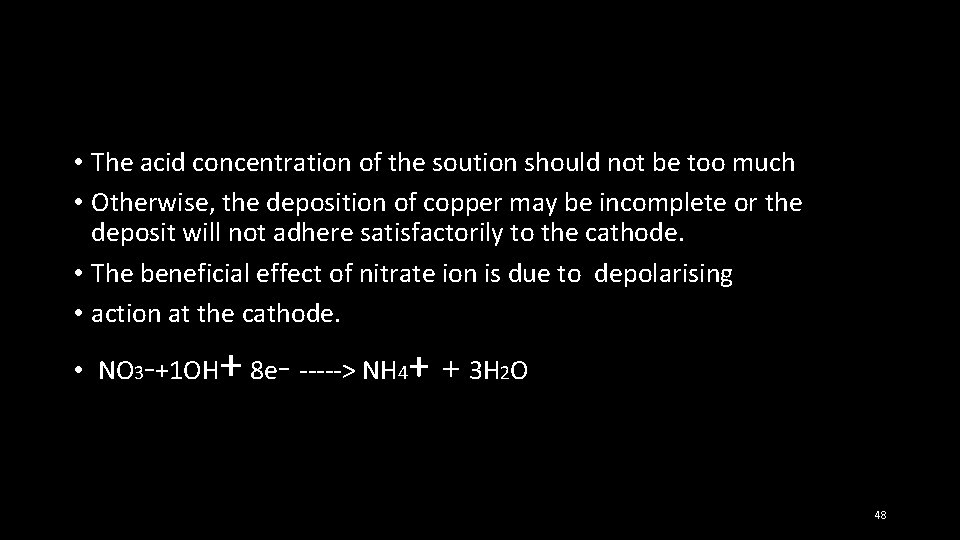
• The acid concentration of the soution should not be too much • Otherwise, the deposition of copper may be incomplete or the deposit will not adhere satisfactorily to the cathode. • The beneficial effect of nitrate ion is due to depolarising • action at the cathode. • NO 3 -+1 OH + 8 e- -----˃ NH 4+ + 3 H 2 O 48
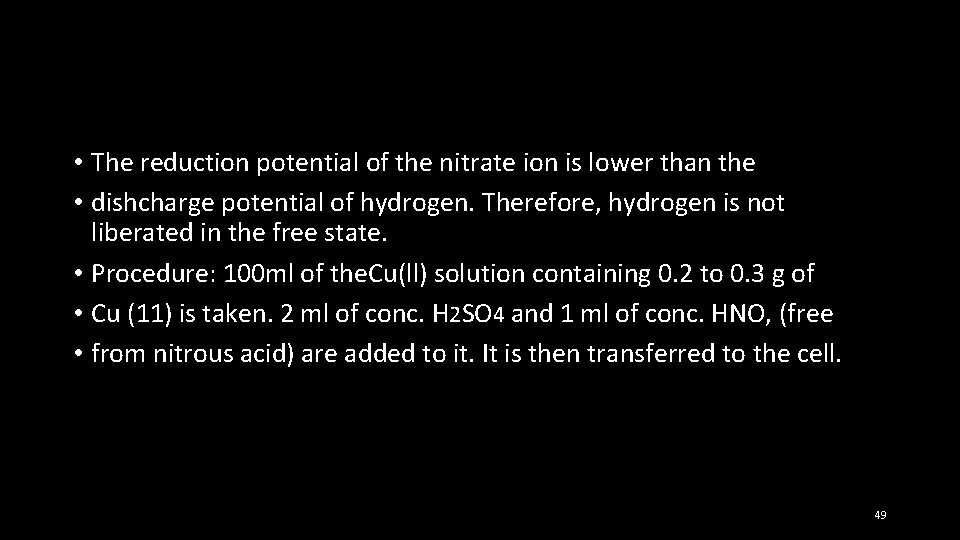
• The reduction potential of the nitrate ion is lower than the • dishcharge potential of hydrogen. Therefore, hydrogen is not liberated in the free state. • Procedure: 100 ml of the. Cu(ll) solution containing 0. 2 to 0. 3 g of • Cu (11) is taken. 2 ml of conc. H 2 SO 4 and 1 ml of conc. HNO, (free • from nitrous acid) are added to it. It is then transferred to the cell. 49
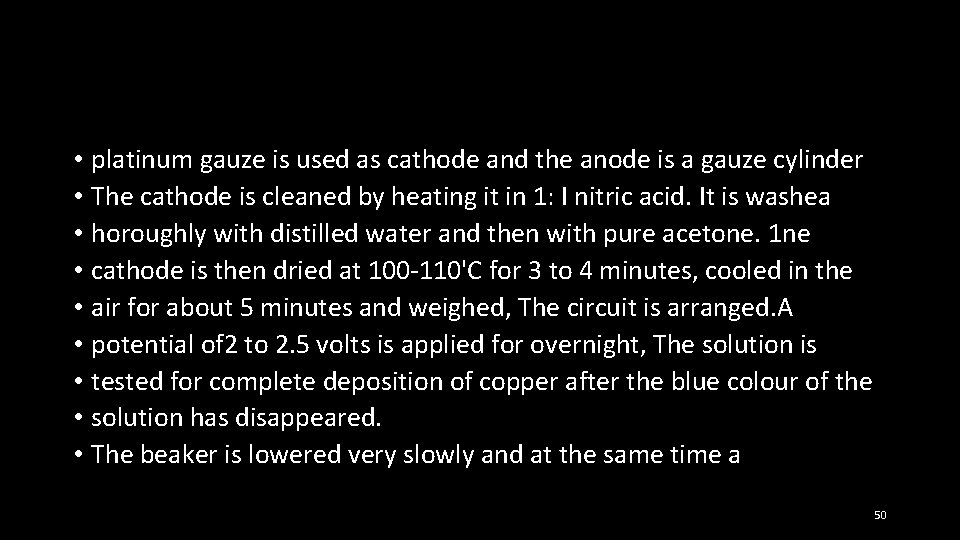
• platinum gauze is used as cathode and the anode is a gauze cylinder • The cathode is cleaned by heating it in 1: I nitric acid. It is washea • horoughly with distilled water and then with pure acetone. 1 ne • cathode is then dried at 100 -110'C for 3 to 4 minutes, cooled in the • air for about 5 minutes and weighed, The circuit is arranged. A • potential of 2 to 2. 5 volts is applied for overnight, The solution is • tested for complete deposition of copper after the blue colour of the • solution has disappeared. • The beaker is lowered very slowly and at the same time a 50
• continuous stream of distilled water is directed against the upper • edge of the cathode. This washing is done immediatley after the • cathode is removed out of the solution and the circuit should not be • broken during the process. After washing the cathode thoroughly, • the circuit is broken and the cathode is dipped into a beaker of • distilled water. It is then rinsed with pure acetone. The electrode is • then dried at 100 to 110°C for 3 to 4 minutes, weighed after cooling • in air for about 5 minutes. From the increase in weight ofthe cathode, • the copper content of the solution is calculated 51
ESTIMATION OF SILVER • Principle: Silver may be determined by electrolysis in nitrate, • ammonical or cyanide solutions. In cyanide solution, the silver is • present largely as the complex ion • • • [Ag(CN)2 - -----˃ Ag+ 2 CNBy this method, an excellent plate is obtained and separation from other elements for e. g. , copper and lead mnay be effected. Procedure: A neutral or faintly acidic solution of silver nitrate containing 0. 2 g of silver is taken. 52
To this solution A. R. potassium cyanide is added until the precipitate ofsilver cyanide is dissolved. Then an excess potassium cyanide is added such that about 2 g of potassium cyanide is prescnt to in the solution. It is then diluted to 100 120 ml. The solution is electrolysedwith 0. 2 to. 5 amperesat 3. 7 to 4. 8 volts at 20 to 30°C. About 0. 1 g of. Agis deposited in 3 hour s. 53
• Completion of deposition is tested as follows. • A few drops of the clectrolyte is transferred intoa test tube, acidified with alittle nitric acid, the HCN boiled off. Ammonium hydroxide and a few drops of • Ammonium sulphide are added. No brown precipitate is obtained. • The determination is completed as under copper. 54