
Thermal Testing Building Regulations U Values Life Cycle
Thermal Testing Building Regulations U Values Life Cycle Assessment
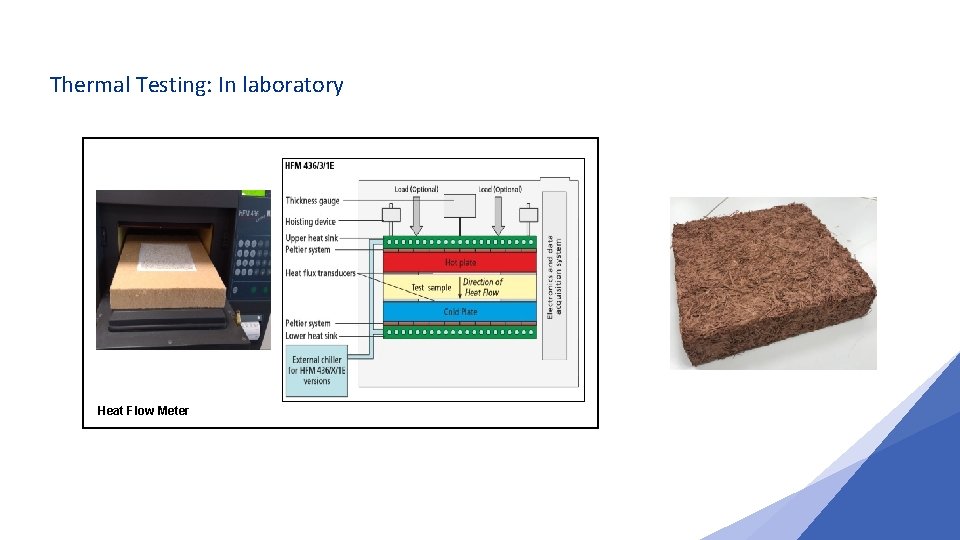
Thermal Testing: In laboratory Heat Flow Meter
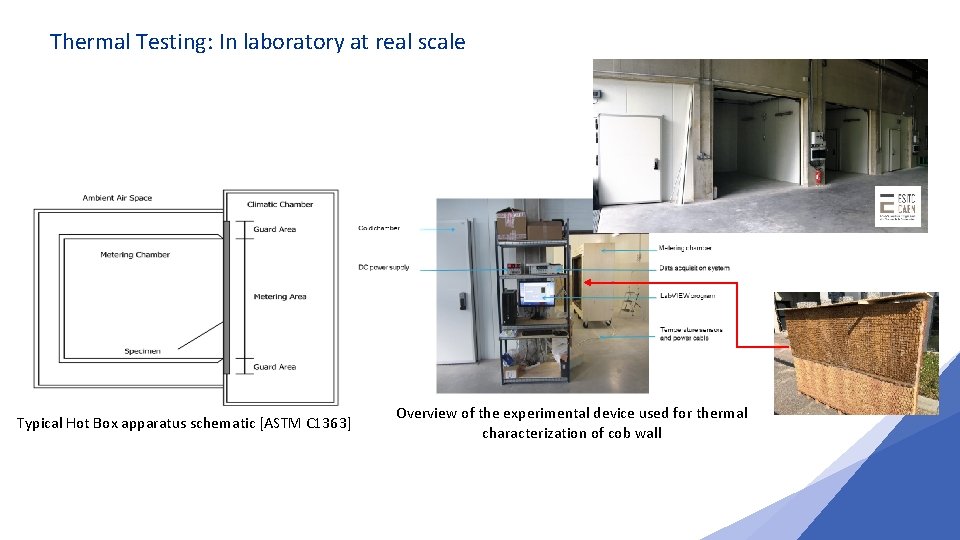
Thermal Testing: In laboratory at real scale Typical Hot Box apparatus schematic [ASTM C 1363] Overview of the experimental device used for thermal characterization of cob wall
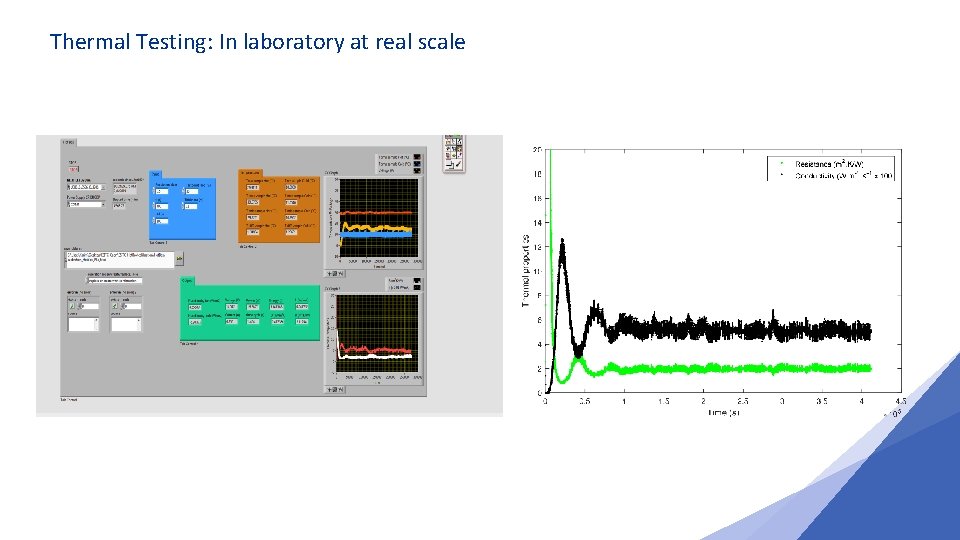
Thermal Testing: In laboratory at real scale

UK Building regulations: Part L 1 A
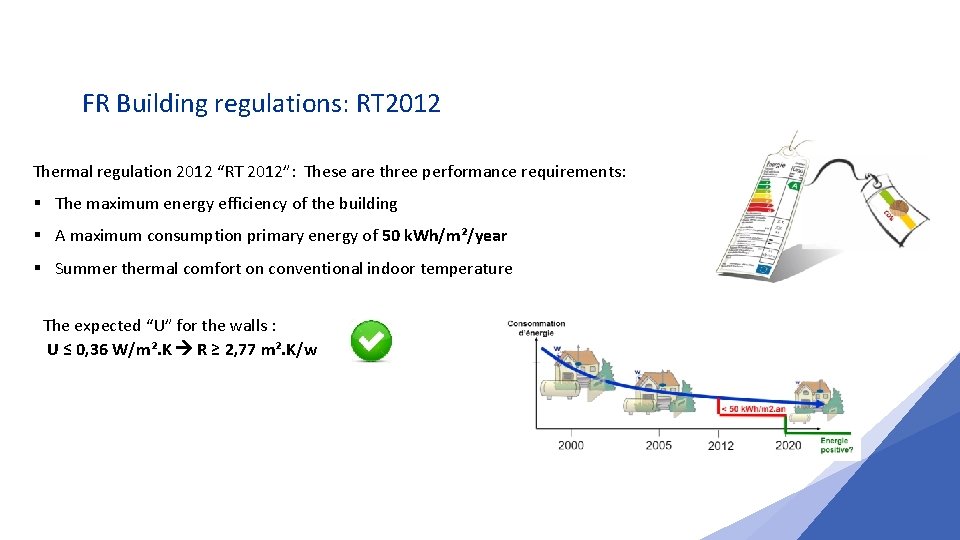
FR Building regulations: RT 2012 Thermal regulation 2012 “RT 2012”: These are three performance requirements: § The maximum energy efficiency of the building § A maximum consumption primary energy of 50 k. Wh/m²/year § Summer thermal comfort on conventional indoor temperature The expected “U” for the walls : U ≤ 0, 36 W/m². K R ≥ 2, 77 m². K/w
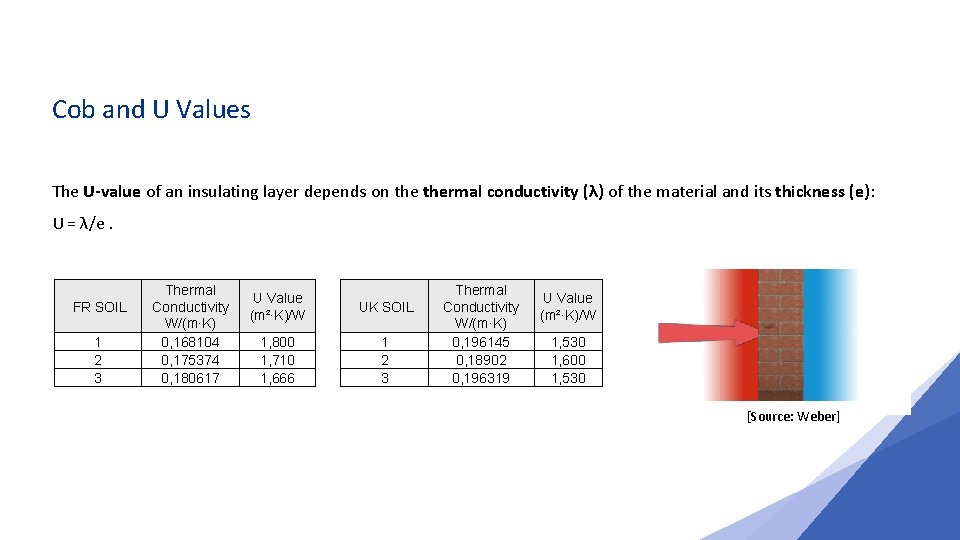
Cob and U Values The U-value of an insulating layer depends on thermal conductivity (λ) of the material and its thickness (e): U = λ/e. FR SOIL 1 2 3 Thermal Conductivity W/(m∙K) 0, 168104 0, 175374 0, 180617 U Value (m²∙K)/W UK SOIL 1, 800 1, 710 1, 666 1 2 3 Thermal Conductivity W/(m∙K) 0, 196145 0, 18902 0, 196319 U Value (m²∙K)/W 1, 530 1, 600 1, 530 [Source: Weber]
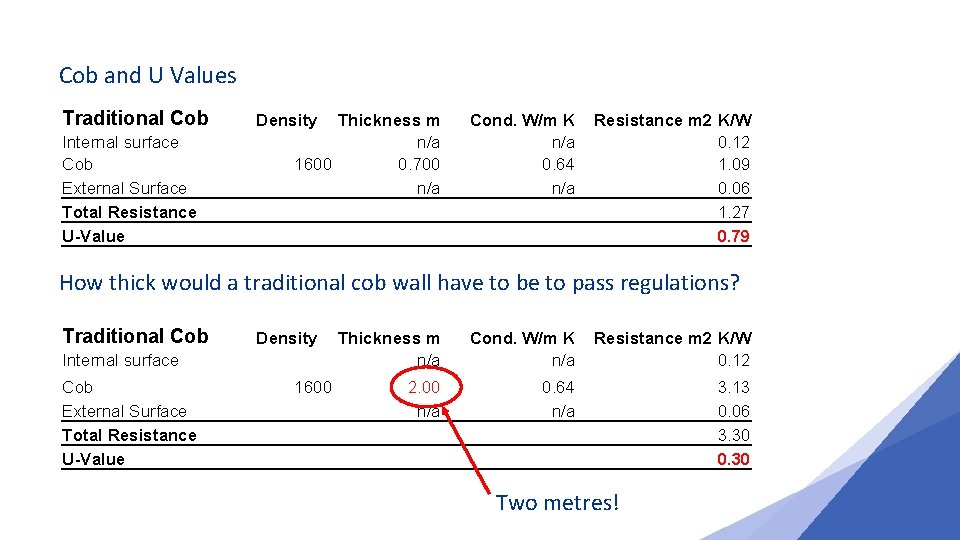
Cob and U Values Traditional Cob Density Internal surface Cob External Surface Total Resistance U-Value Thickness m n/a 1600 0. 700 n/a Cond. W/m K n/a 0. 64 n/a Resistance m 2 K/W 0. 12 1. 09 0. 06 1. 27 0. 79 How thick would a traditional cob wall have to be to pass regulations? Traditional Cob Density Internal surface Cob External Surface Total Resistance U-Value 1600 Thickness m n/a Cond. W/m K n/a Resistance m 2 K/W 0. 12 2. 00 n/a 0. 64 n/a 3. 13 0. 06 3. 30 0. 30 Two metres!
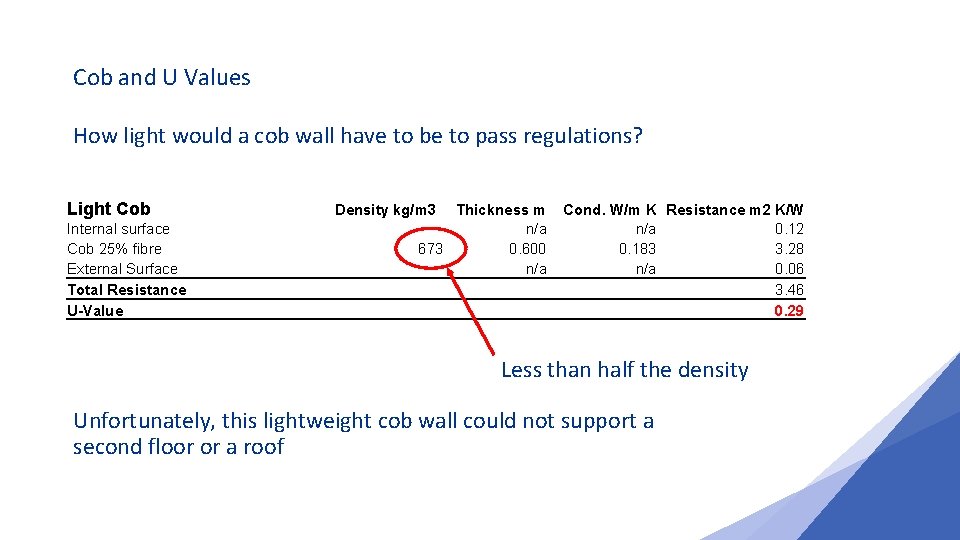
Cob and U Values How light would a cob wall have to be to pass regulations? Light Cob Density kg/m 3 Internal surface Cob 25% fibre External Surface Total Resistance U-Value Thickness m n/a 673 0. 600 n/a Cond. W/m K Resistance m 2 K/W n/a 0. 12 0. 183 3. 28 n/a 0. 06 3. 46 0. 29 Less than half the density Unfortunately, this lightweight cob wall could not support a second floor or a roof
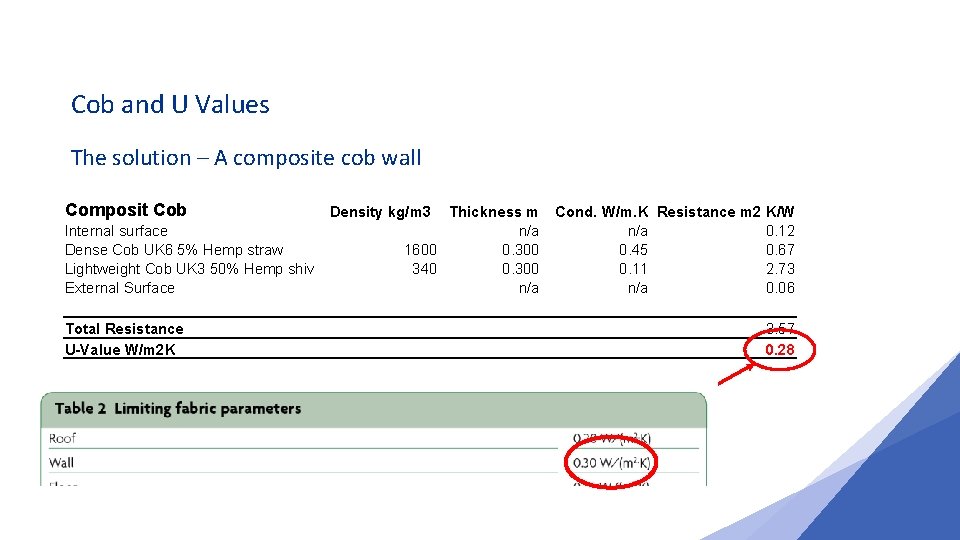
Cob and U Values The solution – A composite cob wall Composit Cob Density kg/m 3 Thickness m n/a 1600 0. 300 340 0. 300 n/a Internal surface Dense Cob UK 6 5% Hemp straw Lightweight Cob UK 3 50% Hemp shiv External Surface Total Resistance U-Value W/m 2 K Cond. W/m. K Resistance m 2 K/W n/a 0. 12 0. 45 0. 67 0. 11 2. 73 n/a 0. 06 This wall achieves the right U value for Building Regulations 3. 57 0. 28
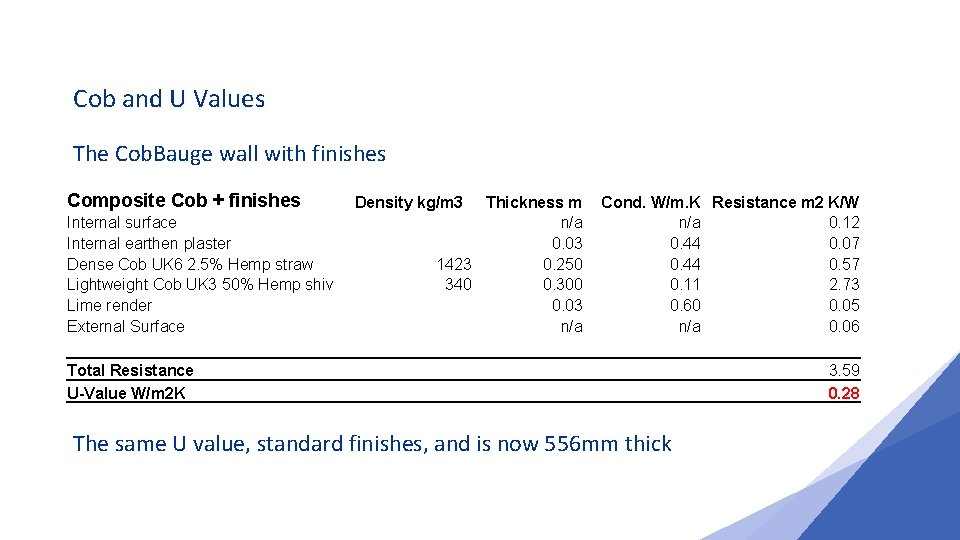
Cob and U Values The Cob. Bauge wall with finishes Composite Cob + finishes Density kg/m 3 Thickness m n/a 0. 03 1423 0. 250 340 0. 300 0. 03 n/a Internal surface Internal earthen plaster Dense Cob UK 6 2. 5% Hemp straw Lightweight Cob UK 3 50% Hemp shiv Lime render External Surface Total Resistance U-Value W/m 2 K Cond. W/m. K Resistance m 2 K/W n/a 0. 12 0. 44 0. 07 0. 44 0. 57 0. 11 2. 73 0. 60 0. 05 n/a 0. 06 The same U value, standard finishes, and is now 556 mm thick 3. 59 0. 28
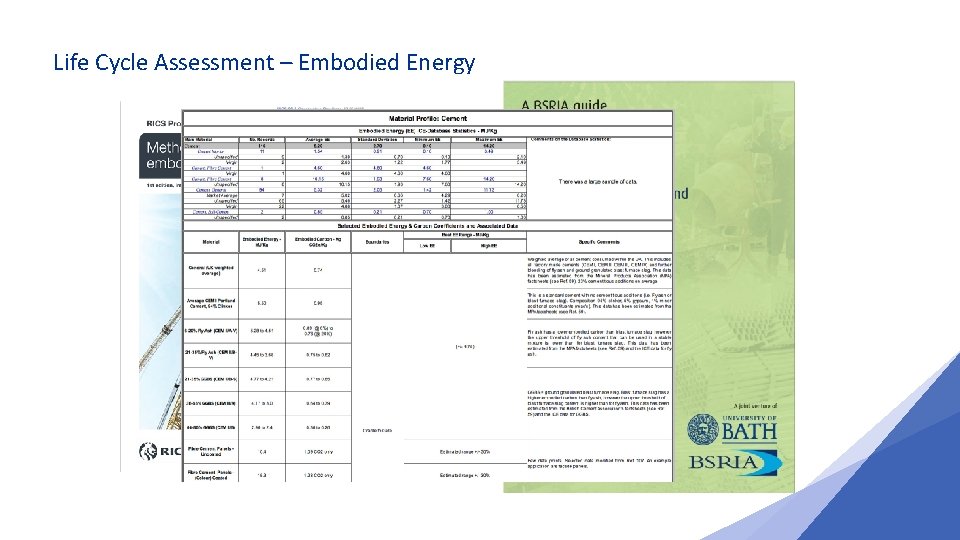
Life Cycle Assessment – Embodied Energy
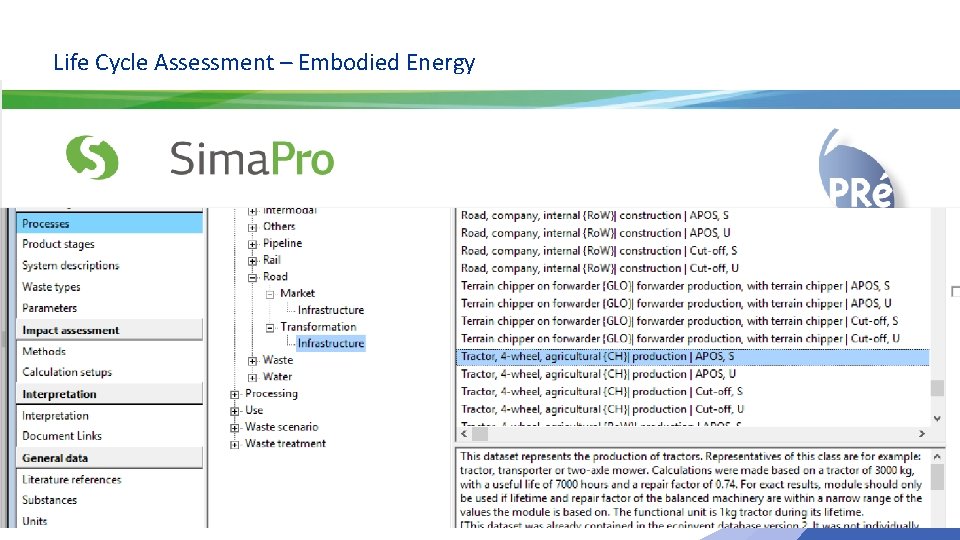
Life Cycle Assessment – Embodied Energy Calculating LCA - Sima. Pro
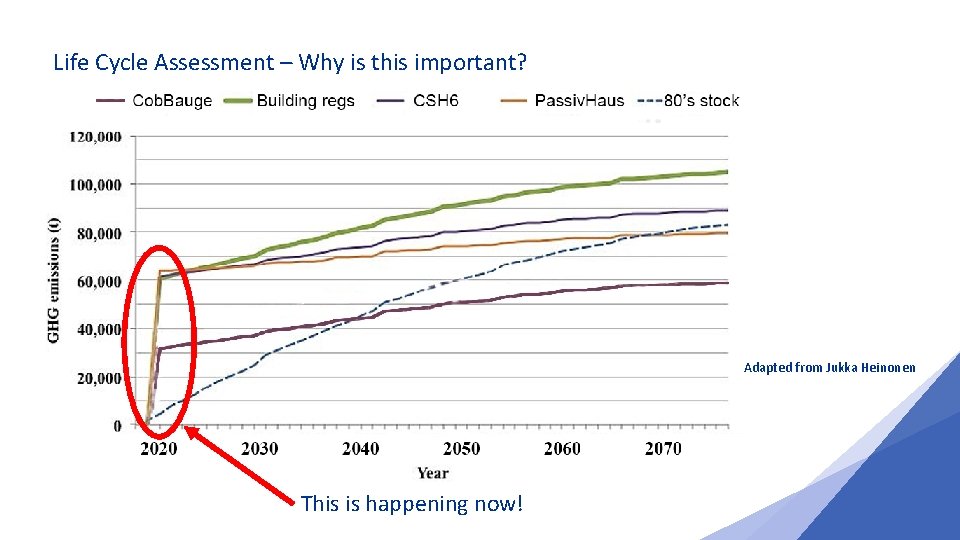
Life Cycle Assessment – Why is this important? Adapted from Jukka Heinonen This is happening now!
Thank you
- Slides: 15