
Thermal Simulation of Thermoelectric Material by Zonemelting Technique
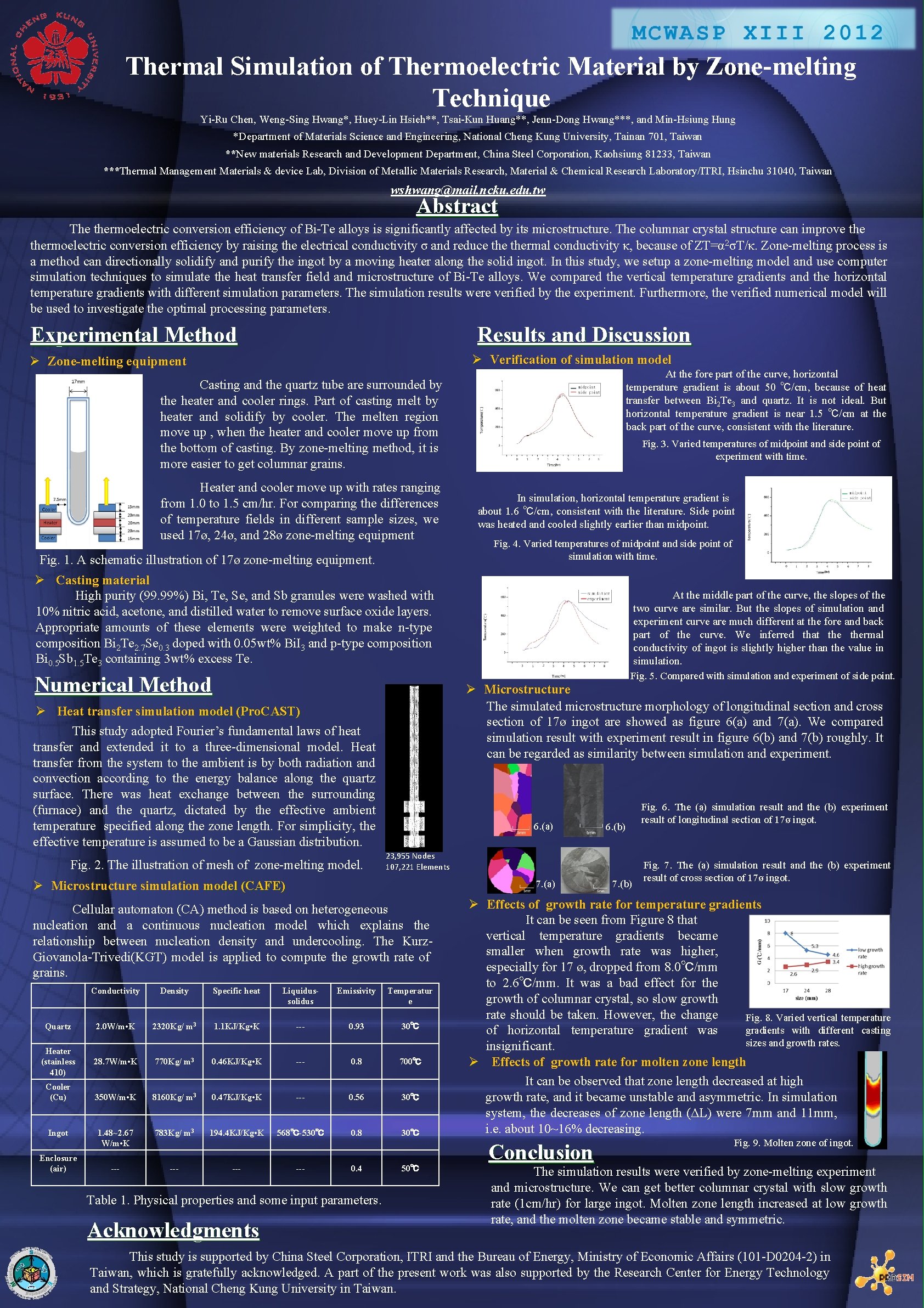
Thermal Simulation of Thermoelectric Material by Zone-melting Technique Yi-Ru Chen, Weng-Sing Hwang*, Huey-Lin Hsieh**, Tsai-Kun Huang**, Jenn-Dong Hwang***, and Min-Hsiung Hung *Department of Materials Science and Engineering, National Cheng Kung University, Tainan 701, Taiwan **New materials Research and Development Department, China Steel Corporation, Kaohsiung 81233, Taiwan ***Thermal Management Materials & device Lab, Division of Metallic Materials Research, Material & Chemical Research Laboratory/ITRI, Hsinchu 31040, Taiwan wshwang@mail. ncku. edu. tw Abstract The thermoelectric conversion efficiency of Bi-Te alloys is significantly affected by its microstructure. The columnar crystal structure can improve thermoelectric conversion efficiency by raising the electrical conductivity σ and reduce thermal conductivity κ, because of ZT=α 2σT/κ. Zone-melting process is a method can directionally solidify and purify the ingot by a moving heater along the solid ingot. In this study, we setup a zone-melting model and use computer simulation techniques to simulate the heat transfer field and microstructure of Bi-Te alloys. We compared the vertical temperature gradients and the horizontal temperature gradients with different simulation parameters. The simulation results were verified by the experiment. Furthermore, the verified numerical model will be used to investigate the optimal processing parameters. Experimental Method Results and Discussion Ø Verification of simulation model Ø Zone-melting equipment At the fore part of the curve, horizontal temperature gradient is about 50 ℃/cm, because of heat transfer between Bi 2 Te 3 and quartz. It is not ideal. But horizontal temperature gradient is near 1. 5 ℃/cm at the back part of the curve, consistent with the literature. Casting and the quartz tube are surrounded by the heater and cooler rings. Part of casting melt by heater and solidify by cooler. The melten region move up , when the heater and cooler move up from the bottom of casting. By zone-melting method, it is more easier to get columnar grains. Heater and cooler move up with rates ranging from 1. 0 to 1. 5 cm/hr. For comparing the differences of temperature fields in different sample sizes, we used 17ø, 24ø, and 28ø zone-melting equipment Fig. 1. A schematic illustration of 17ø zone-melting equipment. Fig. 3. Varied temperatures of midpoint and side point of experiment with time. In simulation, horizontal temperature gradient is about 1. 6 ℃/cm, consistent with the literature. Side point was heated and cooled slightly earlier than midpoint. Fig. 4. Varied temperatures of midpoint and side point of simulation with time. Ø Casting material High purity (99. 99%) Bi, Te, Se, and Sb granules were washed with 10% nitric acid, acetone, and distilled water to remove surface oxide layers. Appropriate amounts of these elements were weighted to make n-type composition Bi 2 Te 2. 7 Se 0. 3 doped with 0. 05 wt% Bi. I 3 and p-type composition Bi 0. 5 Sb 1. 5 Te 3 containing 3 wt% excess Te. Fig. 5. Compared with simulation and experiment of side point. Numerical Method Ø Microstructure The simulated microstructure morphology of longitudinal section and cross section of 17ø ingot are showed as figure 6(a) and 7(a). We compared simulation result with experiment result in figure 6(b) and 7(b) roughly. It can be regarded as similarity between simulation and experiment. Ø Heat transfer simulation model (Pro. CAST) This study adopted Fourier’s fundamental laws of heat transfer and extended it to a three-dimensional model. Heat transfer from the system to the ambient is by both radiation and convection according to the energy balance along the quartz surface. There was heat exchange between the surrounding (furnace) and the quartz, dictated by the effective ambient temperature specified along the zone length. For simplicity, the effective temperature is assumed to be a Gaussian distribution. Fig. 2. The illustration of mesh of zone-melting model. 6. (a) 7. (a) Cellular automaton (CA) method is based on heterogeneous nucleation and a continuous nucleation model which explains the relationship between nucleation density and undercooling. The Kurz. Giovanola-Trivedi(KGT) model is applied to compute the growth rate of grains. Conductivity Density Specific heat Liquidussolidus Emissivity Temperatur e Quartz 2. 0 W/m • K 2320 Kg/ m 3 1. 1 KJ/Kg • K --- 0. 93 30℃ Heater (stainless 410) 28. 7 W/m • K 770 Kg/ m 3 0. 46 KJ/Kg • K --- 0. 8 700℃ 350 W/m • K 8160 Kg/ m 3 0. 47 KJ/Kg • K --- 0. 56 30℃ 1. 48~2. 67 W/m • K 783 Kg/ m 3 194. 4 KJ/Kg • K 568℃-530℃ 0. 8 30℃ --- Ingot Enclosure (air) --- 0. 4 Table 1. Physical properties and some input parameters. Acknowledgments 6. (b) 23, 955 Nodes 107, 221 Elements Ø Microstructure simulation model (CAFE) Cooler (Cu) At the middle part of the curve, the slopes of the two curve are similar. But the slopes of simulation and experiment curve are much different at the fore and back part of the curve. We inferred that thermal conductivity of ingot is slightly higher than the value in simulation. 50℃ 7. (b) Fig. 6. The (a) simulation result and the (b) experiment result of longitudinal section of 17ø ingot. Fig. 7. The (a) simulation result and the (b) experiment result of cross section of 17ø ingot. Ø Effects of growth rate for temperature gradients It can be seen from Figure 8 that vertical temperature gradients became smaller when growth rate was higher, especially for 17 ø, dropped from 8. 0℃/mm to 2. 6℃/mm. It was a bad effect for the growth of columnar crystal, so slow growth rate should be taken. However, the change Fig. 8. Varied vertical temperature gradients with different casting of horizontal temperature gradient was sizes and growth rates. insignificant. Ø Effects of growth rate for molten zone length It can be observed that zone length decreased at high growth rate, and it became unstable and asymmetric. In simulation system, the decreases of zone length (ΔL) were 7 mm and 11 mm, i. e. about 10~16% decreasing. Conclusion Fig. 9. Molten zone of ingot. The simulation results were verified by zone-melting experiment and microstructure. We can get better columnar crystal with slow growth rate (1 cm/hr) for large ingot. Molten zone length increased at low growth rate, and the molten zone became stable and symmetric. This study is supported by China Steel Corporation, ITRI and the Bureau of Energy, Ministry of Economic Affairs (101 -D 0204 -2) in Taiwan, which is gratefully acknowledged. A part of the present work was also supported by the Research Center for Energy Technology and Strategy, National Cheng Kung University in Taiwan.
- Slides: 1