
Thermal Shock Resistance of Oxygen Sensors Marvin Chan


- Slides: 17
Thermal Shock Resistance of Oxygen Sensors Marvin Chan, SURF IT Fellow Jesse Angle, Graduate Student Mentor Professor Mecartney, Faculty Mentor
Outline § Introduction § § Oxygen Sensors Problem of Thermal Shock § Preparation and Test Methods § Results for Additives of Si. O 2, Al 2 O 3 to Zr. O 2 § § § OOF 2: Finite Element Modeling (FEM) § § Theoretical Calculations Experimental Results Conclusion
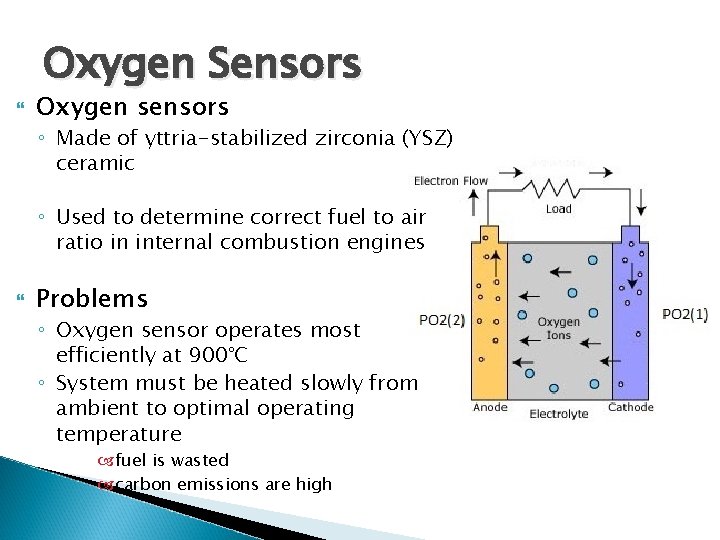
Oxygen Sensors Oxygen sensors ◦ Made of yttria-stabilized zirconia (YSZ) ceramic ◦ Used to determine correct fuel to air ratio in internal combustion engines Problems ◦ Oxygen sensor operates most efficiently at 900°C ◦ System must be heated slowly from ambient to optimal operating temperature fuel is wasted carbon emissions are high
Problem of Thermal Shock YSZ will fracture if heated or cooled too quickly. The property that measures resistance to fracture upon heating/cooling is called thermal shock resistance. Research Question: How to improve and predict thermal shock resistance of YSZ?
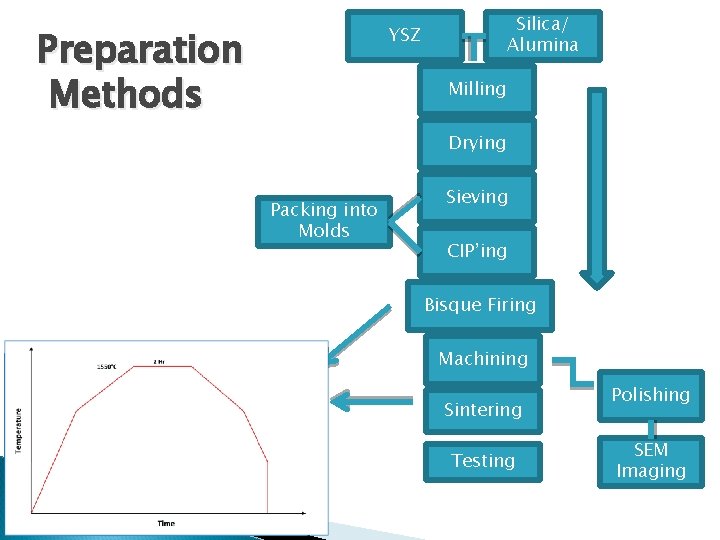
Silica/ Alumina YSZ Preparation Methods Milling Drying Packing into Molds Sieving CIP’ing Bisque Firing Machining Sintering Testing Polishing SEM Imaging
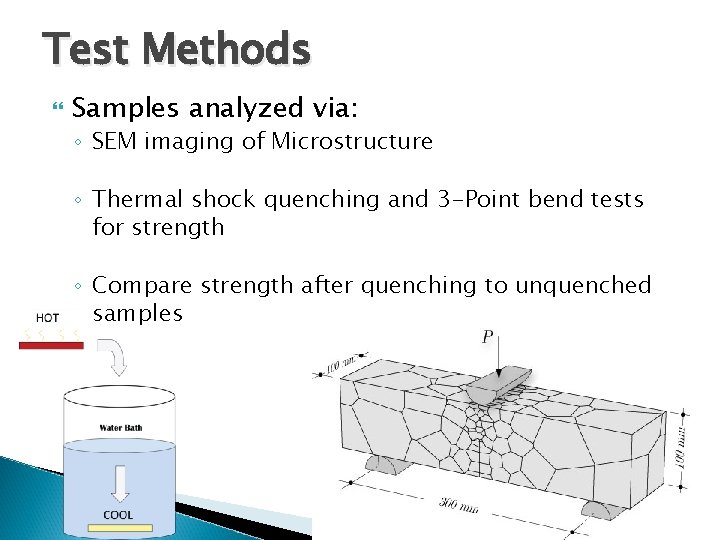
Test Methods Samples analyzed via: ◦ SEM imaging of Microstructure ◦ Thermal shock quenching and 3 -Point bend tests for strength ◦ Compare strength after quenching to unquenched samples
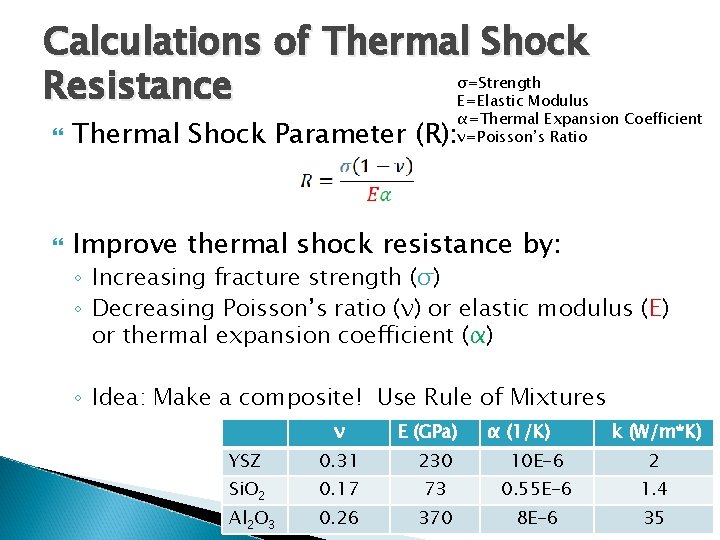
Calculations of Thermal Shock σ=Strength Resistance E=Elastic Modulus α=Thermal Expansion Coefficient ν=Poisson’s Ratio Thermal Shock Parameter (R): Improve thermal shock resistance by: ◦ Increasing fracture strength (σ) ◦ Decreasing Poisson’s ratio (ν) or elastic modulus (E) or thermal expansion coefficient (α) ◦ Idea: Make a composite! Use Rule of Mixtures ν E (GPa) α (1/K) k (W/m*K) YSZ 0. 31 230 10 E-6 2 Si. O 2 0. 17 73 0. 55 E-6 1. 4 0. 26 370 8 E-6 35 Al 2 O 3
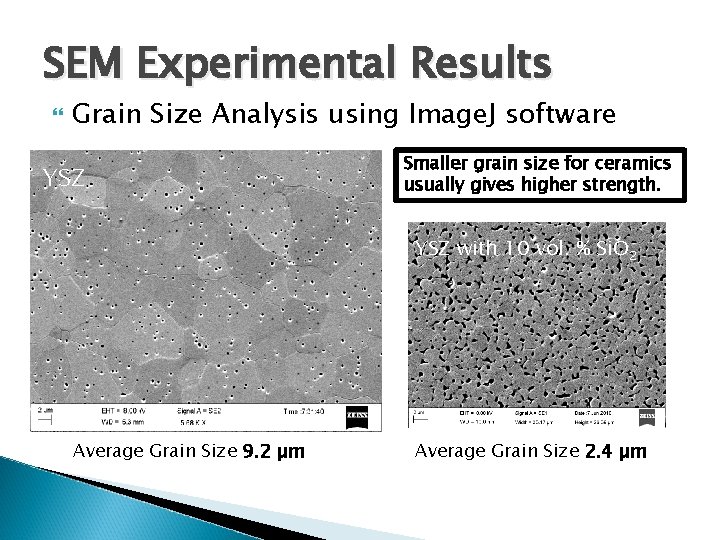
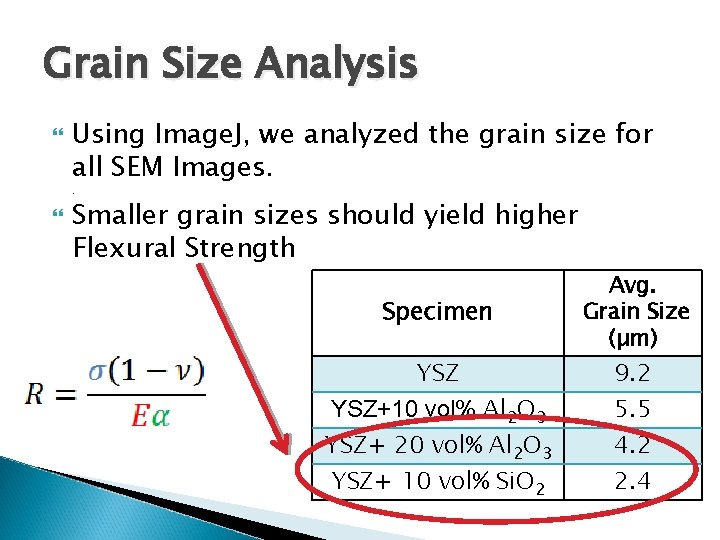
SEM Experimental Results Grain Size Analysis using Image. J software YSZ Smaller grain size for ceramics usually gives higher strength. YSZ with 10 vol. % Si. O 2 Average Grain Size 9. 2 µm Average Grain Size 2. 4 µm
Grain Size Analysis Using Image. J, we analyzed the grain size for all SEM Images. . Smaller grain sizes should yield higher Flexural Strength Specimen YSZ+10 vol% Al 2 O 3 YSZ+ 20 vol% Al 2 O 3 YSZ+ 10 vol% Si. O 2 Avg. Grain Size (µm) 9. 2 5. 5 4. 2 2. 4
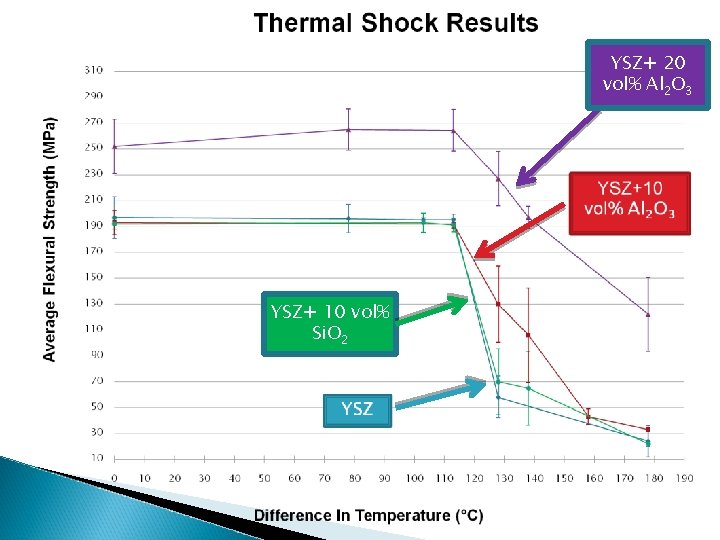
YSZ+ 20 vol% Al 2 O 3 YSZ+ 10 vol% Si. O 2
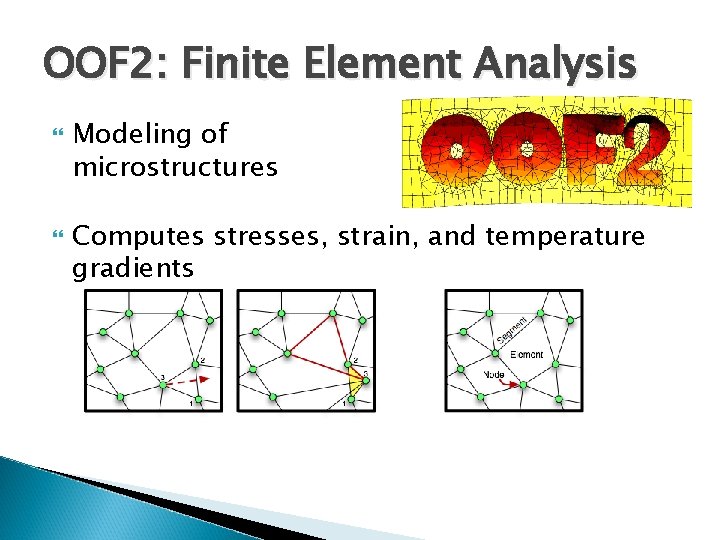
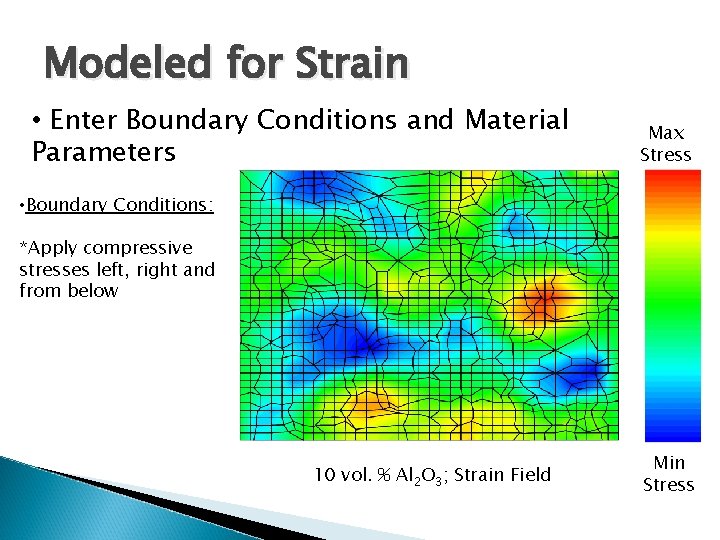
OOF 2: Finite Element Analysis Modeling of microstructures Computes stresses, strain, and temperature gradients
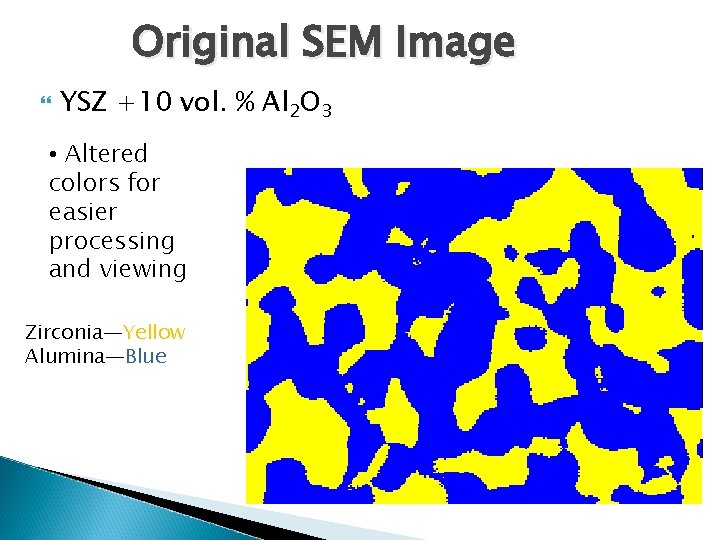
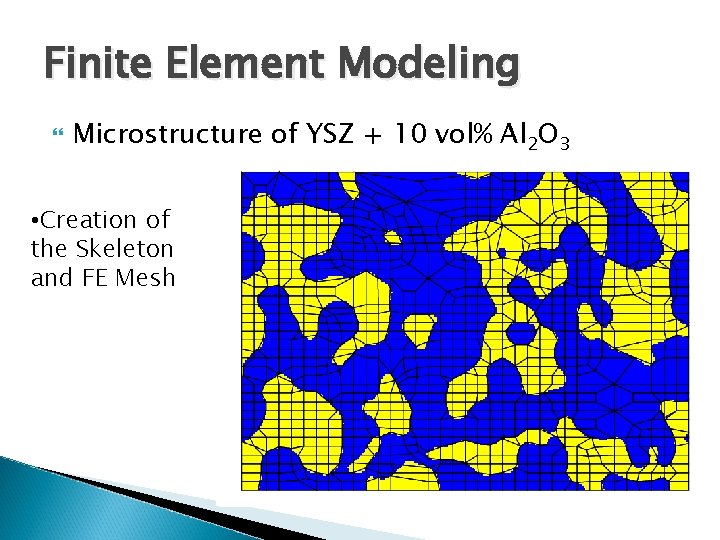
Original SEM Image YSZ +10 vol. % Al 2 O 3 • Altered colors for easier processing and viewing Zirconia—Yellow Alumina—Blue
Finite Element Modeling Microstructure of YSZ + 10 vol% Al 2 O 3 • Creation of the Skeleton and FE Mesh
Modeled for Strain • Enter Boundary Conditions and Material Parameters Max Stress • Boundary Conditions: *Apply compressive stresses left, right and from below 10 vol. % Al 2 O 3; Strain Field Min Stress
Conclusions YSZ + 20 vol% Al 2 O 3 had the highest Flexural Strength and highest Thermal Shock Resistance YSZ + 10 vol% Si. O 2 and YSZ +10 vol% Al 2 O 3 had less than ideal results—led to negligible improvements OOF 2 models areas of stress, i. e. compression and tension for thermal shockcontinuing work in the fall!
Acknowledgements Professor Martha Mecartney, Faculty Mentor Jesse Angle, Graduate Student Mentor Edward Su, Technical Support
Questions ?