
THERMAL SENSATIONS Dr Ghulam Mustafa Learning Objectives Thermal

THERMAL SENSATIONS Dr Ghulam Mustafa

Learning Objectives • Thermal Receptors – Warm receptors – Cold receptor • Temp range • Mechanism of Stimulation of Thermal Receptors • Adaptation of thermal Receptors • Spatial Summation of Thermal Sensations. • Thermal sensations pathways

Thermal Receptors • The human being can perceive different gradations of cold and heat – – – From freezing cold To cool To indifferent To warm to hot to burning hot. • Three types of sensory receptors: – Cold receptors – Warmth receptors – Pain receptors.

• The cold and warmth receptors – Located immediately under the skin – At discrete separated spot • 3 to 10 times as many cold spots as warmth spots

Warm receptors • The existence of distinctive warmth nerve endings – Free nerve endings • Warmth signals are transmitted mainly over Type C nerve fibers • Transmission velocities of only 0. 4 to 2 m/sec.
Cold receptor • Small type A delta Myelinated nerve ending that branches a number of times – Tips - protrude into the bottom surfaces of basal epidermal cells. • Signals - transmitted from these receptors – Via type A delta nerve fibers – At velocities of about 20 m/sec – Some cold sensations -transmitted in type C nerve fibers
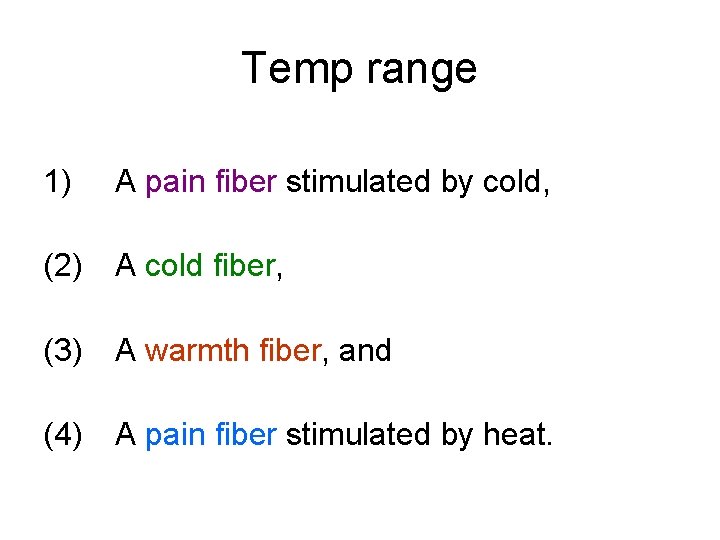
Temp range 1) A pain fiber stimulated by cold, (2) A cold fiber, (3) A warmth fiber, and (4) A pain fiber stimulated by heat.
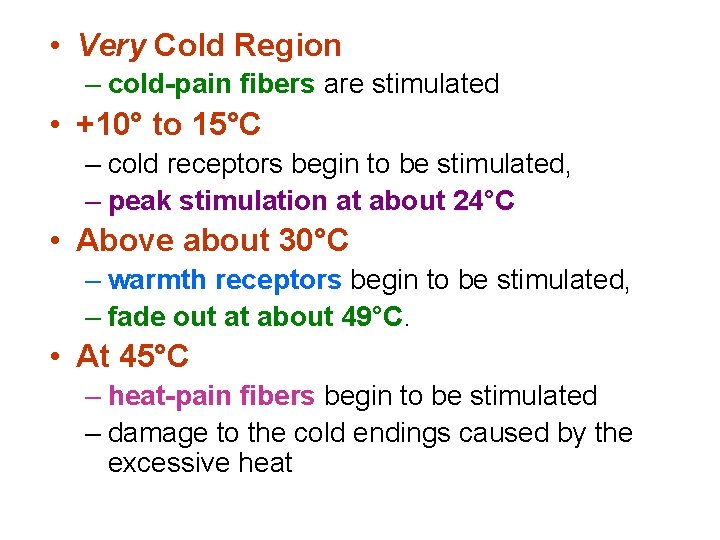
• Very Cold Region – cold-pain fibers are stimulated • +10° to 15°C – cold receptors begin to be stimulated, – peak stimulation at about 24°C • Above about 30°C – warmth receptors begin to be stimulated, – fade out at about 49°C. • At 45°C – heat-pain fibers begin to be stimulated – damage to the cold endings caused by the excessive heat

Freezing cold and burning hot sensations feel almost alike.
Mechanism of Stimulation of Thermal Receptors • Cold and warmth receptors • Stimulated by changes in their metabolic rates • Alters the rate of intracellular chemical reactions • More than twofold for each 10°C change. • Not from direct physical effects of heat or cold on the nerve endings – Chemical stimulation of the endings
Adaptation of Thermal Receptors • Cold receptor is suddenly subjected to an abrupt fall in temperature – Strongly stimulated at first • Stimulation fades – Rapidly during the first few seconds – Progressively more slowly during the next 30 minutes • Thermal senses respond markedly to changes in temperature
Spatial Summation of Thermal Sensations. • Number of cold or warm endings in any one surface area of the body - Less • Difficult to judge gradations of temperature – When small skin areas are stimulated. • When a large skin area - stimulated - at once – The thermal signals from the entire area summate.
Thermal sensations pathways • On entering the spinal cord • Signals travel for a few segments upward or downward in the tract of Lissauer • Terminate mainly in Laminae I, II, and III of the dorsal horn • Small amount of processing • Cross to the opposite anterolateral sensory tract • Terminate in (1) Reticular areas of the brain stem and (2) Ventrobasal complex of the thalamus.
• Also relayed – to the cerebral somatic sensory cortex from the ventrobasal complex • Neuron in cortical somatic sensory area I has been found by microelectrode studies to be directly responsive to – either cold or – warm stimuli • on a specific area of the skin. __________________

- Slides: 18