
Thermal Retrofitting Of Dormitory Under Historic Protection Case
![Energy performance of the building – existing state EP indicator [k. Wh/m 2 a]](https://slidetodoc.com/presentation_image_h/fd1ac53d3a1232fe7ab15597135e61a6/image-5.jpg "Energy performance of the building – existing state EP indicator [k. Wh/m 2 a]")
![Analysis of proposed measures Measure Simple pay-back time [years] Decrease of primary energy indicator](https://slidetodoc.com/presentation_image_h/fd1ac53d3a1232fe7ab15597135e61a6/image-10.jpg "Analysis of proposed measures Measure Simple pay-back time [years] Decrease of primary energy indicator")

- Slides: 12
Thermal Retrofitting Of Dormitory Under Historic Protection - Case Study Jerzy KWIATKOWSKI, Jerzy SOWA, Andrzej WISZNIEWSKI Warsaw University of Technology, Faculty of Building Services, Hydro and Environmental Engineering, jerzy. kwiatkowski@pw. edu. pl
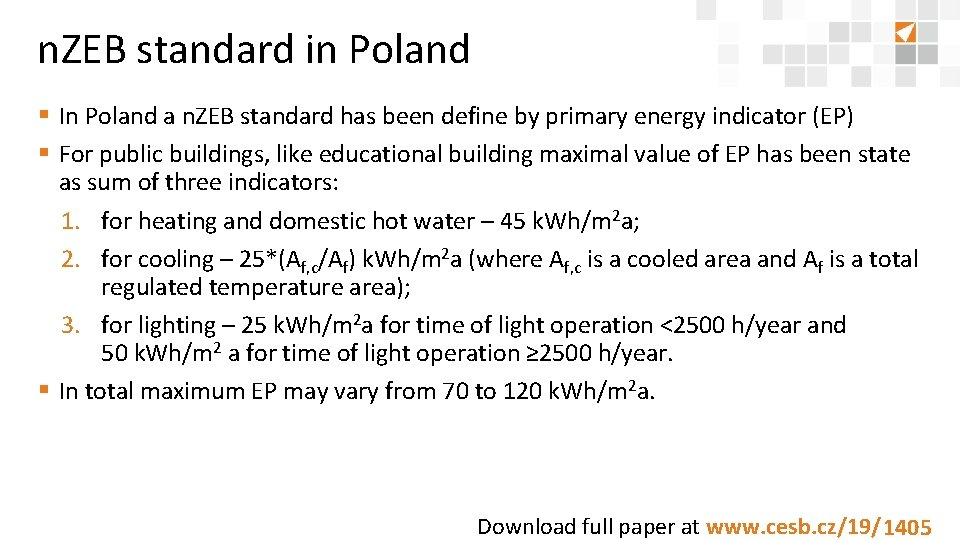
n. ZEB standard in Poland § In Poland a n. ZEB standard has been define by primary energy indicator (EP) § For public buildings, like educational building maximal value of EP has been state as sum of three indicators: 1. for heating and domestic hot water – 45 k. Wh/m 2 a; 2. for cooling – 25*(Af, c/Af) k. Wh/m 2 a (where Af, c is a cooled area and Af is a total regulated temperature area); 3. for lighting – 25 k. Wh/m 2 a for time of light operation <2500 h/year and 50 k. Wh/m 2 a for time of light operation ≥ 2500 h/year. § In total maximum EP may vary from 70 to 120 k. Wh/m 2 a. Download full paper at www. cesb. cz/19/8888 1405
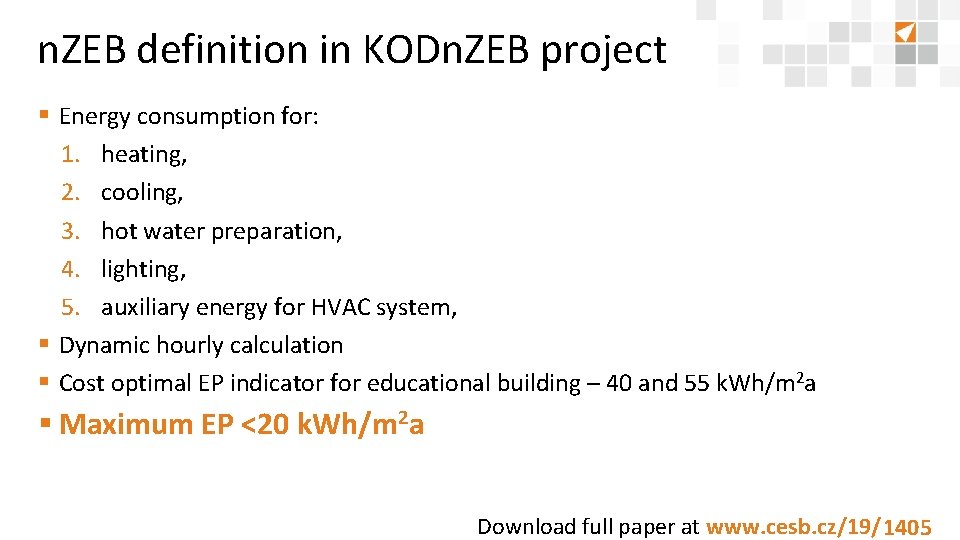
n. ZEB definition in KODn. ZEB project § Energy consumption for: 1. heating, 2. cooling, 3. hot water preparation, 4. lighting, 5. auxiliary energy for HVAC system, § Dynamic hourly calculation § Cost optimal EP indicator for educational building – 40 and 55 k. Wh/m 2 a § Maximum EP <20 k. Wh/m 2 a Download full paper at www. cesb. cz/19/8888 1405
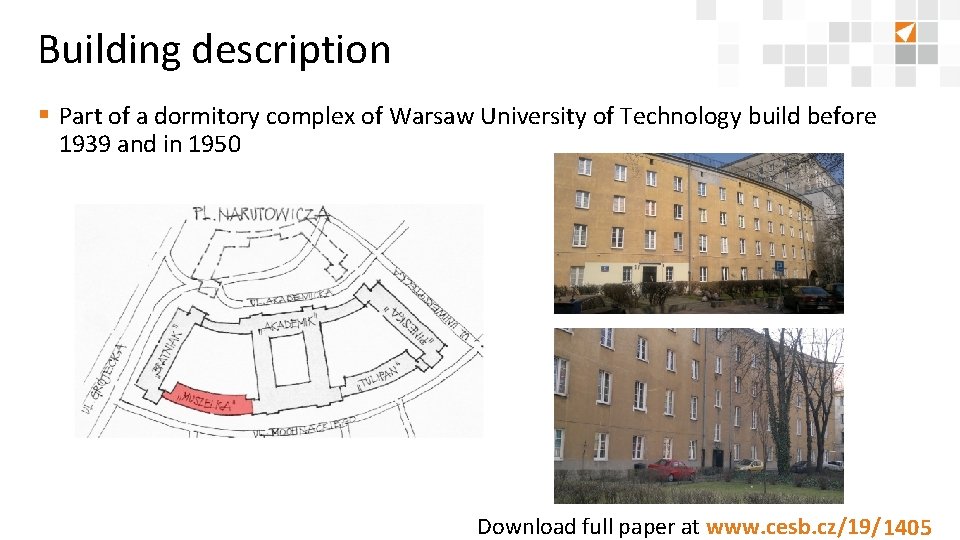
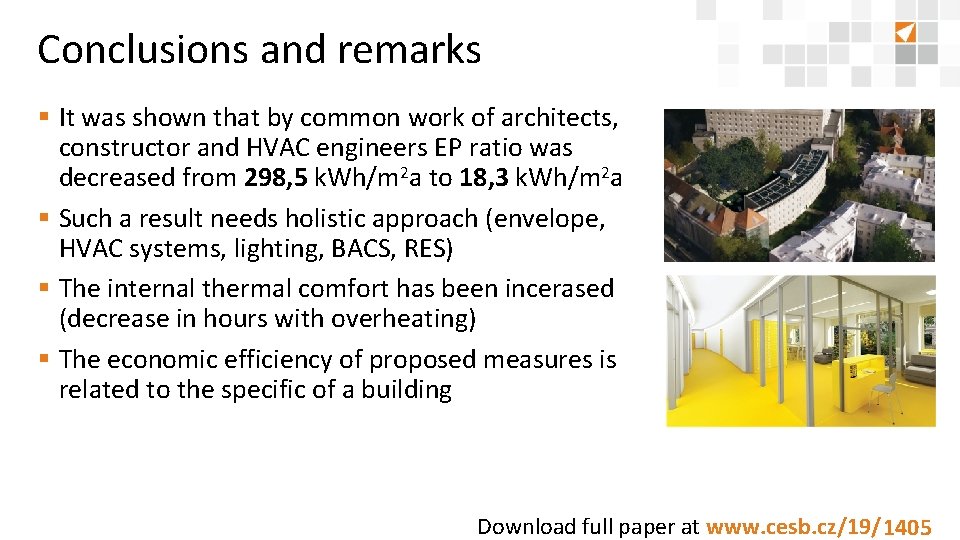
Building description § Part of a dormitory complex of Warsaw University of Technology build before 1939 and in 1950 Download full paper at www. cesb. cz/19/8888 1405
Energy performance of the building – existing state EP indicator [k. Wh/m 2 a] Heating and ventilation 140. 8 Domestic hot water 69. 1 Lighting 85. 3 Auxiliary energy 3. 3 PV installation Sum 0 298. 5 Any modernizations must be agreed with heritage protection officer. Download full paper at www. cesb. cz/19/8888 1405
Retrofitting measures ‐ envelope § Insulation of external walls –aerogel panels (λ=0, 015 W/m. K and the thickness of 4 cm); decrease of the heat transfer coefficient of walls from U=1, 09 W/m 2 K down to U=0, 279 W/m 2 K § Insulation of the ceiling between the top floor of the building and the unheated attic ‐ mineral wool (λ=0, 035 W/m. K and a thickness of 16 cm); decrease of the heat transfer coefficient of the ceiling from U=2, 02 W/m 2 K down to U=0, 197 W/m 2 K § Replacement of windows ‐ an improvement of the heat transfer coefficient of windows from U=1, 87 W/m 2 K to U=0, 70 W/m 2 K; decrease the air tightness coefficient from n 50=3, 0 1/h down to n 50=1, 5 1/h Download full paper at www. cesb. cz/19/8888 1405
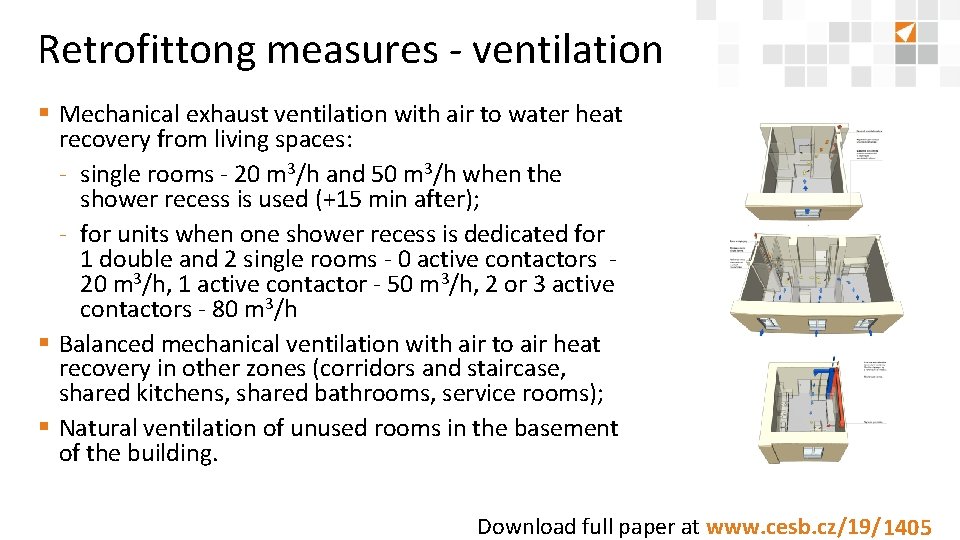
Retrofittong measures ‐ ventilation § Mechanical exhaust ventilation with air to water heat recovery from living spaces: ‐ single rooms ‐ 20 m 3/h and 50 m 3/h when the shower recess is used (+15 min after); ‐ for units when one shower recess is dedicated for 1 double and 2 single rooms ‐ 0 active contactors ‐ 20 m 3/h, 1 active contactor ‐ 50 m 3/h, 2 or 3 active contactors ‐ 80 m 3/h § Balanced mechanical ventilation with air to air heat recovery in other zones (corridors and staircase, shared kitchens, shared bathrooms, service rooms); § Natural ventilation of unused rooms in the basement of the building. Download full paper at www. cesb. cz/19/8888 1405
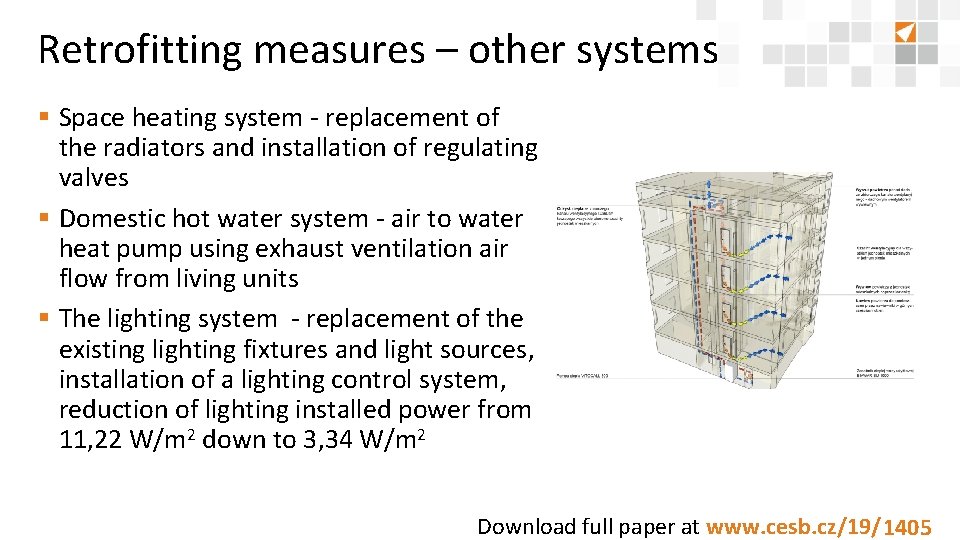
Retrofitting measures – other systems § Space heating system ‐ replacement of the radiators and installation of regulating valves § Domestic hot water system ‐ air to water heat pump using exhaust ventilation air flow from living units § The lighting system ‐ replacement of the existing lighting fixtures and light sources, installation of a lighting control system, reduction of lighting installed power from 11, 22 W/m 2 down to 3, 34 W/m 2 Download full paper at www. cesb. cz/19/8888 1405
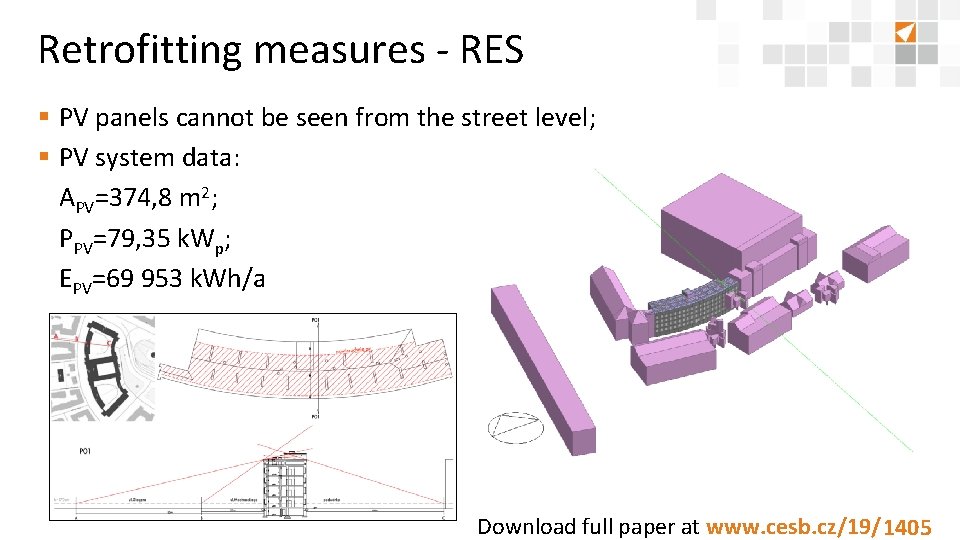
Retrofitting measures ‐ RES § PV panels cannot be seen from the street level; § PV system data: APV=374, 8 m 2; PPV=79, 35 k. Wp; EPV=69 953 k. Wh/a Download full paper at www. cesb. cz/19/8888 1405
Analysis of proposed measures Measure Simple pay-back time [years] Decrease of primary energy indicator [k. Wh/m 2 year] External wall 58. 8 26. 6 Cost of reduction of primary energy indicator reduction [€/(k. Wh/m 2 year)] 12 844 Roof 7. 1 11. 5 1 561 Windows 26. 9 14. 9 5 889 Ventilation system 5. 7 69. 4 1 286 Heating system 23. 9 7. 6 5 279 Lighting 73. 9 48. 0 4 405 Hot water system 0. 6 33. 3 131 Heat pump (hot water only) 9. 1 42. 6* 750 PV system 55. 9 58. 6 4 967 All measures 22. 8 280. 2 3 980 Download full paper at www. cesb. cz/19/8888 1405
Conclusions and remarks § It was shown that by common work of architects, constructor and HVAC engineers EP ratio was decreased from 298, 5 k. Wh/m 2 a to 18, 3 k. Wh/m 2 a § Such a result needs holistic approach (envelope, HVAC systems, lighting, BACS, RES) § The internal thermal comfort has been incerased (decrease in hours with overheating) § The economic efficiency of proposed measures is related to the specific of a building Download full paper at www. cesb. cz/19/8888 1405
Thank you for your attention! Jerzy KWIATKOWSKI jerzy. kwiatkowski@pw. edu. pl Scan QR or download full paper at www. cesb. cz/19/ ID 1405