
THERMAL PHYSICAL FOUNDATION OF HIGH TEMPERATURE TECHNOLOGIES Knyazeva


- Slides: 32
THERMAL PHYSICAL FOUNDATION OF HIGH TEMPERATURE TECHNOLOGIES Knyazeva A. G. (Anna Georgievna) Institute of Physics of High Technologies Lection 1 High temperature technology processes is characterized by the transformation of various energy types into heat energy; here concentration energy sources are have been used. Energy is used for material treatment and production 1
EXAMPLES OF HIGH TEMPERATURE TECHNOLOGIES - Laser and electron beam technologies (welding, cutting, thermal treatment); -arc welding and other ways of material conjugation (diffusion soldering, termite and SHS-welding) ; -plasmic technologies of coating deposition and surface treatment ; -ion technologies ; -oxygen cutting ; -combined technologies of cutting, welding, building-up ; -the processes of thin film obtaining and mono crystal growing ; -many processes of chemical and diffusion treatment of material surfaces. -many technologies of new materials development in chemical industry; -technologies of conversion and burning of natural fuel; -metallurgical processes etc. Each called high temperature process (HTP), in turn, includes many particular technologies depending on concrete technical solution, conditions and materials which are used here 2
High temperature technologies modeling is the part of thermal physics. This field of science has a long history and includes many applications: The construction of heat engines, gasifies, heat exchangers Combustion processes of solid, liquid and gaseous fuels The problems of thermal protection for aircrafts. The domestic space heating The heat transfer to long distance The natural processes in soils The cooling of working parts and mechanisms The problems of food keeping and freezing ……. Besides the basic of thermal physical processes, we will introduce some models of high technology processes 3
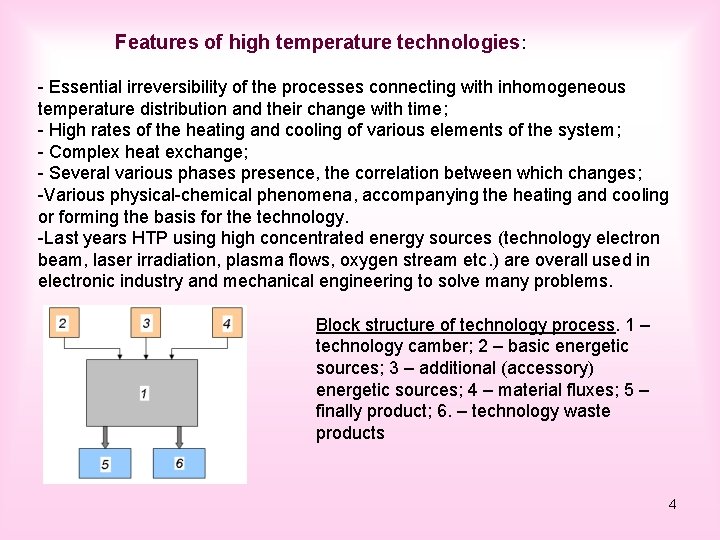
Features of high temperature technologies: - Essential irreversibility of the processes connecting with inhomogeneous temperature distribution and their change with time; - High rates of the heating and cooling of various elements of the system; - Complex heat exchange; - Several various phases presence, the correlation between which changes; -Various physical-chemical phenomena, accompanying the heating and cooling or forming the basis for the technology. -Last years HTP using high concentrated energy sources (technology electron beam, laser irradiation, plasma flows, oxygen stream etc. ) are overall used in electronic industry and mechanical engineering to solve many problems. Block structure of technology process. 1 – technology camber; 2 – basic energetic sources; 3 – additional (accessory) energetic sources; 4 – material fluxes; 5 – finally product; 6. – technology waste products 4
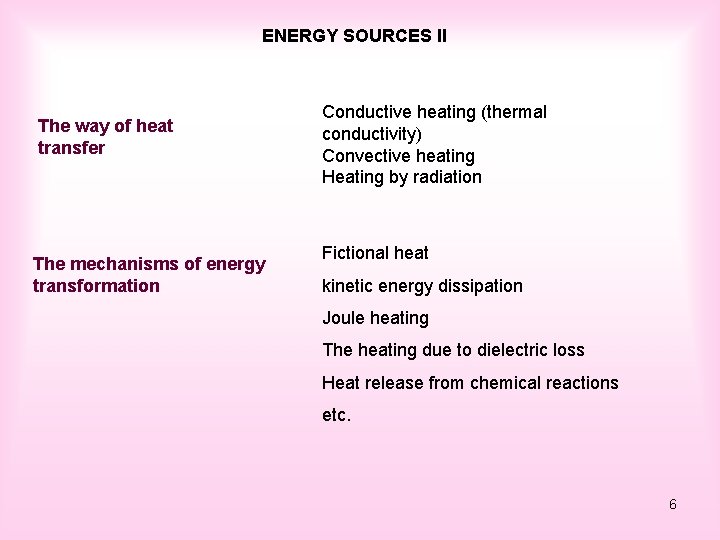
ENERGY SOURCES II The way of heat transfer The mechanisms of energy transformation Conductive heating (thermal conductivity) Convective heating Heating by radiation Fictional heat kinetic energy dissipation Joule heating The heating due to dielectric loss Heat release from chemical reactions etc. 6
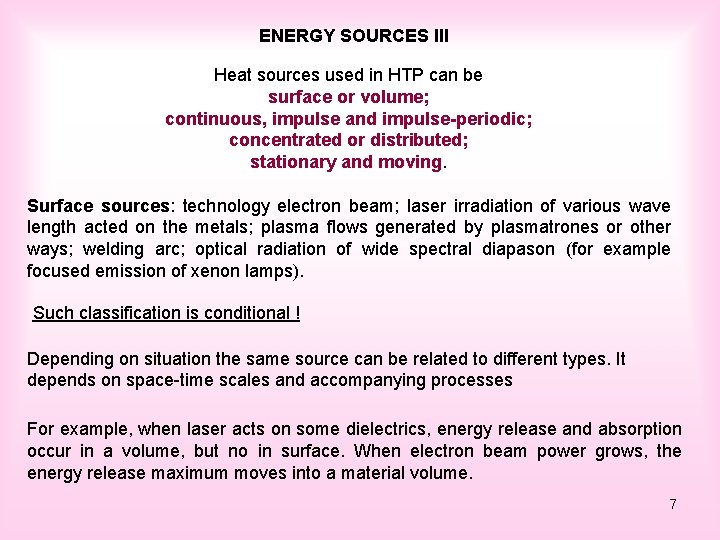
ENERGY SOURCES III Heat sources used in HTP can be surface or volume; continuous, impulse and impulse-periodic; concentrated or distributed; stationary and moving. Surface sources: technology electron beam; laser irradiation of various wave length acted on the metals; plasma flows generated by plasmatrones or other ways; welding arc; optical radiation of wide spectral diapason (for example focused emission of xenon lamps). Such classification is conditional ! Depending on situation the same source can be related to different types. It depends on space-time scales and accompanying processes For example, when laser acts on some dielectrics, energy release and absorption occur in a volume, but no in surface. When electron beam power grows, the energy release maximum moves into a material volume. 7
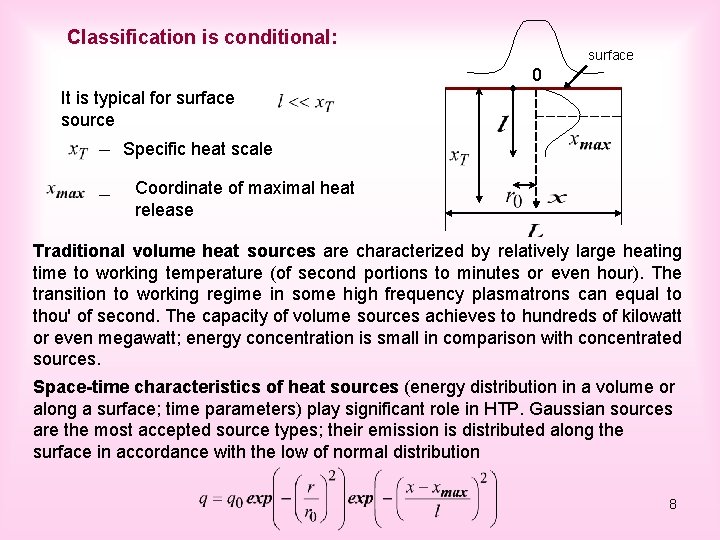
Classification is conditional: surface 0 It is typical for surface source Specific heat scale Coordinate of maximal heat release Traditional volume heat sources are characterized by relatively large heating time to working temperature (of second portions to minutes or even hour). The transition to working regime in some high frequency plasmatrons can equal to thou' of second. The capacity of volume sources achieves to hundreds of kilowatt or even megawatt; energy concentration is small in comparison with concentrated sources. Space-time characteristics of heat sources (energy distribution in a volume or along a surface; time parameters) play significant role in HTP. Gaussian sources are the most accepted source types; their emission is distributed along the surface in accordance with the low of normal distribution 8
Energy sources in modern technologies : Laser energy source. Laser technology (LT) Electron beam. Technology electron beam (TEB) high-current beam of particles The sources of ions and plasma. Ion-plasmous technologies Electric current. Resistive heating Our purpose consists in study thermal physical processes accompanying interrelation of various energy sources with substances using theoretical approaches 9
Mathematical modeling in the field of modern technologies includes - Investigations and development of physical and mathematical models of technology processes; - Development of analytical and numerical methods for the solution of thermalphysical problems corresponding to different model of various technologies; - Engineering relations obtaining to describe temperature and concentration field at the conditions of material treatments; - Investigation and development of the solution methods of inverse problems (including, heat exchange) as the way of technology processes design; - The study of conjugate and coupling problems to obtain more full information on heat and mass transfer at the condition of material treatment; the optimization conditions for technology processes and the methods for their realization; - The obtaining the conditions for monitoring, controlling and regulation of technology processes. Numerical experiment is used as during preliminary analysis of technology process (for identification of the model parameters; for adequacy checking and investigation of technology process) as during the synthesis of technology processes – for testing and comparison of project solutions. The using necessity of NE as the investigation method connects with following circumstance. The solution of modern science – technical problems characterizing extremely complex mathematical description is difficult and sometimes practically no 10 possible on the base of traditional analytical methods.
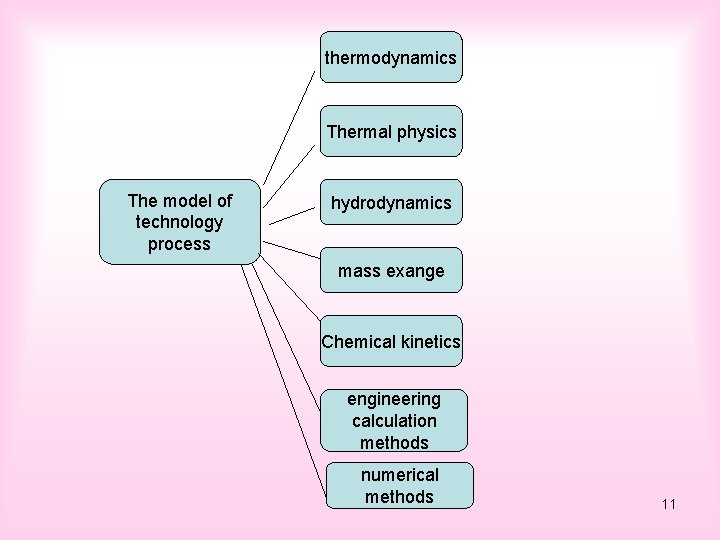
thermodynamics Thermal physics The model of technology process hydrodynamics mass exange Chemical kinetics engineering calculation methods numerical methods 11
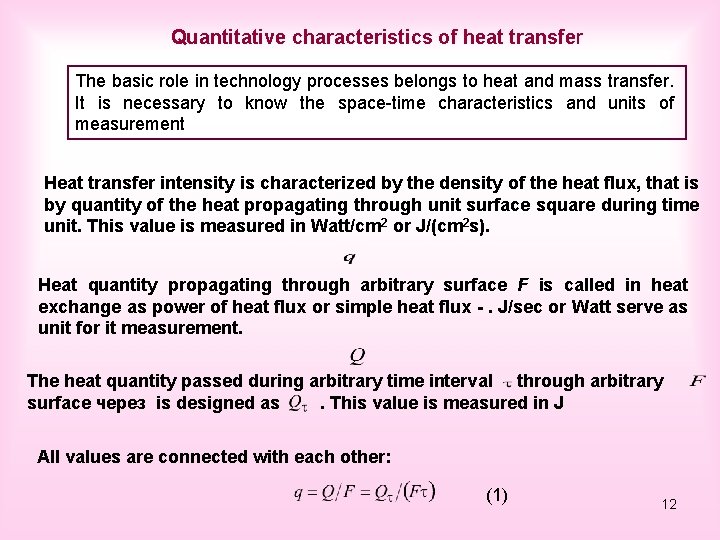
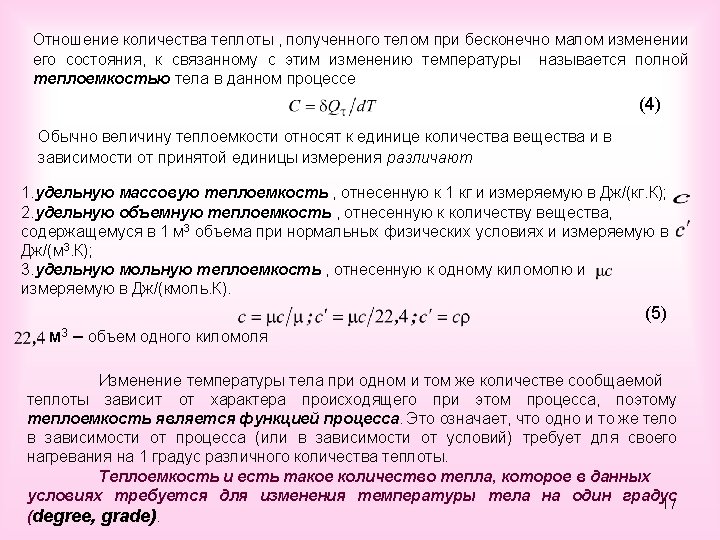
Quantitative characteristics of heat transfer The basic role in technology processes belongs to heat and mass transfer. It is necessary to know the space-time characteristics and units of measurement Heat transfer intensity is characterized by the density of the heat flux, that is by quantity of the heat propagating through unit surface square during time unit. This value is measured in Watt/cm 2 or J/(сm 2 s). Heat quantity propagating through arbitrary surface F is called in heat exchange as power of heat flux or simple heat flux -. J/sec or Watt serve as unit for it measurement. The heat quantity passed during arbitrary time interval through arbitrary surface через is designed as. This value is measured in J All values are connected with each other: (1) 12
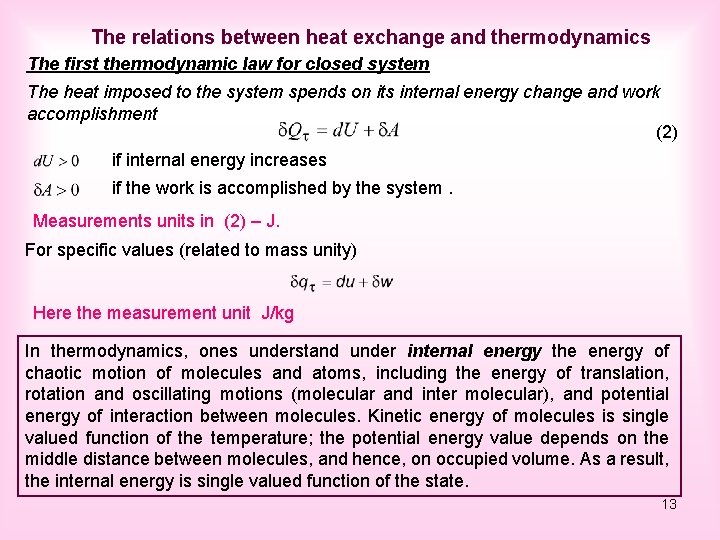
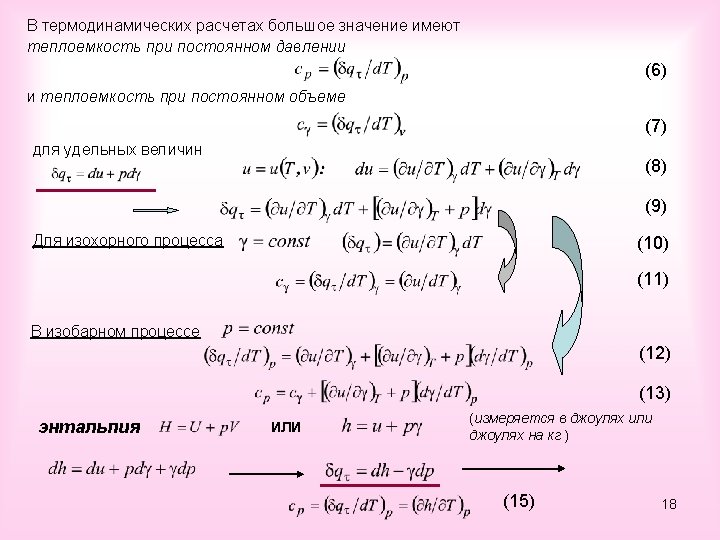
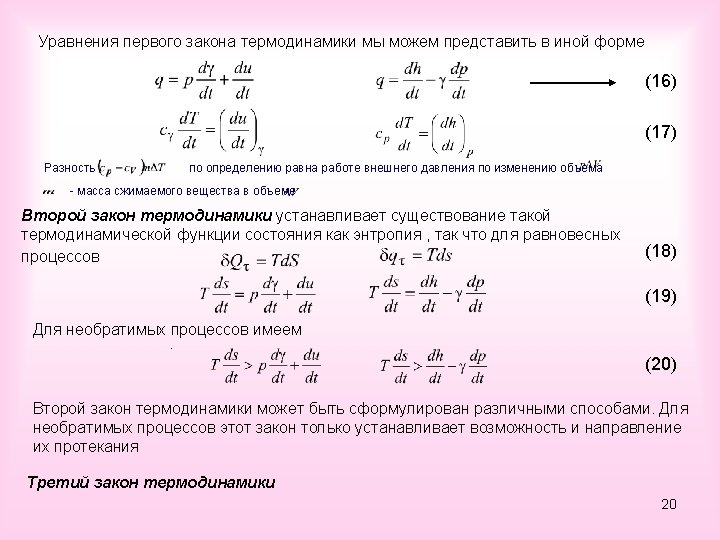
The relations between heat exchange and thermodynamics The first thermodynamic law for closed system The heat imposed to the system spends on its internal energy change and work accomplishment (2) if internal energy increases if the work is accomplished by the system. Measurements units in (2) – J. For specific values (related to mass unity) Here the measurement unit J/kg In thermodynamics, ones understand under internal energy the energy of chaotic motion of molecules and atoms, including the energy of translation, rotation and oscillating motions (molecular and inter molecular), and potential energy of interaction between molecules. Kinetic energy of molecules is single valued function of the temperature; the potential energy value depends on the middle distance between molecules, and hence, on occupied volume. As a result, the internal energy is single valued function of the state. 13
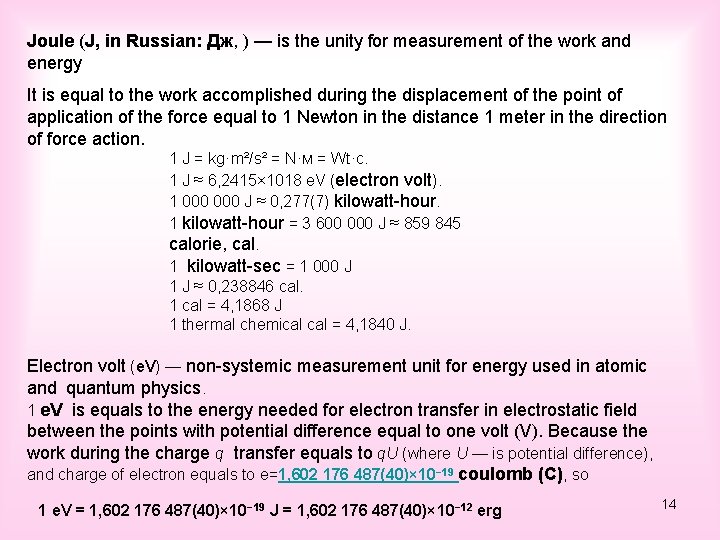
Joule (J, in Russian: Дж, ) — is the unity for measurement of the work and energy It is equal to the work accomplished during the displacement of the point of application of the force equal to 1 Newton in the distance 1 meter in the direction of force action. 1 J = kg·m²/s² = N·м = Wt·с. 1 J ≈ 6, 2415× 1018 e. V (electron volt). 1 000 J ≈ 0, 277(7) kilowatt-hour. 1 kilowatt-hour = 3 600 000 J ≈ 859 845 calorie, cal. 1 kilowatt-sec = 1 000 J 1 J ≈ 0, 238846 cal. 1 cal = 4, 1868 J 1 thermal chemical = 4, 1840 J. Electron volt (e. V) — non-systemic measurement unit for energy used in atomic and quantum physics. 1 e. V is equals to the energy needed for electron transfer in electrostatic field between the points with potential difference equal to one volt (V). Because the work during the charge q transfer equals to q. U (where U — is potential difference), and charge of electron equals to e=1, 602 176 487(40)× 10− 19 coulomb (C), so 1 e. V = 1, 602 176 487(40)× 10− 19 J = 1, 602 176 487(40)× 10− 12 erg 14
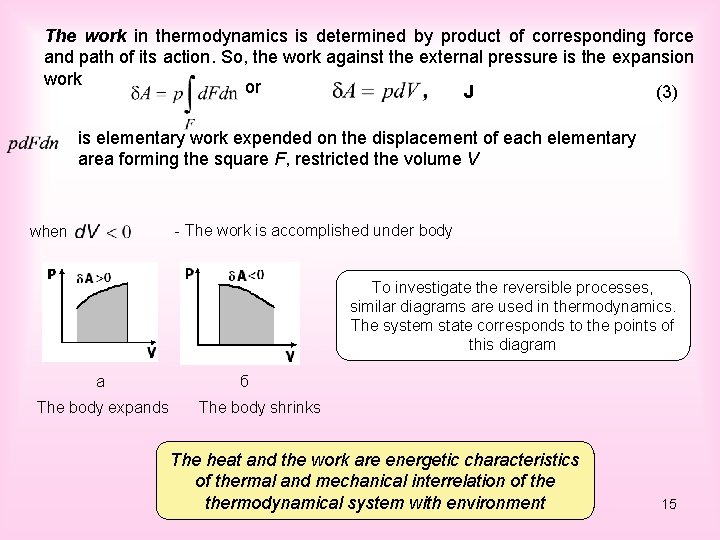
The work in thermodynamics is determined by product of corresponding force and path of its action. So, the work against the external pressure is the expansion work or J (3) is elementary work expended on the displacement of each elementary area forming the square F, restricted the volume V - The work is accomplished under body when To investigate the reversible processes, similar diagrams are used in thermodynamics. The system state corresponds to the points of this diagram а The body expands б The body shrinks The heat and the work are energetic characteristics of thermal and mechanical interrelation of thermodynamical system with environment 15
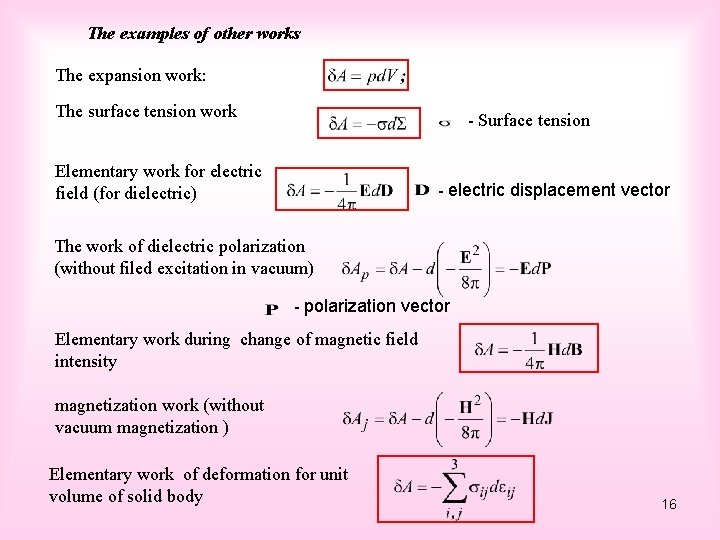
The examples of other works The expansion work: The surface tension work - Surface tension Elementary work for electric field (for dielectric) - electric displacement vector The work of dielectric polarization (without filed excitation in vacuum) - polarization vector Elementary work during change of magnetic field intensity magnetization work (without vacuum magnetization ) Elementary work of deformation for unit volume of solid body 16
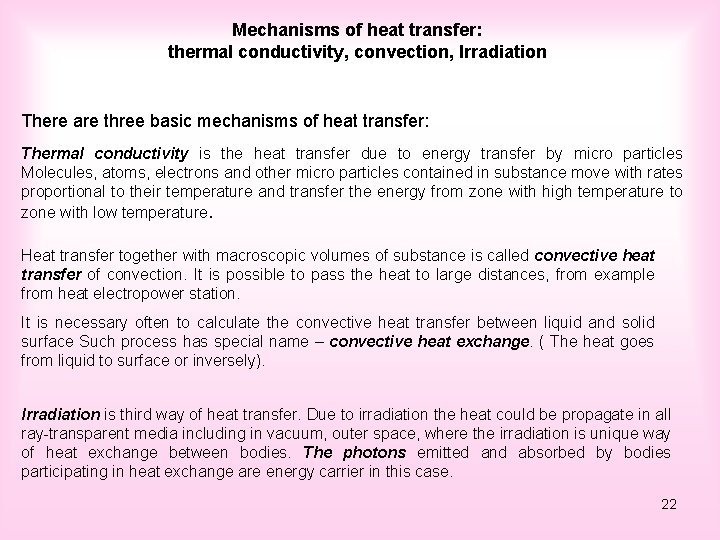
Mechanisms of heat transfer: thermal conductivity, convection, Irradiation There are three basic mechanisms of heat transfer: Thermal conductivity is the heat transfer due to energy transfer by micro particles Molecules, atoms, electrons and other micro particles contained in substance move with rates proportional to their temperature and transfer the energy from zone with high temperature to zone with low temperature. Heat transfer together with macroscopic volumes of substance is called convective heat transfer of convection. It is possible to pass the heat to large distances, from example from heat electropower station. It is necessary often to calculate the convective heat transfer between liquid and solid surface Such process has special name – convective heat exchange. ( The heat goes from liquid to surface or inversely). Irradiation is third way of heat transfer. Due to irradiation the heat could be propagate in all ray-transparent media including in vacuum, outer space, where the irradiation is unique way of heat exchange between bodies. The photons emitted and absorbed by bodies participating in heat exchange are energy carrier in this case. 22
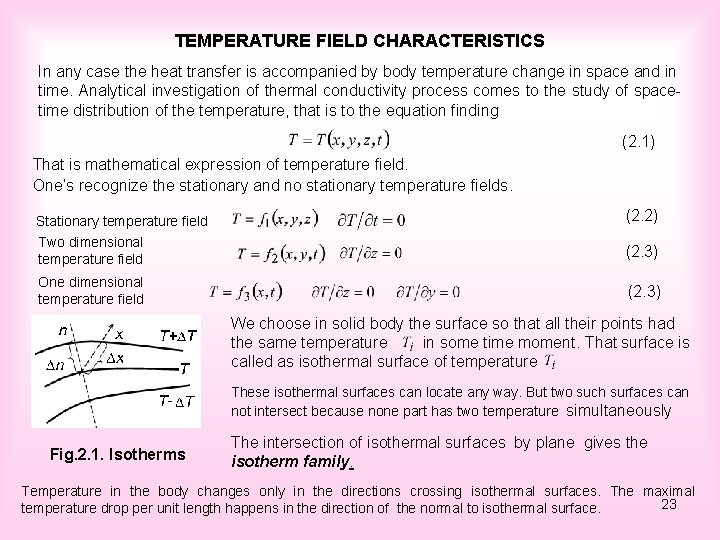
TEMPERATURE FIELD CHARACTERISTICS In any case the heat transfer is accompanied by body temperature change in space and in time. Analytical investigation of thermal conductivity process comes to the study of spacetime distribution of the temperature, that is to the equation finding (2. 1) That is mathematical expression of temperature field. One’s recognize the stationary and no stationary temperature fields. Stationary temperature field (2. 2) Two dimensional temperature field (2. 3) One dimensional temperature field (2. 3) We choose in solid body the surface so that all their points had the same temperature in some time moment. That surface is called as isothermal surface of temperature These isothermal surfaces can locate any way. But two such surfaces can not intersect because none part has two temperature simultaneously Fig. 2. 1. Isotherms The intersection of isothermal surfaces by plane gives the isotherm family. Temperature in the body changes only in the directions crossing isothermal surfaces. The maximal 23 temperature drop per unit length happens in the direction of the normal to isothermal surface.
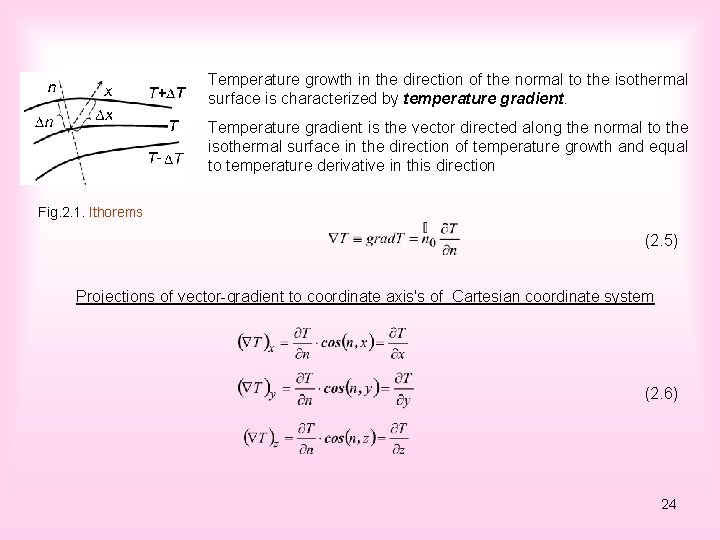
Temperature growth in the direction of the normal to the isothermal surface is characterized by temperature gradient. Temperature gradient is the vector directed along the normal to the isothermal surface in the direction of temperature growth and equal to temperature derivative in this direction Fig. 2. 1. Ithorems (2. 5) Projections of vector-gradient to coordinate axis's of Cartesian coordinate system (2. 6) 24
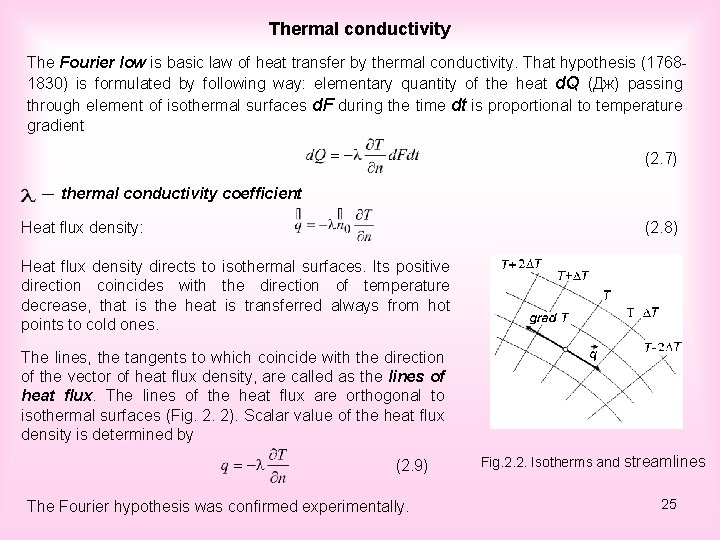
Thermal conductivity The Fourier low is basic law of heat transfer by thermal conductivity. That hypothesis (17681830) is formulated by following way: elementary quantity of the heat d. Q (Дж) passing through element of isothermal surfaces d. F during the time dt is proportional to temperature gradient (2. 7) thermal conductivity coefficient Heat flux density: (2. 8) Heat flux density directs to isothermal surfaces. Its positive direction coincides with the direction of temperature decrease, that is the heat is transferred always from hot points to cold ones. The lines, the tangents to which coincide with the direction of the vector of heat flux density, are called as the lines of heat flux. The lines of the heat flux are orthogonal to isothermal surfaces (Fig. 2. 2). Scalar value of the heat flux density is determined by (2. 9) The Fourier hypothesis was confirmed experimentally. Fig. 2. 2. Isotherms and streamlines 25
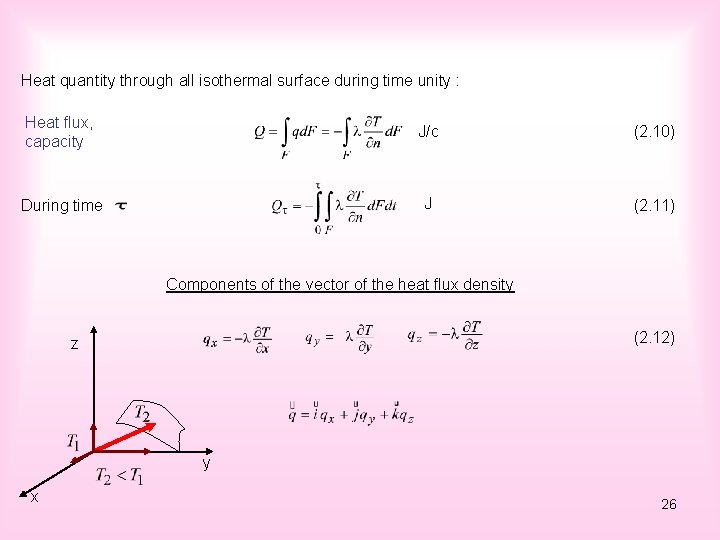
Heat quantity through all isothermal surface during time unity : Heat flux, capacity J/с (2. 10) During time J (2. 11) Components of the vector of the heat flux density (2. 12) z y x 26
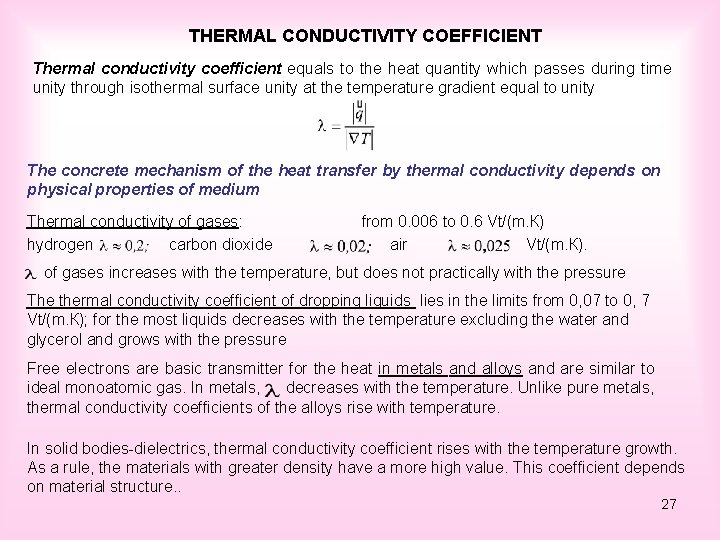
THERMAL CONDUCTIVITY COEFFICIENT Thermal conductivity coefficient equals to the heat quantity which passes during time unity through isothermal surface unity at the temperature gradient equal to unity The concrete mechanism of the heat transfer by thermal conductivity depends on physical properties of medium Thermal conductivity of gases: hydrogen carbon dioxide from 0. 006 to 0. 6 Vt/(m. К) air Vt/(m. К). of gases increases with the temperature, but does not practically with the pressure The thermal conductivity coefficient of dropping liquids lies in the limits from 0, 07 to 0, 7 Vt/(m. К); for the most liquids decreases with the temperature excluding the water and glycerol and grows with the pressure Free electrons are basic transmitter for the heat in metals and alloys and are similar to ideal monoatomic gas. In metals, decreases with the temperature. Unlike pure metals, thermal conductivity coefficients of the alloys rise with temperature. In solid bodies-dielectrics, thermal conductivity coefficient rises with the temperature growth. As a rule, the materials with greater density have a more high value. This coefficient depends on material structure. . 27
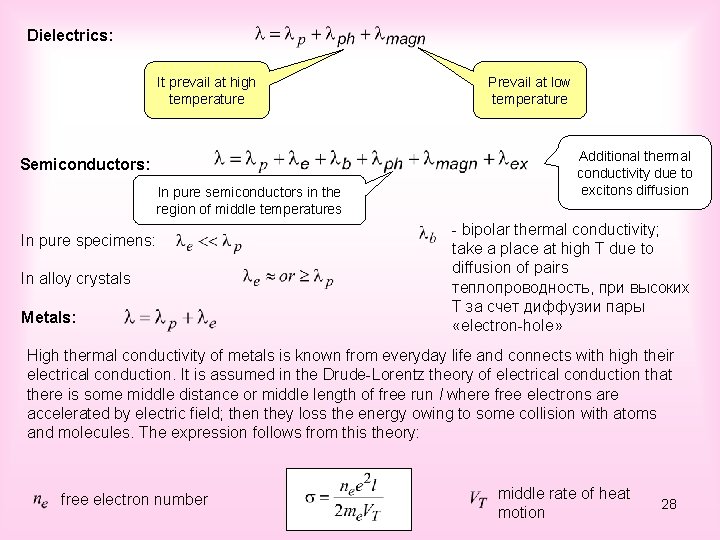
Dielectrics: It prevail at high temperature Semiconductors: In pure semiconductors in the region of middle temperatures In pure specimens: In alloy crystals Metals: Prevail at low temperature Additional thermal conductivity due to excitons diffusion - bipolar thermal conductivity; take a place at high T due to diffusion of pairs теплопроводность, при высоких T за счет диффузии пары «electron-hole» High thermal conductivity of metals is known from everyday life and connects with high their electrical conduction. It is assumed in the Drude-Lorentz theory of electrical conduction that there is some middle distance or middle length of free run l where free electrons are accelerated by electric field; then they loss the energy owing to some collision with atoms and molecules. The expression follows from this theory: free electron number middle rate of heat motion 28
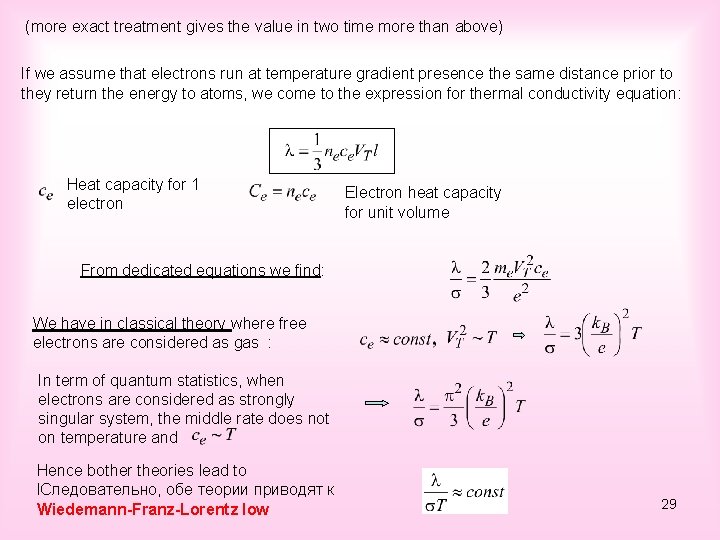
(more exact treatment gives the value in two time more than above) If we assume that electrons run at temperature gradient presence the same distance prior to they return the energy to atoms, we come to the expression for thermal conductivity equation: Heat capacity for 1 electron Electron heat capacity for unit volume From dedicated equations we find: We have in classical theory where free electrons are considered as gas : In term of quantum statistics, when electrons are considered as strongly singular system, the middle rate does not on temperature and Hence bother theories lead to l. Следовательно, обе теории приводят к Wiedemann-Franz-Lorentz low 29
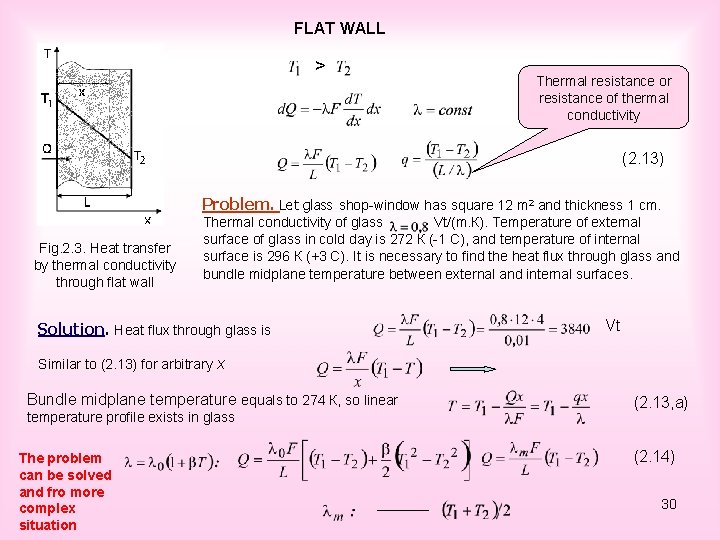
FLAT WALL > Thermal resistance or resistance of thermal conductivity (2. 13) Problem. Let glass shop-window has square 12 m 2 and thickness 1 cm. Fig. 2. 3. Heat transfer by thermal conductivity through flat wall Thermal conductivity of glass Vt/(m. К). Temperature of external surface of glass in cold day is 272 К (-1 С), and temperature of internal surface is 296 К (+3 С). It is necessary to find the heat flux through glass and bundle midplane temperature between external and internal surfaces. Solution. Heat flux through glass is Vt Similar to (2. 13) for arbitrary x Bundle midplane temperature equals to 274 К, so linear temperature profile exists in glass The problem can be solved and fro more complex situation (2. 13, а) (2. 14) 30
This and other problems can be solved enough rigorous with the help of modern methods of mathematical physics 31