
Thermal Infrared Remote Sensing Introduction All previous sensor




- Slides: 21
Thermal Infrared Remote Sensing
Introduction • All previous sensor systems discussed sensing or measuring reflected solar radiation • In thermal infrared we measure emitted terrestrial radiation – Energy is first absorbed, then is emitted by the object Reflected Emitted Absorption
Comparison of Reflective and Thermal Bands Landsat 7 ETM+ data
Day and Night Thermal Images Lillesand & Kiefer
• The level of radiation emitted by objects is determined by their • temperature • emissivity • Absorption, not scattering, is the dominant atmospheric effect
Temperature • Concentration of internal thermal energy – is a measure of the average kinetic energy of atomic and molecular motions within bodies above absolute zero (0 degrees Kelvin) • Interactions (collisions) among these units lead to changes in energy --emitted as radiation that can be detected externally.
Thermal Energy of an Object is Indicated by its: • Kinetic Temperature – is measured by a thermometer – also called internal, real, contact and thermodynamic temperature • Radiant Temperature – is measured by a radiometer – also called external, apparent and noncontact temperature
Relation between Kinetic and Radiant Temperatures • If the emissivity of an object is 1 (i. e. , a perfect blackbody), then its kinetic temperature equals its radiant temperature • But, for natural or graybodies, the kinetic and radiant temperatures differ according to the emissivity of the body
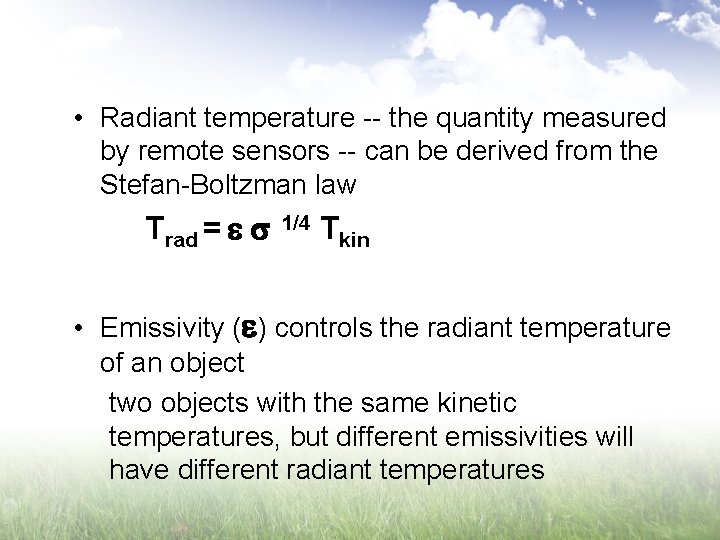
• Radiant temperature -- the quantity measured by remote sensors -- can be derived from the Stefan-Boltzman law Trad = 1/4 Tkin • Emissivity ( ) controls the radiant temperature of an object two objects with the same kinetic temperatures, but different emissivities will have different radiant temperatures
Summary of Basic Thermal Properties • Temperature of an object measured remotely is known as its radiant or apparent temperature • Radiant temperature is the blackbody or kinetic temperature reduced by its emissivity • Remotely sensed thermal IR radiances are a composite of emitted energy, emissivity, and atmospheric and sensor effects
• Time of day is critical to assessing temperature response patterns Radiant Temperature Diurnal Variation in Radiant Temperatures Dawn Noon Sunset Avery & Berlin, 1992
Reflective Bands Thermal Infrared Bands Death Valley,
Thermal IR image of Lake Tahoe over Landsat TM image
Thermal and Visible Images of Glen Canyon and Surrounding Sandstone
Urban Heat Island Effects Surface Temperature Feb. 27, 2001 282 K Minneapolis St. Paul 251 K MUSA Boundary
Urban Heat Island Effects Surface Temperature July 16, 2002 318 K Minneapolis 251 K MUSA Boundary St. Paul
Day (left) and night (right) thermal images of a power plant with plume of hot water coming into river An example of density slicing Lillesand & Kieffer
Detection of Building Heat Loss Remote Sensing Tutorial
Fire Detection
Atlantic Gulf Stream Temperatures temperature range, 5 – 25 C
Global Sea Surface Temperature