
Thermal Inertia of Binary NearEarth Asteroids Ben Rozitis
Thermal Inertia of Binary Near-Earth Asteroids Ben Rozitis with E. C. Brown, S. F. Green, S. C. Lowry, A. Fitzsimmons, A. Rozek, C. Snodgrass, P. Weissman & T. Zegmott 1/16
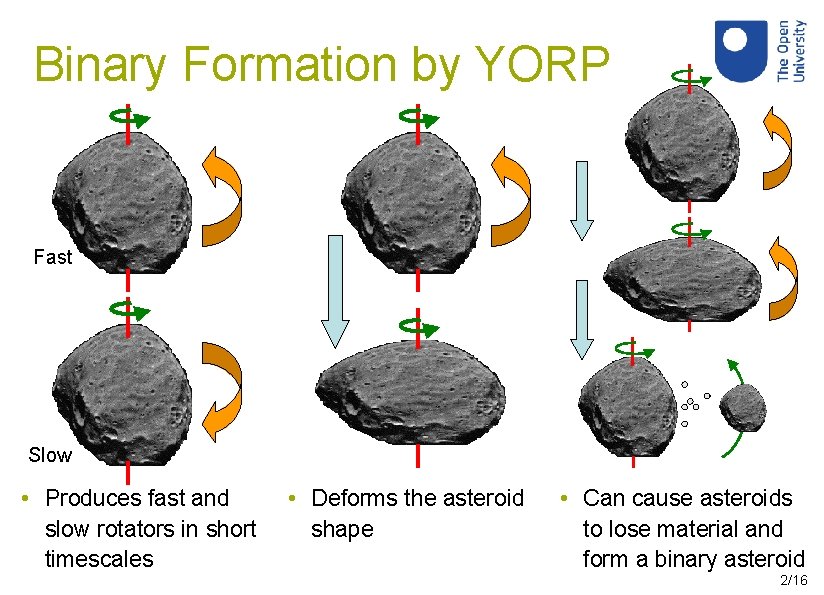
Binary Formation by YORP Fast Slow • Produces fast and slow rotators in short timescales • Deforms the asteroid shape • Can cause asteroids to lose material and form a binary asteroid 2/16
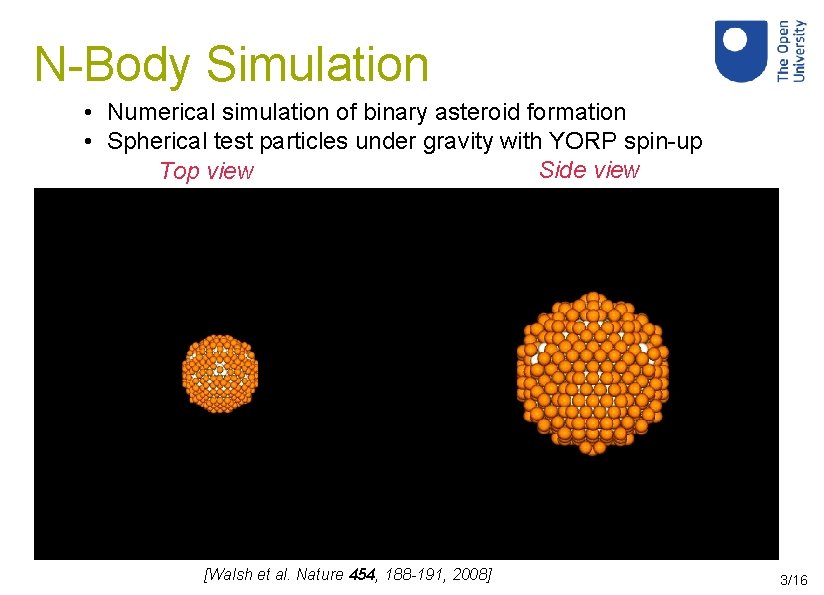
N-Body Simulation • Numerical simulation of binary asteroid formation • Spherical test particles under gravity with YORP spin-up Side view Top view [Walsh et al. Nature 454, 188 -191, 2008] 3/16

N-Body Simulation • Produces orbit and shape consistent with observed NEA binaries 1999 KW 4 radar model, Ostro et al. 2005 [Ostro et al. , Science 314, 1276, 2006] 4/16
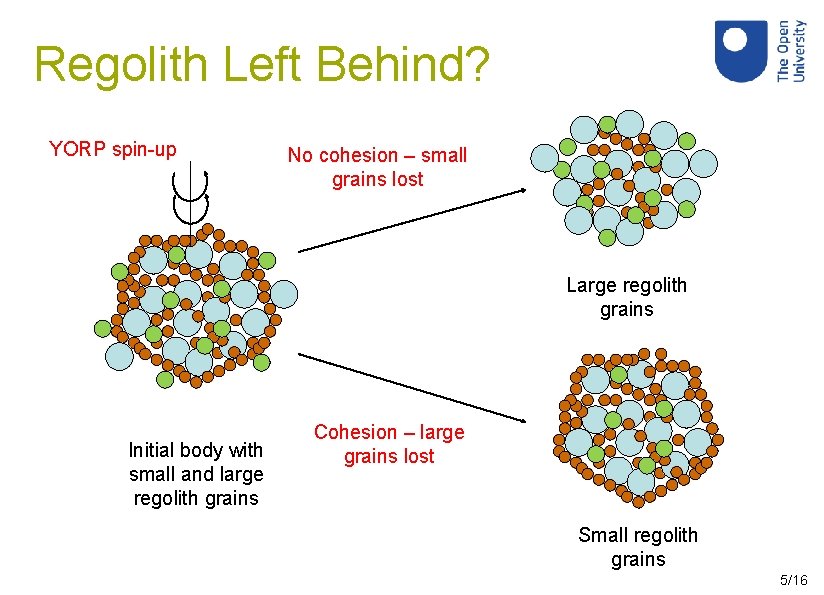
Regolith Left Behind? YORP spin-up No cohesion – small grains lost Large regolith grains Initial body with small and large regolith grains Cohesion – large grains lost Small regolith grains 5/16

Thermal Inertia • Is a measure of a material’s resistance to temperature change • Can infer the presence or absence of loose material on a planetary surface Thermal Inertia Lunar Regolith Density Coarse Sand Specific Heat Capacity Heat Conductivity Pebbles Increasing Thermal Inertia Solid Rock Metal Rich Asteroidal Fragments 6/16
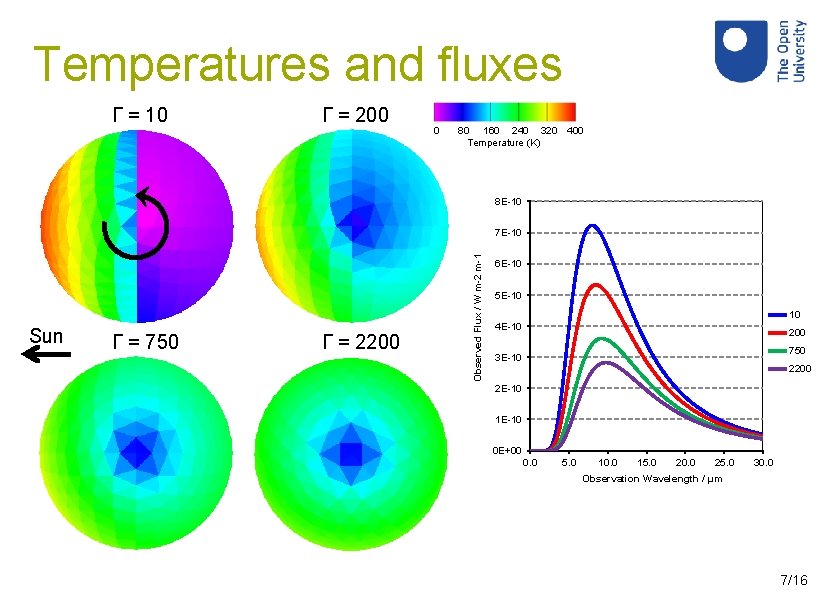
Temperatures and fluxes Γ = 10 Γ = 200 0 80 160 240 320 400 Temperature (K) 8 E-10 Sun Γ = 750 Γ = 2200 Observed Flux / W m-2 m-1 7 E-10 6 E-10 5 E-10 10 4 E-10 200 750 3 E-10 2200 2 E-10 1 E-10 0 E+00 0. 0 5. 0 10. 0 15. 0 20. 0 25. 0 30. 0 Observation Wavelength / μm 7/16
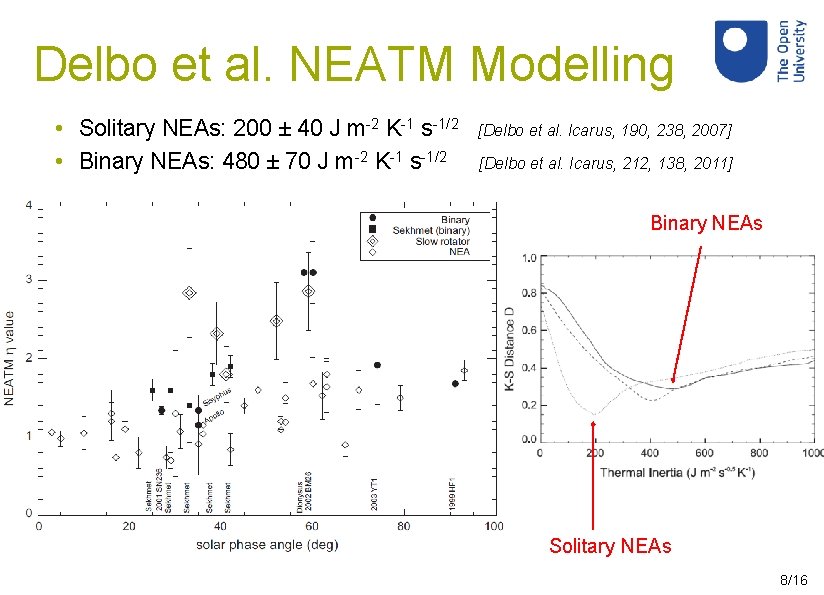
Delbo et al. NEATM Modelling • Solitary NEAs: 200 ± 40 J m-2 K-1 s-1/2 • Binary NEAs: 480 ± 70 J m-2 K-1 s-1/2 [Delbo et al. Icarus, 190, 238, 2007] [Delbo et al. Icarus, 212, 138, 2011] Binary NEAs Solitary NEAs 8/16
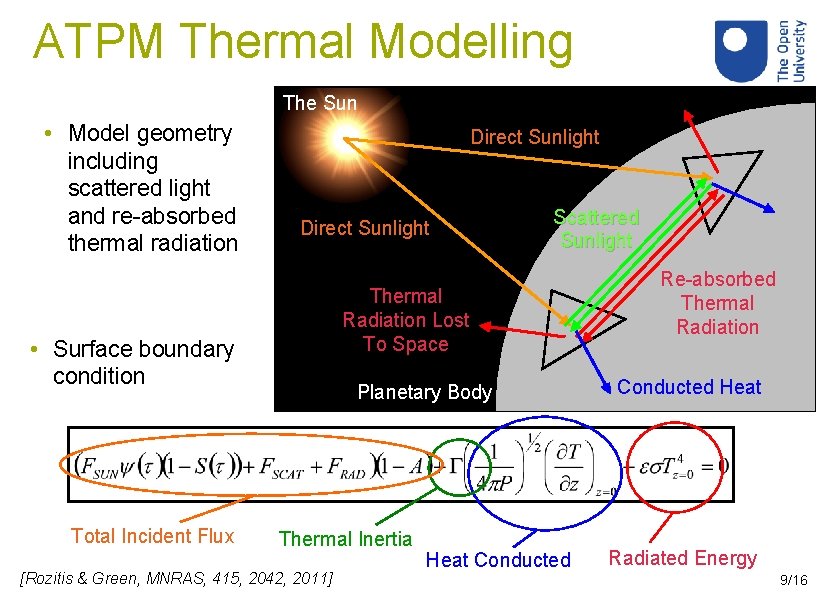
ATPM Thermal Modelling The Sun • Model geometry including scattered light and re-absorbed thermal radiation Direct Sunlight Thermal Radiation Lost To Space • Surface boundary condition Total Incident Flux Scattered Sunlight Planetary Body Thermal Inertia [Rozitis & Green, MNRAS, 415, 2042, 2011] Heat Conducted Re-absorbed Thermal Radiation Conducted Heat Radiated Energy 9/16

(1862) Apollo Thermal-IR • Strong detections of Yarkovsky orbital drift and YORP rotational acceleration, and has a diverse observational dataset TI Distribution Normalised Frequency Observed Flux (10 -14 W m-2 μm-1) 0. 08 1 Thermal-IR Spectrum 0. 1 0. 06 0. 04 0. 02 0. 00 0 5 10 15 Wavelength (μm) 20 25 0 200 400 600 800 1000 Thermal Inertia (J m-2 K-1 s-1/2) [Rozitis et al. A&A, 555, A 20, 2013] • ATPM fitting determines: D = 1. 55 ± 0. 07 km Γ = 140 +140/-100 J m-2 K-1 s-1/2 pv = 0. 20 ± 0. 07 f = 60 ± 30 % 10/16
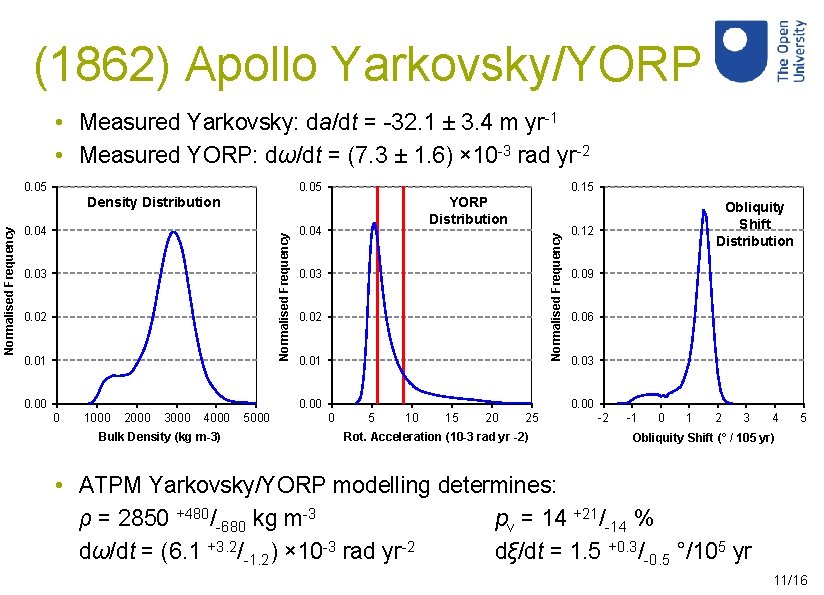
(1862) Apollo Yarkovsky/YORP • Measured Yarkovsky: da/dt = -32. 1 ± 3. 4 m yr-1 • Measured YORP: dω/dt = (7. 3 ± 1. 6) × 10 -3 rad yr-2 0. 05 0. 15 0. 03 0. 02 0. 01 0. 00 YORP Distribution 0. 04 Normalised Frequency Density Distribution 0. 03 0. 02 0. 01 0. 00 0 1000 2000 3000 4000 Bulk Density (kg m-3) 5000 Obliquity Shift Distribution 0. 12 0. 09 0. 06 0. 03 0. 00 0 5 10 15 20 25 Rot. Acceleration (10 -3 rad yr -2) -2 -1 0 1 2 3 4 5 Obliquity Shift (° / 105 yr) • ATPM Yarkovsky/YORP modelling determines: ρ = 2850 +480/-680 kg m-3 pv = 14 +21/-14 % dω/dt = (6. 1 +3. 2/-1. 2) × 10 -3 rad yr-2 dξ/dt = 1. 5 +0. 3/-0. 5 °/105 yr 11/16
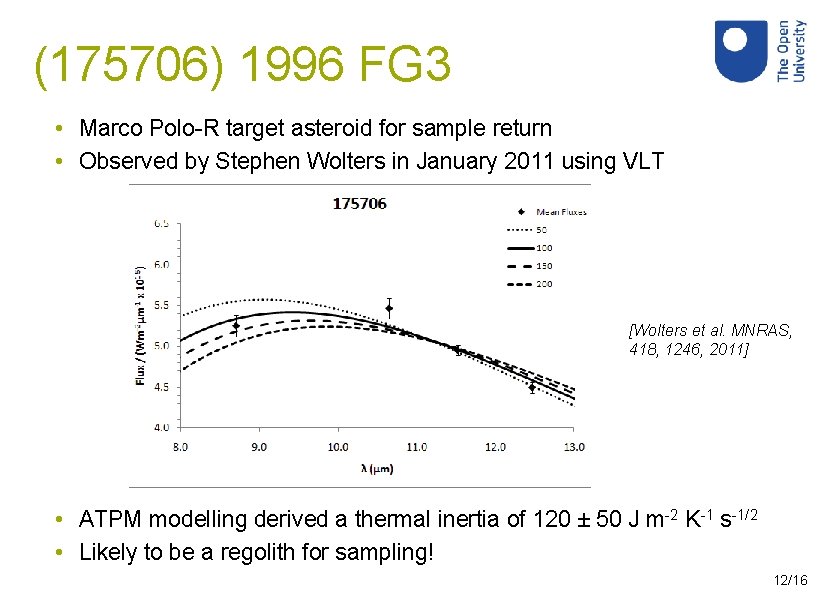
(175706) 1996 FG 3 • Marco Polo-R target asteroid for sample return • Observed by Stephen Wolters in January 2011 using VLT [Wolters et al. MNRAS, 418, 1246, 2011] • ATPM modelling derived a thermal inertia of 120 ± 50 J m-2 K-1 s-1/2 • Likely to be a regolith for sampling! 12/16
![(276049) 2002 CE 26 Shape from Shepard et al. [Icarus 184, 198, 2006] •](http://slidetodoc.com/presentation_image_h2/5aa1d4cffe384ebd4f0fbb6e12db4ecd/image-13.jpg "(276049) 2002 CE 26 Shape from Shepard et al. [Icarus 184, 198, 2006] •")
(276049) 2002 CE 26 Shape from Shepard et al. [Icarus 184, 198, 2006] • C-type binary asteroid • D = 3. 5 km, Prot = 3. 29 hr • NEOWISE observations and ATPM modelling give: - Γ = 50 ± 30 at 2. 98 AU - Γ = 100 ± 30 at 1. 84 AU - Γ = 170 ± 30 at 1. 32 AU Rozitis et al. MNRAS, 477, 1782, 2018 13/16
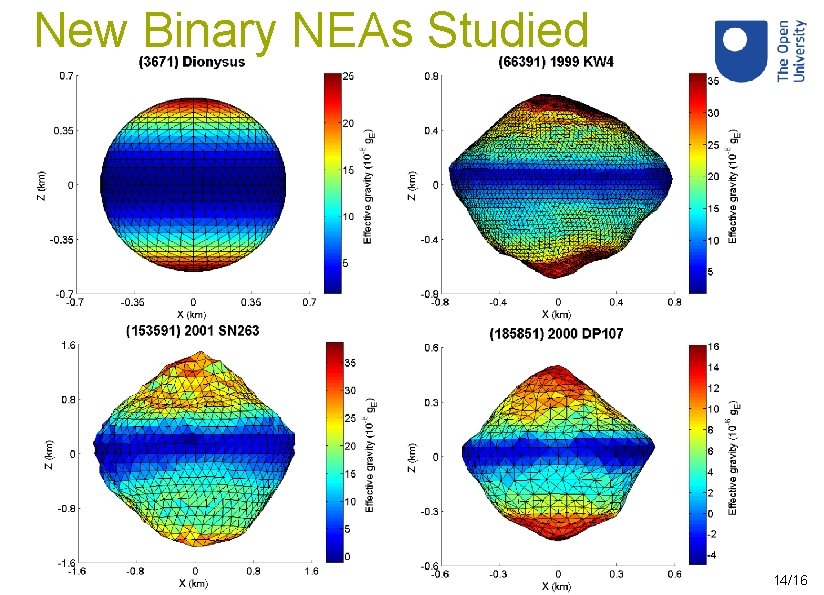
New Binary NEAs Studied 14/16
Results and conclusions Sorry – not for public consumption yet See Rozitis et al. presentation at EPSC and published paper to follow 15/16
- Slides: 15