
THERMAL FILAMENTATION AND RAMAN AMPLIFICATION OF SHORT WAVELENGTHS

- Slides: 15
THERMAL FILAMENTATION AND RAMAN AMPLIFICATION OF SHORT WAVELENGTHS Bob Bingham Cf. FP and U of Strathclyde R Trines, F Fiuza, J Santos, R Fonseca, L Silva, A Cairns. P Norreys
Overview • Raman Amplification at short wavelengths • Filamentation instability: Ponderomotive vs Thermal • Bandwidth issues • Conclusions
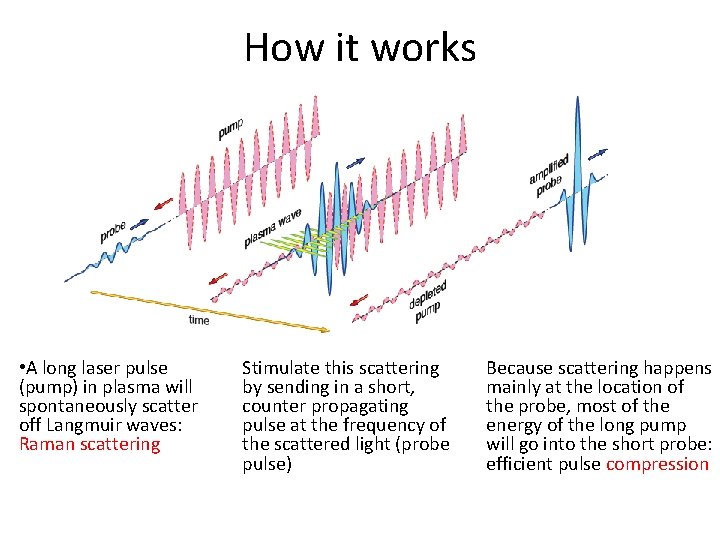
How it works • A long laser pulse (pump) in plasma will spontaneously scatter off Langmuir waves: Raman scattering Stimulate this scattering by sending in a short, counter propagating pulse at the frequency of the scattered light (probe pulse) Because scattering happens mainly at the location of the probe, most of the energy of the long pump will go into the short probe: efficient pulse compression
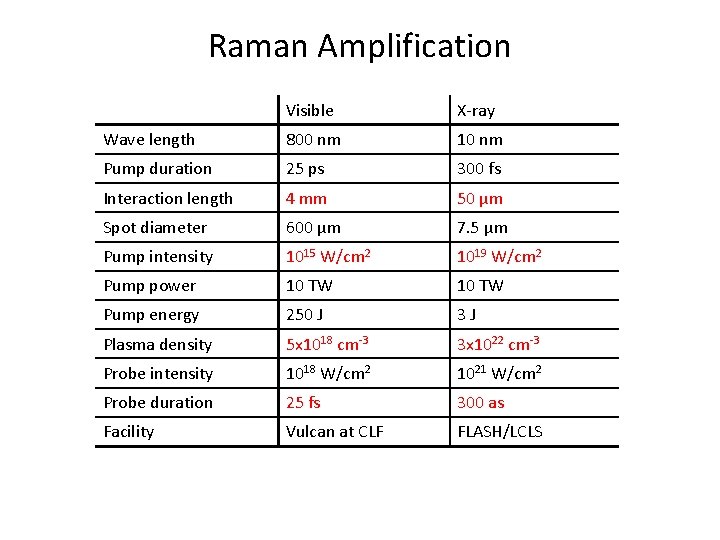
Raman Amplification Visible X-ray Wave length 800 nm 10 nm Pump duration 25 ps 300 fs Interaction length 4 mm 50 μm Spot diameter 600 μm 7. 5 μm Pump intensity 1015 W/cm 2 1019 W/cm 2 Pump power 10 TW Pump energy 250 J 3 J Plasma density 5 x 1018 cm-3 3 x 1022 cm-3 Probe intensity 1018 W/cm 2 1021 W/cm 2 Probe duration 25 fs 300 as Facility Vulcan at CLF FLASH/LCLS
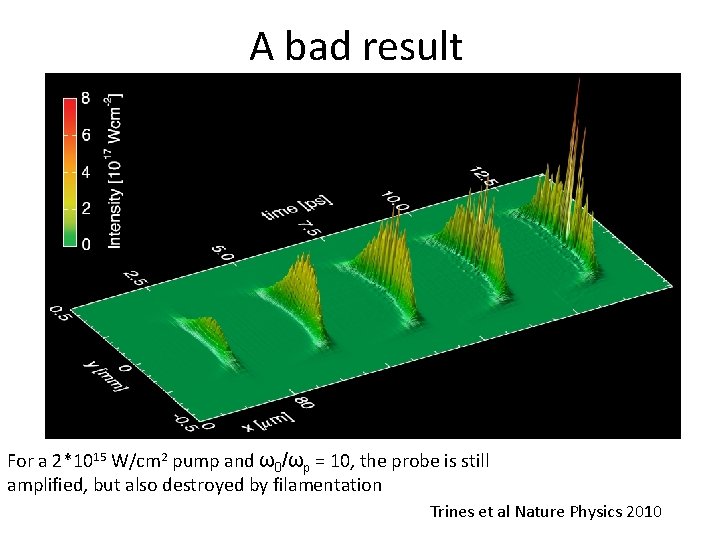
A bad result For a 2*1015 W/cm 2 pump and ω0/ωp = 10, the probe is still amplified, but also destroyed by filamentation Trines et al Nature Physics 2010
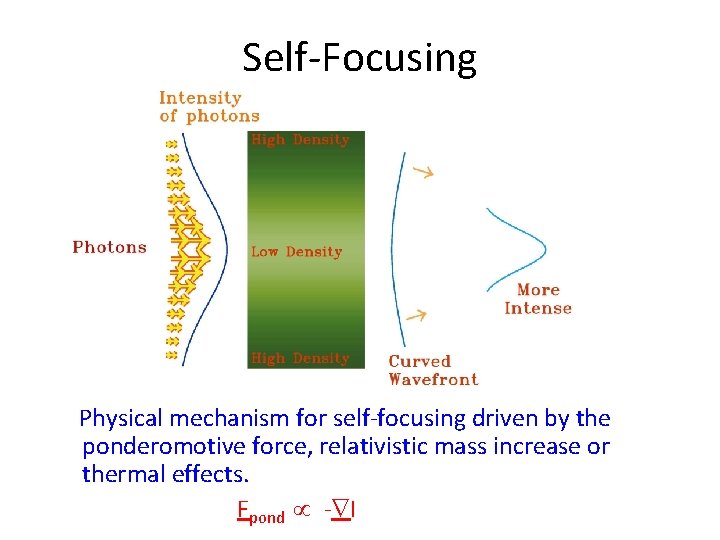
Self-Focusing Physical mechanism for self-focusing driven by the ponderomotive force, relativistic mass increase or thermal effects. Fpond - I
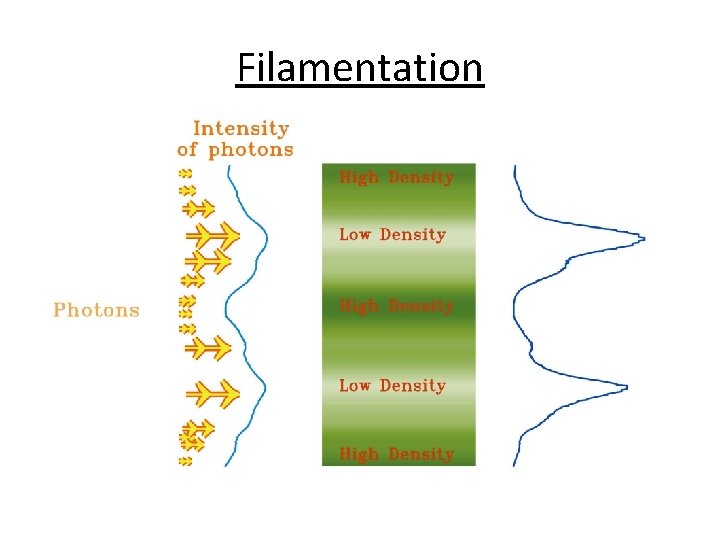
Filamentation
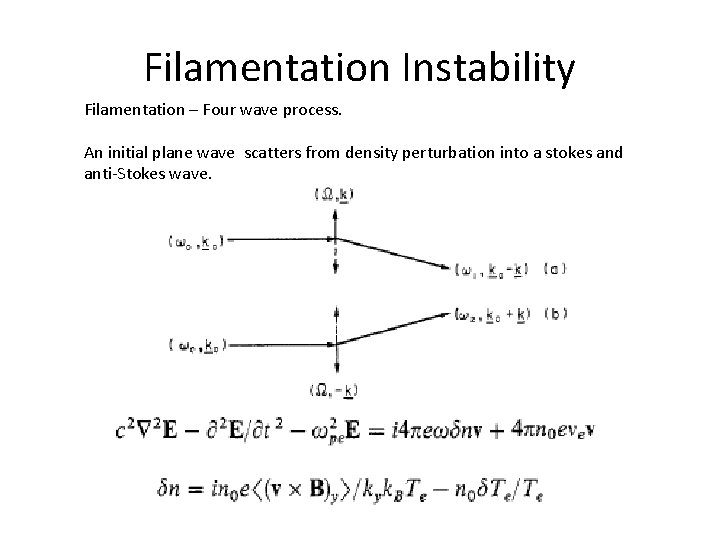
Filamentation Instability Filamentation – Four wave process. An initial plane wave scatters from density perturbation into a stokes and anti-Stokes wave.
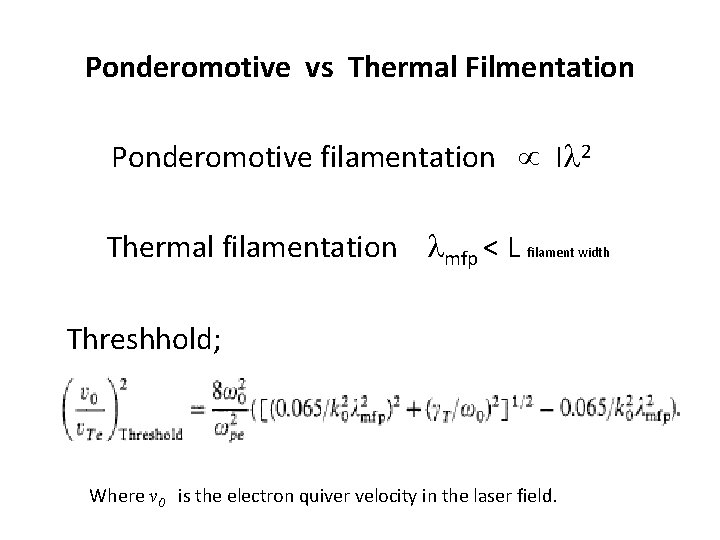
Ponderomotive vs Thermal Filmentation Ponderomotive filamentation I 2 Thermal filamentation mfp < L filament width Threshhold; Where v 0 is the electron quiver velocity in the laser field.
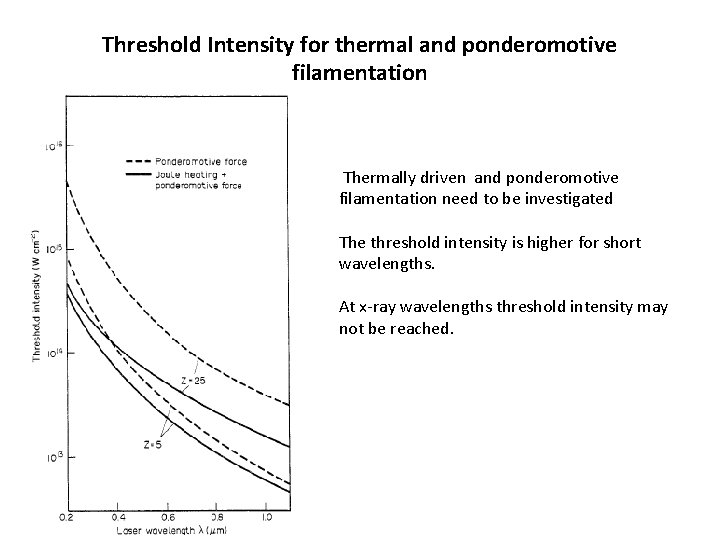
Threshold Intensity for thermal and ponderomotive filamentation Thermally driven and ponderomotive filamentation need to be investigated The threshold intensity is higher for short wavelengths. At x-ray wavelengths threshold intensity may not be reached.
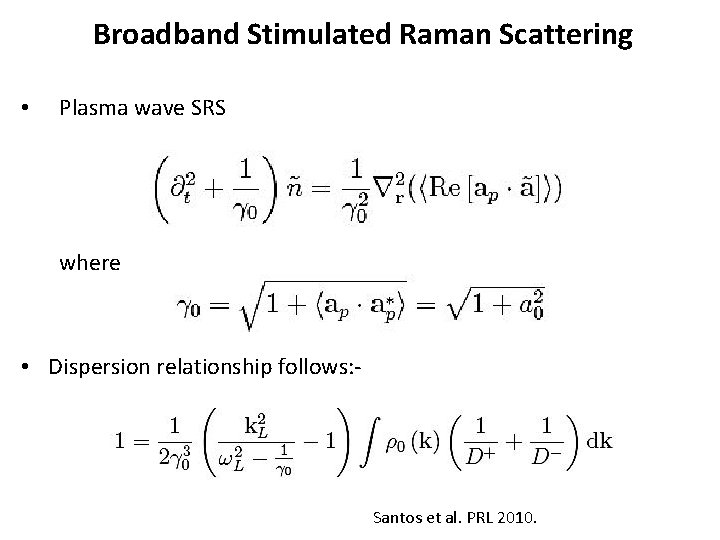
Broadband Stimulated Raman Scattering • Plasma wave SRS where • Dispersion relationship follows: - Santos et al. PRL 2010.
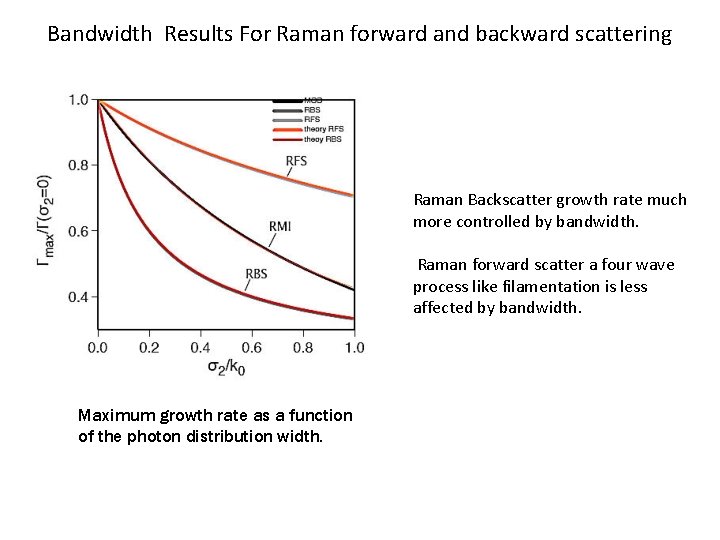
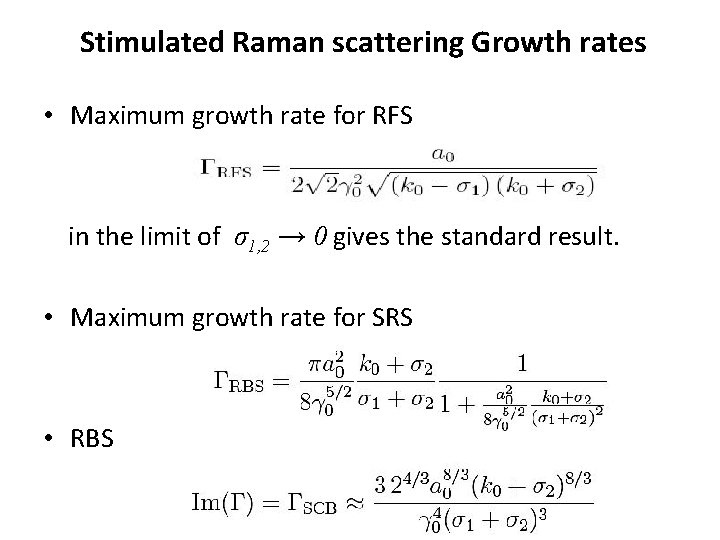
Bandwidth Results For Raman forward and backward scattering Raman Backscatter growth rate much more controlled by bandwidth. Raman forward scatter a four wave process like filamentation is less affected by bandwidth. Maximum growth rate as a function of the photon distribution width.
Conclusions • At short wavelengths the filamentation instability is dominated by Joule heating. • Raman backscatter and hence Raman amplification affected by finite bandwidth effects. One other reason for not using beams with spatially induced incoherence. • Raman amplification at short wavelengths may be seriously affected by thermal filamentation.
Stimulated Raman scattering Growth rates • Maximum growth rate for RFS in the limit of σ1, 2 → 0 gives the standard result. • Maximum growth rate for SRS • RBS