
Thermal Energy Thermal Energy How does thermal energy









- Slides: 84
Thermal Energy
Thermal Energy How does thermal energy work?
Important terms to know: o Temperature:
Important terms to know: o Temperature: A measure of the average kinetic energy of the individual particles in matter.
Important terms to know: o Temperature: A measure of the average kinetic energy of the individual particles in matter. n Low temperatures = low kinetic energy
Important terms to know: o Temperature: A measure of the average kinetic energy of the individual particles in matter. Low temperatures = low kinetic energy n High temperatures = high kinetic energy n
Important terms to know: o Temperature: continued n Thermometers: As the liquid in thermometer heats up its volume increases (rises) and as it cools off its volume goes down (drops).
Important terms to know: o Temperature: continued n Scales: The three common scales are Fahrenheit, Celsius, and the Kelvin scales.
Important terms to know: o Temperature: continued n Scales: The three common scales are Fahrenheit, Celsius, and the Kelvin scales. p Fahrenheit: Used in the United States.
Important terms to know: o Temperature: continued n Scales: The three common scales are Fahrenheit, Celsius, and the Kelvin scales. p Fahrenheit: Used in the United States. p Celsius: Used nearly everywhere else.
Important terms to know: o Temperature: continued n Scales: The three common scales are Fahrenheit, Celsius, and the Kelvin scales. p Fahrenheit: Used in the United States. p Celsius: Used nearly everywhere else. p Kelvin: Commonly used in the physical sciences.
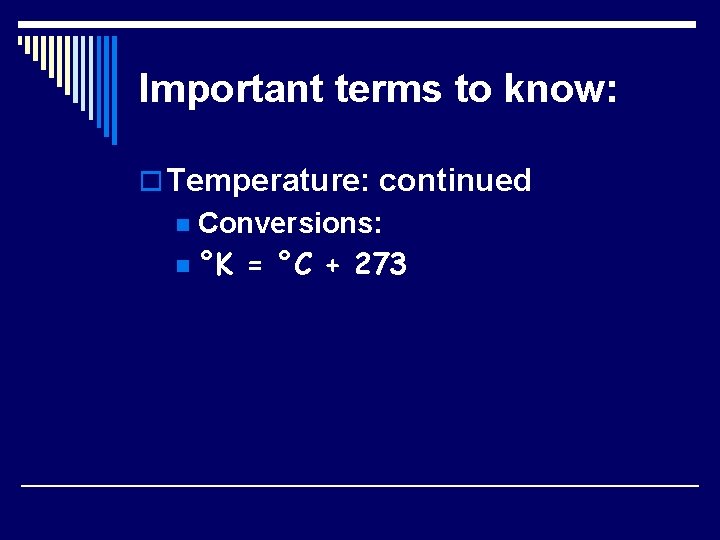
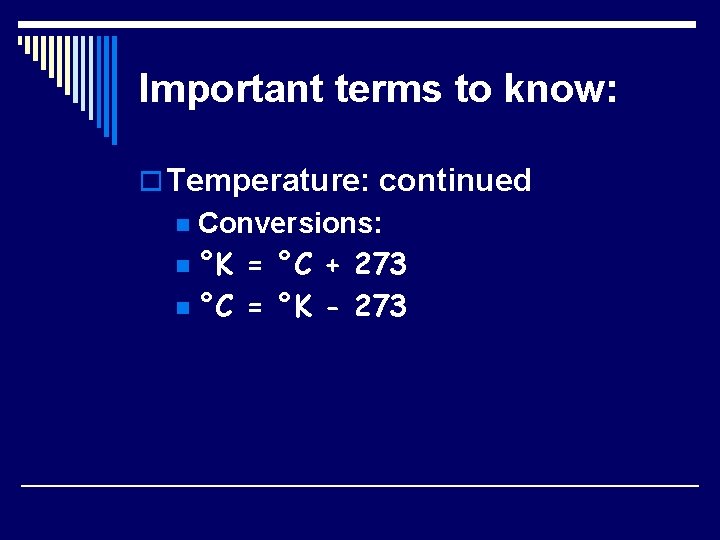
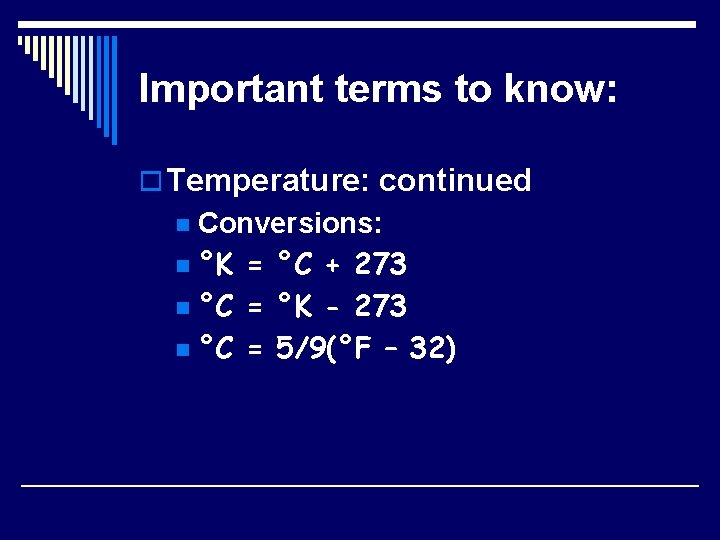
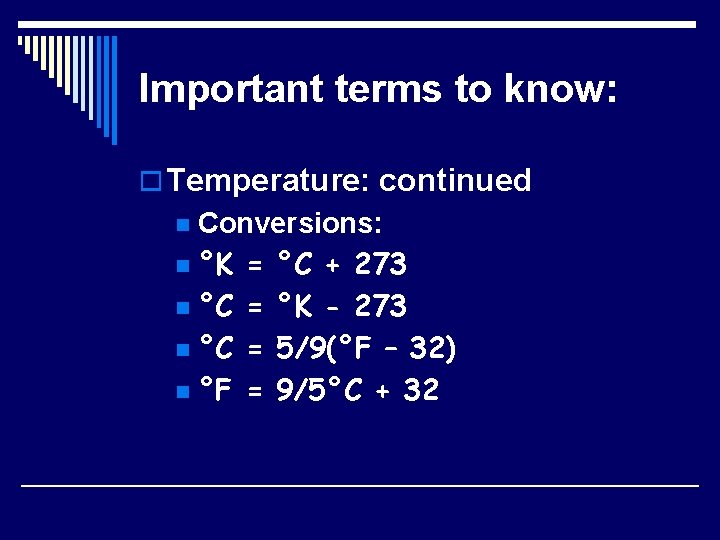
Important terms to know: o Temperature: continued n Conversions:
Important terms to know: o Temperature: continued Conversions: n °K = °C + 273 n
Important terms to know: o Temperature: continued Conversions: n °K = °C + 273 n °C = °K - 273 n
Important terms to know: o Temperature: continued Conversions: n °K = °C + 273 n °C = °K - 273 n °C = 5/9(°F – 32) n
Important terms to know: o Temperature: continued Conversions: n °K = °C + 273 n °C = °K - 273 n °C = 5/9(°F – 32) n °F = 9/5°C + 32 n
Thermal Energy: o Thermal Energy depends on:
Thermal Energy: o Thermal Energy depends on: n the number of particles an object has.
Thermal Energy: o Thermal Energy depends on: n n the number of particles an object has. the temperature of an object.
Thermal Energy: o Thermal Energy depends on: n n n the number of particles an object has. the temperature of an object. the arrangement of the object’s particles.
Thermal Energy: o Thermal Energy depends on: n n n the number of particles an object has. the temperature of an object. the arrangement of the object’s particles. o Heat:
Thermal Energy: o Thermal Energy depends on: n n n the number of particles an object has. the temperature of an object. the arrangement of the object’s particles. o Heat: n Thermal energy that moves from a warmer object to a cooler object.
Thermal Energy: o Thermal Energy depends on: n n n the number of particles an object has. the temperature of an object. the arrangement of the object’s particles. o Heat: n n Thermal energy that moves from a warmer object to a cooler object. Thermal energy only becomes heat when it is transferred.
Thermal Energy: o Thermal Energy depends on: n the number of particles an object has. n the temperature of an object. n the arrangement of the object’s particles. o Heat: n Thermal energy that moves from a warmer object to a cooler object. n Thermal energy only becomes heat when it is transferred. n It’s unit of measure is “Joules”.
Thermal Energy: o Specific Heat:
Thermal Energy: o Specific Heat: The amount of energy required to raise 1 g of a material by 1 °C.
Thermal Energy: o Specific Heat: The amount of energy required to raise 1 g of a material by 1 °C. o Measured in joules per kilogram-Celsius
Thermal Energy: o Specific Heat: The amount of energy required to raise 1 g of a material by 1 °C. o Measured in joules per kilogram-Kelvin n J/(kg*C)
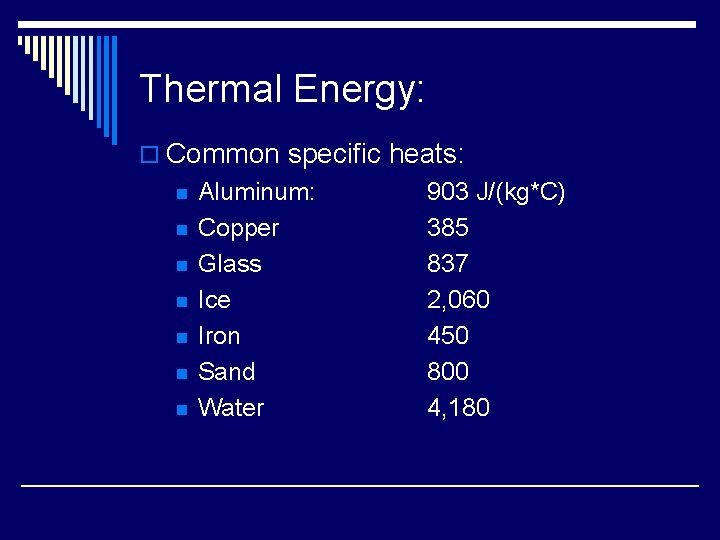
Thermal Energy: o Common specific heats: n n n n Aluminum: Copper Glass Ice Iron Sand Water 903 J/(kg*C) 385 837 2, 060 450 800 4, 180
Heat Transfer: o Heat is transferred by three different methods.
Heat Transfer: o Heat is transferred by three different methods. n Conduction: The transfer of heat without the movement of matter.
Heat Transfer: o Heat is transferred by three different methods. n Conduction: The transfer of heat without the movement of matter. p. A metal spoon in a pan of hot water (the spoon gets hot over time).
Heat Transfer: o Heat is transferred by three different methods. n Convection: The transfer of heat by the movement of currents within a fluid.
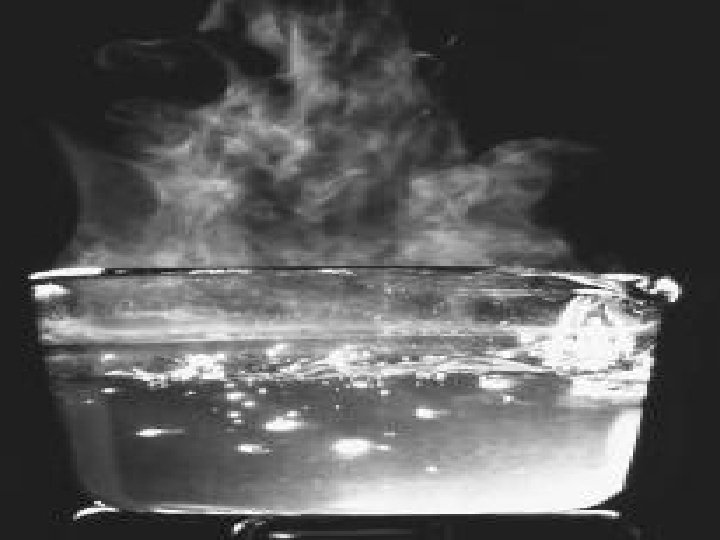
Heat Transfer: o Heat is transferred by three different methods. n Convection: The transfer of heat by the movement of currents within a fluid. p Water heating up in a pot on the stove (you can see the water moving).
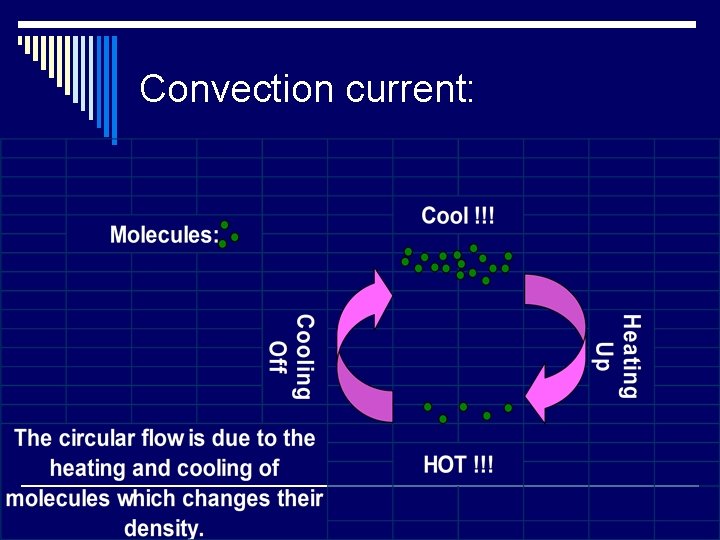
Heat Transfer: o Heat is transferred by three different methods. n Convection: The transfer of heat by the movement of currents within a fluid. p Water heating up in a pot on the stove (you can see the water moving). p Convection currents? !? !
Convection current:
Heat Transfer: o Heat is transferred by three different methods. n Radiation: The transfer of energy by electromagnetic waves.
Heat Transfer: o Heat is transferred by three different methods. n Radiation: The transfer of energy by electromagnetic waves. p. A fireplace warming a room.
Heat Transfer: o Heat is transferred by three different methods. n Radiation: The transfer of energy by electromagnetic waves. p. A fireplace warming a room. p Does not require matter to transfer thermal energy (the sun).
Heat Transfer: o Heat flow:
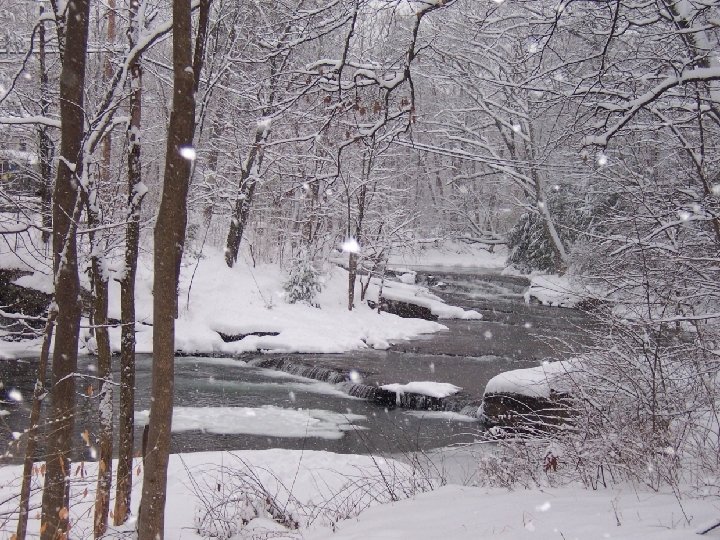
Heat Transfer: o Heat flow: n Heat transfer goes in one direction.
Heat Transfer: o Heat flow: n Heat transfer goes in one direction. p Heat leaves the warmer object and goes to the cooler object.
Heat Transfer: o Heat flow: n Heat transfer goes in one direction. p Heat leaves the warmer object and goes to the cooler object. p This will continue until the two objects have the same temperature.
Heat Transfer: o Conductors:
Heat Transfer: o Conductors: A material that transfers thermal energy well, partially because its atoms or molecules are close together.
Heat Transfer: o Conductors: A material that transfers thermal energy well, partially because its atoms or molecules are close together. n Silver n Stainless steel n tile
Heat Transfer: o Conductors: A material that transfers thermal energy well, partially because its atoms or molecules are close together. n Silver n Stainless steel n tile o Insulators:
Heat Transfer: o Conductors: A material that transfers thermal energy well, partially because its atoms or molecules are close together. n Silver n Stainless steel n tile o Insulators: A material that does not transfer thermal energy very well, partially because its atoms or molecules are not closely packed together.
Heat Transfer: o Conductors: A material that transfers thermal energy well, partially because its atoms or molecules are close together. n Silver n Stainless steel n tile o Insulators: A material that does not transfer thermal energy very well, partially because its atoms or molecules are not closely packed together. n n Wood Wool Paper Atmospheric gases
Thermal Expansion: Does matter with thermal energy?
Matter: o What is matter?
Matter: o What is matter? n Has mass
Matter: o What is matter? n Has mass n Takes up space (has volume)
Matter: o The three states of matter:
Matter: o The three states of matter: n Solids p Has a fixed shape p Has a fixed volume
Matter: o The three states of matter: n Solids p Has a fixed shape p Has a fixed volume n Liquids p Has a shape that can change p Has a fixed volume
Matter: o The three states of matter: n Solids p Has a fixed shape p Has a fixed volume n Liquids p Has a shape that can change p Has a fixed volume n Gases p Has a shape that can change. p Has a volume that can change.
Matter:
Matter: o The fourth state of matter is plasma.
Matter: o The fourth state of matter is plasma. n Plasma is the highest energy state of matter (moving super fast).
Matter: o The fourth state of matter is plasma. Plasma is the highest energy state of matter (moving super fast). n Very, very, very hot!!! n
Matter: o The fourth state of matter is plasma. Plasma is the highest energy state of matter (moving super fast). n Very, very, very hot!!! n Found in places like our sun. n
Matter: o The fourth state of matter is plasma. Plasma is the highest energy state of matter (moving super fast). n Very, very, very hot!!! n Found in places like our sun. n Not always considered a state of matter. n
Matter: o Changes in states of matter:
Matter: o Changes in states of matter: n Matter can change from any state to any other state by adding energy.
Matter: o Changes in states of matter: Matter can change from any state to any other state by adding energy. n The temperature does not change until the change of state is complete. n
Thermal Expansion: o When an object is heated it usually responds to the heat.
Thermal Expansion: o When an object is heated it usually responds to the heat. n One response is for the particles of the object to move faster and spread out (increasing volume).
Thermal Expansion: o When an object is heated it usually responds to the heat. One response is for the particles of the object to move faster and spread out (increasing volume). n This causes the object to expand is called thermal expansion. n
Thermal Expansion examples: o When thermometers are exposed to warmer temperatures.
Thermal Expansion examples: o When thermometers are exposed to warmer temperatures. o Thermostats in your home.
Thermal Expansion examples: o When thermometers are exposed to warmer temperatures. o Thermostats in your home. o Sidewalks
Thermal Expansion examples: o When thermometers are exposed to warmer temperatures. o Thermostats in your home. o Sidewalks o Bridges
Thermal Expansion examples: o When thermometers are exposed to warmer temperatures. o Thermostats in your home. o Sidewalks o Bridges o Jars (pickles, jelly, etc…)
Thermal Expansion: o Contraction:
Thermal Expansion: o Contraction: 1. The heat source gets removed.
Thermal Expansion: o Contraction: 1. 2. The heat source gets removed. The particles move less and take up less space.
Thermal Expansion: o Contraction: 1. 2. 3. The heat source gets removed. The particles move less and take up less space. The size of the object decreases.