
Thermal Energy Storage For commercial Buildings Why do
Thermal Energy Storage For commercial Buildings
Why do we need TES? • In many regions of the world, ventilation system account for up to 60% of buildings electricity demand during peak hours. • Electricity companies charge separate demand charge per k. W of energy consumed per month. • More electricity consumption at peak, More electricity needs to be produces, More fossil fuels needs to be burned, More CO 2
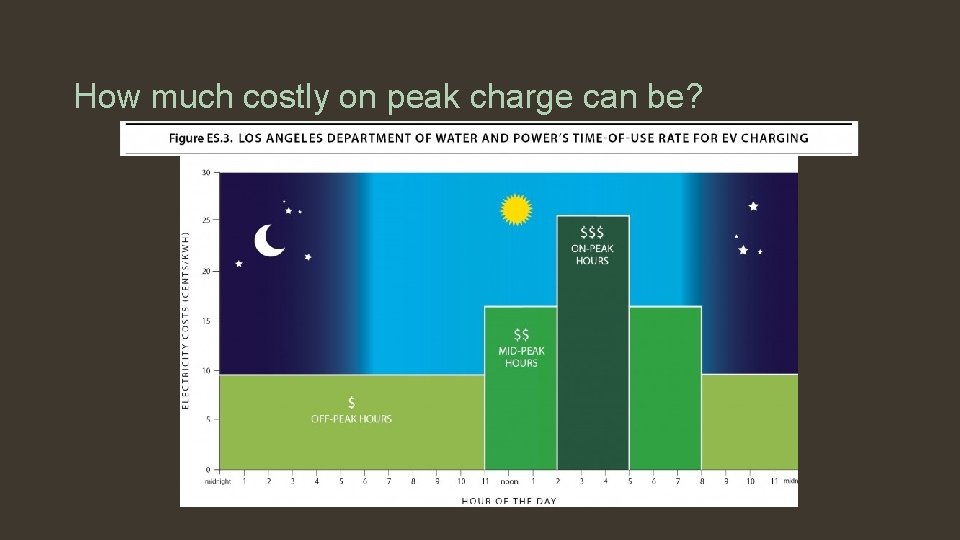
How much costly on peak charge can be?
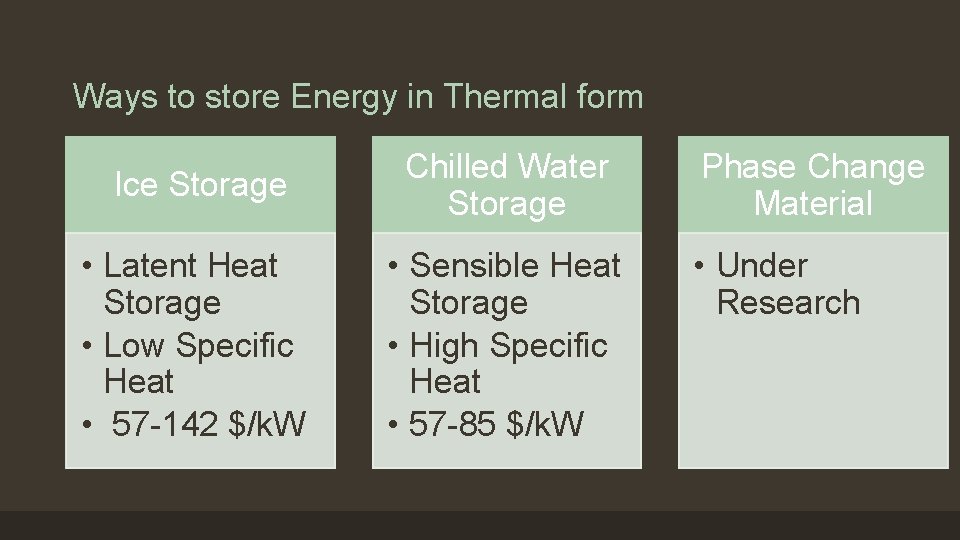
Ways to store Energy in Thermal form Ice Storage Chilled Water Storage • Latent Heat Storage • Low Specific Heat • 57 -142 $/k. W • Sensible Heat Storage • High Specific Heat • 57 -85 $/k. W Phase Change Material • Under Research
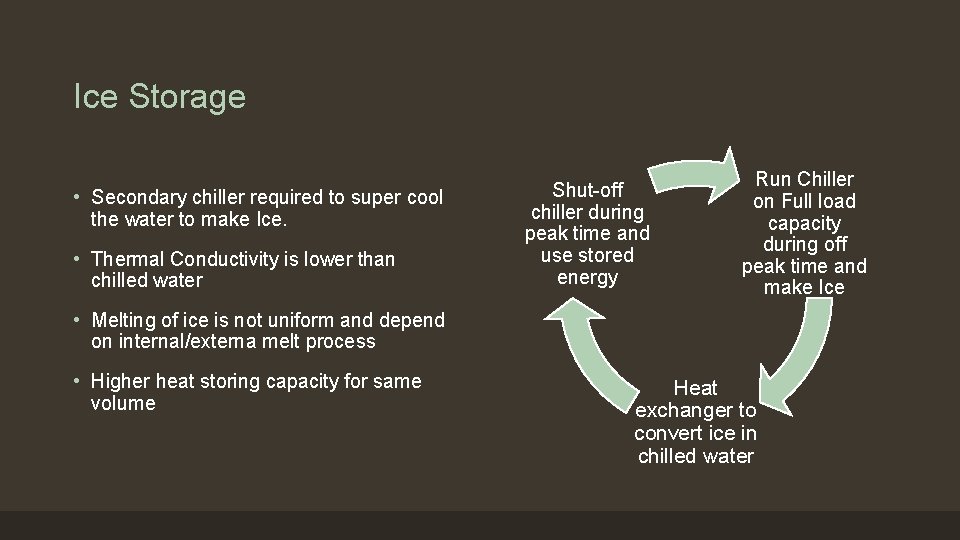
Ice Storage • Secondary chiller required to super cool the water to make Ice. • Thermal Conductivity is lower than chilled water Shut-off chiller during peak time and use stored energy Run Chiller on Full load capacity during off peak time and make Ice • Melting of ice is not uniform and depend on internal/externa melt process • Higher heat storing capacity for same volume Heat exchanger to convert ice in chilled water
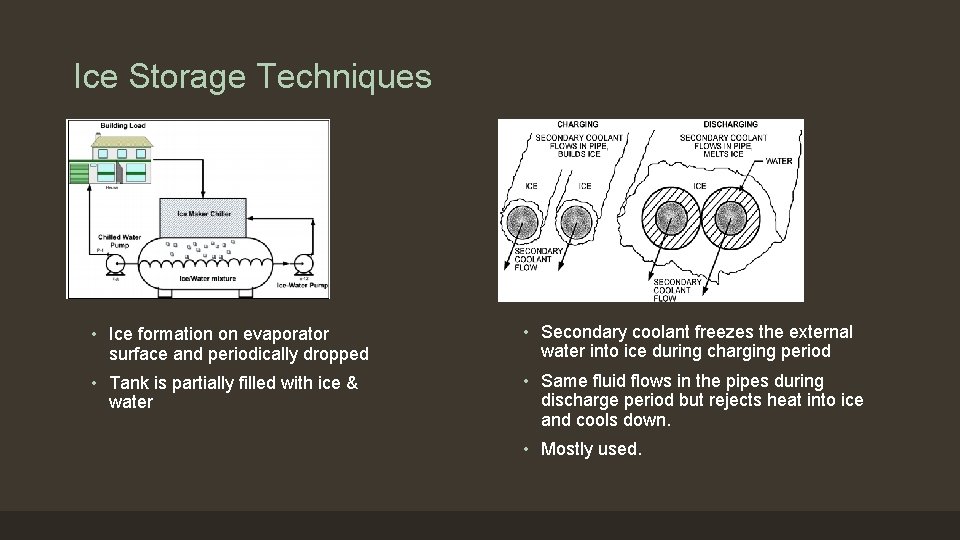
Ice Storage Techniques • Ice formation on evaporator surface and periodically dropped • Secondary coolant freezes the external water into ice during charging period • Tank is partially filled with ice & water • Same fluid flows in the pipes during discharge period but rejects heat into ice and cools down. • Mostly used.
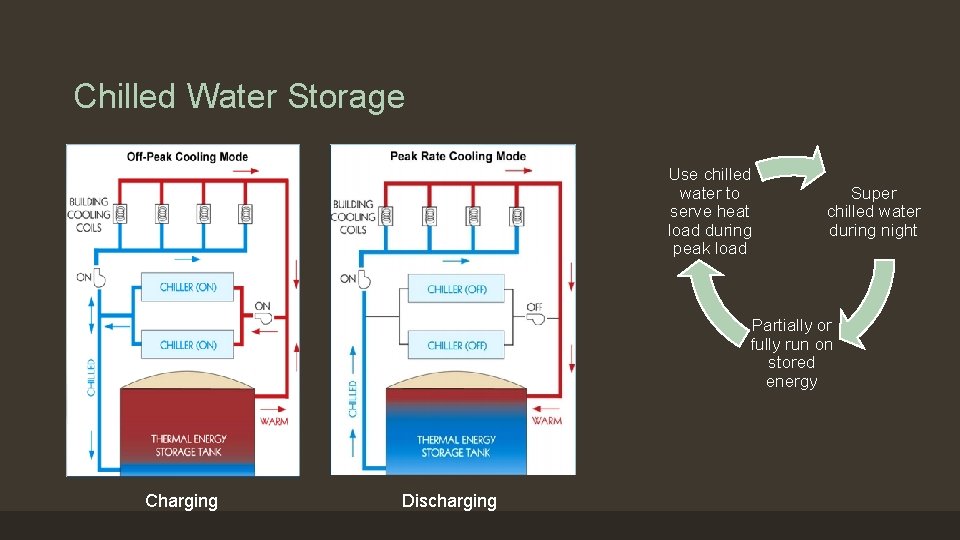
Chilled Water Storage Use chilled water to serve heat load during peak load Super chilled water during night Partially or fully run on stored energy Charging Discharging
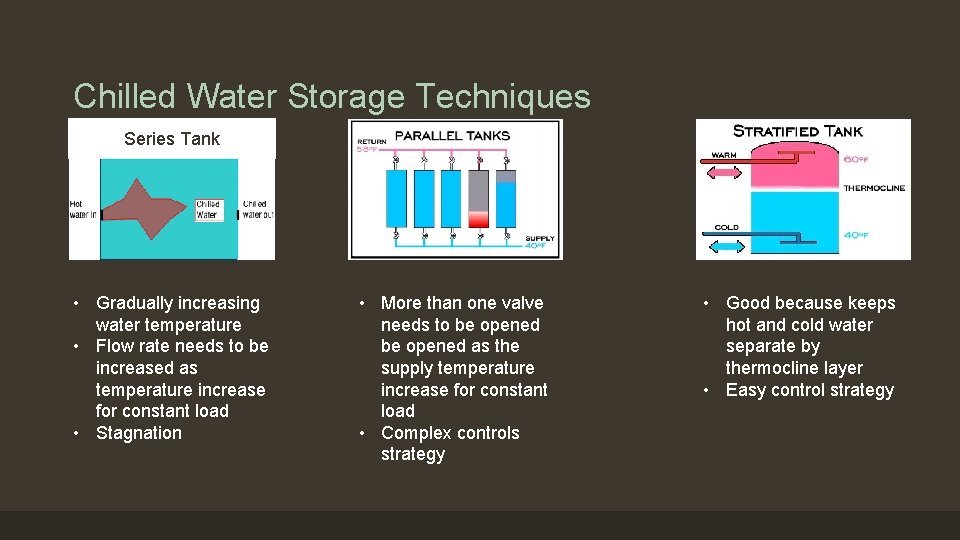
Chilled Water Storage Techniques Series Tank • Gradually increasing water temperature • Flow rate needs to be increased as temperature increase for constant load • Stagnation • More than one valve needs to be opened as the supply temperature increase for constant load • Complex controls strategy • Good because keeps hot and cold water separate by thermocline layer • Easy control strategy
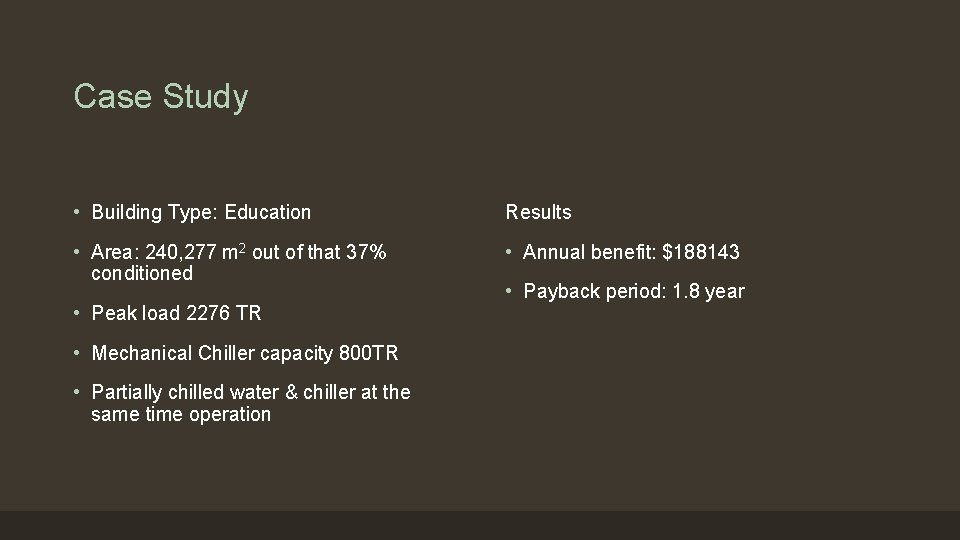
Case Study • Building Type: Education Results • Area: 240, 277 m 2 out of that 37% conditioned • Annual benefit: $188143 • Peak load 2276 TR • Mechanical Chiller capacity 800 TR • Partially chilled water & chiller at the same time operation • Payback period: 1. 8 year

Is this Practical? Energy Modelling Approach
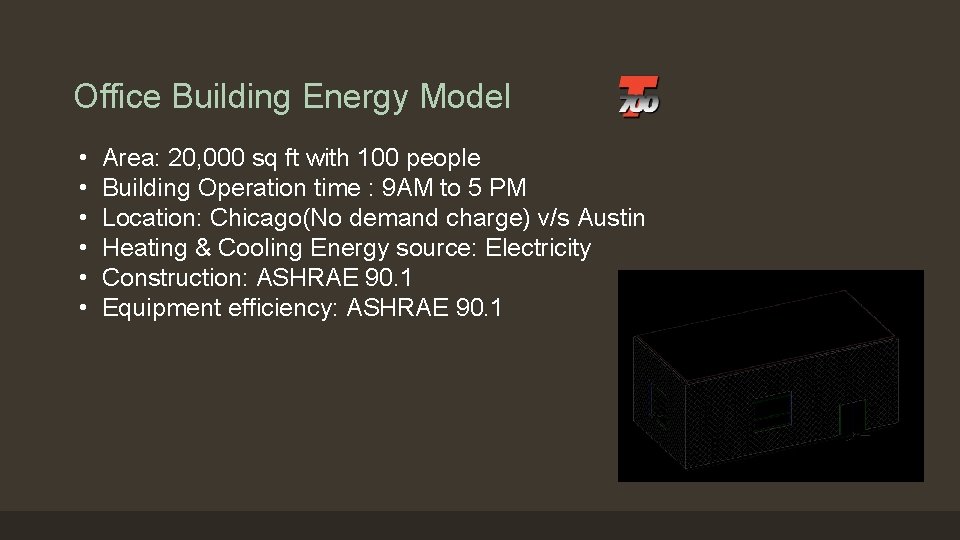
Office Building Energy Model • • • Area: 20, 000 sq ft with 100 people Building Operation time : 9 AM to 5 PM Location: Chicago(No demand charge) v/s Austin Heating & Cooling Energy source: Electricity Construction: ASHRAE 90. 1 Equipment efficiency: ASHRAE 90. 1
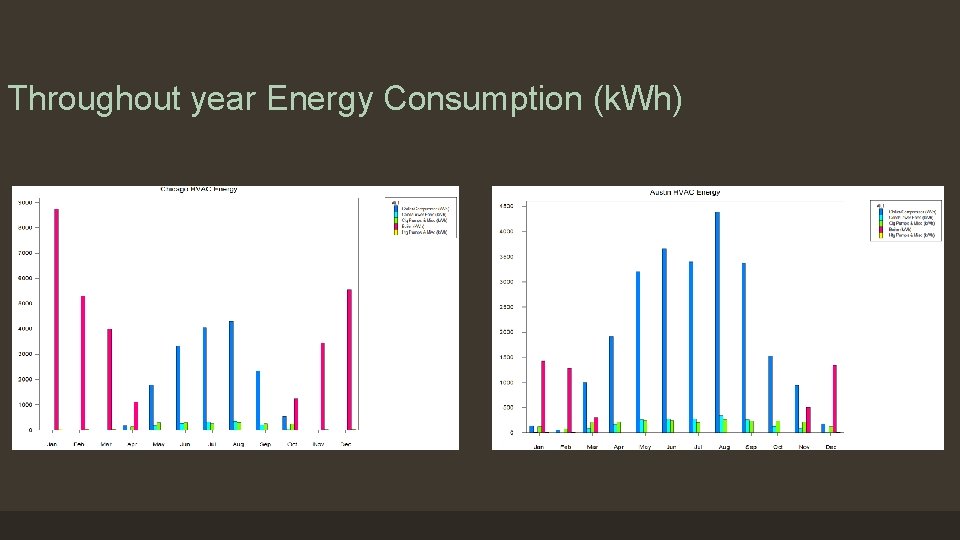
Throughout year Energy Consumption (k. Wh)
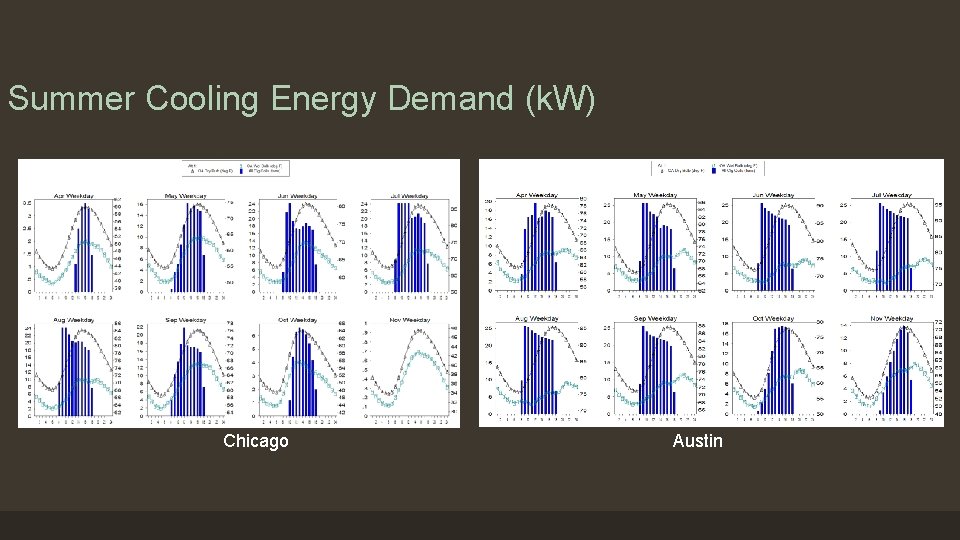
Summer Cooling Energy Demand (k. W) Chicago Austin
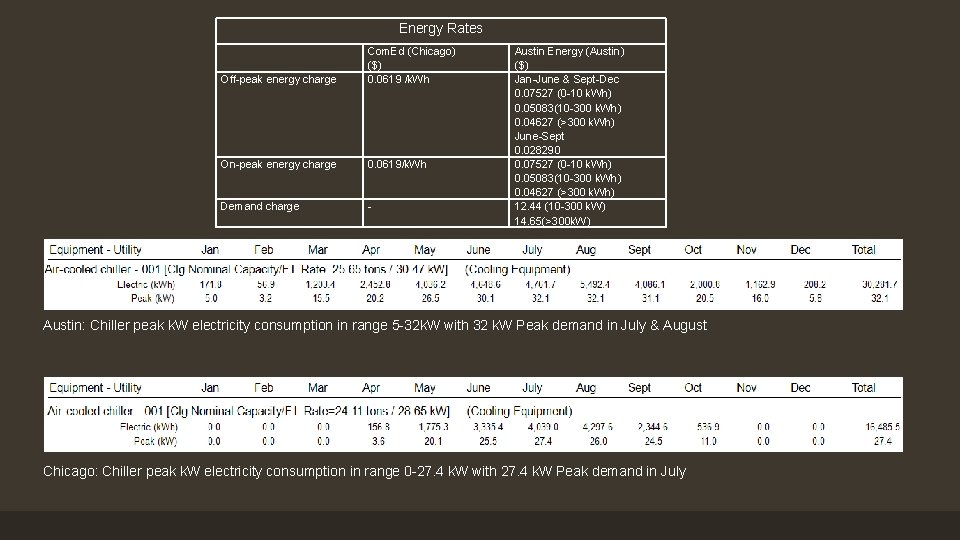
Energy Rates Off-peak energy charge Com. Ed (Chicago) ($) 0. 0619 /k. Wh On-peak energy charge 0. 0619/k. Wh Demand charge - Austin Energy (Austin) ($) Jan-June & Sept-Dec 0. 07527 (0 -10 k. Wh) 0. 05083(10 -300 k. Wh) 0. 04627 (>300 k. Wh) June-Sept 0. 028290 0. 07527 (0 -10 k. Wh) 0. 05083(10 -300 k. Wh) 0. 04627 (>300 k. Wh) 12. 44 (10 -300 k. W) 14. 65(>300 k. W) Austin: Chiller peak k. W electricity consumption in range 5 -32 k. W with 32 k. W Peak demand in July & August Chicago: Chiller peak k. W electricity consumption in range 0 -27. 4 k. W with 27. 4 k. W Peak demand in July
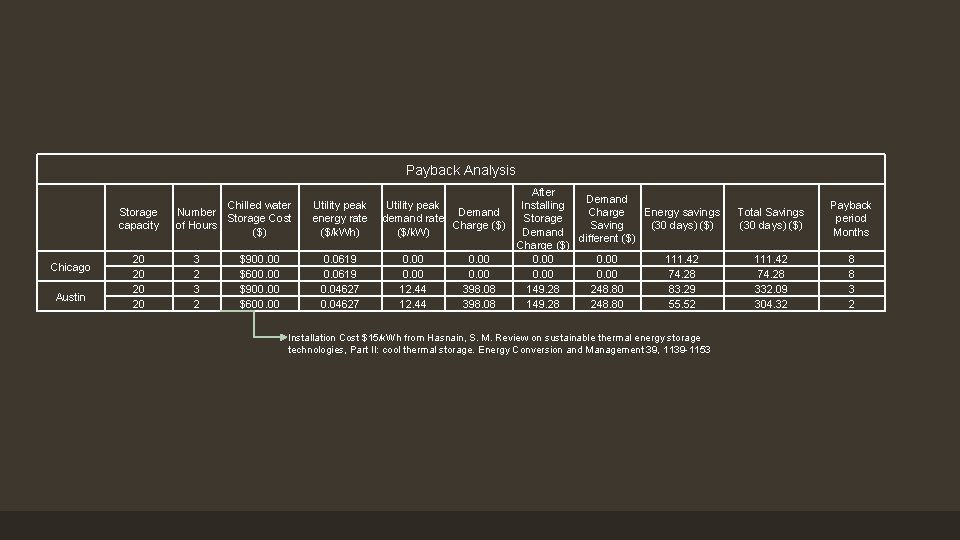
Payback Analysis Storage capacity Chicago Austin 20 20 Chilled water Number Storage Cost of Hours ($) 3 2 $900. 00 $600. 00 Utility peak energy rate ($/k. Wh) 0. 0619 0. 04627 Utility peak Demand demand rate Charge ($) ($/k. W) 0. 00 12. 44 0. 00 398. 08 After Demand Installing Charge Energy savings Storage Saving (30 days) ($) Demand different ($) Charge ($) 0. 00 111. 42 0. 00 74. 28 149. 28 248. 80 83. 29 149. 28 248. 80 55. 52 Installation Cost $15/k. Wh from Hasnain, S. M. Review on sustainable thermal energy storage technologies, Part II: cool thermal storage. Energy Conversion and Management 39, 1139 -1153 Total Savings (30 days) ($) Payback period Months 111. 42 74. 28 332. 09 304. 32 8 8 3 2
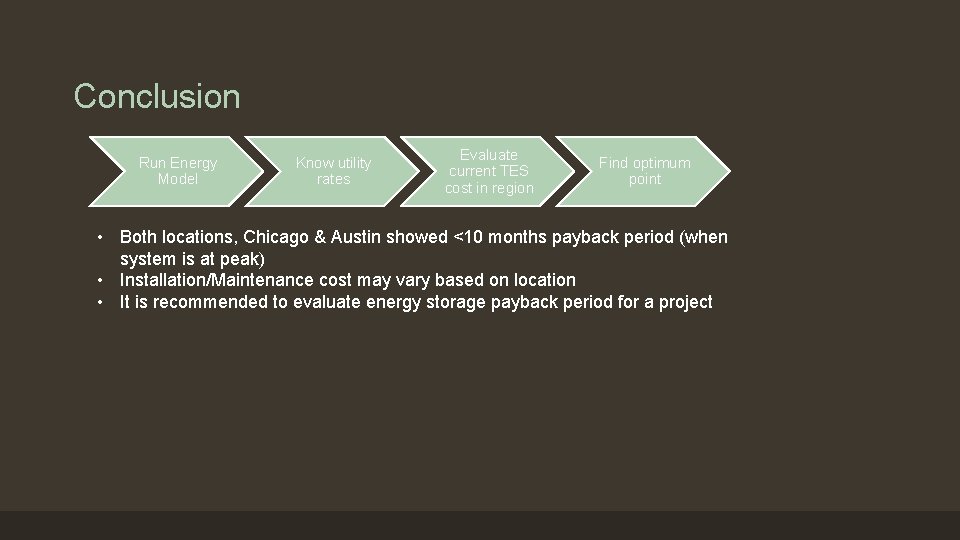
Conclusion Run Energy Model Know utility rates Evaluate current TES cost in region Find optimum point • Both locations, Chicago & Austin showed <10 months payback period (when system is at peak) • Installation/Maintenance cost may vary based on location • It is recommended to evaluate energy storage payback period for a project
Reference: • Lizana, J. , Chacartegui, R. , Barrios-Padura, A. & Manuel Valverde, J. Advances in thermal energy storage materials and their applications towards zero energy buildings: A critical review. Appl. Energy 203, 219 -239 (2017). • • http: //www. energy. ca. gov/reports/500 -95 -005_TES-REPORT. PDF • Hasnain, S. M. Review on sustainable thermal energy storage technologies, Part II: cool thermal storage. Energy Conversion and Management 39, 1139 -1153 (1998). • Thermal storage. In: ASHRAE handbook. American Society of Heating, Refrigerating and Air Conditioning Engineers, Inc. , Atlanta: HVAC Applications; 2007 [chapter 34]. • Wu, C. & Tsai, Y. Design of an ice thermal energy storage system for a building of hospitality operation. International Journal of Hospitality Management 46, 46 -54 (2015). • Sanaye, S. & Shirazi, A. Thermo-economic optimization of an ice thermal energy storage system for air-conditioning applications. Energy and Buildings 60, 100 -109 (2013). • • • https: //www. comed. com/Pages/default. aspx Yau, Y. H. & Rismanchi, B. A review on cool thermal storage technologies and operating strategies. Renewable and Sustainable Energy Reviews 16, 787 -797 (2012). http: //austinenergy. com/ https: //www. dntanks. com/wp-content/uploads/2015/03/San. Antonio. Lackland_TX_Project. Profile. pdf Ahrinet. org. (2017). HVACR Equipment/Components. Available at: http: //www. ahrinet. org/contractors. aspx? S=141. Trane Trace 700 software

Questions?
- Slides: 18