
Thermal Energy Caloric Theory Scientists used to think
- Slides: 14
Thermal Energy
Caloric Theory • Scientists used to think thermal energy was an invisible fluid that flowed from hot objects to colder ones. • They called this fluid caloric.
Caloric Theory • Lavoisier considered caloric to be an actual fluid. • Hot objects had a lot of caloric. • Caloric naturally flows from hot objects to cold ones. • Temperature was a measure of the density of caloric.
Benjamin Thompson • He was a scientist better known as Count Rumford, who disproved the caloric theory. • He did this by observing the boring of cannon barrels.
Benjamin Thompson • He noticed that dull bits produced little cutting but much heat, while sharp bits produced much cutting and less heat. • This would mean that the amount of caloric in the same metal could change, which is impossible.
James Prescott Joule • He was the first to understand the connection between mechanical energy (motion) and heat.
James Prescott Joule • If heat is not a fluid, what is it? • Heat is caused by motion. • The Greek word for motion is kinetos, from which we get “kinetic. ”
Kinetic-Molecular Model • When Kelvin calculated the speed of molecules in air based on their kinetic energies, this firmly established this model. • Thermal energy is the total of all the kinetic energy of all the particles in an object.
Kinetic-Molecular Model • Are there any other energies in the particles of an object? • Yes. There attractions and repulsions between the particles.
Kinetic-Molecular Model • The sum of all these energies is called the internal energy of the substance. • This energy cannot be measured, but thermal energy can be measured.
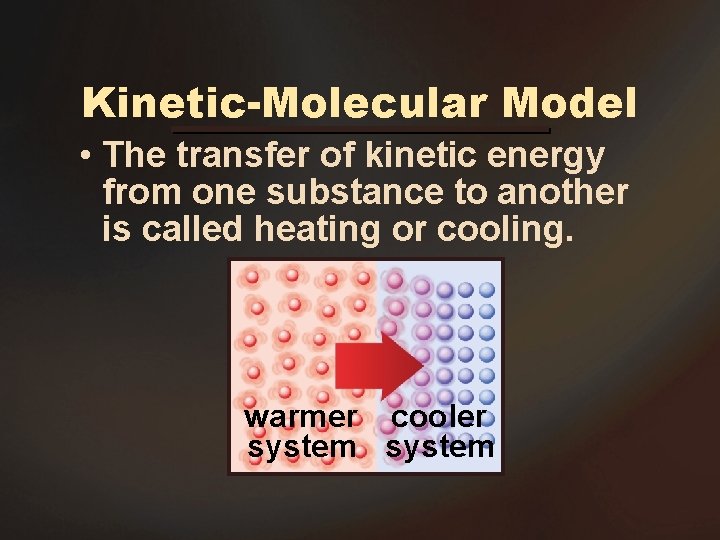
Kinetic-Molecular Model • The transfer of kinetic energy from one substance to another is called heating or cooling. warmer cooler system
Who developed the caloric theory? 1. 2. 3. 4. Count Rumford Benjamin Franklin Benjamin Thompson Lavoisier Question
According to the caloric theory, heat is a _____. 1. 2. 3. 4. solid gas fluid movement of matter Question
According to the kinetic theory, heat is a _____. 1. 2. 3. 4. solid gas fluid movement of matter Question