
Thermal and flow processes in cryogenic systems following

- Slides: 47
Thermal and flow processes in cryogenic systems following failure modes combined with superconducting magnets resistive transitions. M. Chorowski, M. Grabowski, J. Poliński Wrocław University of Technology, Poland CHATS 10. October 2013
MCh, TE Seminar 12. 11. 09 Content 1. Internal structure of cryogenic systems 2. Categorization of cryogenic system failures 3. Methodology of risk analysis 4. Modelling of heat transfer processes in the helium • Convective heat transfer • Electrical arc • Magnet quench 5. Conclusions
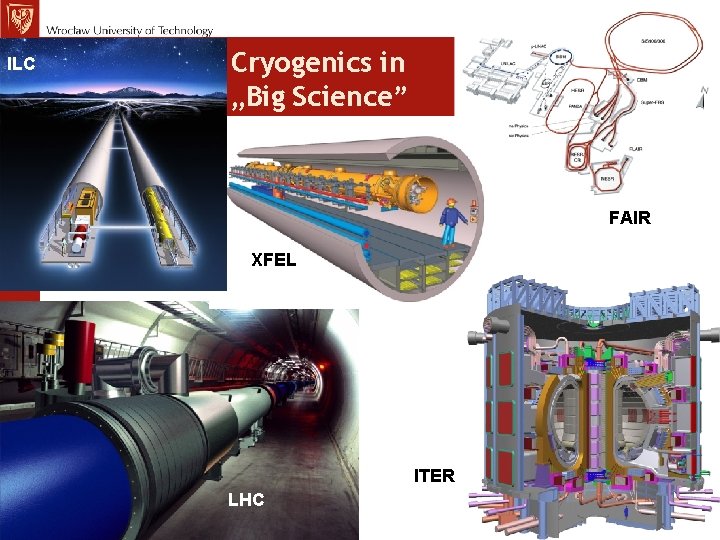
MCh, TE Seminar 12. 11. 09 ILC Cryogenics in „Big Science” FAIR XFEL ITER LHC
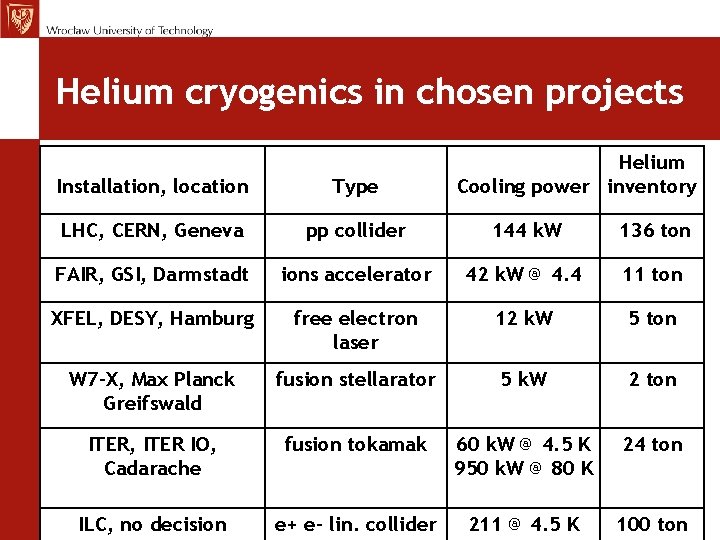
MCh, TE Seminar 12. 11. 09 Helium cryogenics in chosen projects Helium Cooling power inventory Installation, location Type LHC, CERN, Geneva pp collider 144 k. W 136 ton FAIR, GSI, Darmstadt ions accelerator 42 k. W @ 4. 4 11 ton XFEL, DESY, Hamburg free electron laser 12 k. W 5 ton W 7 -X, Max Planck Greifswald fusion stellarator 5 k. W 2 ton ITER, ITER IO, Cadarache fusion tokamak 60 k. W @ 4. 5 K 950 k. W @ 80 K 24 ton ILC, no decision e+ e- lin. collider 211 @ 4. 5 K 100 ton
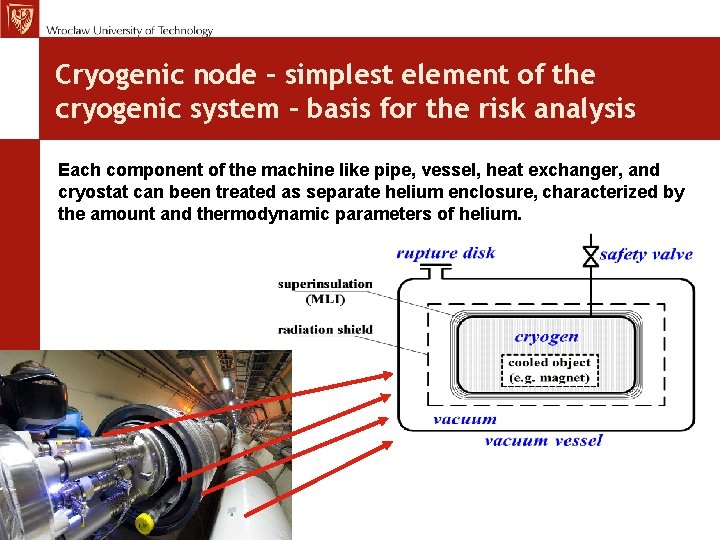
MCh, TE Seminar 12. 11. 09 Cryogenic node – simplest element of the cryogenic system – basis for the risk analysis Each component of the machine like pipe, vessel, heat exchanger, and cryostat can been treated as separate helium enclosure, characterized by the amount and thermodynamic parameters of helium.
MCh, TE Seminar 12. 11. 09 Potential failure modes of cryogenic systems 1. Mechanical break of warm vacuum vessel followed by air flow to insulation vacuum space. 2. Mechanical break of cold vessel or process pipe followed by helium flow to insulation vacuum space. 3. Electrical arc caused by faulty joint of superconducting cables leading to the consequences similar like in failure 2, but on a much more extensive scale 4. Extensive resistive transition of superconducting magnets and quench propagation – non foreseen as operational mode
MCh, TE Seminar 12. 11. 09 Potential failure modes of cryogenic systems 1. Mechanical break of warm vacuum vessel followed by air flow to insulation vacuum space. 2. Mechanical break of cold vessel or process pipe followed by helium flow to insulation vacuum space. 3. Electrical arc caused by faulty joint of superconducting cables leading to the consequences similar like in failure 2, but on a much more extensive scale 4. Extensive resistive transition of superconducting magnets and quench propagation – non foreseen as operational mode
MCh, TE Seminar 12. 11. 09 Flow consequences of mechanical break of cold vessel, including el. arc 1. Mechanical and/or arc induced break of the cold vessel 2. Fast degradation of the vacuum insulation with cryogen. 3. Intensive heat flow to the cryogen. 4. Energy release to the helium, e. g. , due to a magnet quench (optionally) or eddy current heating. 5. Pressure increase of the cryogen and in the vacuum space. 6. Opening of the rupture disk and/or safety valve. 7. Cryogen discharges through the rupture disk and/or safety valve.
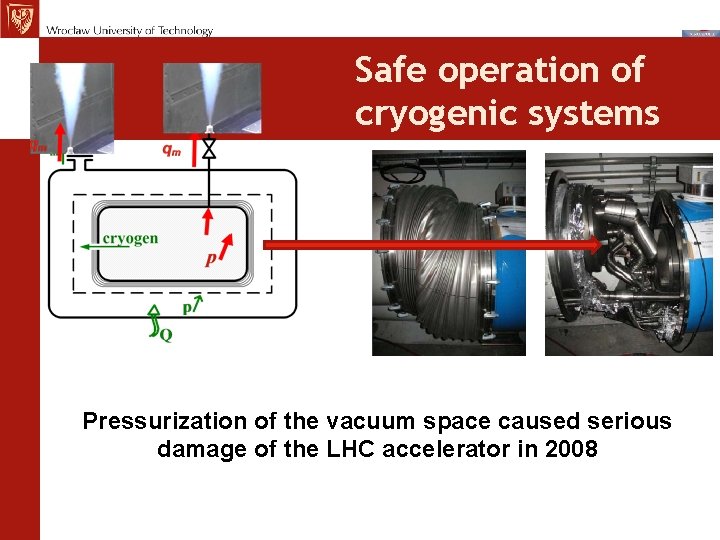
MCh, TE Seminar 12. 11. 09 Safe operation of cryogenic systems Pressurization of the vacuum space caused serious damage of the LHC accelerator in 2008
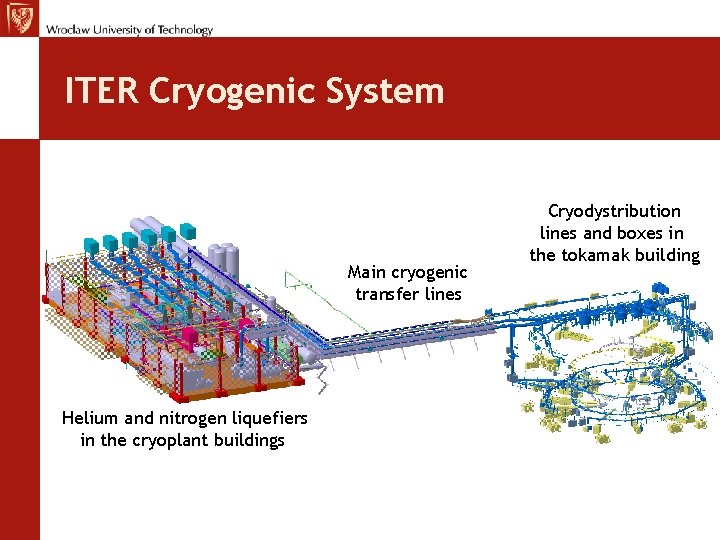
ITER Cryogenic System Main cryogenic transfer lines Helium and nitrogen liquefiers in the cryoplant buildings Cryodystribution lines and boxes in the tokamak building
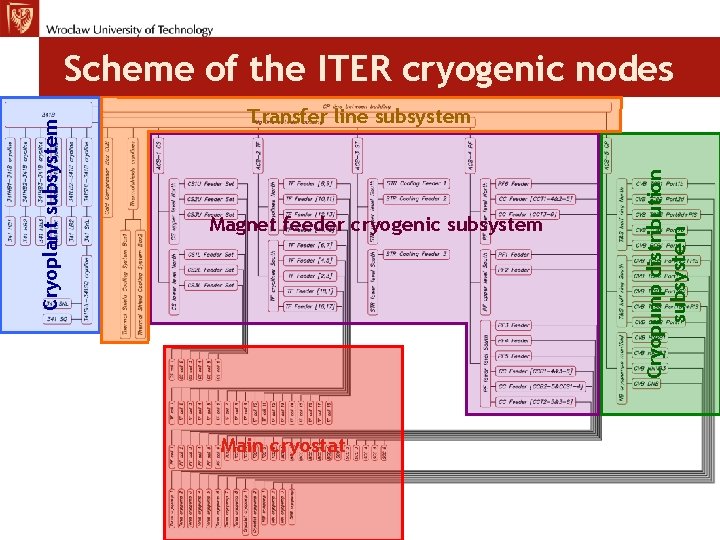
Transfer line subsystem Magnet feeder cryogenic subsystem Main cryostat Cryopump distribution subsystem Cryoplant subsystem Scheme of the ITER cryogenic nodes
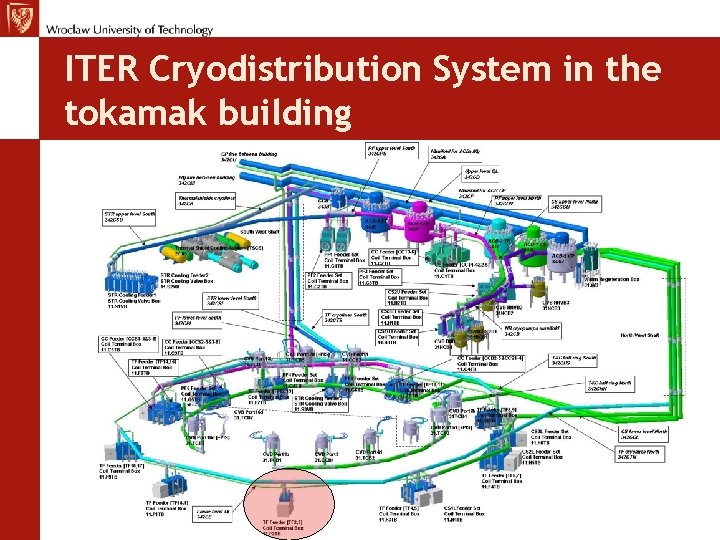
ITER Cryodistribution System in the tokamak building
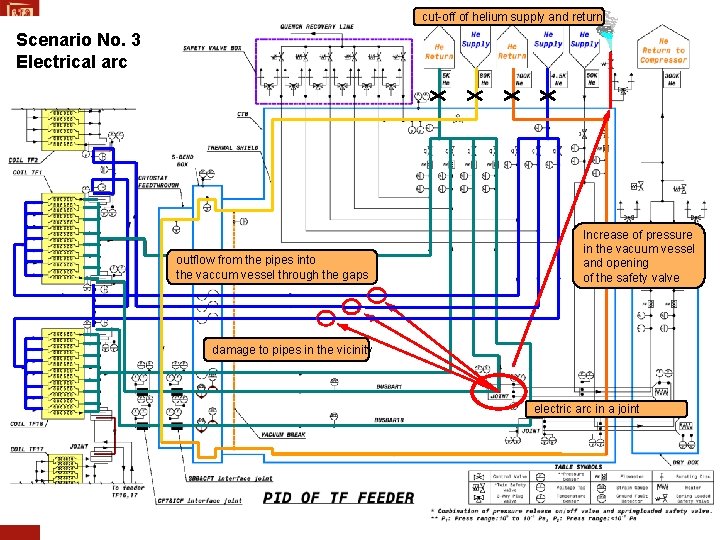
cut-off of helium supply and return Scenario No. 3 Electrical arc outflow from the pipes into the vaccum vessel through the gaps Increase of pressure in the vacuum vessel and opening of the safety valve damage to pipes in the vicinity electric arc in a joint
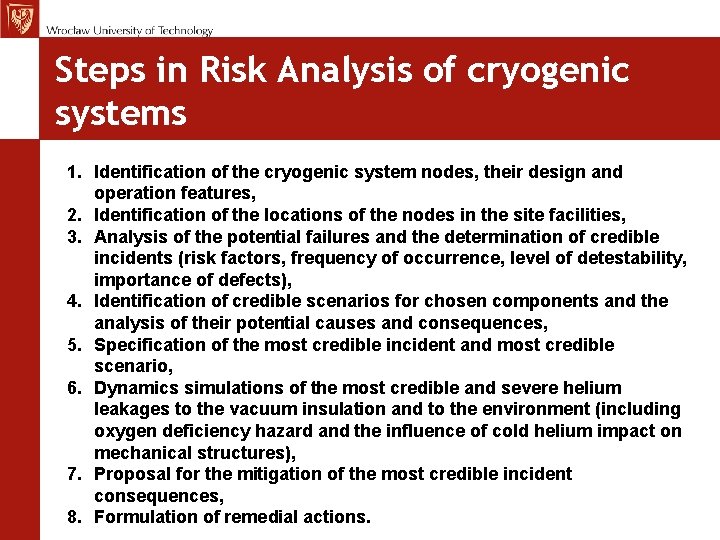
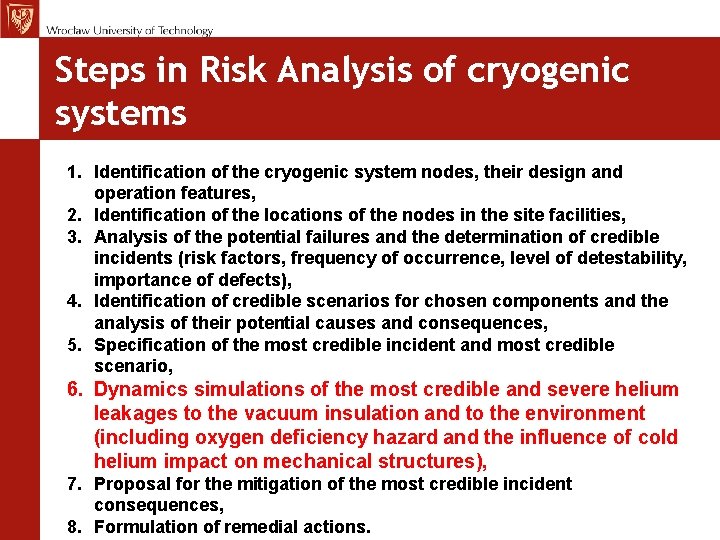
MCh, TE Seminar 12. 11. 09 Steps in Risk Analysis of cryogenic systems 1. Identification of the cryogenic system nodes, their design and operation features, 2. Identification of the locations of the nodes in the site facilities, 3. Analysis of the potential failures and the determination of credible incidents (risk factors, frequency of occurrence, level of detestability, importance of defects), 4. Identification of credible scenarios for chosen components and the analysis of their potential causes and consequences, 5. Specification of the most credible incident and most credible scenario, 6. Dynamics simulations of the most credible and severe helium leakages to the vacuum insulation and to the environment (including oxygen deficiency hazard and the influence of cold helium impact on mechanical structures), 7. Proposal for the mitigation of the most credible incident consequences, 8. Formulation of remedial actions.
MCh, TE Seminar 12. 11. 09 Steps in Risk Analysis of cryogenic systems 1. Identification of the cryogenic system nodes, their design and operation features, 2. Identification of the locations of the nodes in the site facilities, 3. Analysis of the potential failures and the determination of credible incidents (risk factors, frequency of occurrence, level of detestability, importance of defects), 4. Identification of credible scenarios for chosen components and the analysis of their potential causes and consequences, 5. Specification of the most credible incident and most credible scenario, 6. Dynamics simulations of the most credible and severe helium leakages to the vacuum insulation and to the environment (including oxygen deficiency hazard and the influence of cold helium impact on mechanical structures), 7. Proposal for the mitigation of the most credible incident consequences, 8. Formulation of remedial actions.
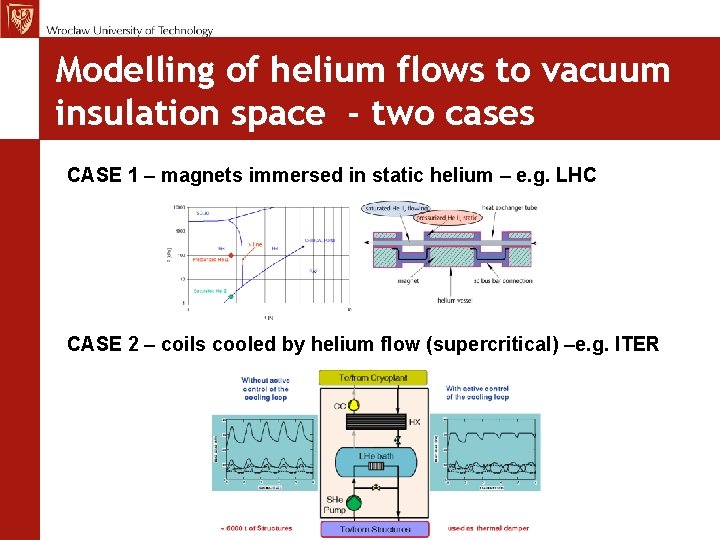
MCh, TE Seminar 12. 11. 09 Modelling of helium flows to vacuum insulation space - two cases CASE 1 – magnets immersed in static helium – e. g. LHC CASE 2 – coils cooled by helium flow (supercritical) –e. g. ITER
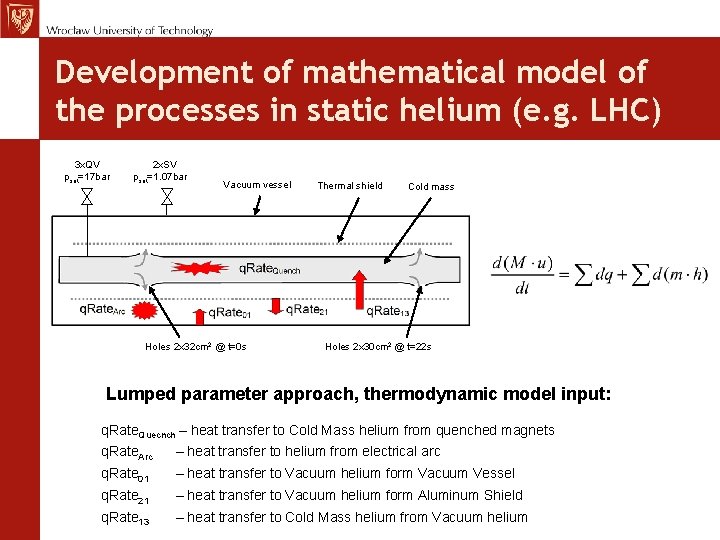
MCh, TE Seminar 12. 11. 09 Development of mathematical model of the processes in static helium (e. g. LHC) 3 x. QV pset=17 bar 2 x. SV pset=1. 07 bar Vacuum vessel Holes 2 x 32 cm 2 @ t=0 s Thermal shield Cold mass Holes 2 x 30 cm 2 @ t=22 s Lumped parameter approach, thermodynamic model input: q. Rate. Quecnch – heat transfer to Cold Mass helium from quenched magnets q. Rate. Arc – heat transfer to helium from electrical arc q. Rate 01 – heat transfer to Vacuum helium form Vacuum Vessel q. Rate 21 – heat transfer to Vacuum helium form Aluminum Shield q. Rate 13 – heat transfer to Cold Mass helium from Vacuum helium
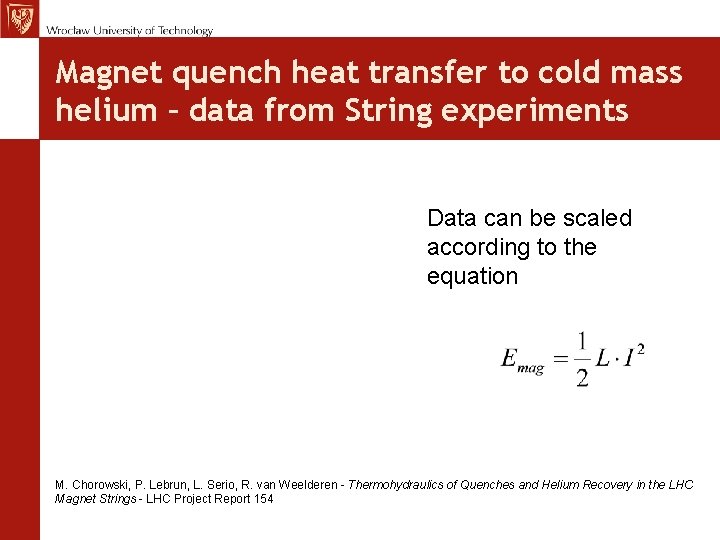
MCh, TE Seminar 12. 11. 09 Magnet quench heat transfer to cold mass helium – data from String experiments Data can be scaled according to the equation M. Chorowski, P. Lebrun, L. Serio, R. van Weelderen - Thermohydraulics of Quenches and Helium Recovery in the LHC Magnet Strings - LHC Project Report 154
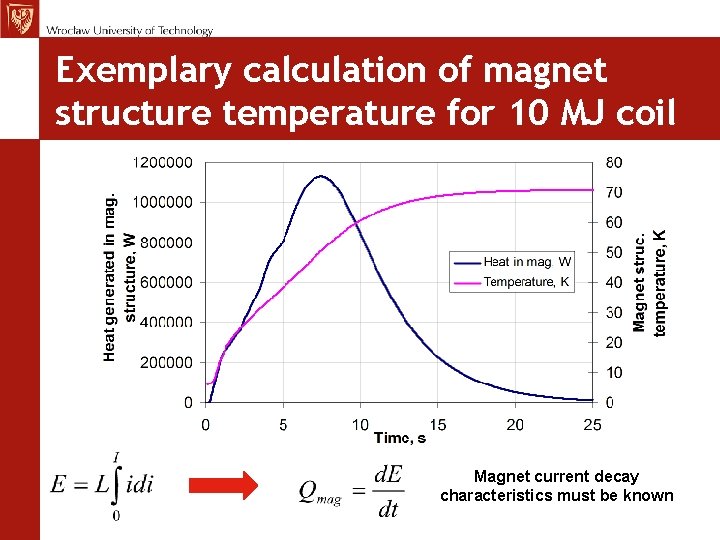
MCh, TE Seminar 12. 11. 09 Exemplary calculation of magnet structure temperature for 10 MJ coil Magnet current decay characteristics must be known
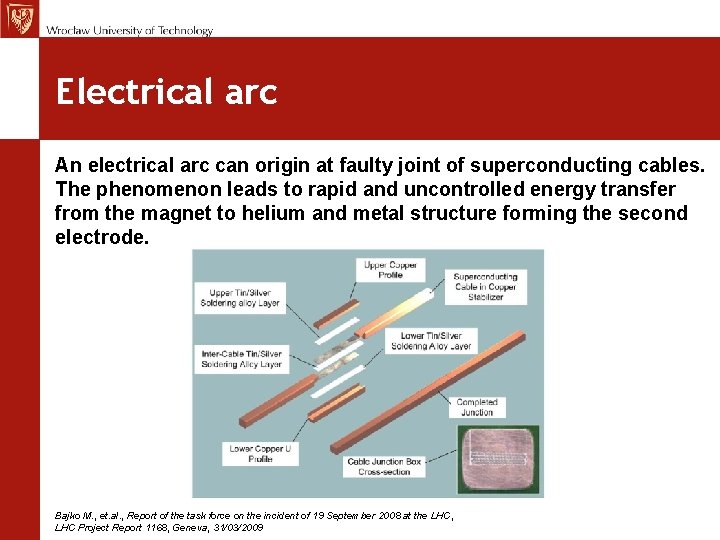
MCh, TE Seminar 12. 11. 09 Electrical arc An electrical arc can origin at faulty joint of superconducting cables. The phenomenon leads to rapid and uncontrolled energy transfer from the magnet to helium and metal structure forming the second electrode. Bajko M. , et. al. , Report of the task force on the incident of 19 September 2008 at the LHC, LHC Project Report 1168, Geneva, 31/03/2009
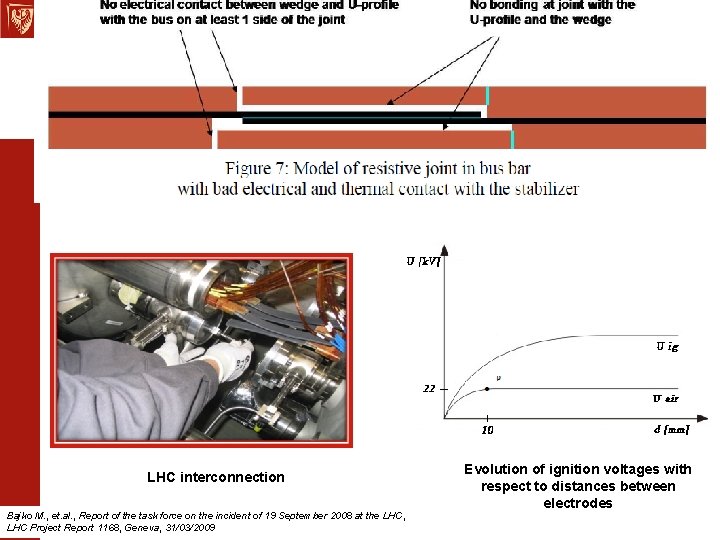
MCh, TE Seminar 12. 11. 09 LHC interconnection Bajko M. , et. al. , Report of the task force on the incident of 19 September 2008 at the LHC, LHC Project Report 1168, Geneva, 31/03/2009 Evolution of ignition voltages with respect to distances between electrodes
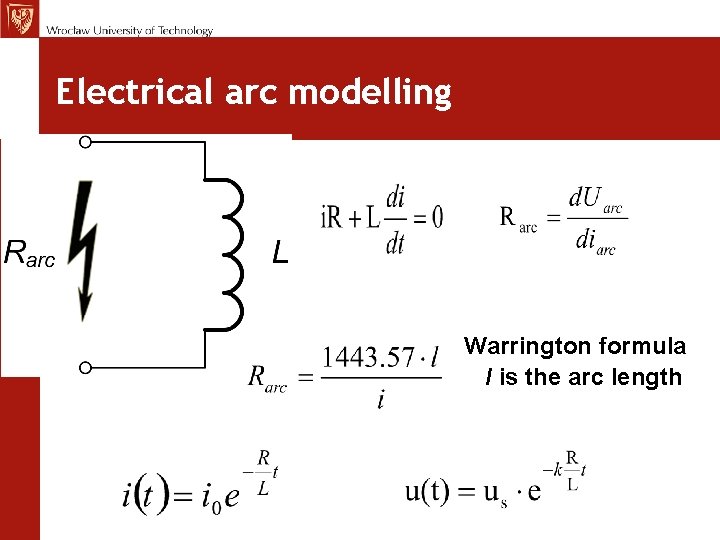
MCh, TE Seminar 12. 11. 09 Electrical arc modelling Warrington formula l is the arc length
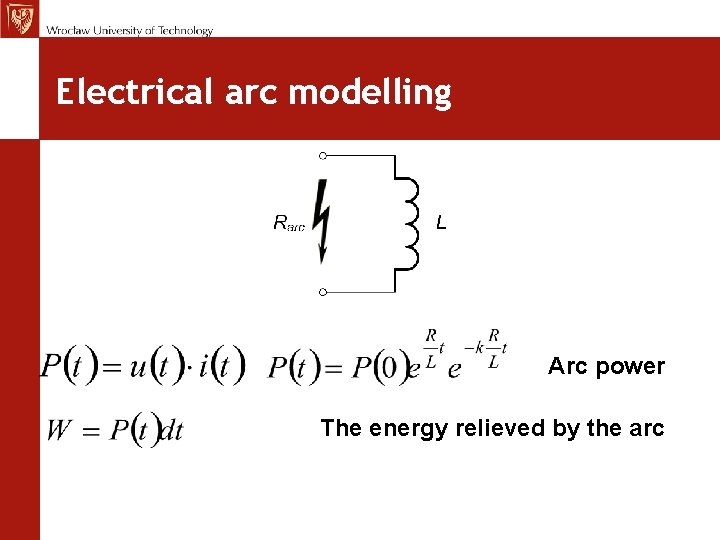
MCh, TE Seminar 12. 11. 09 Electrical arc modelling Arc power The energy relieved by the arc
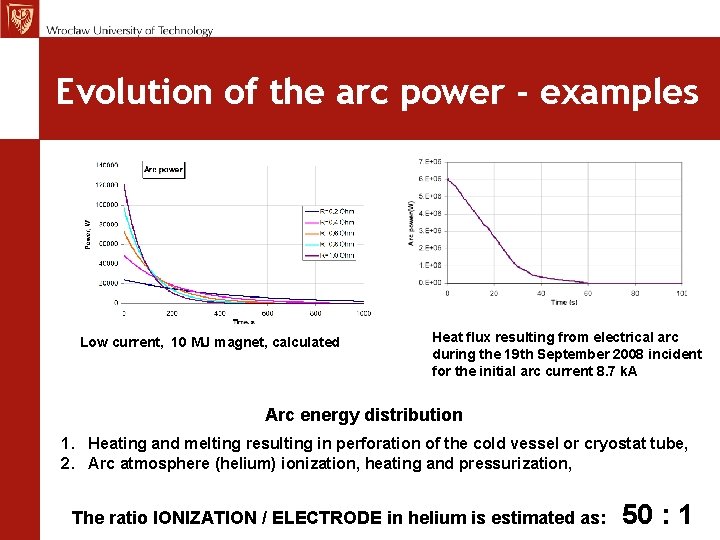
MCh, TE Seminar 12. 11. 09 Evolution of the arc power - examples Low current, 10 MJ magnet, calculated Heat flux resulting from electrical arc during the 19 th September 2008 incident for the initial arc current 8. 7 k. A Arc energy distribution 1. Heating and melting resulting in perforation of the cold vessel or cryostat tube, 2. Arc atmosphere (helium) ionization, heating and pressurization, The ratio IONIZATION / ELECTRODE in helium is estimated as: 50 : 1
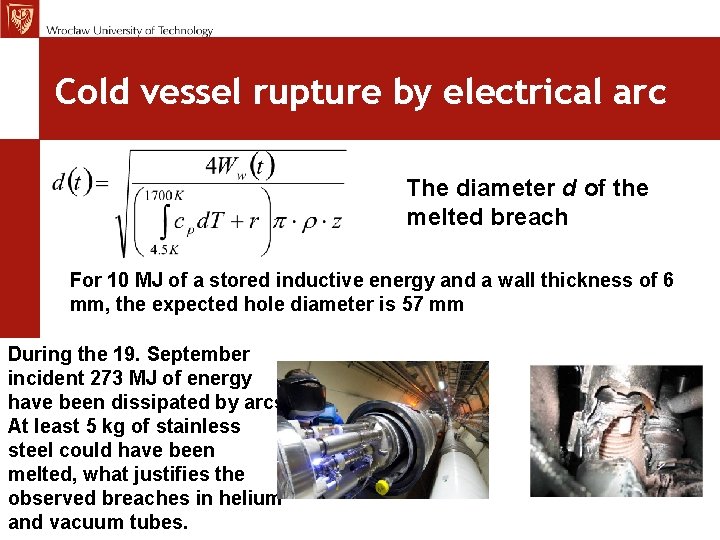
MCh, TE Seminar 12. 11. 09 Cold vessel rupture by electrical arc The diameter d of the melted breach For 10 MJ of a stored inductive energy and a wall thickness of 6 mm, the expected hole diameter is 57 mm During the 19. September incident 273 MJ of energy have been dissipated by arcs. At least 5 kg of stainless steel could have been melted, what justifies the observed breaches in helium and vacuum tubes.
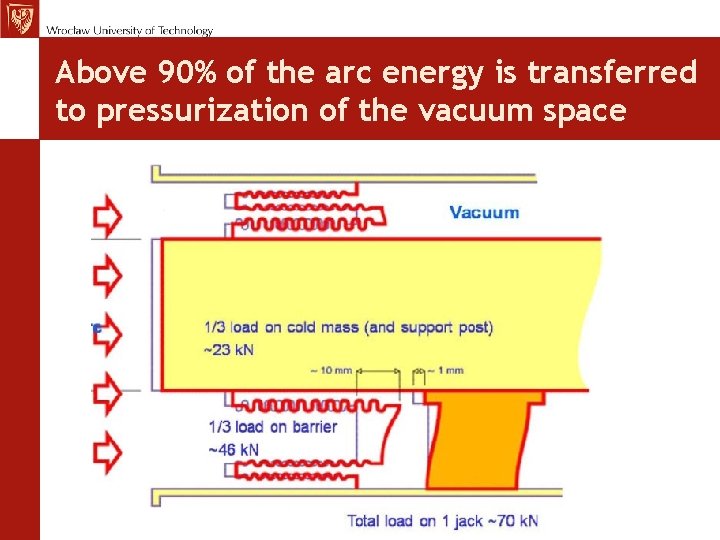
MCh, TE Seminar 12. 11. 09 Above 90% of the arc energy is transferred to pressurization of the vacuum space
MCh, TE Seminar 12. 11. 09 Damage caused by the pressurization of the vacuum space
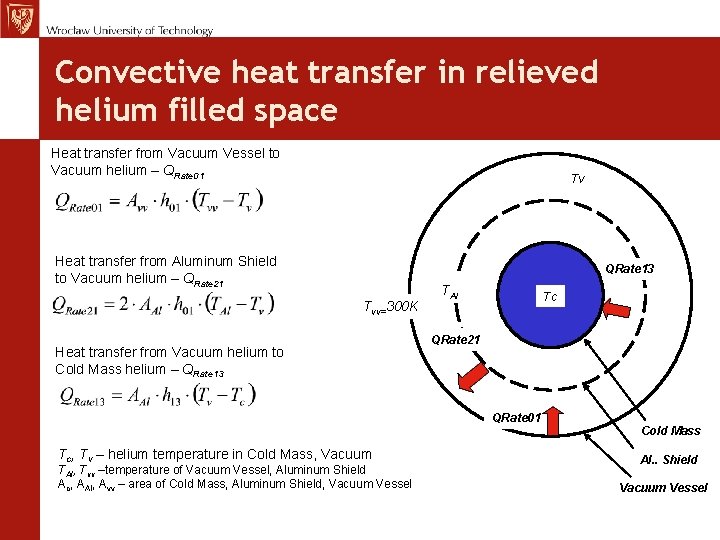
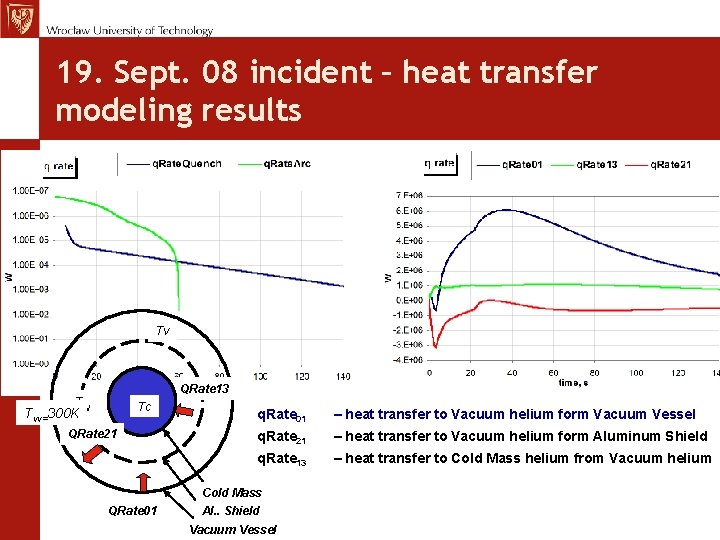
MCh, TE Seminar 12. 11. 09 Convective heat transfer in relieved helium filled space Heat transfer from Vacuum Vessel to Vacuum helium – QRate 01 Tv Heat transfer from Aluminum Shield to Vacuum helium – QRate 21 QRate 13 Tvv=300 K Heat transfer from Vacuum helium to Cold Mass helium – QRate 13 TAl Tc QRate 21 QRate 01 Tc, Tv – helium temperature in Cold Mass, Vacuum TAl, Tvv –temperature of Vacuum Vessel, Aluminum Shield Ac, AAl, Avv – area of Cold Mass, Aluminum Shield, Vacuum Vessel Cold Mass Al. . Shield Vacuum Vessel
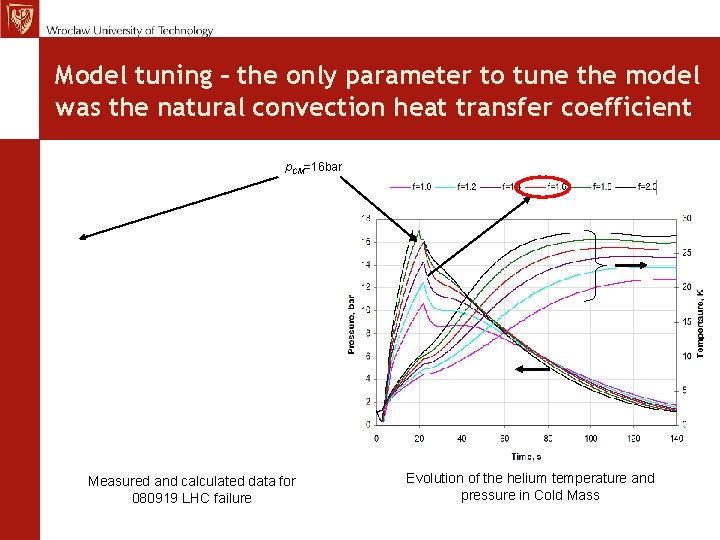
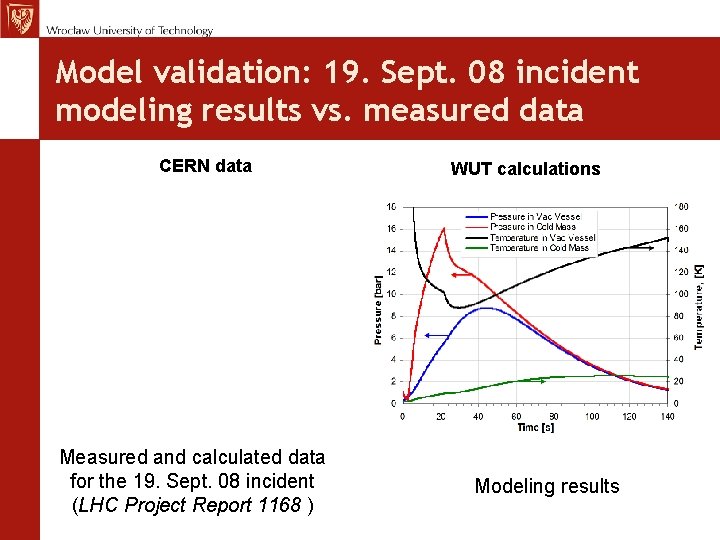
MCh, TE Seminar 12. 11. 09 Model tuning – the only parameter to tune the model was the natural convection heat transfer coefficient p. CM=16 bar Measured and calculated data for 080919 LHC failure Evolution of the helium temperature and pressure in Cold Mass
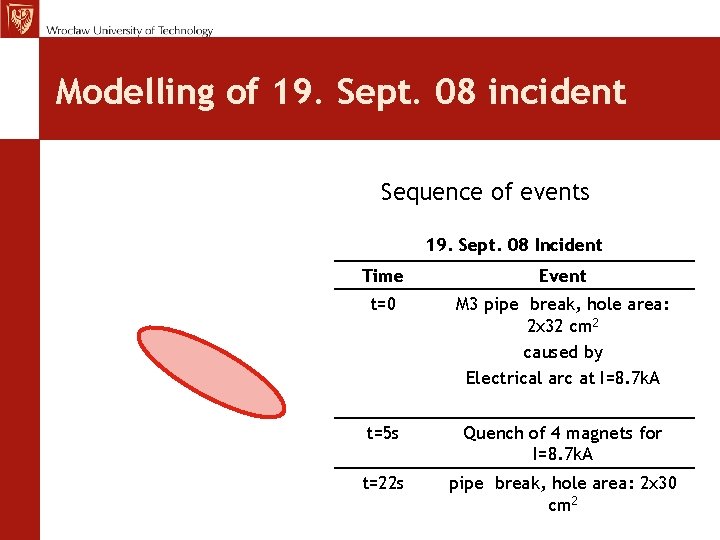
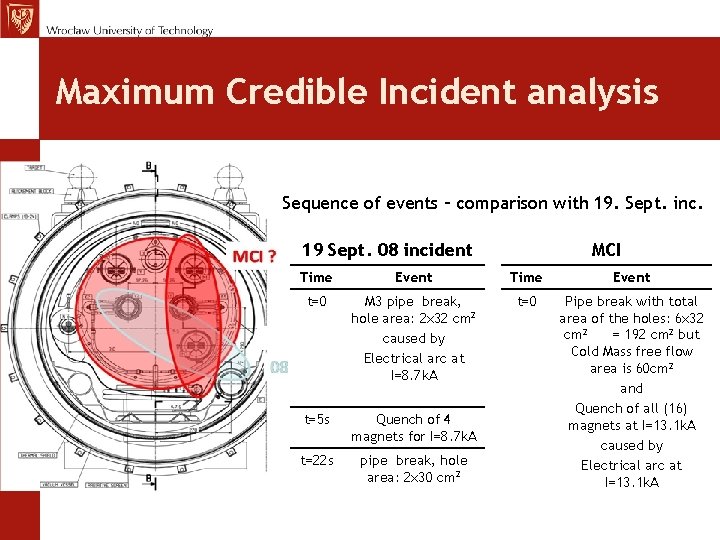
MCh, TE Seminar 12. 11. 09 Modelling of 19. Sept. 08 incident Sequence of events 19. Sept. 08 Incident Time Event t=0 M 3 pipe break, hole area: 2 x 32 cm 2 caused by Electrical arc at I=8. 7 k. A t=5 s Quench of 4 magnets for I=8. 7 k. A t=22 s pipe break, hole area: 2 x 30 cm 2
MCh, TE Seminar 12. 11. 09 Model validation: 19. Sept. 08 incident modeling results vs. measured data CERN data Measured and calculated data for the 19. Sept. 08 incident (LHC Project Report 1168 ) WUT calculations Modeling results
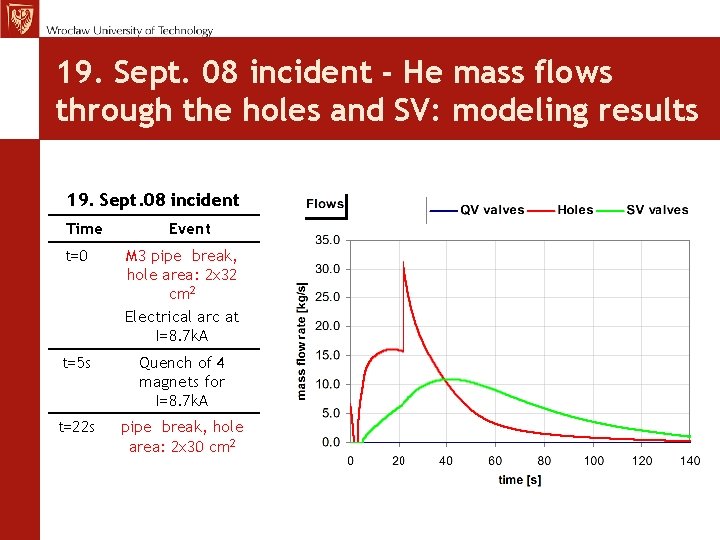
MCh, TE Seminar 12. 11. 09 19. Sept. 08 incident - He mass flows through the holes and SV: modeling results 19. Sept. 08 incident Time Event t=0 M 3 pipe break, hole area: 2 x 32 cm 2 Electrical arc at I=8. 7 k. A t=5 s Quench of 4 magnets for I=8. 7 k. A t=22 s pipe break, hole area: 2 x 30 cm 2
MCh, TE Seminar 12. 11. 09 19. Sept. 08 incident – heat transfer modeling results Tv QRate 13 TAl Tvv=300 K Tc QRate 21 q. Rate 01 – heat transfer to Vacuum helium form Vacuum Vessel q. Rate 21 – heat transfer to Vacuum helium form Aluminum Shield q. Rate 13 – heat transfer to Cold Mass helium from Vacuum helium Cold Mass QRate 01 Al. . Shield Vacuum Vessel
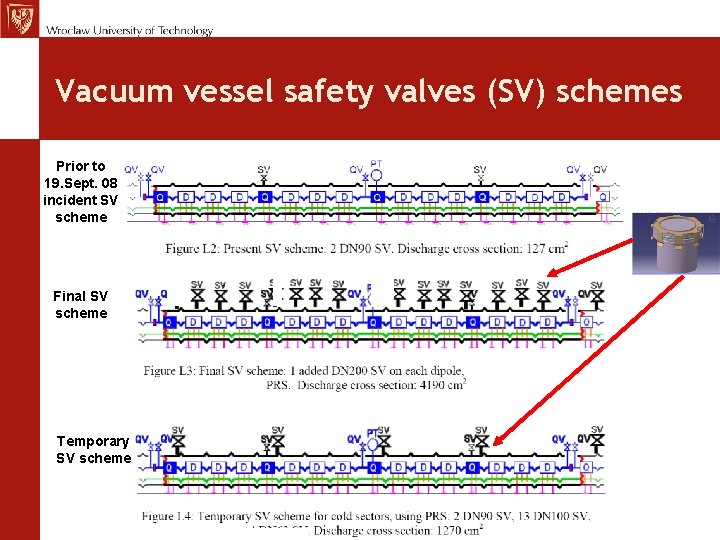
MCh, TE Seminar 12. 11. 09 Vacuum vessel safety valves (SV) schemes Prior to 19. Sept. 08 incident SV scheme Final SV scheme Temporary SV scheme
MCh, TE Seminar 12. 11. 09 Maximum Credible Incident analysis Sequence of events – comparison with 19. Sept. inc. 19 Sept. 08 incident MCI Time Event t=0 M 3 pipe break, hole area: 2 x 32 cm 2 caused by Electrical arc at I=8. 7 k. A t=0 t=5 s Quench of 4 magnets for I=8. 7 k. A t=22 s pipe break, hole area: 2 x 30 cm 2 Pipe break with total area of the holes: 6 x 32 cm 2 = 192 cm 2 but Cold Mass free flow area is 60 cm 2 and Quench of all (16) magnets at I=13. 1 k. A caused by Electrical arc at I=13. 1 k. A
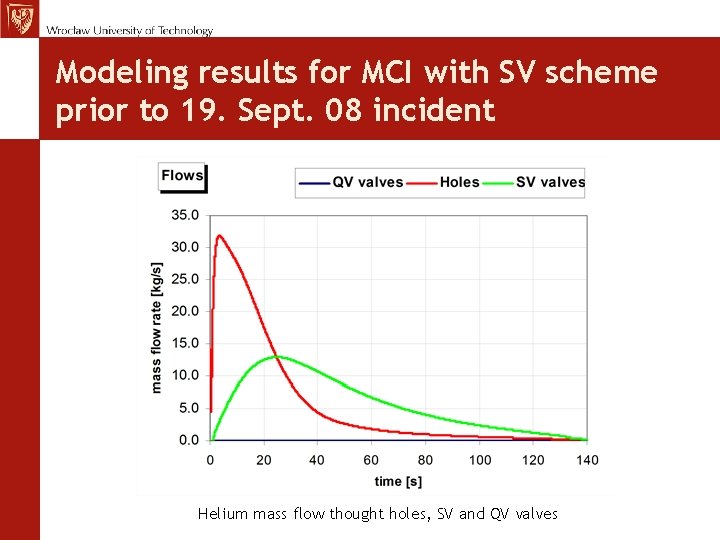
MCh, TE Seminar 12. 11. 09 Modeling results for MCI with SV scheme prior to 19. Sept. 08 incident Helium mass flow thought holes, SV and QV valves
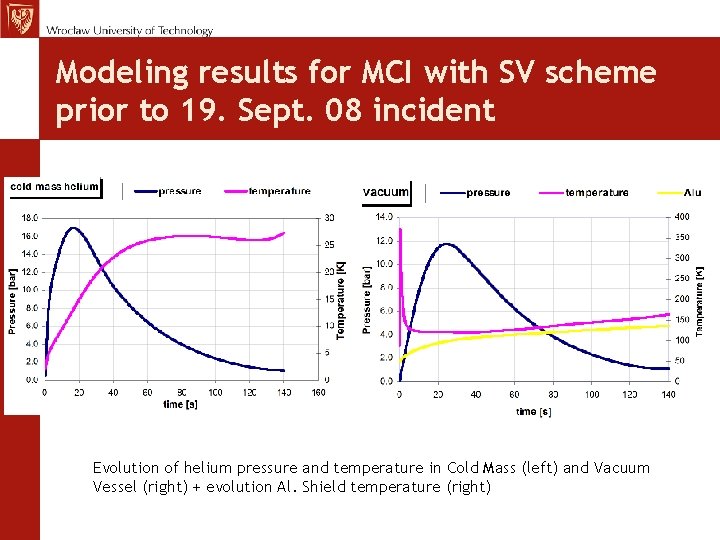
MCh, TE Seminar 12. 11. 09 Modeling results for MCI with SV scheme prior to 19. Sept. 08 incident Evolution of helium pressure and temperature in Cold Mass (left) and Vacuum Vessel (right) + evolution Al. Shield temperature (right)
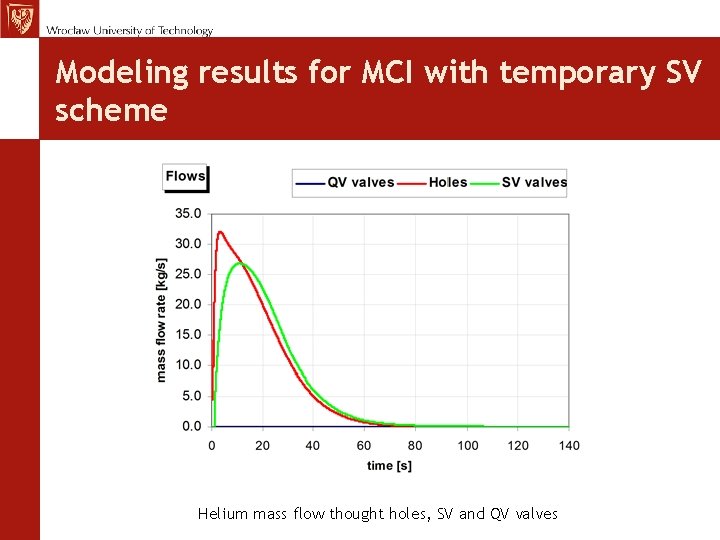
MCh, TE Seminar 12. 11. 09 Modeling results for MCI with temporary SV scheme Helium mass flow thought holes, SV and QV valves
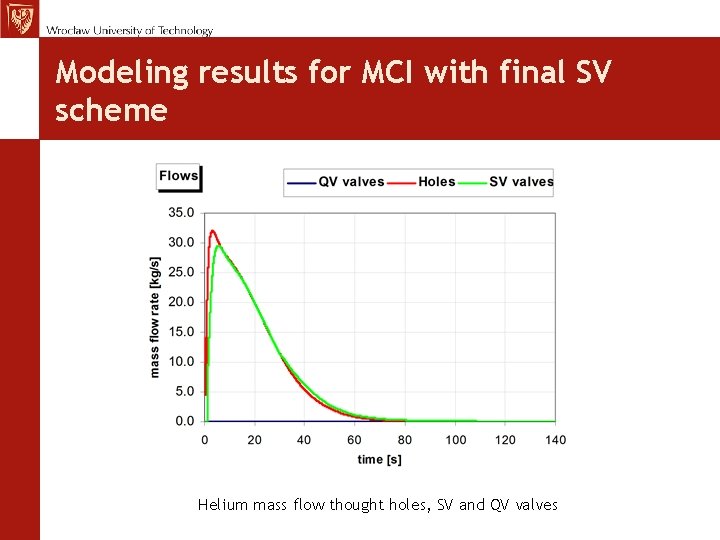
MCh, TE Seminar 12. 11. 09 Modeling results for MCI with final SV scheme Helium mass flow thought holes, SV and QV valves
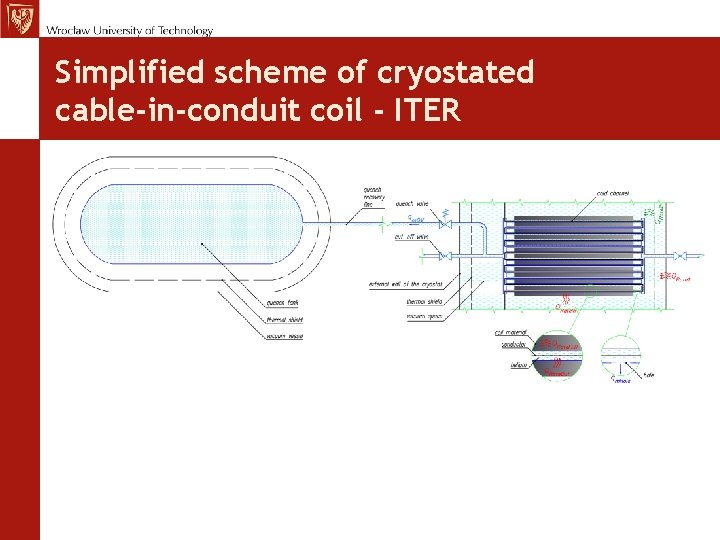
MCh, TE Seminar 12. 11. 09 Simplified scheme of cryostated cable-in-conduit coil - ITER
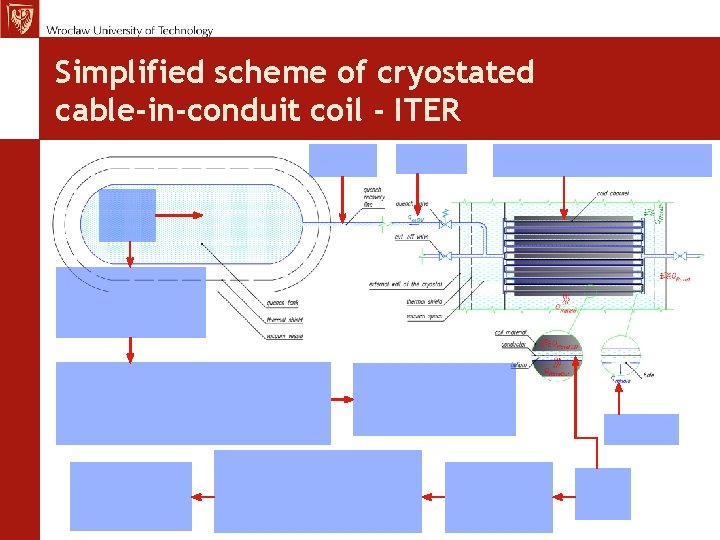
MCh, TE Seminar 12. 11. 09 Simplified scheme of cryostated cable-in-conduit coil - ITER
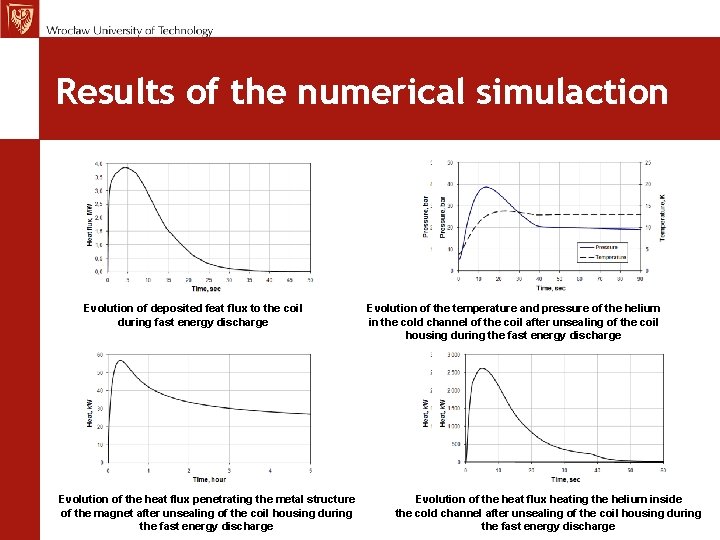
MCh, TE Seminar 12. 11. 09 Results of the numerical simulaction Evolution of deposited feat flux to the coil during fast energy discharge Evolution of the heat flux penetrating the metal structure of the magnet after unsealing of the coil housing during the fast energy discharge Evolution of the temperature and pressure of the helium in the cold channel of the coil after unsealing of the coil housing during the fast energy discharge Evolution of the heat flux heating the helium inside the cold channel after unsealing of the coil housing during the fast energy discharge
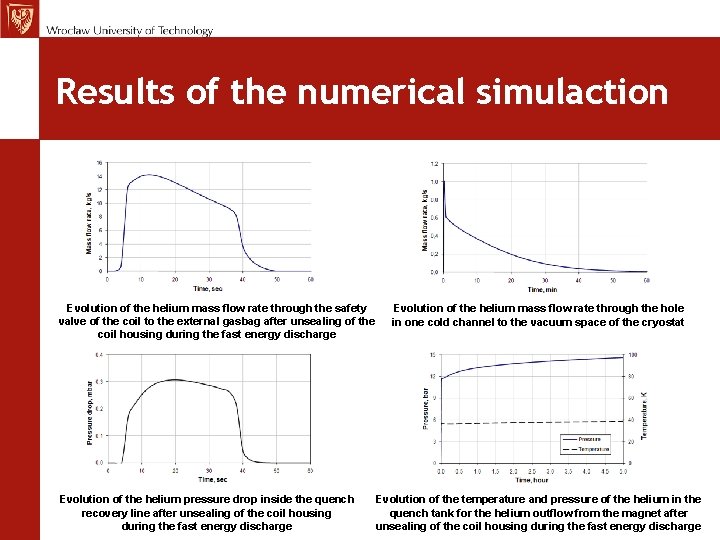
MCh, TE Seminar 12. 11. 09 Results of the numerical simulaction Evolution of the helium mass flow rate through the safety valve of the coil to the external gasbag after unsealing of the coil housing during the fast energy discharge Evolution of the helium pressure drop inside the quench recovery line after unsealing of the coil housing during the fast energy discharge Evolution of the helium mass flow rate through the hole in one cold channel to the vacuum space of the cryostat Evolution of the temperature and pressure of the helium in the quench tank for the helium outflow from the magnet after unsealing of the coil housing during the fast energy discharge
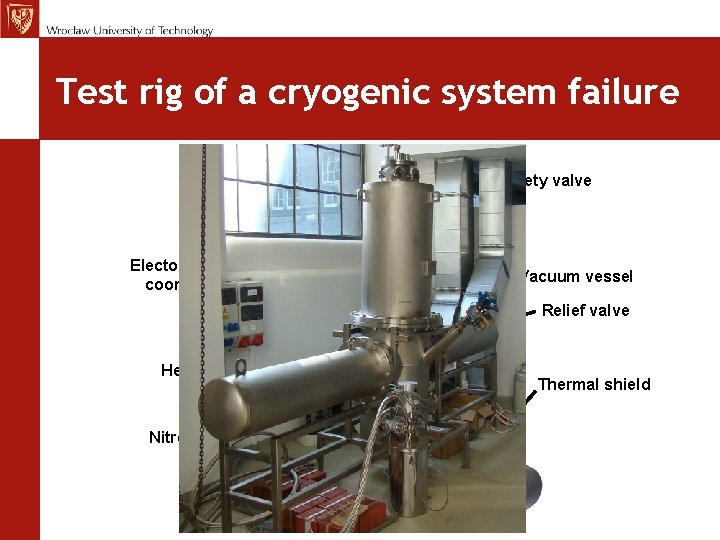
MCh, TE Seminar 12. 11. 09 Test rig of a cryogenic system failure Safety valve Vacuum Electodes with coonductors Vacuum vessel Relief valve Helium tank Nitrogen tank Thermal shield
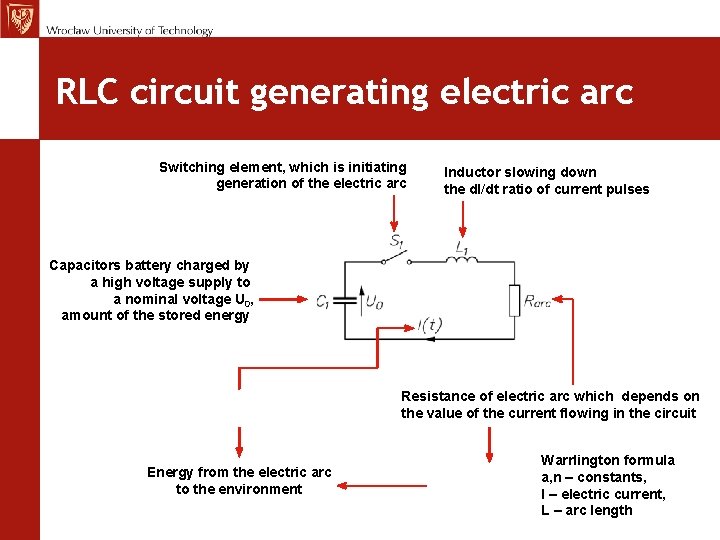
MCh, TE Seminar 12. 11. 09 RLC circuit generating electric arc Switching element, which is initiating generation of the electric arc Inductor slowing down the d. I/dt ratio of current pulses Capacitors battery charged by a high voltage supply to a nominal voltage U 0, amount of the stored energy Resistance of electric arc which depends on the value of the current flowing in the circuit Energy from the electric arc to the environment Warrlington formula a, n – constants, I – electric current, L – arc length
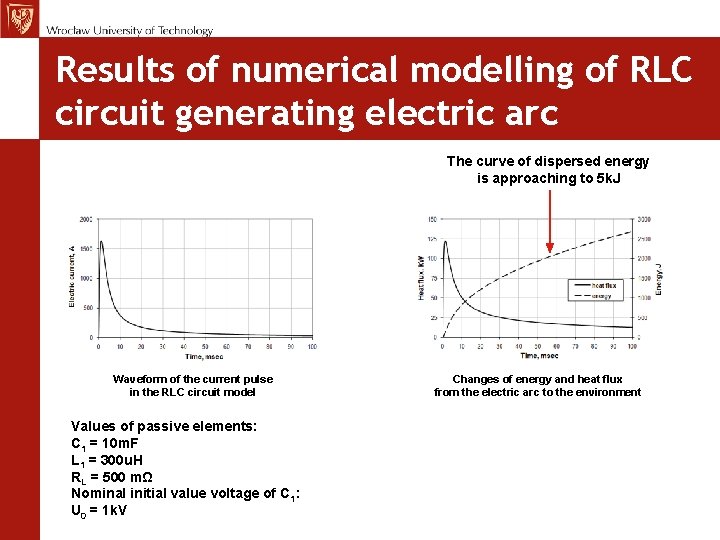
MCh, TE Seminar 12. 11. 09 Results of numerical modelling of RLC circuit generating electric arc The curve of dispersed energy is approaching to 5 k. J Waveform of the current pulse in the RLC circuit model Values of passive elements: C 1 = 10 m. F L 1 = 300 u. H RL = 500 mΩ Nominal initial value voltage of C 1: U 0 = 1 k. V Changes of energy and heat flux from the electric arc to the environment
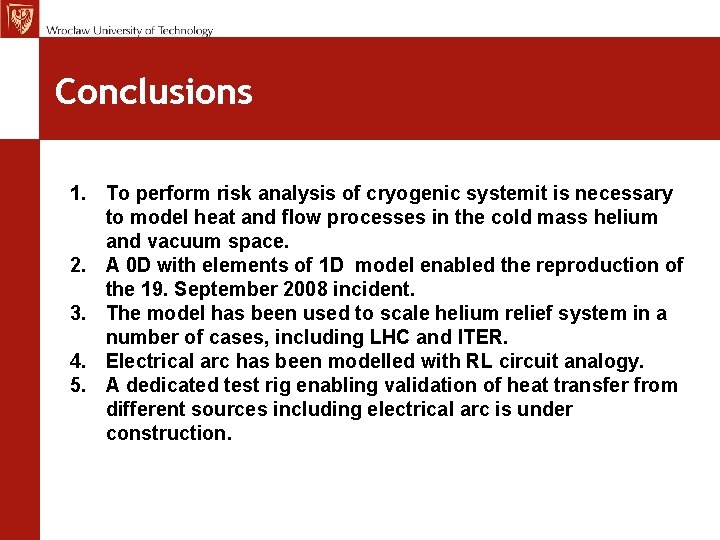
MCh, TE Seminar 12. 11. 09 Conclusions 1. To perform risk analysis of cryogenic systemit is necessary to model heat and flow processes in the cold mass helium and vacuum space. 2. A 0 D with elements of 1 D model enabled the reproduction of the 19. September 2008 incident. 3. The model has been used to scale helium relief system in a number of cases, including LHC and ITER. 4. Electrical arc has been modelled with RL circuit analogy. 5. A dedicated test rig enabling validation of heat transfer from different sources including electrical arc is under construction.