
Thermal Analysis Different Techniques Thermometric Titration TT Heat
- Slides: 15
Thermal Analysis
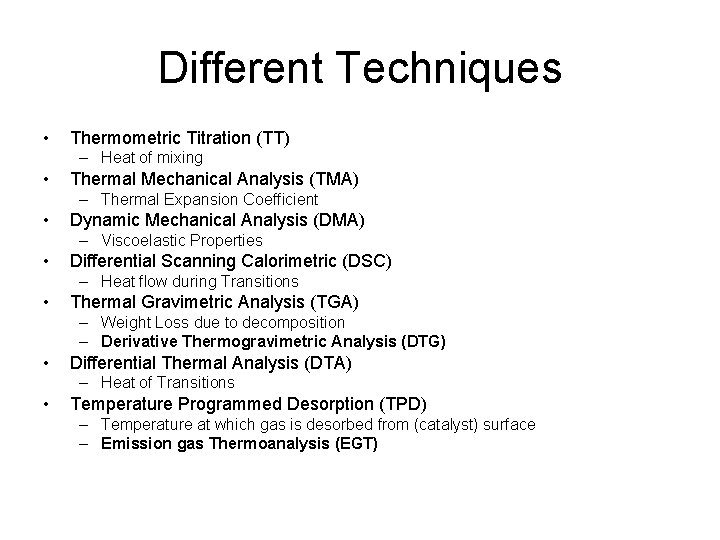
Different Techniques • Thermometric Titration (TT) – Heat of mixing • Thermal Mechanical Analysis (TMA) – Thermal Expansion Coefficient • Dynamic Mechanical Analysis (DMA) – Viscoelastic Properties • Differential Scanning Calorimetric (DSC) – Heat flow during Transitions • Thermal Gravimetric Analysis (TGA) – Weight Loss due to decomposition – Derivative Thermogravimetric Analysis (DTG) • Differential Thermal Analysis (DTA) – Heat of Transitions • Temperature Programmed Desorption (TPD) – Temperature at which gas is desorbed from (catalyst) surface – Emission gas Thermoanalysis (EGT)
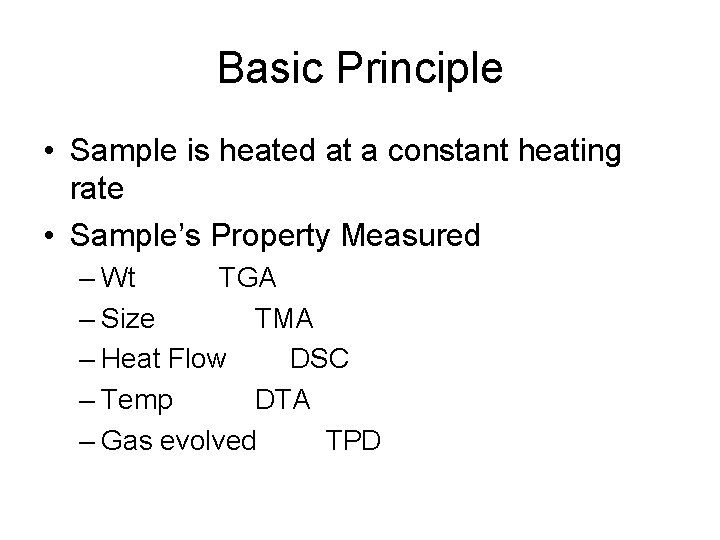
Basic Principle • Sample is heated at a constant heating rate • Sample’s Property Measured – Wt TGA – Size TMA – Heat Flow DSC – Temp DTA – Gas evolved TPD
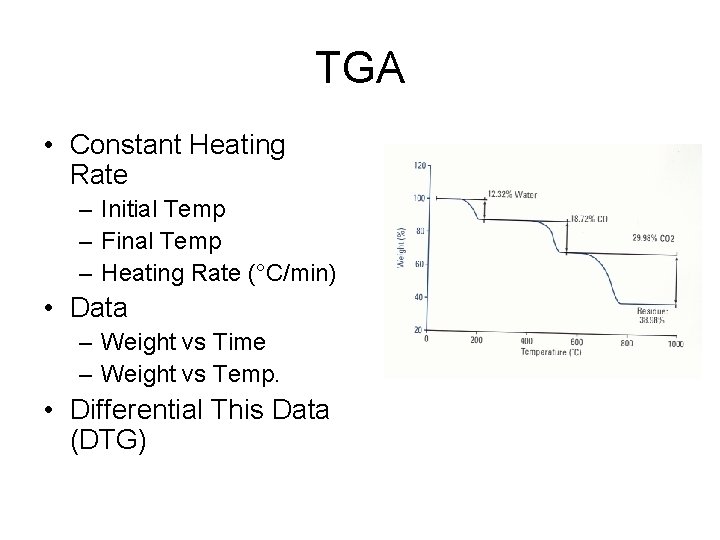
TGA • Constant Heating Rate – Initial Temp – Final Temp – Heating Rate (°C/min) • Data – Weight vs Time – Weight vs Temp. • Differential This Data (DTG)
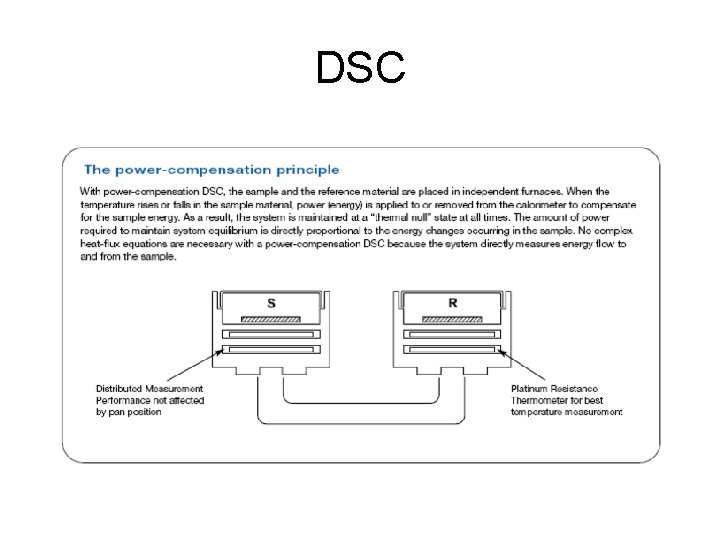
DSC
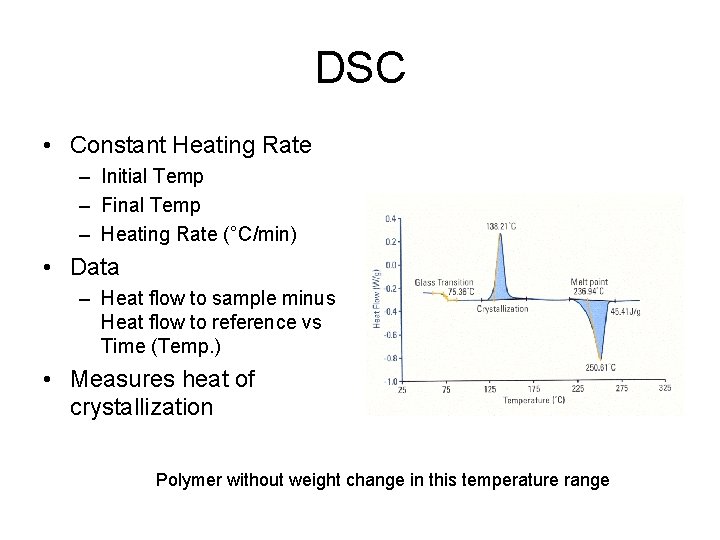
DSC • Constant Heating Rate – Initial Temp – Final Temp – Heating Rate (°C/min) • Data – Heat flow to sample minus Heat flow to reference vs Time (Temp. ) • Measures heat of crystallization Polymer without weight change in this temperature range
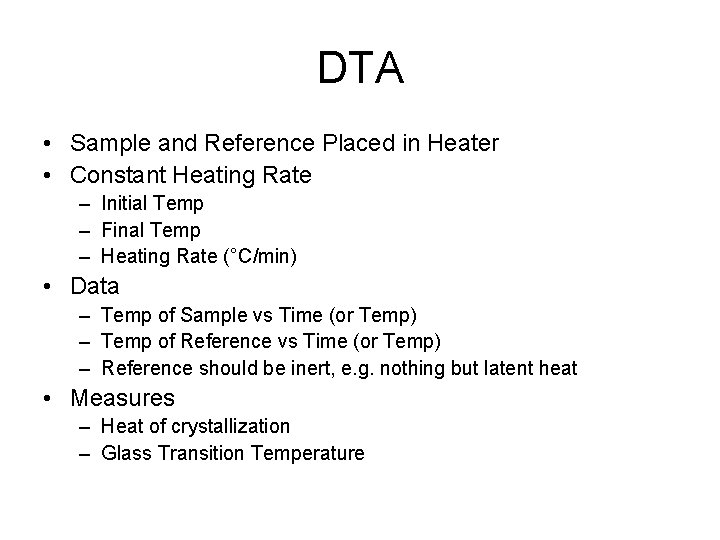
DTA • Sample and Reference Placed in Heater • Constant Heating Rate – Initial Temp – Final Temp – Heating Rate (°C/min) • Data – Temp of Sample vs Time (or Temp) – Temp of Reference vs Time (or Temp) – Reference should be inert, e. g. nothing but latent heat • Measures – Heat of crystallization – Glass Transition Temperature
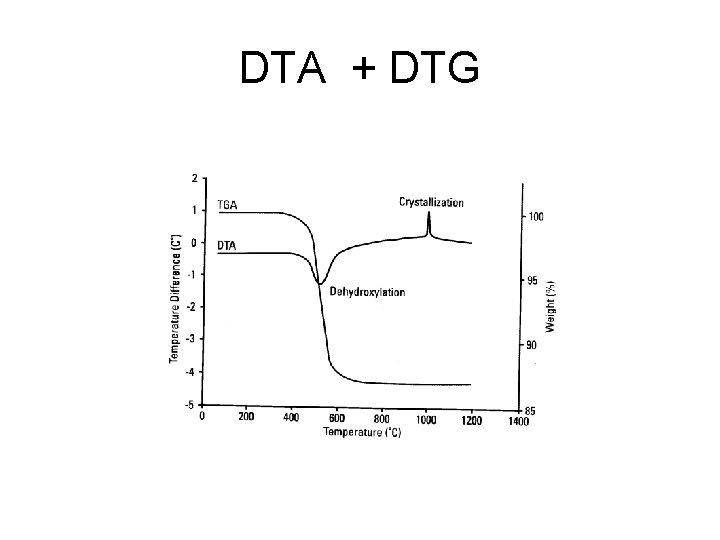
DTA + DTG
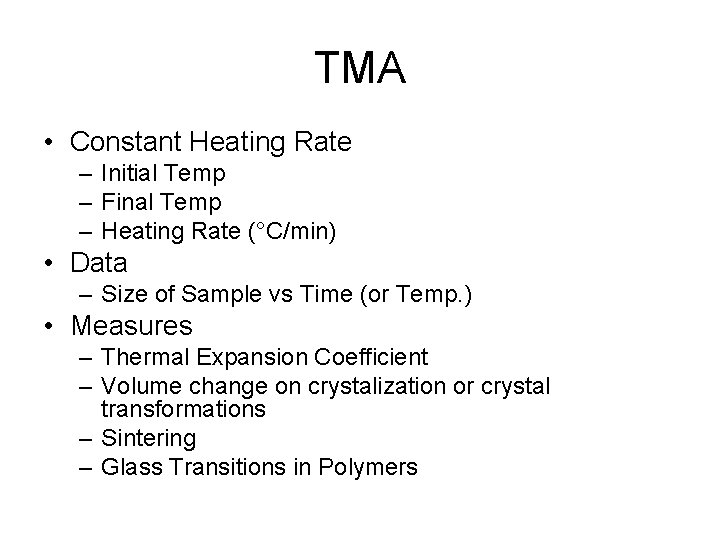
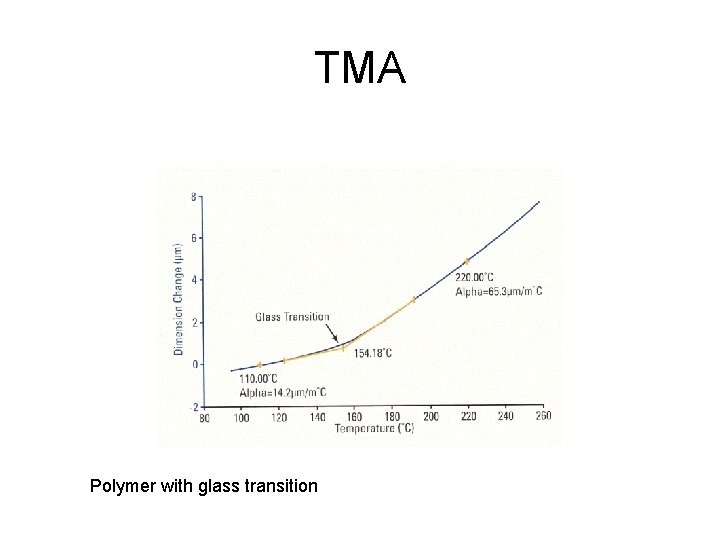
TMA • Constant Heating Rate – Initial Temp – Final Temp – Heating Rate (°C/min) • Data – Size of Sample vs Time (or Temp. ) • Measures – Thermal Expansion Coefficient – Volume change on crystalization or crystal transformations – Sintering – Glass Transitions in Polymers
TMA Polymer with glass transition
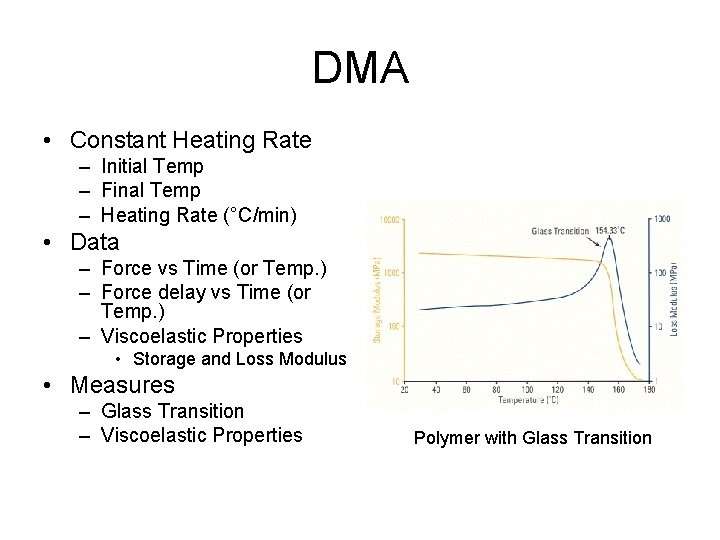
DMA • Constant Heating Rate – Initial Temp – Final Temp – Heating Rate (°C/min) • Data – Force vs Time (or Temp. ) – Force delay vs Time (or Temp. ) – Viscoelastic Properties • Storage and Loss Modulus • Measures – Glass Transition – Viscoelastic Properties Polymer with Glass Transition
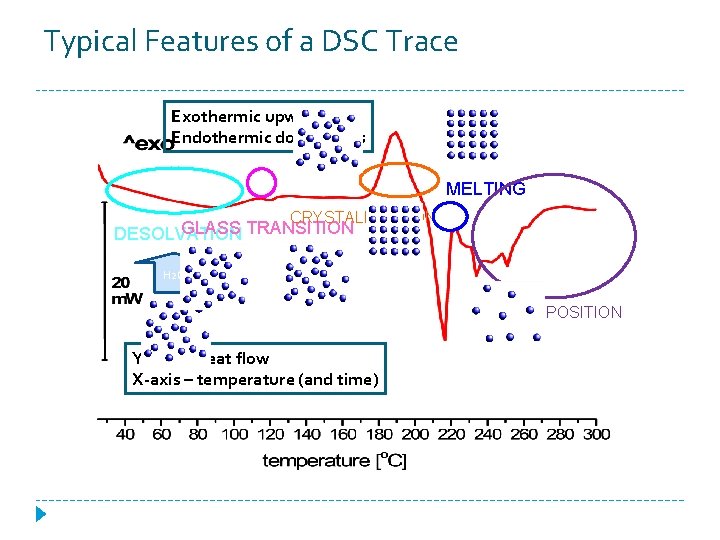
Typical Features of a DSC Trace Exothermic upwards Endothermic downwards MELTING CRYSTALLISATION GLASS TRANSITION DESOLVATION H 2 O DECOMPOSITION Y-axis – heat flow X-axis – temperature (and time)
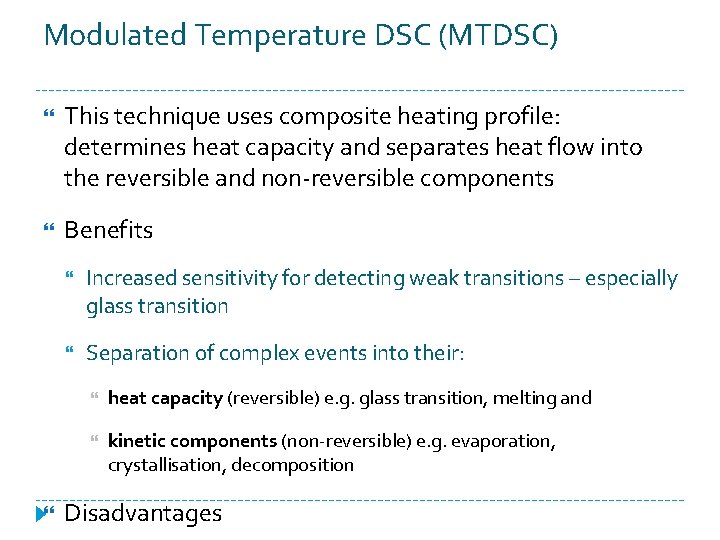
Modulated Temperature DSC (MTDSC) This technique uses composite heating profile: determines heat capacity and separates heat flow into the reversible and non-reversible components Benefits Increased sensitivity for detecting weak transitions – especially glass transition Separation of complex events into their: heat capacity (reversible) e. g. glass transition, melting and kinetic components (non-reversible) e. g. evaporation, crystallisation, decomposition Disadvantages
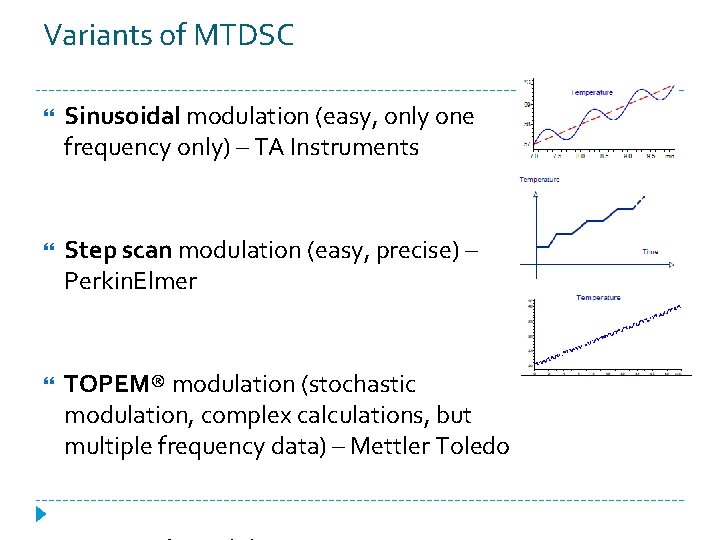
Variants of MTDSC Sinusoidal modulation (easy, only one frequency only) – TA Instruments Step scan modulation (easy, precise) – Perkin. Elmer TOPEM® modulation (stochastic modulation, complex calculations, but multiple frequency data) – Mettler Toledo
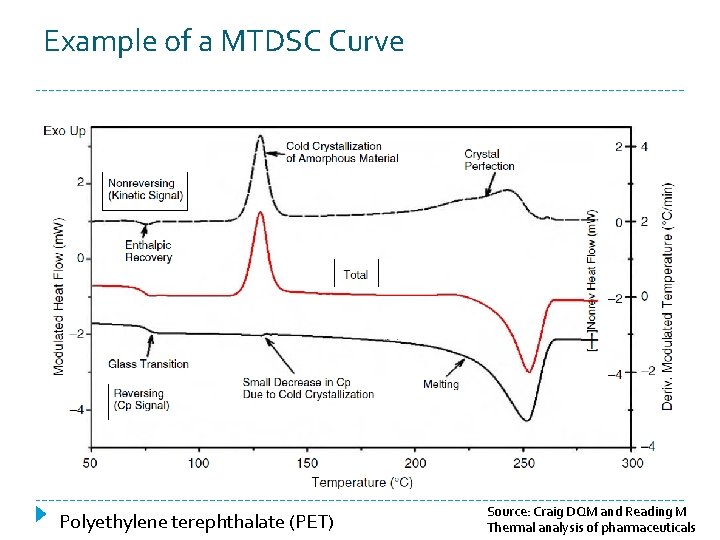
Example of a MTDSC Curve Polyethylene terephthalate (PET) Source: Craig DQM and Reading M Thermal analysis of pharmaceuticals