
Theres Plenty of Room at the Bottom An
There’s Plenty of Room at the Bottom An Invitation to Enter a New Field of Physics Richard Feynman 1959
Outline • • • Introduction How do we write small? Information on a small scale Better electron microscopes The marvelous biological system Miniaturizing the computer Miniaturization by evaporation Problems of lubrication 100 tiny hands Rearranging the atoms Atoms in a small world Feynman Prizes 2
Introduction In 1959, Feynman observed: • Nobody studied applied physics of the very small • No theoretical knowledge seemed likely to result. • Practical applications seemed enormous. 3
Introduction … “Why cannot we write the entire 24 volumes of the Encyclopedia Brittanica on the head of a pin? ” – A pin’s diameter = 1/16 inch. – Magnify by 25, 000: • • 25, 000 / 16 = 130. 2 feet. It’s area = 13, 314 square feet This is enough to fit the Brittanica. It thus suffices to shrink it to 1/25, 000. – At that scale, 1 half-tone dot = 32*32 atoms. – This is big enough to work. 4
Introduction … Such a miniaturization is readable. • Make a temporary copy of mold 1. Press the pin’s head into plastic; peel off plastic; • Construct a copy of mold 1. Evaporate silica into the plastic 2. Evaporate gold at an angle (only raised parts coated); 3. Dissolve plastic, leaving only silica & gold. • Read the copy 1. Look thru this “cloth” with an electron microscope. Original mold (pin) is reusable. 5
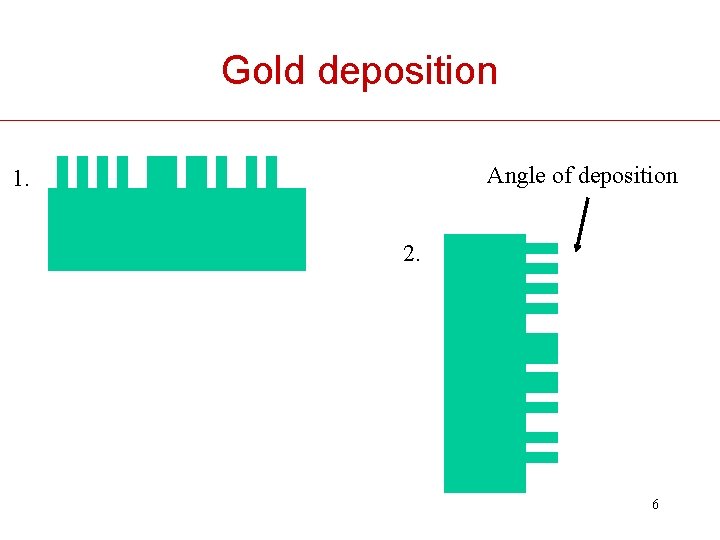
Gold deposition Angle of deposition 1. 2. 6
Outline • • • Introduction How do we write small? Information on a small scale Better electron microscopes The marvelous biological system Miniaturizing the computer Miniaturization by evaporation Problems of lubrication 100 tiny hands Rearranging the atoms Atoms in a small world Feynman Prizes 7
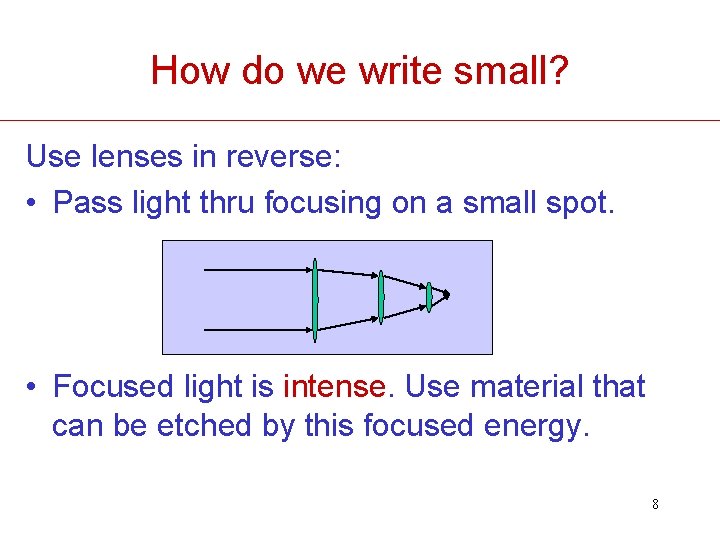
How do we write small? Use lenses in reverse: • Pass light thru focusing on a small spot. • Focused light is intense. Use material that can be etched by this focused energy. 8
How do we write small? … • Entire LOC fits in area of a 35 -page magazine. • there is room at the bottom. • Feynman then demonstrates: – There is plenty of room at the bottom. – Using physics known in 1959(!). 9
Outline • • • Introduction How do we write small? Information on a small scale Better electron microscopes The marvelous biological system Miniaturizing the computer Miniaturization by evaporation Problems of lubrication 100 tiny hands Rearranging the atoms Atoms in a small world Feynman Prizes 10
Information on a small scale • Encode information as bits: 1 char = 7 bits. • Using volumes instead of surfaces – – 5 X 5 = 125 atoms of 1 metal for 1 125 atoms of another metal for 0 The Brittanica = 1015 bits All of mankind’s books fit in 1/200 inch cubed. • (Reading inside the cube is not discussed. ) • Nature uses approximately 50 atoms/bit in DNA. 11
Outline • • • Introduction How do we write small? Information on a small scale Better electron microscopes The marvelous biological system Miniaturizing the computer Miniaturization by evaporation Problems of lubrication 100 tiny hands Rearranging the atoms Atoms in a small world Feynman Prizes 12
Better electron microscopes • A 100 -fold improvement in electron microscopy goes a long way. • It is possible: – 1959 microscopes resolve to 10 angstroms. – Wave length of electron is 1/20 angstrom – 100 -fold improvement thus is possible. (been done? ) • Applications to scientific problems: – See DNA, RNA, the cell at work. – See chemical reactions at work. • Is there a physical way to synthesize chemicals? 13
Outline • • • Introduction How do we write small? Information on a small scale Better electron microscopes The marvelous biological system Miniaturizing the computer Miniaturization by evaporation Problems of lubrication 100 tiny hands Rearranging the atoms Atoms in a small world Feynman Prizes 14
The marvelous biological system • Cells don’t just write information, they are active. – Replicating parts (e. g. , proteins) – Replicating themselves (mitosis) – Replicating an entire organism. • Some cells move; all have moving parts. • Can we make small: – Computers – Other maneuverable devices? 15
Outline • • • Introduction How do we write small? Information on a small scale Better electron microscopes The marvelous biological system Miniaturizing the computer Miniaturization by evaporation Problems of lubrication 100 tiny hands Rearranging the atoms Atoms in a small world Feynman Prizes 16
Miniaturizing the computer • Make wires 10 – 100 atoms in diameter. (In 1959, computers filled entire rooms. ) • Feynman speculates: 106 bigger computers could perform qualitatively harder tasks. – E. g. , face recognition, at which the brain excels (occupies an enormous % of the human brain). 17
Miniaturizing the computer … • Brain’s microscopic elements >> computers. • What if we made sub-microscopic elements? • Feynman: faster computers ultimately must have smaller elements (Speed of light lower bound on latency) 18
Outline • • • Introduction How do we write small? Information on a small scale Better electron microscopes The marvelous biological system Miniaturizing the computer Miniaturization by evaporation Problems of lubrication 100 tiny hands Rearranging the atoms Atoms in a small world Feynman Prizes 19
Miniaturization by evaporation • Make small elements using evaporation: – Evaporate: • a metal layer; • an insulation layer; • repeat until have all the elements you want. • ICs, “invented” much later, (still!) made this way. 20
Miniaturization by evaporation … • Make small machines (not just computers) using small tools? • What are the problems? – Resolution of the material. • A flywheel of diameter 10 atoms won’t be round. – Weight/inertia do not dominate at smaller scale. – Electrical parts (e. g. , magnetic fields) must be redesigned (but can be done). 21
Outline • • • Introduction How do we write small? Information on a small scale Better electron microscopes The marvelous biological system Miniaturizing the computer Miniaturization by evaporation Problems of lubrication 100 tiny hands Rearranging the atoms Atoms in a small world Feynman Prizes 22
Problems of lubrication • Heat dissipates rapidly at that scale. • Don’t lubricate! • Feynman’s friend, Hibbs: nanoscale machines as medical agents, running around inside our bodies. • How to make small things: – With existing tools, make smaller tools. – With smaller tools, make yet smaller tools. – Iterate. • What about needed increases in precision? 23
Problems of lubrication … • Increasing precision: an example. 1. Make smaller flat surfaces. 2. Take 3 such smaller surfaces. Rub them together until they are flat enough at that scale. • • At each level, perform precision-improving actions, at that scale. Use simultaneous replication to increase manufacturing efficiency. 24
Outline • • • Introduction How do we write small? Information on a small scale Better electron microscopes The marvelous biological system Miniaturizing the computer Miniaturization by evaporation Problems of lubrication 100 tiny hands Rearranging the atoms Atoms in a small world Feynman Prizes 25
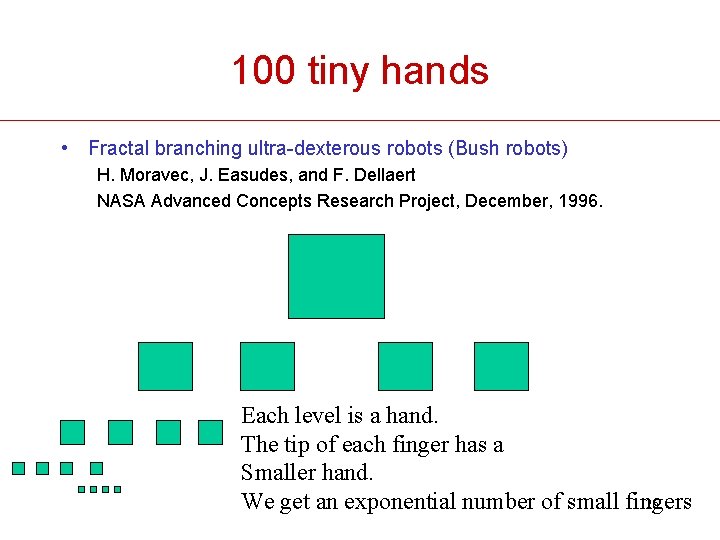
100 tiny hands • Fractal branching ultra-dexterous robots (Bush robots) H. Moravec, J. Easudes, and F. Dellaert NASA Advanced Concepts Research Project, December, 1996. Each level is a hand. The tip of each finger has a Smaller hand. 26 We get an exponential number of small fingers
100 tiny hands … • Feynamn notes, at this scale: – Gravity is almost imperceptible compared to Van der Waals molecular attraction. – Van der Waals attractions make things at this scale attract (stick). – Designs must take account for these forces. 27
Outline • • • Introduction How do we write small? Information on a small scale Better electron microscopes The marvelous biological system Miniaturizing the computer Miniaturization by evaporation Problems of lubrication 100 tiny hands Rearranging the atoms Atoms in a small world Feynman Prizes 28
Rearranging the atoms • Constructing materials atom by atom gives “materials science” enormously more potential. • E. g. , make arrays of tiny circuits that emit light at the same wavelength in the same direction. (This is being done now in laboratories. ) • Resistance problems increase at that scale. Suggests using superconductivity, as 1 approach. 29
Outline • • • Introduction How do we write small? Information on a small scale Better electron microscopes The marvelous biological system Miniaturizing the computer Miniaturization by evaporation Problems of lubrication 100 tiny hands Rearranging the atoms Atoms in a small world Feynman Prizes 30
Atoms in a small world • Atoms on a small scale satisfy laws of quantum mechanics. – Nothing acts like this at a large scale. – We can exploit: • quantized energy levels • Interactions of quantized spins, etc. • Manufacturing perfection: – If resolution is less than 1 atom, then each copy is exact, atom for atom. 31
Atoms in a small world … • Replace chemistry with physical manufacture. • Proposed a competition: Who can build the smallest motor, for example. 32
Outline • • • Introduction How do we write small? Information on a small scale Better electron microscopes The marvelous biological system Miniaturizing the computer Miniaturization by evaporation Problems of lubrication 100 tiny hands Rearranging the atoms Atoms in a small world Feynman Prizes 33
Feynman Prizes • Information on the Feynman Prizes: http: //www. foresight. org/FI/fi_spons. html 1998 Feynman Prize in Nanotechnology, Theory • Ralph Merkle (Xerox PARC) • Stephen Walch (ELORET at NASA Ames) For computational model of molecular tools for atomically-precise chemical reactions. 34
- Slides: 34