
Theres No Shortage of Electrical Events Lessons Learned
- Slides: 39
There’s No Shortage of Electrical Events Lessons Learned at BNL and Beyond! Edward A. Sierra Quality Management Office Presented to: ALD for ESH&Q Safety & Health Services Division Manager Lab Electrical Safety Committee Brookhaven Science Associates August 30, 2006
AGENDA n n n n n Point to Ponder Why this Presentation? DOE Electrical Safety Report – 2004 BNL Electrical Occurrences, 2002 – 2006 • Causes • BNL Lesson Learned Statements Electrical “R” ORPS Reports in the Complex • Causes DOE Suggested Measures to Prevent Electrical Occurrences DOE Special Operations Report, Electrical Safety 2006 • Mandated Response BNL World-Class in Electrical Safety? Beyond BNL, Electrical Safety Programs Path Forward Brookhaven Science Associates
Point to Ponder Organizations only improve “where the truth is told and the brutal facts confronted. ” - Jim Collins Good to Great, 2001 Brookhaven Science Associates
Why this Presentation? n As directed by the Deputy Director of Operations: • The Laboratory will evaluate the DOE’s ORPS and lessons learned-databases concerning all previous electrical events to identify lessons learned. In addition, a search will be made for electrical safety “best practices” within the DOE complex. The results of this evaluation/search will be presented to the ALD for ESH&Q, the Safety and Health Services Division Manager, and the Laboratory’s Electrical Safety Brookhaven Science Committee for them to assess the Associates
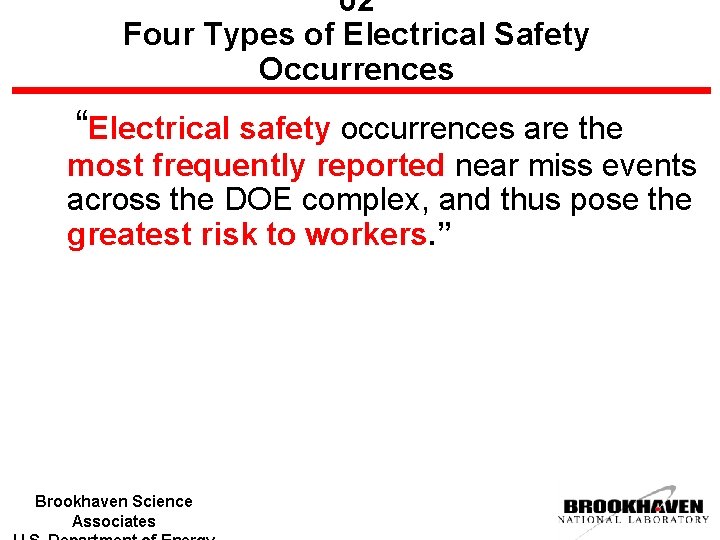
02 Four Types of Electrical Safety Occurrences “Electrical safety occurrences are the most frequently reported near miss events across the DOE complex, and thus pose the greatest risk to workers. ” Brookhaven Science Associates
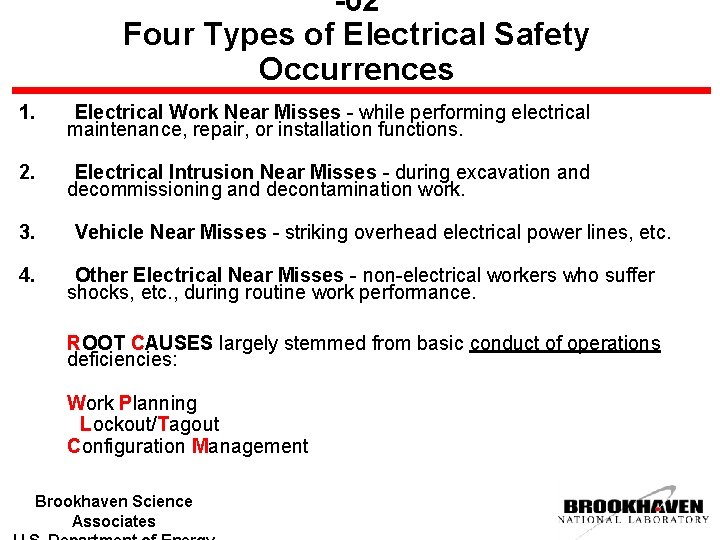
-02 Four Types of Electrical Safety Occurrences 1. Electrical Work Near Misses - while performing electrical maintenance, repair, or installation functions. 2. Electrical Intrusion Near Misses - during excavation and decommissioning and decontamination work. 3. 4. Vehicle Near Misses - striking overhead electrical power lines, etc. Other Electrical Near Misses - non-electrical workers who suffer shocks, etc. , during routine work performance. ROOT CAUSES largely stemmed from basic conduct of operations deficiencies: Work Planning Lockout/Tagout Configuration Management Brookhaven Science Associates
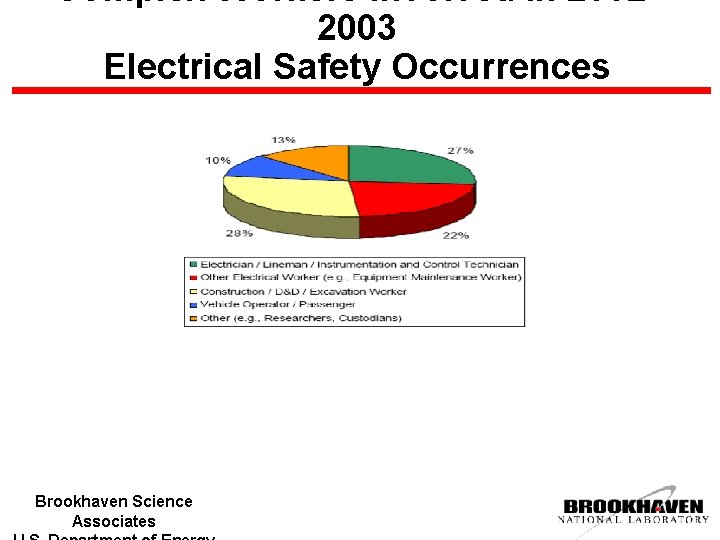
Complex Workers Involved in 20022003 Electrical Safety Occurrences Brookhaven Science Associates
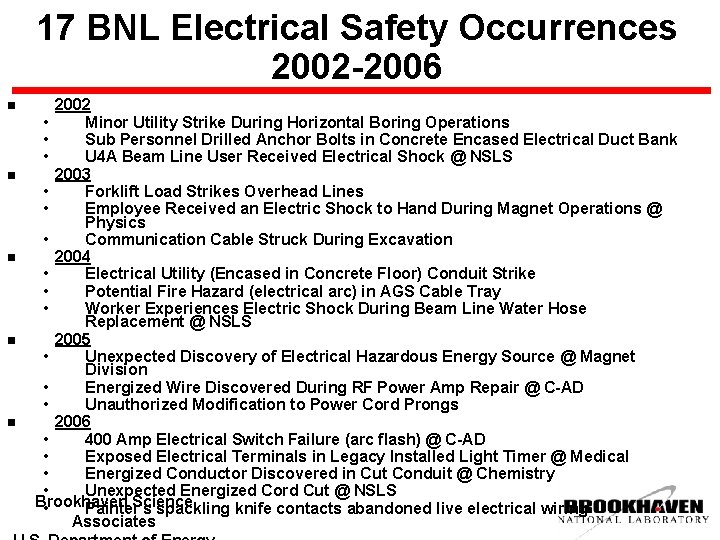
17 BNL Electrical Safety Occurrences 2002 -2006 n n n 2002 • Minor Utility Strike During Horizontal Boring Operations • Sub Personnel Drilled Anchor Bolts in Concrete Encased Electrical Duct Bank • U 4 A Beam Line User Received Electrical Shock @ NSLS 2003 • Forklift Load Strikes Overhead Lines • Employee Received an Electric Shock to Hand During Magnet Operations @ Physics • Communication Cable Struck During Excavation 2004 • Electrical Utility (Encased in Concrete Floor) Conduit Strike • Potential Fire Hazard (electrical arc) in AGS Cable Tray • Worker Experiences Electric Shock During Beam Line Water Hose Replacement @ NSLS 2005 • Unexpected Discovery of Electrical Hazardous Energy Source @ Magnet Division • Energized Wire Discovered During RF Power Amp Repair @ C-AD • Unauthorized Modification to Power Cord Prongs 2006 • 400 Amp Electrical Switch Failure (arc flash) @ C-AD • Exposed Electrical Terminals in Legacy Installed Light Timer @ Medical • Energized Conductor Discovered in Cut Conduit @ Chemistry • Unexpected Energized Cord Cut @ NSLS Brookhaven Science • Painter's spackling knife contacts abandoned live electrical wiring Associates
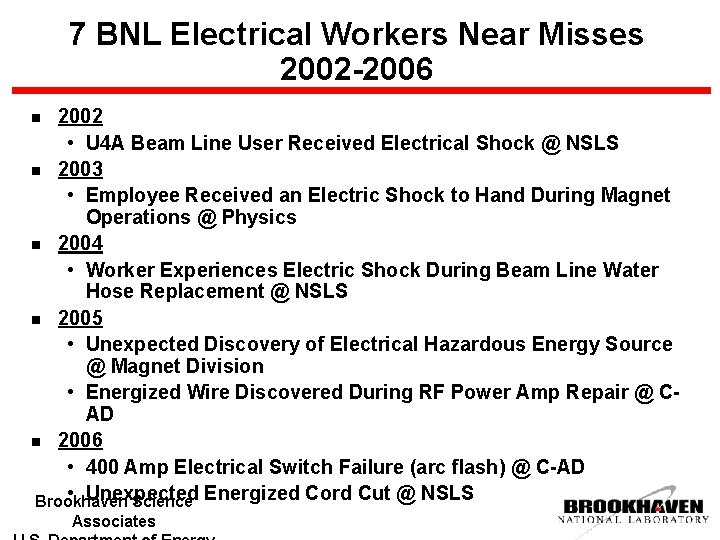
7 BNL Electrical Workers Near Misses 2002 -2006 2002 • U 4 A Beam Line User Received Electrical Shock @ NSLS n 2003 • Employee Received an Electric Shock to Hand During Magnet Operations @ Physics n 2004 • Worker Experiences Electric Shock During Beam Line Water Hose Replacement @ NSLS n 2005 • Unexpected Discovery of Electrical Hazardous Energy Source @ Magnet Division • Energized Wire Discovered During RF Power Amp Repair @ CAD n 2006 • 400 Amp Electrical Switch Failure (arc flash) @ C-AD • Unexpected Brookhaven Science Energized Cord Cut @ NSLS n Associates
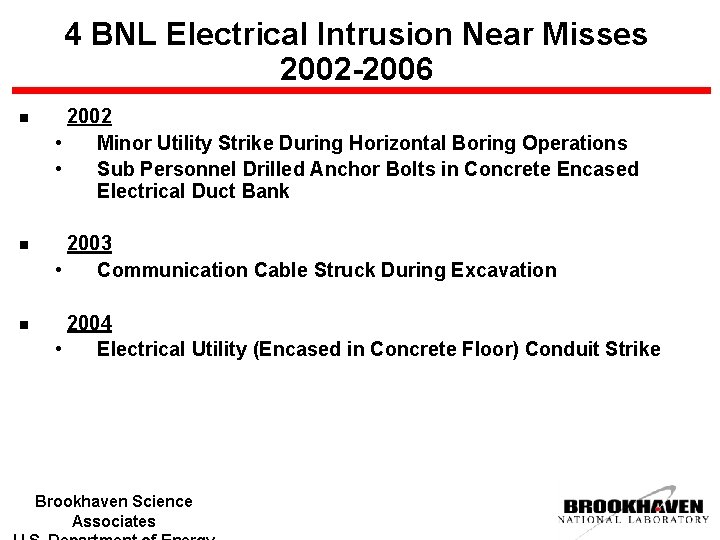
4 BNL Electrical Intrusion Near Misses 2002 -2006 n 2002 • Minor Utility Strike During Horizontal Boring Operations • Sub Personnel Drilled Anchor Bolts in Concrete Encased Electrical Duct Bank n 2003 • Communication Cable Struck During Excavation n 2004 • Electrical Utility (Encased in Concrete Floor) Conduit Strike Brookhaven Science Associates
1 BNL Vehicle Near Misses 2002 -2006 n 2003 • Forklift Load Strikes Overhead Lines Brookhaven Science Associates
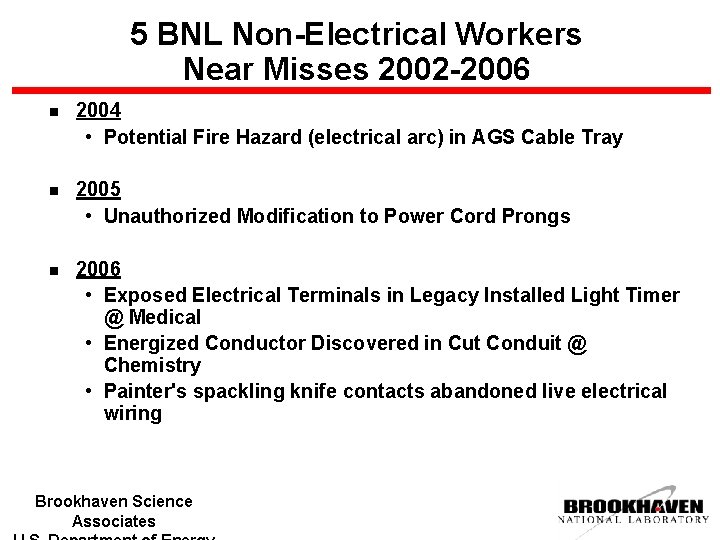
5 BNL Non-Electrical Workers Near Misses 2002 -2006 n 2004 • Potential Fire Hazard (electrical arc) in AGS Cable Tray n 2005 • Unauthorized Modification to Power Cord Prongs n 2006 • Exposed Electrical Terminals in Legacy Installed Light Timer @ Medical • Energized Conductor Discovered in Cut Conduit @ Chemistry • Painter's spackling knife contacts abandoned live electrical wiring Brookhaven Science Associates
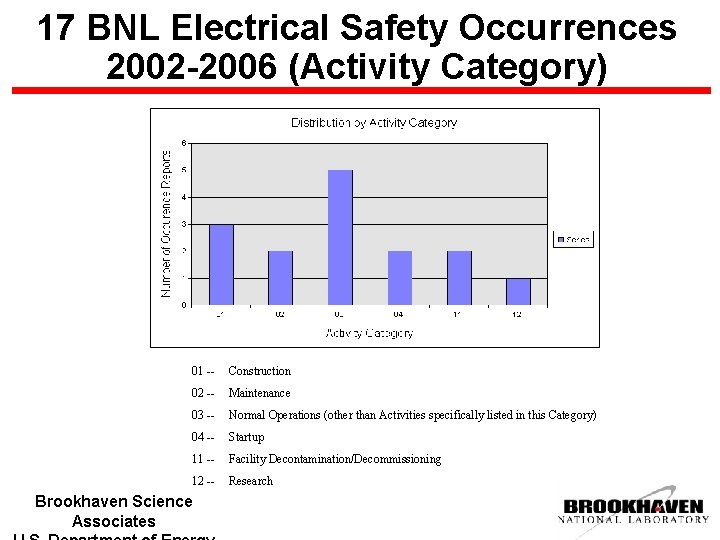
17 BNL Electrical Safety Occurrences 2002 -2006 (Activity Category) 01 -- Construction 02 -- Maintenance 03 -- Normal Operations (other than Activities specifically listed in this Category) 04 -- Startup 11 -- Facility Decontamination/Decommissioning 12 -- Research Brookhaven Science Associates
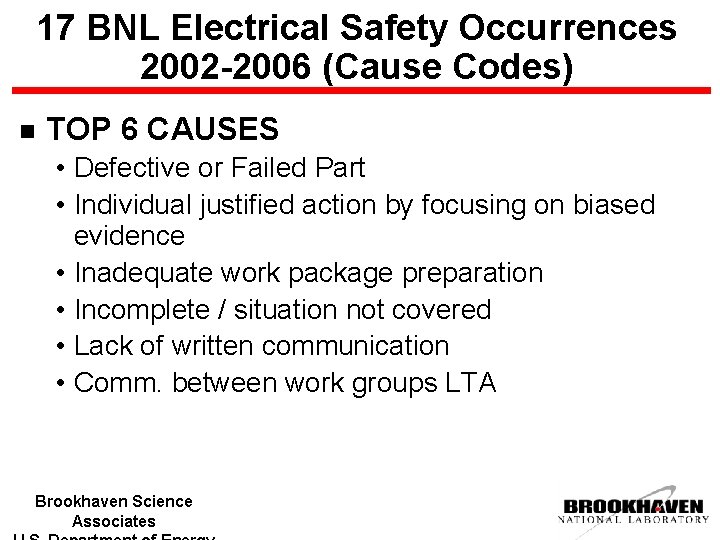
17 BNL Electrical Safety Occurrences 2002 -2006 (Cause Codes) n TOP 6 CAUSES • Defective or Failed Part • Individual justified action by focusing on biased evidence • Inadequate work package preparation • Incomplete / situation not covered • Lack of written communication • Comm. between work groups LTA Brookhaven Science Associates
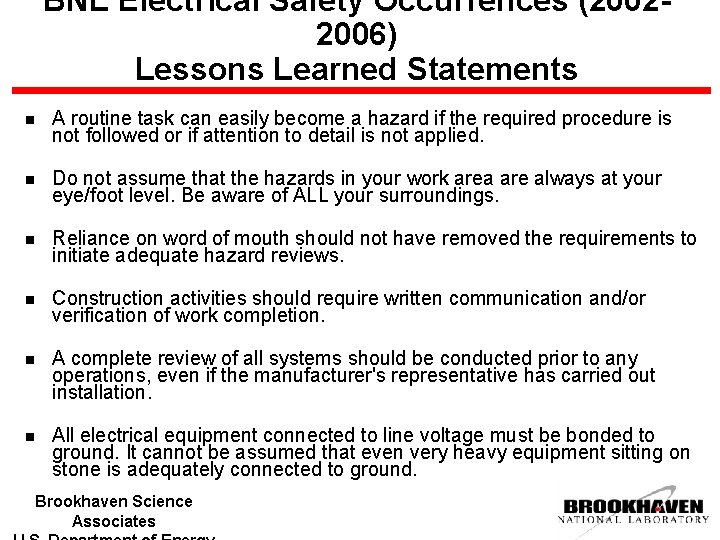
BNL Electrical Safety Occurrences (20022006) Lessons Learned Statements n A routine task can easily become a hazard if the required procedure is not followed or if attention to detail is not applied. n Do not assume that the hazards in your work area are always at your eye/foot level. Be aware of ALL your surroundings. n Reliance on word of mouth should not have removed the requirements to initiate adequate hazard reviews. n Construction activities should require written communication and/or verification of work completion. n A complete review of all systems should be conducted prior to any operations, even if the manufacturer's representative has carried out installation. n All electrical equipment connected to line voltage must be bonded to ground. It cannot be assumed that even very heavy equipment sitting on stone is adequately connected to ground. Brookhaven Science Associates
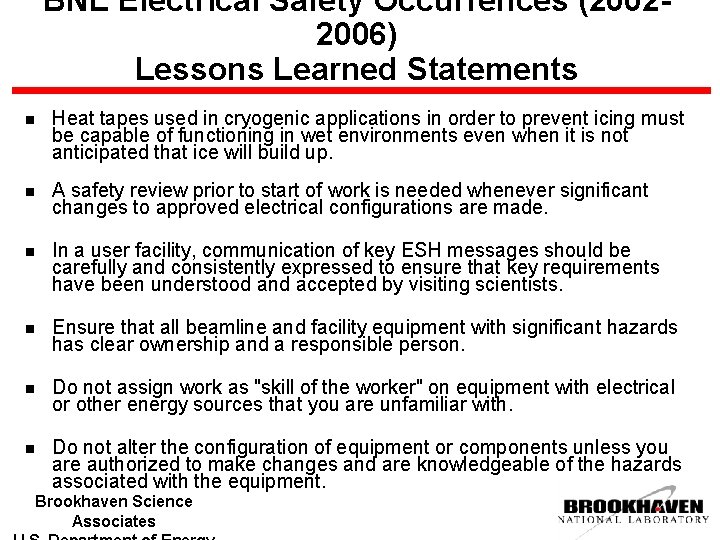
BNL Electrical Safety Occurrences (20022006) Lessons Learned Statements n Heat tapes used in cryogenic applications in order to prevent icing must be capable of functioning in wet environments even when it is not anticipated that ice will build up. n A safety review prior to start of work is needed whenever significant changes to approved electrical configurations are made. n In a user facility, communication of key ESH messages should be carefully and consistently expressed to ensure that key requirements have been understood and accepted by visiting scientists. n Ensure that all beamline and facility equipment with significant hazards has clear ownership and a responsible person. n Do not assign work as "skill of the worker" on equipment with electrical or other energy sources that you are unfamiliar with. n Do not alter the configuration of equipment or components unless you are authorized to make changes and are knowledgeable of the hazards associated with the equipment. Brookhaven Science Associates
BNL Electrical Safety Occurrences (20022006) Lessons Learned Statements n Project managers are responsible to ensure that they comply with all applicable procedures for the work that they perform or execute. It is imperative that the Project Manager review all project requirements with the contractor to ensure thorough job knowledge and operating conditions are known. n The process of identifying concealed utilities embedded in concrete is an inherently challenging and imprecise process that, even when carried out in accordance with established procedures and utilizing the latest detection equipment, does not guarantee the utility can be precisely located. Personnel must recognize the uncertainty involved and assure that all relevant information about the area in question has been communicated and that all reasonable measures have been taken to protect the safety of workers and facilities prior to authorizing the start of work in the area. Due to this uncertainty, embedded utilities should be avoided in all new designs and de-energized whenever possible if penetrations are required during construction. Brookhaven Science Associates
Electrical “R” ORPS Reports n 10 Electrical “R” Reports issued across complex • Hanford Site (3) • Yucca Mountain • Idaho National Lab (2) • Sandia National Lab • Los Alamos National Lab • Savannah River Site • Rocky Flats Env. Technology Site – Note: On 2/28/05 BNL ORPS Categorizers voted that an “R” Report concerning utility strikes was not Brookhaven Science warranted. Associates
Electrical ORPS Reports n 10 “R” Report CAUSES • Check of work was LTA • Management policy guidance / expectations not well-defined, understood or enforced • Work planning not coordinated with all departments involved in task • Inadequate work package preparation • Comm. Brookhaven Sciencebetween work Associates groups LTA n 17 BNL Report CAUSES • Defective or Failed Part • Individual justified action by focusing on biased evidence • Incomplete / situation not covered • Lack of written communication • Inadequate work package preparation • Comm. between work groups LTA
02 Suggested Measures to Prevent Electrical Work Occurrences n Walk down the work site to (1) identify equipment to be worked on, (2) ensure that equipment to be isolated is clearly marked, (3) verify or modify drawings to reflect as-built conditions, and (4) identify additional hazards or other safety issues. n For decommissioning work, re-evaluate electrical hazards as systems and equipment are dismantled and isolations are removed. n Ensure that lockout/tagout procedures or work instructions include a zero -energy check to confirm the effectiveness of the lockout/tagout installation. Always perform a zero-energy check on the circuit to be worked, as well as on other nearby circuits and terminals. Perform these checks any time new areas or equipment are accessed. n Upon completion of wiring work, check for proper voltages, phasing, and grounding. n Use lockout/tagout processes if there is a possibility that work may be performed in close proximity to energized electrical conductors. n Ensure that lockout/tagout procedures or work instructions include that the lockout/tagout has been correctly Brookhaven Science independent verification Associates performed.
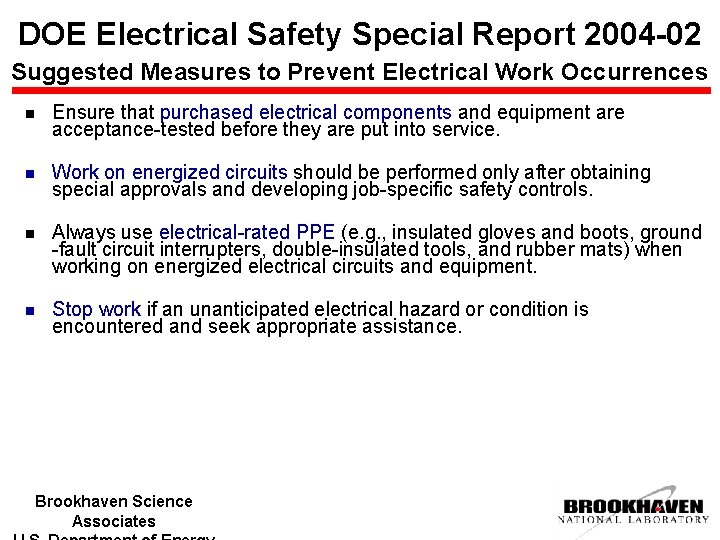
DOE Electrical Safety Special Report 2004 -02 Suggested Measures to Prevent Electrical Work Occurrences n Ensure that purchased electrical components and equipment are acceptance-tested before they are put into service. n Work on energized circuits should be performed only after obtaining special approvals and developing job-specific safety controls. n Always use electrical-rated PPE (e. g. , insulated gloves and boots, ground -fault circuit interrupters, double-insulated tools, and rubber mats) when working on energized electrical circuits and equipment. n Stop work if an unanticipated electrical hazard or condition is encountered and seek appropriate assistance. Brookhaven Science Associates
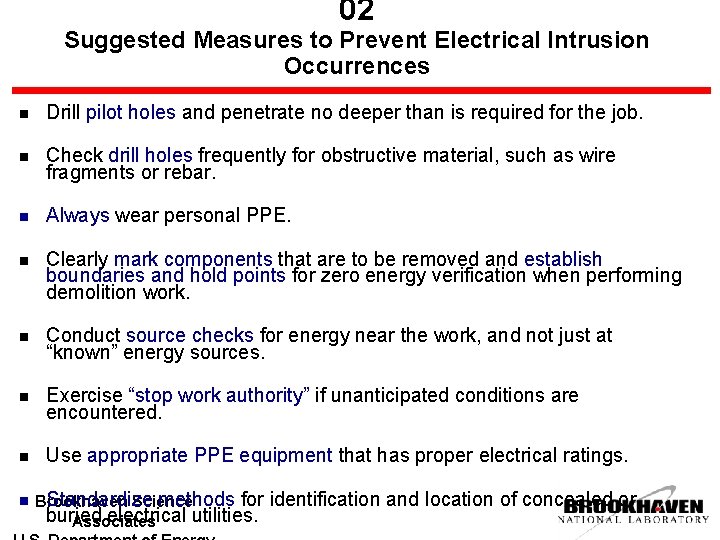
02 Suggested Measures to Prevent Electrical Intrusion Occurrences n Drill pilot holes and penetrate no deeper than is required for the job. n Check drill holes frequently for obstructive material, such as wire fragments or rebar. n Always wear personal PPE. n Clearly mark components that are to be removed and establish boundaries and hold points for zero energy verification when performing demolition work. n Conduct source checks for energy near the work, and not just at “known” energy sources. n Exercise “stop work authority” if unanticipated conditions are encountered. n Use appropriate PPE equipment that has proper electrical ratings. n Brookhaven Standardize methods Science for identification and location of concealed or buried electrical utilities. Associates
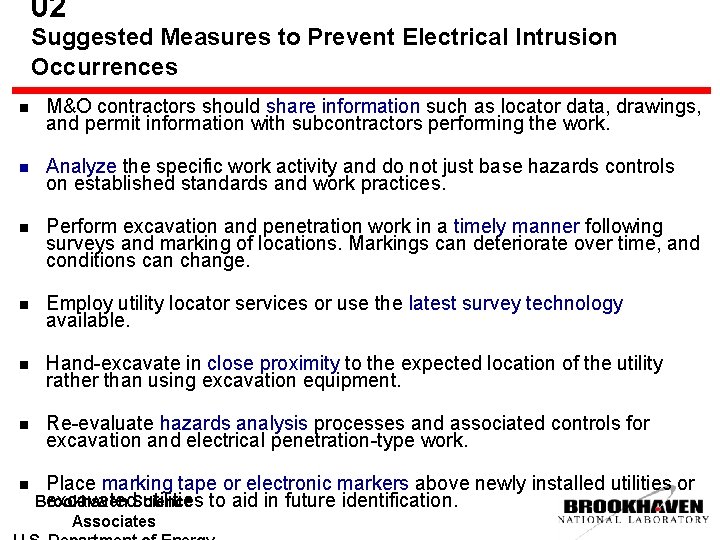
02 Suggested Measures to Prevent Electrical Intrusion Occurrences n M&O contractors should share information such as locator data, drawings, and permit information with subcontractors performing the work. n Analyze the specific work activity and do not just base hazards controls on established standards and work practices. n Perform excavation and penetration work in a timely manner following surveys and marking of locations. Markings can deteriorate over time, and conditions can change. n Employ utility locator services or use the latest survey technology available. n Hand-excavate in close proximity to the expected location of the utility rather than using excavation equipment. n Re-evaluate hazards analysis processes and associated controls for excavation and electrical penetration-type work. n Place marking tape or electronic markers above newly installed utilities or excavated. Science utilities to aid in future identification. Brookhaven Associates
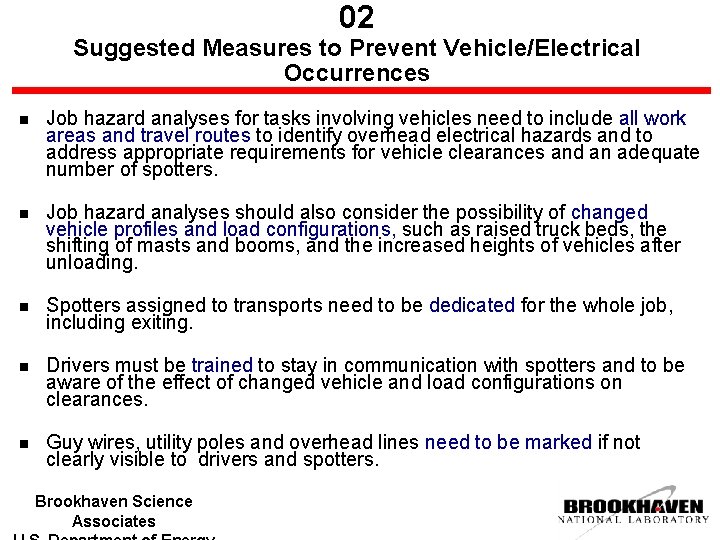
02 Suggested Measures to Prevent Vehicle/Electrical Occurrences n Job hazard analyses for tasks involving vehicles need to include all work areas and travel routes to identify overhead electrical hazards and to address appropriate requirements for vehicle clearances and an adequate number of spotters. n Job hazard analyses should also consider the possibility of changed vehicle profiles and load configurations, such as raised truck beds, the shifting of masts and booms, and the increased heights of vehicles after unloading. n Spotters assigned to transports need to be dedicated for the whole job, including exiting. n Drivers must be trained to stay in communication with spotters and to be aware of the effect of changed vehicle and load configurations on clearances. n Guy wires, utility poles and overhead lines need to be marked if not clearly visible to drivers and spotters. Brookhaven Science Associates
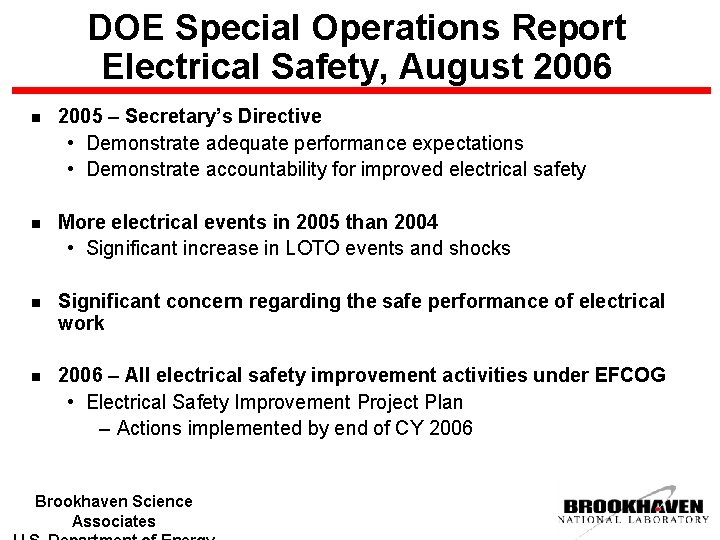
DOE Special Operations Report Electrical Safety, August 2006 n 2005 – Secretary’s Directive • Demonstrate adequate performance expectations • Demonstrate accountability for improved electrical safety n More electrical events in 2005 than 2004 • Significant increase in LOTO events and shocks n Significant concern regarding the safe performance of electrical work n 2006 – All electrical safety improvement activities under EFCOG • Electrical Safety Improvement Project Plan – Actions implemented by end of CY 2006 Brookhaven Science Associates
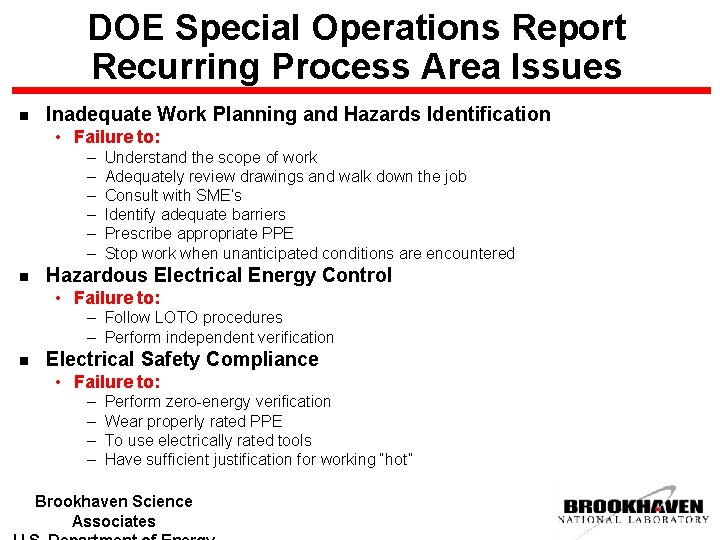
DOE Special Operations Report Recurring Process Area Issues n Inadequate Work Planning and Hazards Identification • Failure to: – – – n Understand the scope of work Adequately review drawings and walk down the job Consult with SME’s Identify adequate barriers Prescribe appropriate PPE Stop work when unanticipated conditions are encountered Hazardous Electrical Energy Control • Failure to: – Follow LOTO procedures – Perform independent verification n Electrical Safety Compliance • Failure to: – – Perform zero-energy verification Wear properly rated PPE To use electrically rated tools Have sufficient justification for working “hot” Brookhaven Science Associates
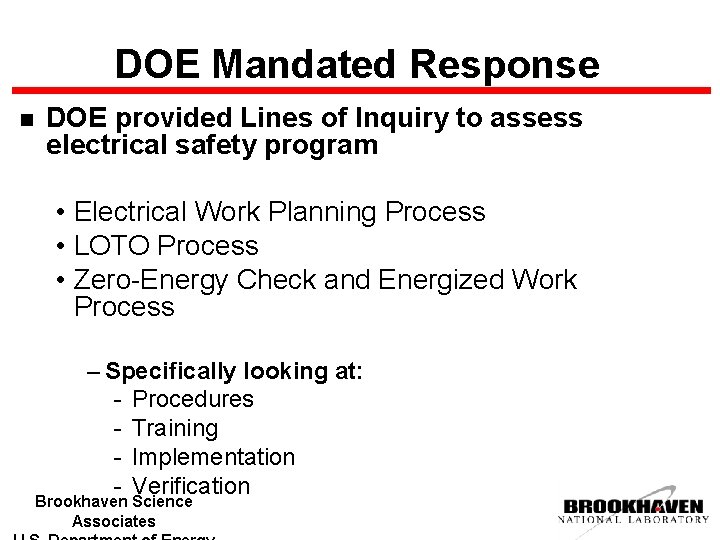
DOE Mandated Response n DOE provided Lines of Inquiry to assess electrical safety program • Electrical Work Planning Process • LOTO Process • Zero-Energy Check and Energized Work Process – Specifically looking at: - Procedures - Training - Implementation - Verification Brookhaven Science Associates
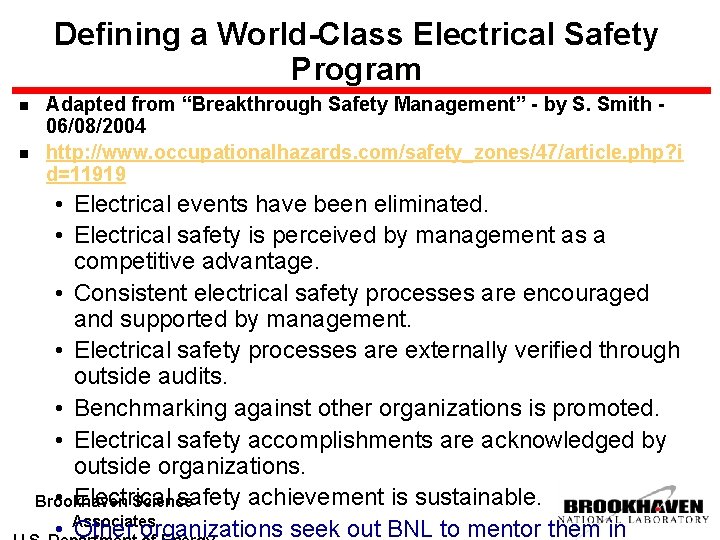
Defining a World-Class Electrical Safety Program n n Adapted from “Breakthrough Safety Management” - by S. Smith 06/08/2004 http: //www. occupationalhazards. com/safety_zones/47/article. php? i d=11919 • Electrical events have been eliminated. • Electrical safety is perceived by management as a competitive advantage. • Consistent electrical safety processes are encouraged and supported by management. • Electrical safety processes are externally verified through outside audits. • Benchmarking against other organizations is promoted. • Electrical safety accomplishments are acknowledged by outside organizations. • Electrical safety achievement is sustainable. Brookhaven Science • Associates Other organizations seek out BNL to mentor them in
BNL’s World-Class Electrical Safety Program n Why Not Us? Why Not Now? Brookhaven Science Associates
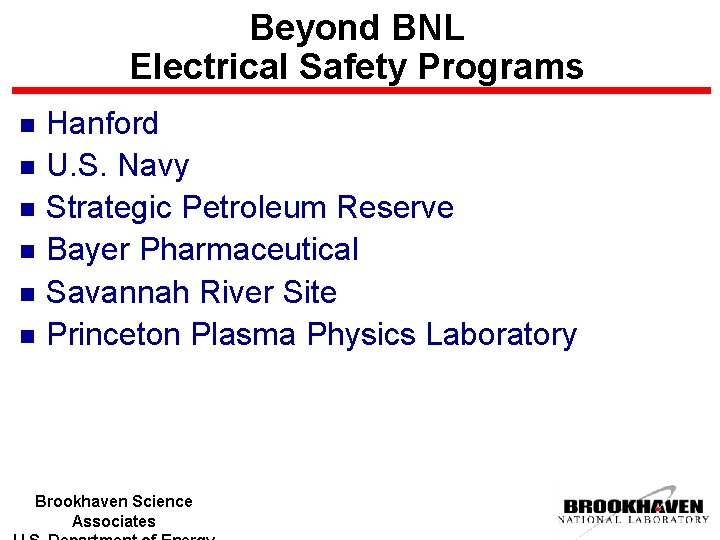
Beyond BNL Electrical Safety Programs n n n Hanford U. S. Navy Strategic Petroleum Reserve Bayer Pharmaceutical Savannah River Site Princeton Plasma Physics Laboratory Brookhaven Science Associates
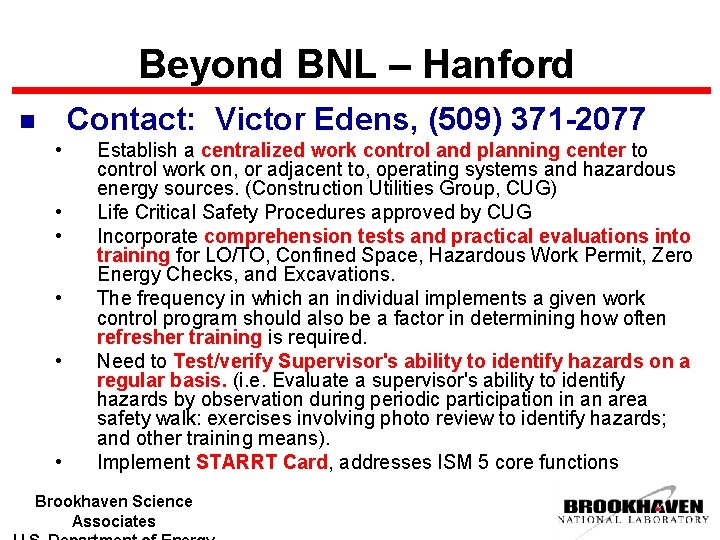
Beyond BNL – Hanford Contact: Victor Edens, (509) 371 -2077 n • • • Establish a centralized work control and planning center to control work on, or adjacent to, operating systems and hazardous energy sources. (Construction Utilities Group, CUG) Life Critical Safety Procedures approved by CUG Incorporate comprehension tests and practical evaluations into training for LO/TO, Confined Space, Hazardous Work Permit, Zero Energy Checks, and Excavations. The frequency in which an individual implements a given work control program should also be a factor in determining how often refresher training is required. Need to Test/verify Supervisor's ability to identify hazards on a regular basis. (i. e. Evaluate a supervisor's ability to identify hazards by observation during periodic participation in an area safety walk: exercises involving photo review to identify hazards; and other training means). Implement STARRT Card, addresses ISM 5 core functions Brookhaven Science Associates
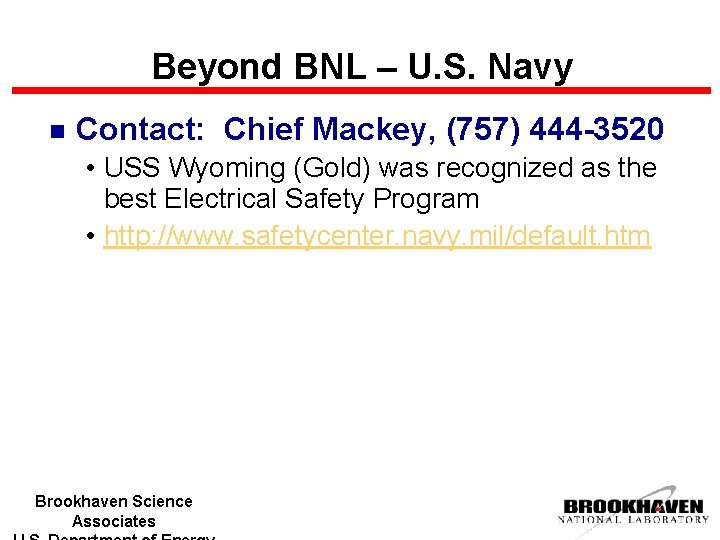
Beyond BNL – U. S. Navy n Contact: Chief Mackey, (757) 444 -3520 • USS Wyoming (Gold) was recognized as the best Electrical Safety Program • http: //www. safetycenter. navy. mil/default. htm Brookhaven Science Associates
Beyond BNL – Strategic Petroleum Reserve n Contact: Will Woods (DOE), (504) 7344329 • Close Call Program • Human Factors Program • Hired contractor to complete arc flash calculations Brookhaven Science Associates
Beyond BNL – Bayer Pharmaceutical n Contact: Frank Caslaina, (203) 8122790 • Electrical workers wear FR clothing at all times • After deeneergizes > 480 v load side is grounded prior to work Brookhaven Science Associates
Beyond BNL - Savannah River Site n n Contact: Jackie Mcalhaney, (803) 2083389 Electrical Site-wide stand down – Summer of 05 • LOTO, D&D, Equip. Abandonment, Drilling, and Excavation n n Electrical Safety Awareness Week (Raised Awareness) • Tailored presentations to Admin. , Field, and Electrical Workers • Facility walk downs (1200 findings, most minor) – Exposed conductors Electrical Safety Express – Publication written by SME’s • Referenced during tool box meetings n Vacuum type Technology, Location of buried utilities (No hand digging) • Mounted on trailer – uses air/water/vacuum • Contact: Jack Goldenburg, (803) 557 -9386 n Proximity Voltage Detector Brookhaven Science Associates • Tech DVA – 30 (detects voltage and current)
Beyond BNL - Savannah River Site n n n Signed Work Expectation Form, 100% voltage checks All LOTO’s reviewed by Engineer prior to start of work Formal Analysis Program Software Program • Outputs hazard analysis tree based on site requirements Stop Work out, Time Out in • Now workers to stop • Encouraged to take time out • Reinforced Annual Training on Energized Work Procedure • 1 st time – Live Instructor Brookhaven Science Associates
n n n n Beyond BNL - Princeton Plasma Physics Laboratory Contact: John Lacernere, (609) 243 -3308 4 Tier Safety Program – (Initially provided by Live Instructor) 3 Year Re-training Cycle or as Needed • Introductory training • Basic electrical training • Electrical utility training (EUT) • High voltage maint. training (Admin by PSE&G) Bus work is deenergized when racking breakers or done remotely Bus work is deenergized when racking MCC buckets Nothing requires working hot except troubleshooting CONVENIENCE IS NEVER TO OVERRIDE SAFETY Contractor Work • Qualified to work electrically by PPPL beyond EUT • Heavily supervised by PPPL, at least initially Brookhaven Science Associates
Beyond BNL - Princeton Plasma Physics Laboratory n Raised awareness of arc flash issue across site • Folks did not fully appreciate potential danger – Resulted in fewer people operating switches/breakers Brookhaven Science Associates
The Path Forward n As directed by the Deputy Director of Operations: • The results of this evaluation/search will be presented to the ALD for ESH&Q, the Safety and Health Services Manager, and the Laboratory’s Electrical Safety Committee for them to assess the applicability to BNL. Brookhaven Science Associates