
There are three common types of precipitation titrations
![after the endpoint Fe 3+ + SCN- → Fe. SCN 2+ [Cl-] = total](https://slidetodoc.com/presentation_image_h2/87f003fc833ebae508a311e4981afd56/image-5.jpg "after the endpoint Fe 3+ + SCN- → Fe. SCN 2+ [Cl-] = total")
- Slides: 7
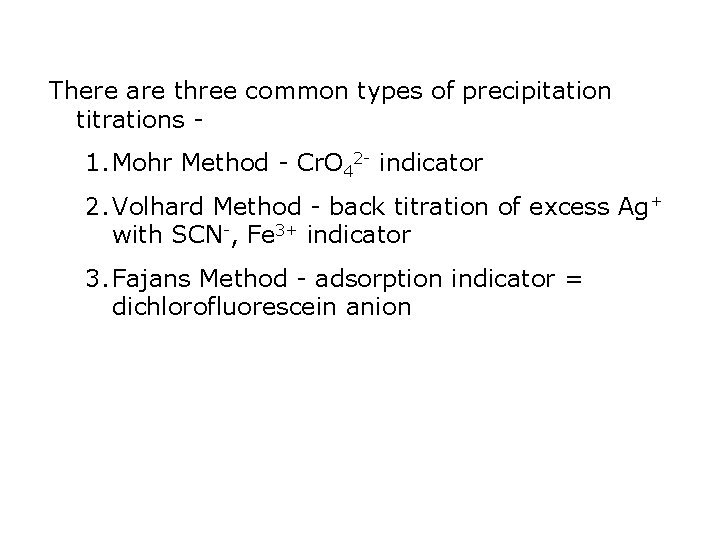
There are three common types of precipitation titrations - 1. Mohr Method - Cr. O 42 - indicator 2. Volhard Method - back titration of excess Ag+ with SCN-, Fe 3+ indicator 3. Fajans Method - adsorption indicator = dichlorofluorescein anion
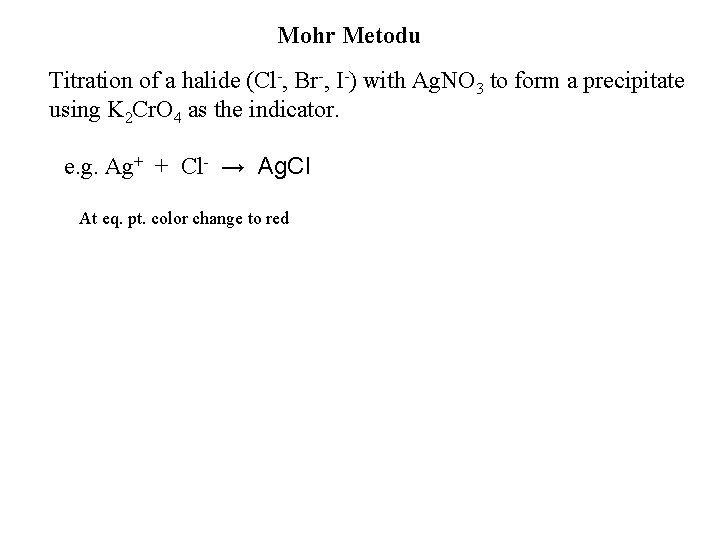
Mohr Metodu Titration of a halide (Cl-, Br-, I-) with Ag. NO 3 to form a precipitate using K 2 Cr. O 4 as the indicator. e. g. Ag+ + Cl- → Ag. Cl At eq. pt. color change to red
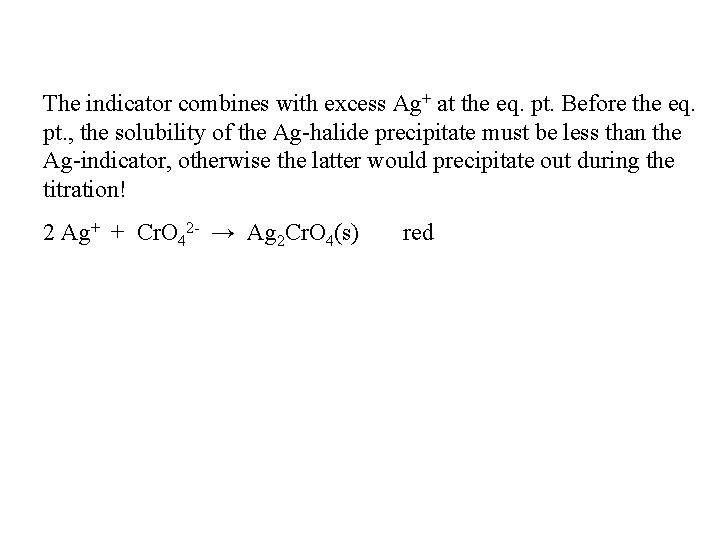
The indicator combines with excess Ag+ at the eq. pt. Before the eq. pt. , the solubility of the Ag-halide precipitate must be less than the Ag-indicator, otherwise the latter would precipitate out during the titration! 2 Ag+ + Cr. O 42 - → Ag 2 Cr. O 4(s) red
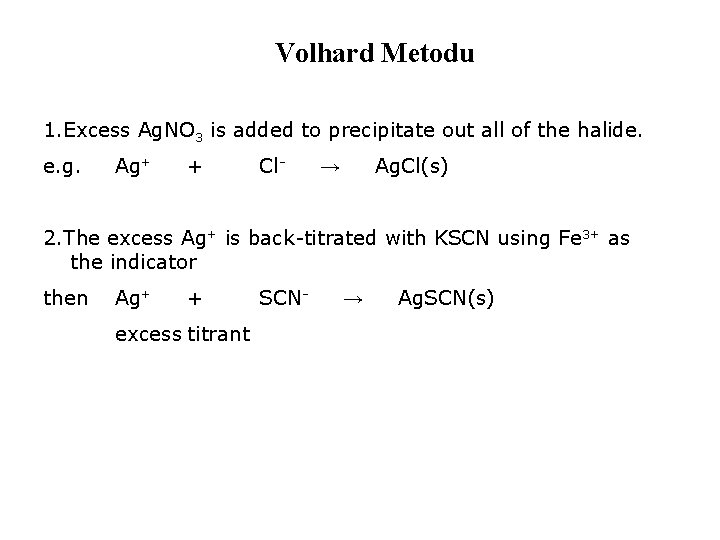
Volhard Metodu 1. Excess Ag. NO 3 is added to precipitate out all of the halide. e. g. Ag+ + Cl- Ag. Cl(s) → 2. The excess Ag+ is back-titrated with KSCN using Fe 3+ as the indicator then Ag+ + excess titrant SCN- → Ag. SCN(s)
after the endpoint Fe 3+ + SCN- → Fe. SCN 2+ [Cl-] = total Ag+ - amount backtitrated
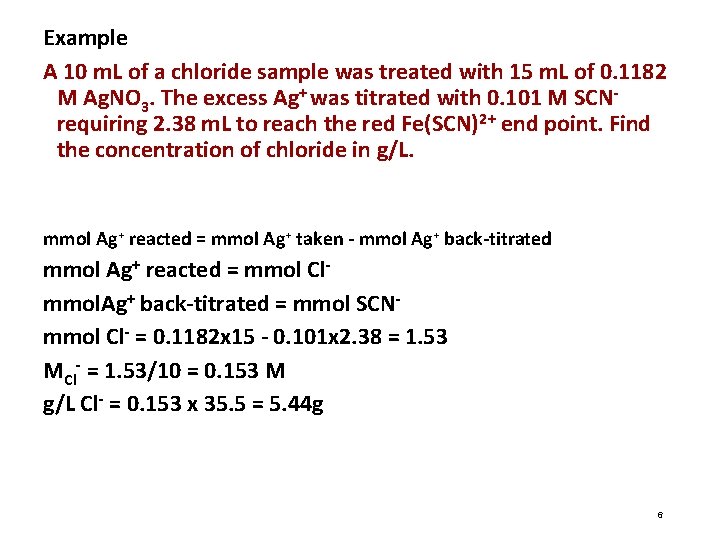
Example A 10 m. L of a chloride sample was treated with 15 m. L of 0. 1182 M Ag. NO 3. The excess Ag+ was titrated with 0. 101 M SCNrequiring 2. 38 m. L to reach the red Fe(SCN)2+ end point. Find the concentration of chloride in g/L. mmol Ag+ reacted = mmol Ag+ taken - mmol Ag+ back-titrated mmol Ag+ reacted = mmol Clmmol. Ag+ back-titrated = mmol SCNmmol Cl- = 0. 1182 x 15 - 0. 101 x 2. 38 = 1. 53 MCl- = 1. 53/10 = 0. 153 M g/L Cl- = 0. 153 x 35. 5 = 5. 44 g 6
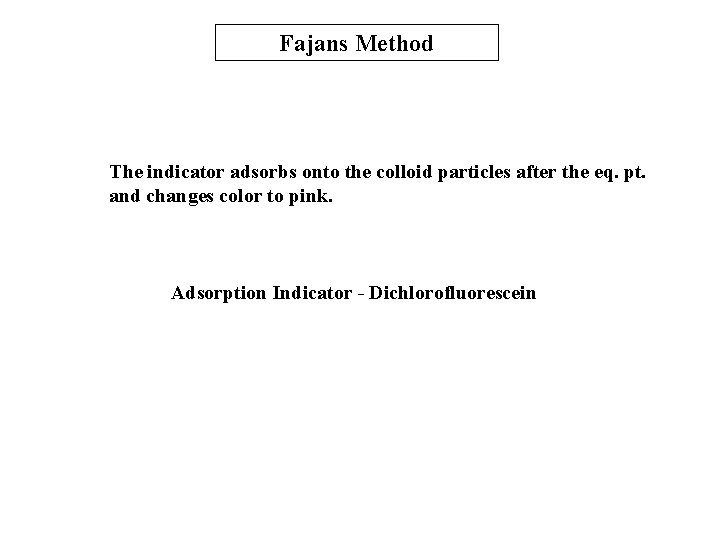
Fajans Method The indicator adsorbs onto the colloid particles after the eq. pt. and changes color to pink. Adsorption Indicator - Dichlorofluorescein