
There are several different types of props PERSONAL
- Slides: 13
There are several different types of props: PERSONAL PROPS –an item that is used personally by the actor. These are props that are carried on and used by an actor such as a handkerchief, mobile telephone or shopping bags. When the props master/mistress gives the prop to the actor, he/she is then responsible for all their personal props. These props may also be placed on the props table by the props master for the actors to collect when needed. COSTUME PROPS – an item that is worn by the actor. They may be part of a character’s costume, such as an engagement ring, a watch or a pair of spectacles. However, for an engagement ring to be a prop it must be an essential element of the story and not just part of the visual look of the character.
PRE-SET PROPS - these are props which are placed on the set before the performance begins or between scenes. These props are used by the actors. These props are pre-set on the stage by the props master/mistress or stage crew and have to be in placed at a set time in a set place, such as the gun in the drawer or the diary on the desk. SET-DRESS PROPS – these are props which are also placed on the set to enhance the visual impact of the set design (this is called dressing the set). These props are only there for visual purposes and are not used by the actors. A REHEARSAL PROP – used in rehearsal only, this is a prop that represents the actual prop. This is usually because the original is too delicate or is being sourced or made. Although the actor isn’t using the real prop, it is very useful for the actor to get used to having something in his/her hands.
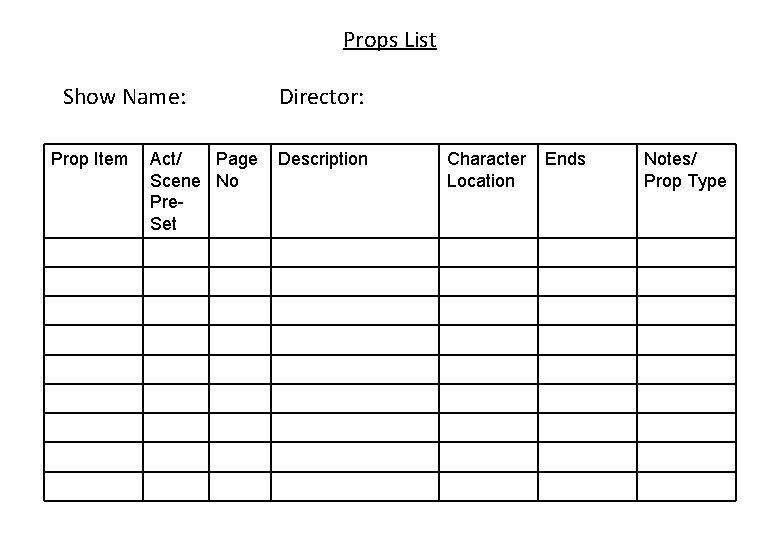
Activity You are going to write a list of props required for ‘Mort’ by Terry Pratchett. You must also decide whether they are personal, pre-set or dress props. Your teacher will give you a copy of the table on the following slide.
Props List Show Name: Prop Item Act/ Page Scene No Pre. Set Director: Description Character Location Ends Notes/ Prop Type
Props and the Props Table Task: Read the following information carefully. Any production, large or small, makes use of props. Props help bring the production to life and contribute to its success. A props table is just what it sounds like, a table where you lay out all your props so that they are readily available during the production. Having a well-organized props table will ensure that your production runs smoothly and in the best possible manner. Read the steps below to learn how to set up a props table.
• The more props you have the more props tables you are going to need. Never be tempted to crowd everything on one table. Learn to use more tables when appropriate. Productions will usually provide the props manager with a list of all the props to be used. Using your list you can easily estimate just how many tables you are going to be using. • Knowing where to set up each props table is very important. As the props manager approach the stage manager. The stage manager should inform you where the props tables are allowed to be set up. There are typically two areas they are set up, the wings and the green room, but where exactly will always by up to the company behind the production. • You will want to add a layer of paper to your props tables. Using long sheets, place them across the whole table and secure them around the edges of the table using masking tape.
• Now that you have setup your props tables and have added paper to protect both the table and the props, you can actually start laying out the props on the tables. Lay out the props and you can start organizing them. • Lie out all the props on your table and spend some time looking them all over. Props come in all shapes and sizes and they are going to be used to different times during the production. Keep in mind that some props are used more than once. It is advisable and makes the most sense to group the props according to what part of the production they will be used. This makes everything nice and organized come the time when they are to be used. Delicate props need special attention and make sure to place them in the middle of the table. Remember that the backstage of a production can be quite hectic and the props tables may be accidentally bumped into multiple times.
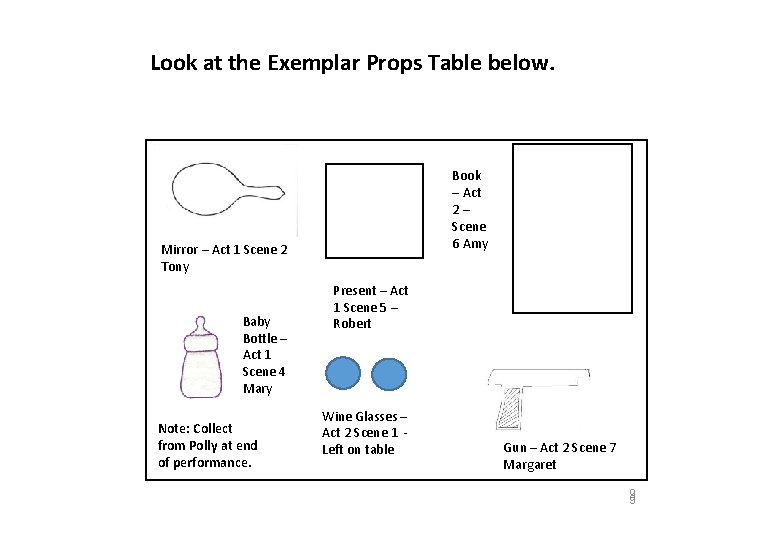
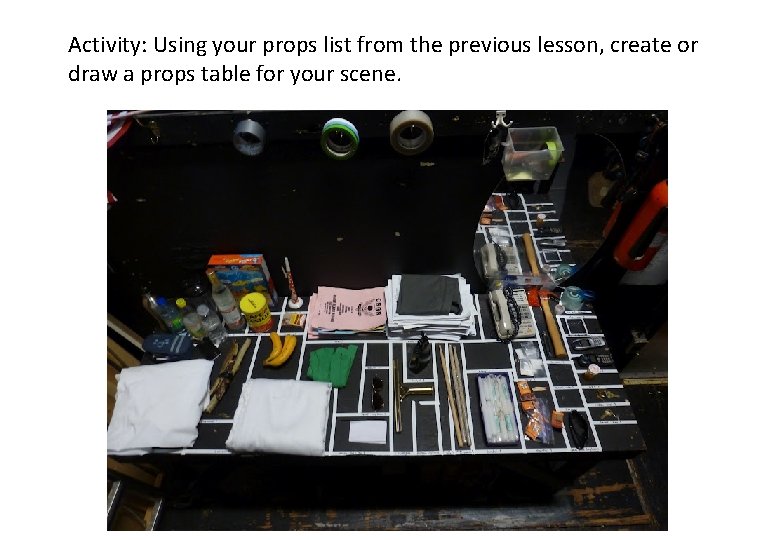
• Props can fall off when the tables are hit so it’s best to keep the fragile ones in the centre where they cannot really fall off and break. A broken prop is something a props manager should avoid at all costs. • It is very useful to label the table and create a little area for each prop. Draw round each item and label it with a short description: the act, and scene in which it’s used, and the name of the character who uses it. So that at a quick place a prop can be located or returned to its proper place. It looks a little like a theatrical CSI table and, sometimes actors are guilty of not returning their props to the table. Be prepared to make changes as rehearsals progress to best serve the show's smooth run. Remember it's your rehearsals too. Theatre is a collaborative art form, it takes a team.
Look at the Exemplar Props Table below. Book – Act 2– Scene 6 Amy Mirror – Act 1 Scene 2 Tony Baby Bottle – Act 1 Scene 4 Mary Note: Collect from Polly at end of performance. Present – Act 1 Scene 5 – Robert Wine Glasses – Act 2 Scene 1 Left on table Gun – Act 2 Scene 7 Margaret 9 9
Activity: Using your props list from the previous lesson, create or draw a props table for your scene.
Problem Solving Task: Imagine you are the props master for a performance of ‘Mort’. You must create an hour glass timer for Death. Write down a list of materials you would use and then an instruction sheet on how to create this prop. If you have time you could make the prop and photograph it for your folio. An example can be seen on the following slides. The best ones will be displayed.
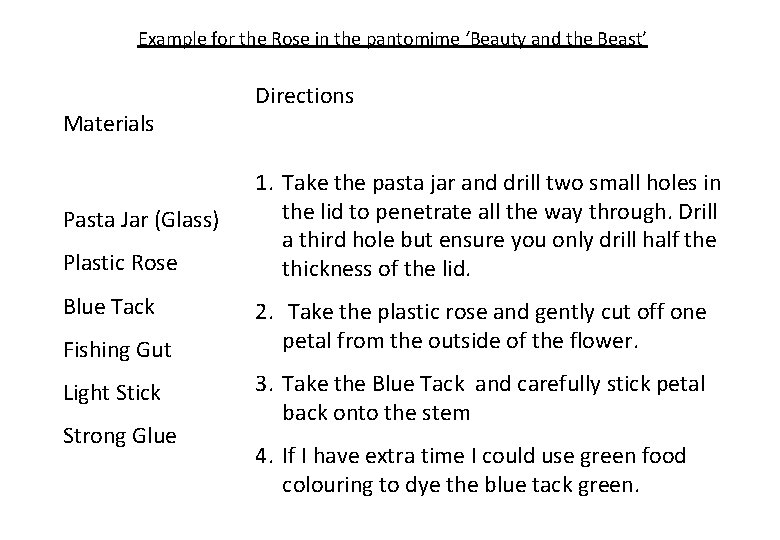
Example for the Rose in the pantomime ‘Beauty and the Beast’ Materials Pasta Jar (Glass) Plastic Rose Blue Tack Fishing Gut Light Stick Strong Glue Directions 1. Take the pasta jar and drill two small holes in the lid to penetrate all the way through. Drill a third hole but ensure you only drill half the thickness of the lid. 2. Take the plastic rose and gently cut off one petal from the outside of the flower. 3. Take the Blue Tack and carefully stick petal back onto the stem 4. If I have extra time I could use green food colouring to dye the blue tack green.
5. Now place a small bit of the glue into the third hole and stick the rose stem into the hole. Hold it there until it is secure. 6. Now take the fishing gut and thread it though both holes. 7. Place thread over blue tack petal and tie both ends into a knot. 8. Place the lid on the jar. Note: When the actor wishes the petal to fall from the rose he should simply pull the fishing thread gently in a downward fashion and it will severe the blue tack and the petal will fall to the bottom. 9. A light stick secured into a circle can be placed at the top and bottom of the jar to light up the rose during performance. This should be done at the start of the performance and replaced at the interval.