
Therapeutic ultrasound o principles of operation function use

- Slides: 15
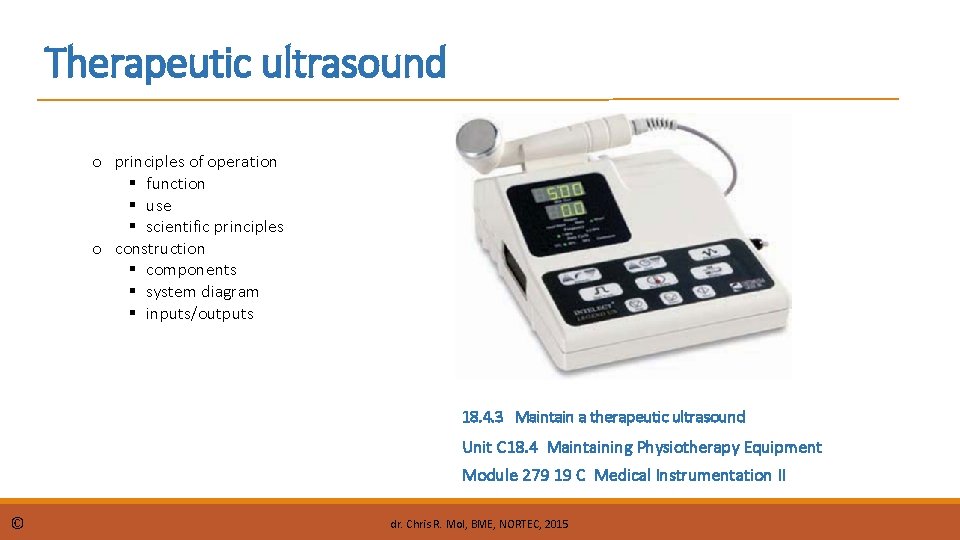
Therapeutic ultrasound o principles of operation function use scientific principles o construction components system diagram inputs/outputs 18. 4. 3 Maintain a therapeutic ultrasound Unit C 18. 4 Maintaining Physiotherapy Equipment Module 279 19 C Medical Instrumentation II © dr. Chris R. Mol, BME, NORTEC, 2015
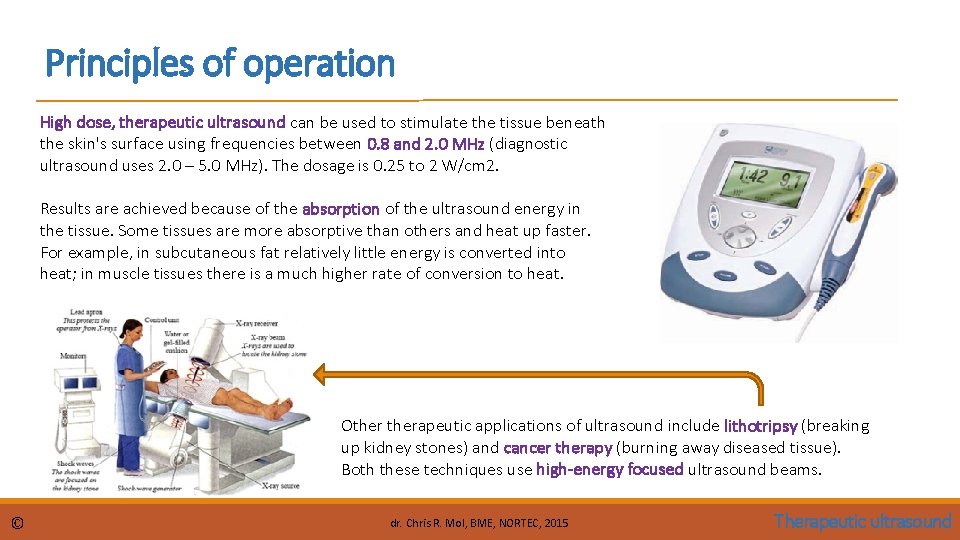
Principles of operation High dose, therapeutic ultrasound can be used to stimulate the tissue beneath the skin's surface using frequencies between 0. 8 and 2. 0 MHz (diagnostic ultrasound uses 2. 0 – 5. 0 MHz). The dosage is 0. 25 to 2 W/cm 2. Results are achieved because of the absorption of the ultrasound energy in the tissue. Some tissues are more absorptive than others and heat up faster. For example, in subcutaneous fat relatively little energy is converted into heat; in muscle tissues there is a much higher rate of conversion to heat. Otherapeutic applications of ultrasound include lithotripsy (breaking up kidney stones) and cancer therapy (burning away diseased tissue). Both these techniques use high-energy focused ultrasound beams. © dr. Chris R. Mol, BME, NORTEC, 2015 Therapeutic ultrasound
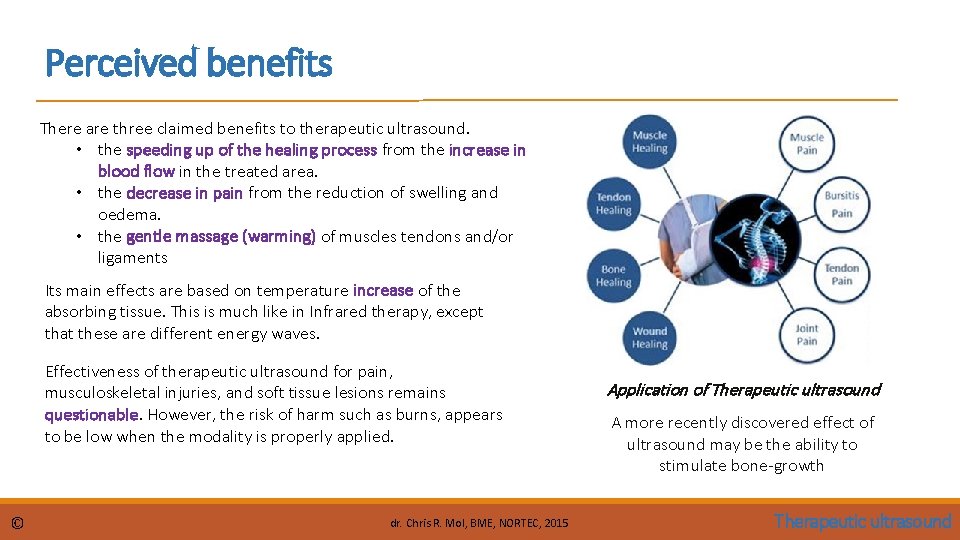
Perceived benefits There are three claimed benefits to therapeutic ultrasound. • the speeding up of the healing process from the increase in blood flow in the treated area. • the decrease in pain from the reduction of swelling and oedema. • the gentle massage (warming) of muscles tendons and/or ligaments Its main effects are based on temperature increase of the absorbing tissue. This is much like in Infrared therapy, except that these are different energy waves. Effectiveness of therapeutic ultrasound for pain, musculoskeletal injuries, and soft tissue lesions remains questionable. However, the risk of harm such as burns, appears to be low when the modality is properly applied. © dr. Chris R. Mol, BME, NORTEC, 2015 Application of Therapeutic ultrasound A more recently discovered effect of ultrasound may be the ability to stimulate bone-growth Therapeutic ultrasound
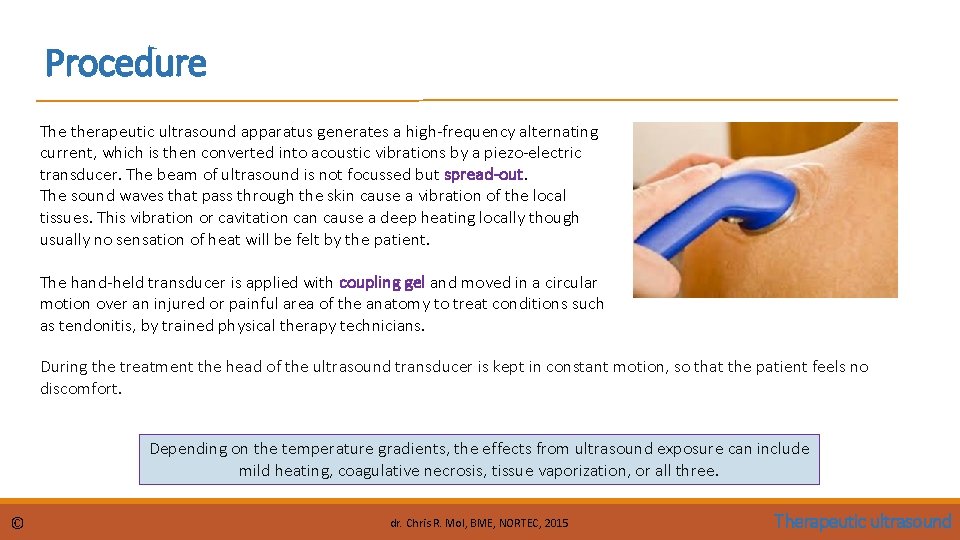
Procedure The therapeutic ultrasound apparatus generates a high-frequency alternating current, which is then converted into acoustic vibrations by a piezo-electric transducer. The beam of ultrasound is not focussed but spread-out. The sound waves that pass through the skin cause a vibration of the local tissues. This vibration or cavitation cause a deep heating locally though usually no sensation of heat will be felt by the patient. The hand-held transducer is applied with coupling gel and moved in a circular motion over an injured or painful area of the anatomy to treat conditions such as tendonitis, by trained physical therapy technicians. During the treatment the head of the ultrasound transducer is kept in constant motion, so that the patient feels no discomfort. Depending on the temperature gradients, the effects from ultrasound exposure can include mild heating, coagulative necrosis, tissue vaporization, or all three. © dr. Chris R. Mol, BME, NORTEC, 2015 Therapeutic ultrasound
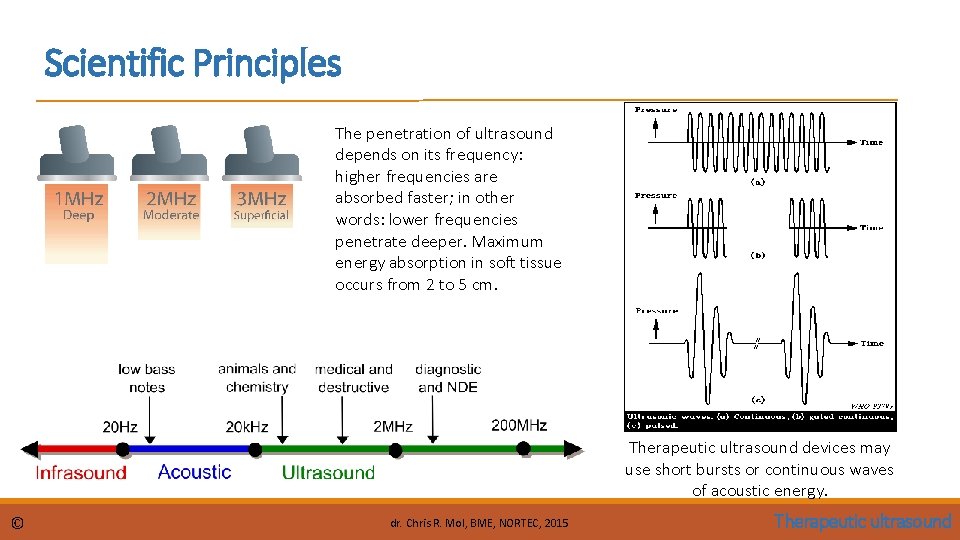
Scientific Principles The penetration of ultrasound depends on its frequency: higher frequencies are absorbed faster; in other words: lower frequencies penetrate deeper. Maximum energy absorption in soft tissue occurs from 2 to 5 cm. Therapeutic ultrasound devices may use short bursts or continuous waves of acoustic energy. © dr. Chris R. Mol, BME, NORTEC, 2015 Therapeutic ultrasound
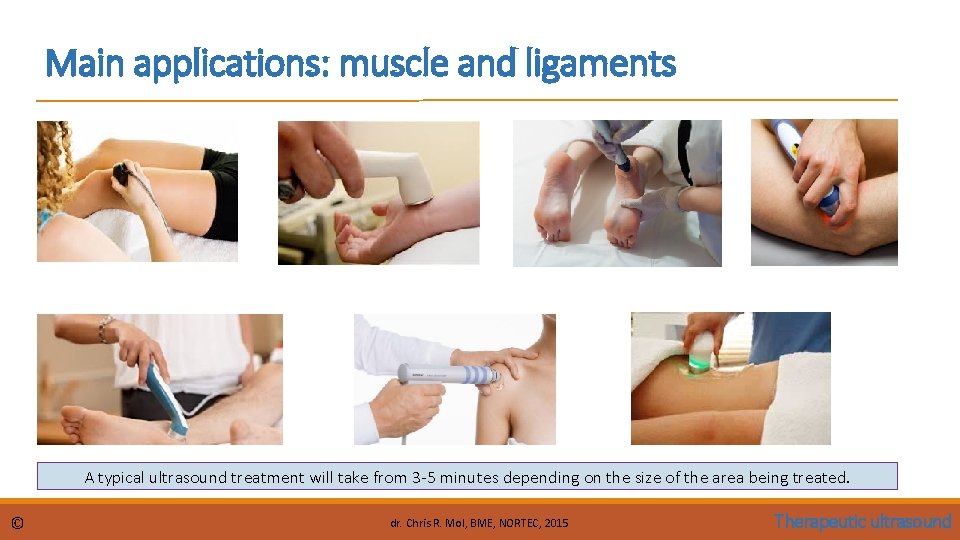
Main applications: muscle and ligaments A typical ultrasound treatment will take from 3 -5 minutes depending on the size of the area being treated. © dr. Chris R. Mol, BME, NORTEC, 2015 Therapeutic ultrasound
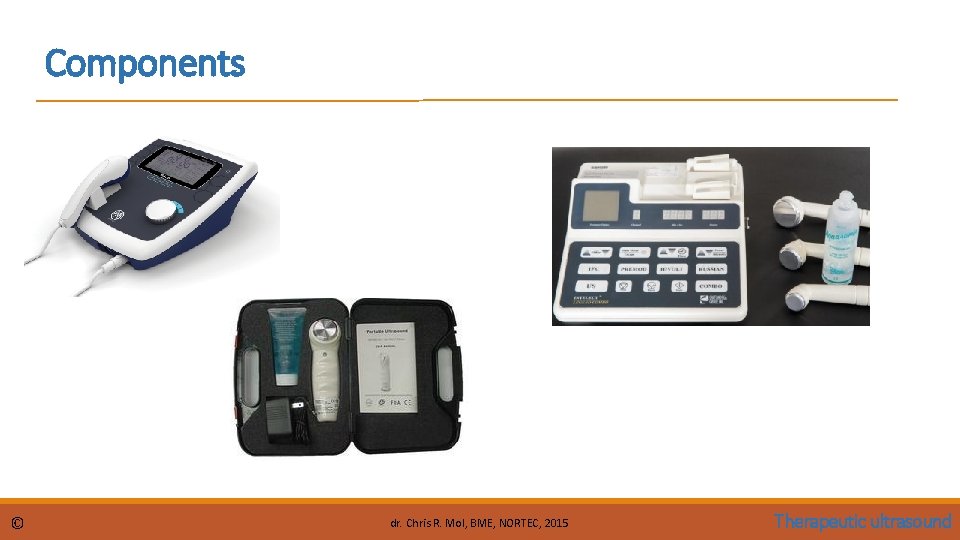
Components © dr. Chris R. Mol, BME, NORTEC, 2015 Therapeutic ultrasound
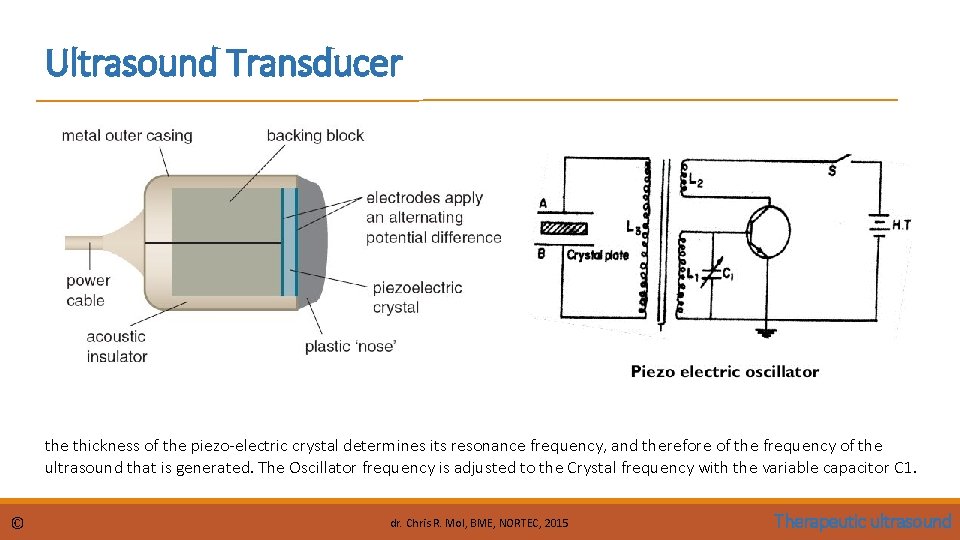
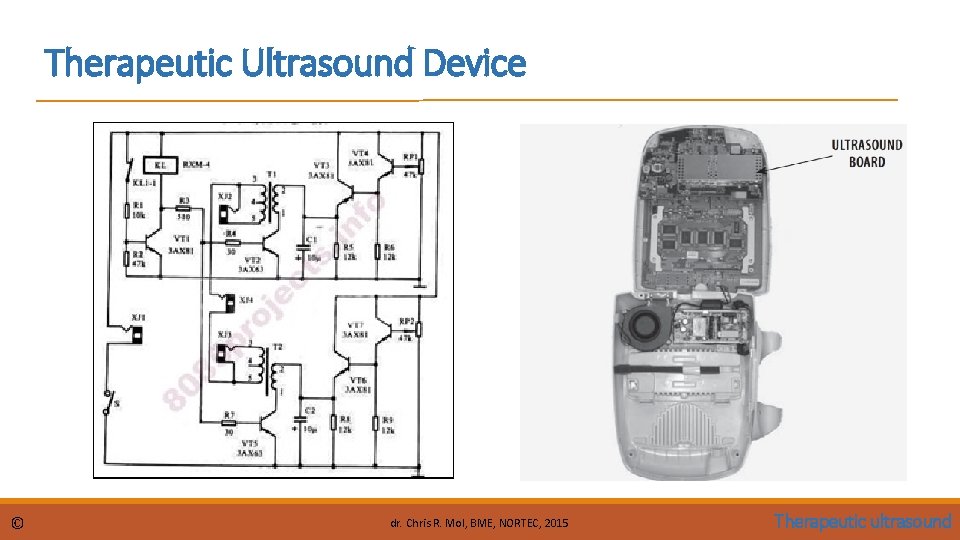
Ultrasound Transducer the thickness of the piezo-electric crystal determines its resonance frequency, and therefore of the frequency of the ultrasound that is generated. The Oscillator frequency is adjusted to the Crystal frequency with the variable capacitor C 1. © dr. Chris R. Mol, BME, NORTEC, 2015 Therapeutic ultrasound
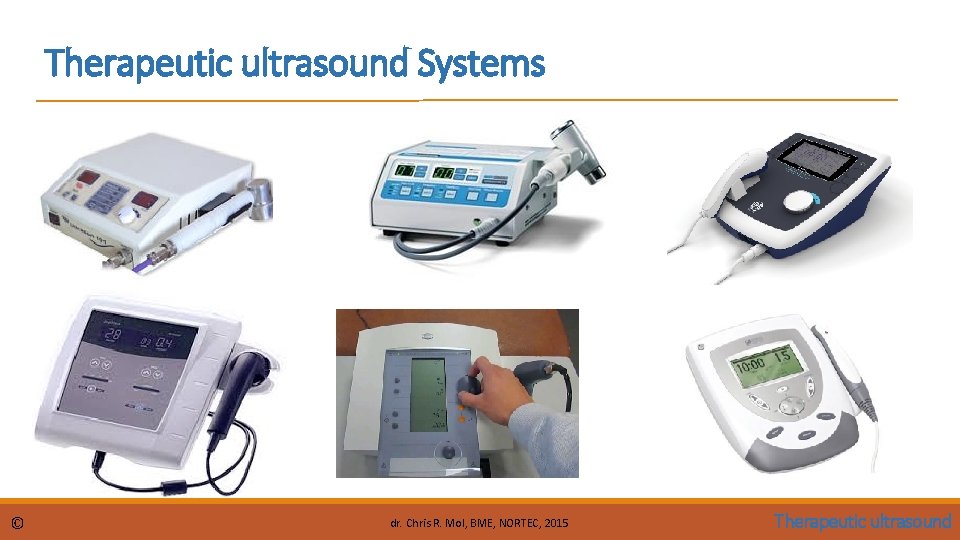
Therapeutic ultrasound Systems © dr. Chris R. Mol, BME, NORTEC, 2015 Therapeutic ultrasound
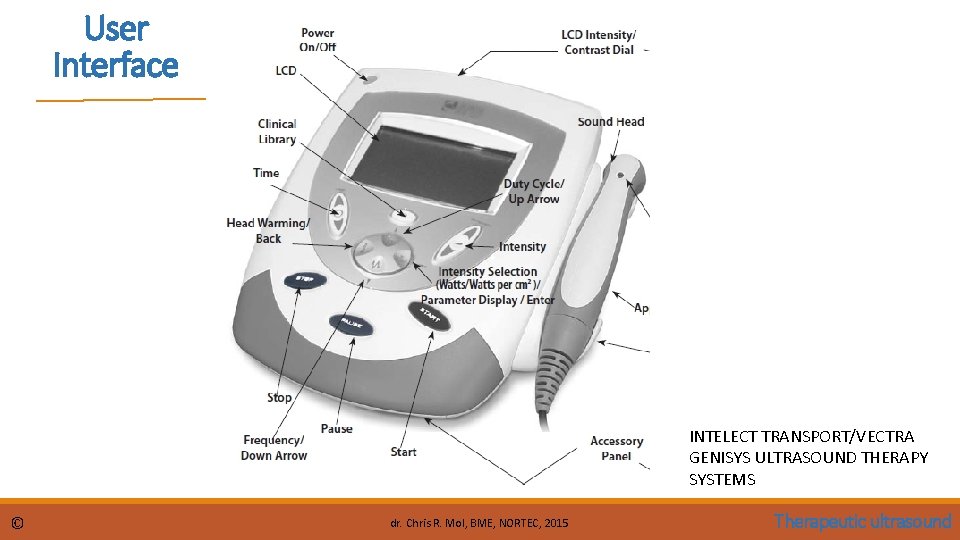
User Interface INTELECT TRANSPORT/VECTRA GENISYS ULTRASOUND THERAPY SYSTEMS © dr. Chris R. Mol, BME, NORTEC, 2015 Therapeutic ultrasound
Therapeutic Ultrasound Device © dr. Chris R. Mol, BME, NORTEC, 2015 Therapeutic ultrasound
Trouble shooting: follow the user / service manual 5. 5 VISUAL INSPECTION Visually inspect the Intelect Ultrasound Therapy Systems. A visual inspection can, to an experienced technician, indicate possible abuse of the unit and internal problems. 5. 6 UNIT STARTUP AND FAN TESTING A. Test 1. Place unit face up on work surface. 2. Connect Power Cord to unit and plug into proper power receptacle. 3. Connect an Applicator to the unit. 4. Turn system on. Adjust the Intensity up and press Start. The fan will begin to run, after the audible beep tones. 5. Place hand at the back of system, near Contrast Control, to verify Fan is blowing out. Intelect Tran. Sport®/Vectra Genisys® Ultrasound Therapy Systems © dr. Chris R. Mol, BME, NORTEC, 2015 Therapeutic ultrasound
Trouble shooting example B. Test Results 1. Unit will not start, unit failed test. a) Possible bad Main Power Switch. b) Possible bad Power Supply. c) Possible bad power outlet or Mains Power Cord. d) Possible bad Ultrasound Board. 2. Treatment will not start up. a) Applicator not connected. b) Possible bad Ultrasound Board. c) Possible bad Control Board. 3. Screen does not display, unit failed test. a) Contrast Control needs adjusting. b) Possible bad Display. c) Possible bad Control Board. d) Possible bad Power Supply. © e) Visually check power LED. If flashing, the Power Supply is good. Replace the Control Board. f ) If not flashing perform the Ultrasound Board test to check the Ultrasound Board. Refer to section 5. 7 page 15. If the Power Supply functions, replace the Ultrasound Board. 4. Fan not blowing outward, unit failed test a) Fan blowing inward. Fan wired wrong. Rewire or replace Fan. 5. Fan not blowing. dr. Chris R. Mol, BME, NORTEC, 2015 Intelect Tran. Sport®/Vectra Genisys® Ultrasound Therapy Systems Therapeutic ultrasound
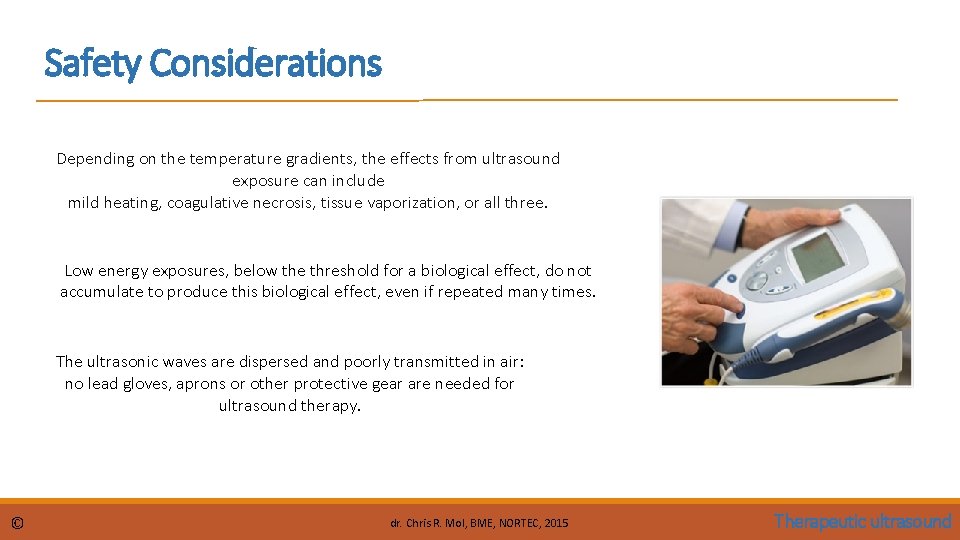
Safety Considerations Depending on the temperature gradients, the effects from ultrasound exposure can include mild heating, coagulative necrosis, tissue vaporization, or all three. Low energy exposures, below the threshold for a biological effect, do not accumulate to produce this biological effect, even if repeated many times. The ultrasonic waves are dispersed and poorly transmitted in air: no lead gloves, aprons or other protective gear are needed for ultrasound therapy. © dr. Chris R. Mol, BME, NORTEC, 2015 Therapeutic ultrasound
END The creation of this presentation was supported by a grant from THET: see https: //www. thet. org/