
Therapeutic Exercise I Chapter 10 Soft Tissue Injury
- Slides: 18
Therapeutic Exercise I Chapter 10 Soft Tissue Injury, Repair, and Management
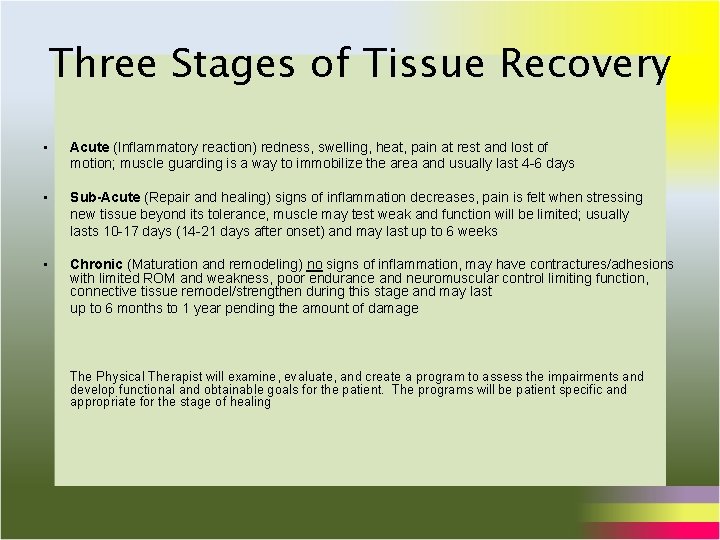
Three Stages of Tissue Recovery • Acute (Inflammatory reaction) redness, swelling, heat, pain at rest and lost of motion; muscle guarding is a way to immobilize the area and usually last 4 -6 days • Sub-Acute (Repair and healing) signs of inflammation decreases, pain is felt when stressing new tissue beyond its tolerance, muscle may test weak and function will be limited; usually lasts 10 -17 days (14 -21 days after onset) and may last up to 6 weeks • Chronic (Maturation and remodeling) no signs of inflammation, may have contractures/adhesions with limited ROM and weakness, poor endurance and neuromuscular control limiting function, connective tissue remodel/strengthen during this stage and may last up to 6 months to 1 year pending the amount of damage The Physical Therapist will examine, evaluate, and create a program to assess the impairments and develop functional and obtainable goals for the patient. The programs will be patient specific and appropriate for the stage of healing
Examples of Soft Tissue Lesions -Musculoskeletal Disorders • • • Strain Sprain Dislocation Subluxation Muscle/Tendon rupture or tear Tendinous lesion/tendinopathy – Tenosynovitis – Tenovaginitis – Tendinosis
Continued: Examples of Soft Tissue Lesions-Musculoskeletal Disorders • • • Synovitis Hemarthrosis Ganglion Bursitis Contusion Overuse Syndrome
Clinical Conditions Resulting from Trauma Pathology • • Dysfunction Joint dysfunction Contractures Adhesions Reflex muscle guarding Intrinsic muscle spasm Muscle weakness Myofascial compartment syndromes
Severity of Tissue Injury • Grade 1 (first degree)-Mild pain within the first 24 hours, with mild swelling, local tenderness, and pain when the tissues are stressed • Grade 2 (second degree)-Moderate, requires stopping the activity, stress and palpation to the tissue causing increase pain, when it is a ligament-some fibers are torn resulting in increase joint mobility • Grade 3 (third degree)-Severe, near complete/complete tear of avulsion of the tissue (tendon/ligament) with severe pain, stresses to the joint do not involve pain and palpation may reveal defect, torn ligaments results in instability of the joint
Irritability of Tissue: Stages of Inflammation and Repair • • Acute Stage Subacute Stage Discussed in earlier slide Chronic Stage Chronic Inflammation (Overuse syndrome)-increase complaints of pain, swelling, and muscle guarding lasting more than several hours after activities, stiffness, loss of ROM 24 hours after activity • Chronic Pain Syndrome – persistent pain longer than 6 months-physical, emotional, and psychosocial parameters; pain inconsistent with source of irritation, inflammation, functional limitation, disability
Management Guidelines. Protection Phase • Control the effects of swelling, facilitate wound healing and maintain normal joint function • Patient education (HEP) • Minimize pain/swelling by 1 st 24 -48 hours with rest, cold, compression and elevation • Prevent adverse reactions from immobilization • Tissue specific movement to prevent abnormal adherence • Gentle intensity to prevent increase pain/swelling • General movements to uninjured tissue and to aid in circulation/lymphatic flow
• • Specific Interventions And Dosage For The Protection Phase PROM Low-dosage joint mobilization techniques Muscle setting Massage • Interventions for Associated Areas- ROM, Muscle performance, functional activities, and circulation
Management Guidelines. Controlled Motion Phase • During the 2 nd-4 th day after tissue injury, the inflammation begins to decrease • Clots start and repair begins • Last 10 -17 days and may last up to 6 weeks • Noxious stimuli are removed, and capillary beds begin to grow • Fibroblastic activity, collagen formation, and granulation tissue development increases • Production of new collagen takes place of the formed clot • Scar linkage caused by myofibroblastic activities occurs at day 5 • Wound closure in muscles and skin takes 5 -8 days • Wound closure in tendons and ligaments takes 3 -6 weeks
Management Guidelines. Controlled Motion Phase-Continued • The key is to initiate and progress nondestructive exercises/activities • Patient education (HEP) • Management of pain and inflammation prior to initiating active exercise and stretching…. there should be no increase signs of pain/swelling • Monitor activities and exercise specifically new ones and modify as needed
-In The Controlled Phase. Initiation of: Active Exercises --Multiangle, submaximal isometrics --Active ROM --Muscular endurance --Protected weight bearing activities Stretching --Warm the tissues --Inhibition techniques --Joint mobilization --Stretching techniques --Massage --Use of new range --Correction of contributing factors
Management Guidelines. Return to Function Phase • Scar retraction from activity of the myofibrobalsts is usually complete by the 21 st day and it stops increasing in size • From 21 -60 day, there is a predominance of fibroblasts that are easily remodeled • Maturation begins late in the sub-acute stage and continues for several months • Remodeling time is influenced by factors: how long immobilized, stress placed on tissue, location of lesion, and vascular supply • Maturation of tissue is possible up to 10 weeks and at 14 weeks the tissue becomes unresponsive to remodeling
Management Guidelines. Return to Function Phase. Continued • Safe combination of stretches and strengthening to maturing tissue…this should be a balanced combo • Patient education (HEP) • To avoid pain/soreness, contractures need to be stretched/mobilized or adhesions broken up ie: cross friction massage • Proper performance/guidelines set up • Consideration of progression of exercises— as long as no adverse reaction is felt
Tissue Response To Chronic Inflammation(Prolong/Recurring Pain) • Tissue that is stressed beyond the ability to repair itself, the inflammation is perpetuated • New immature collagen is produced, which weakens the effect of tissue • Microfibroblastic activities continues, which may lead to loss of motion • With efforts to stretch the inflamed tissue, this may lead to additional irritation and progressive limitations • Mechanical causes need to be identified
Management of Chronic Inflammation • Start treatment as it is an acute condition with the focus on decreasing the inflammation to avoid continued tissue breakdown and excessive scar formationavoid cross friction massage • Once inflammation is down, treat impairments and functional limitation • Acute stage with use of modalities and rest and correct faulty biomechanics • Educate the patient in repeated trauma and the lack of healing process • Allow only non-stressful activities/exercises
Sub-acute and chronic stages of healing following Chronic Inflammation • Once decreased, progress exercises slowly to allow connective tissue to be able to withstand the stresses in functional activities • May need to mobilize a scar • If ROM is lost, too much stretching has been applied • Remember: Muscle guarding is a protective mechanism • Identify faulty movements • Work on muscle endurance to sustain repetitive activities • Progress towards function (HEP) • May use work-conditioning/work-hardening programs or sports-specific exercises
Break for Lab with Lecture on UE Manual Resistance Exercises, Mechanical Resisted Exercises, Selected Resistance Training Regimens, Equipment for Resisted Training Resistance Techniques in Anatomical Planes of Motion/Diagonals of the UE’s (If time permits may review LE’s)