
Theorymaker Cheat Sheet Symbols for Theories of Change
Theorymaker Cheat Sheet Symbols for Theories of Change Part 1: Theories Steve Powell | steve@pogol. net | i. theorymaker. info
Keep it Simple! Theorymaker provides several different symbols for use in Theories of Change. They fit together into a complete “language”, but you can just use the bits you need. Only use the symbols you need, just enough to avoid ambiguity.

Simple Theory Dimmer-switch (angle) Lamp brightness Rectangles = Variables Arrow = influence (“causes or partially causes”)

“Continuous” Variable: ◢ How far away the sound is ◢ How loud the sound is ◢ ◢= continuous Variable. No maximum. Common in physical sciences.

“lo-hi” Variable: ◪ Dimmer-switch (angle) ◪ Lamp brightness ◪ ◪ = lo-hi = continuous Variable with (possibly unclear) maximum and minimum. Similar to a proportion. Common in social sciences.
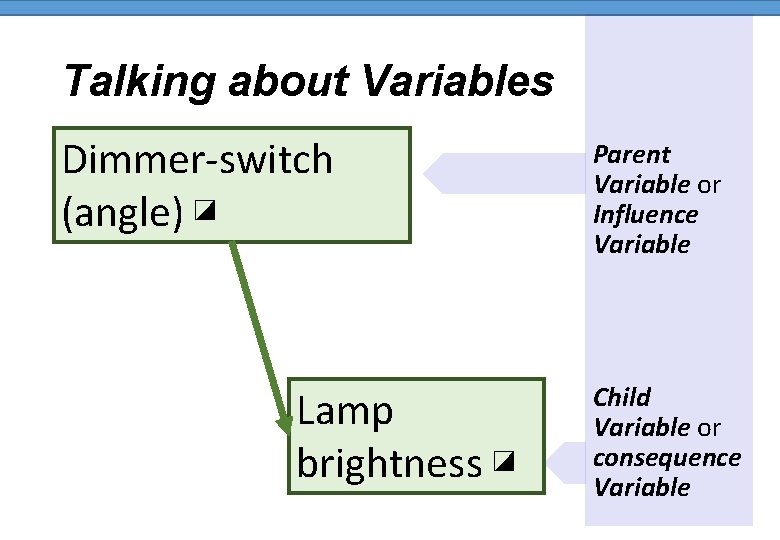
Talking about Variables Dimmer-switch (angle) ◪ Lamp brightness ◪ Parent Variable or Influence Variable Child Variable or consequence Variable

Talking about Theories A Simple Theory has just one consequence Variable. A composite Theory is made up of more than one simple Theory. A Mechanism is what a Theory is about. You can say “this Theory correctly represents the actual Mechanism”.

Same-Direction Rule: ⇈ Dimmer-switch (angle) ◪ ⇈ Lamp brightness ◪ Rule: ⇈ Rule on Arrow says what kind of influence ⇈ = “same direction” Rule. Turn switch further = more light Alternatively you can put the Rule inside the consequence Variable
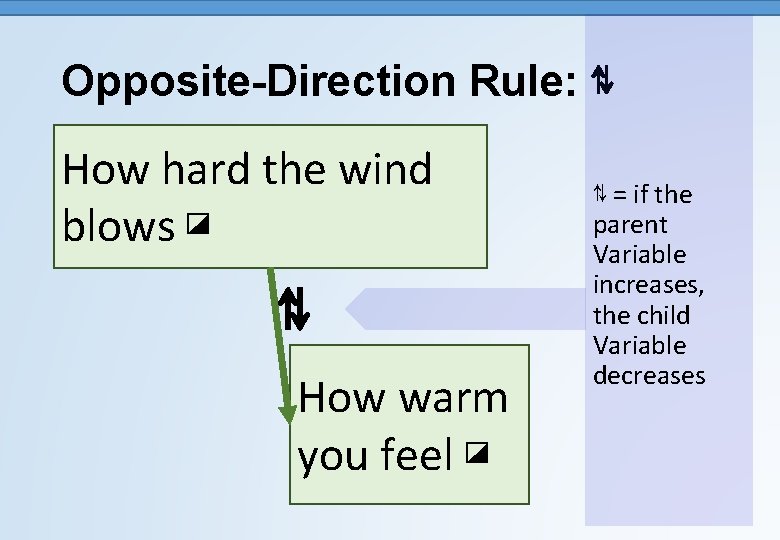
Opposite-Direction Rule: ⇅ How hard the wind blows ◪ ⇅ How warm you feel ◪ ⇅ = if the parent Variable increases, the child Variable decreases
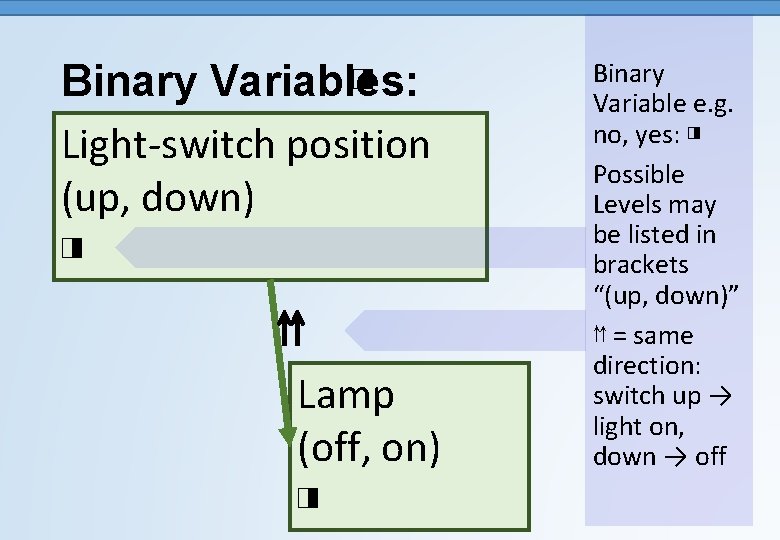
◨ Binary Variables: Light-switch position (up, down) ◨ ⇈ Lamp (off, on) ◨ Binary Variable e. g. no, yes: ◨ Possible Levels may be listed in brackets “(up, down)” ⇈ = same direction: switch up → light on, down → off
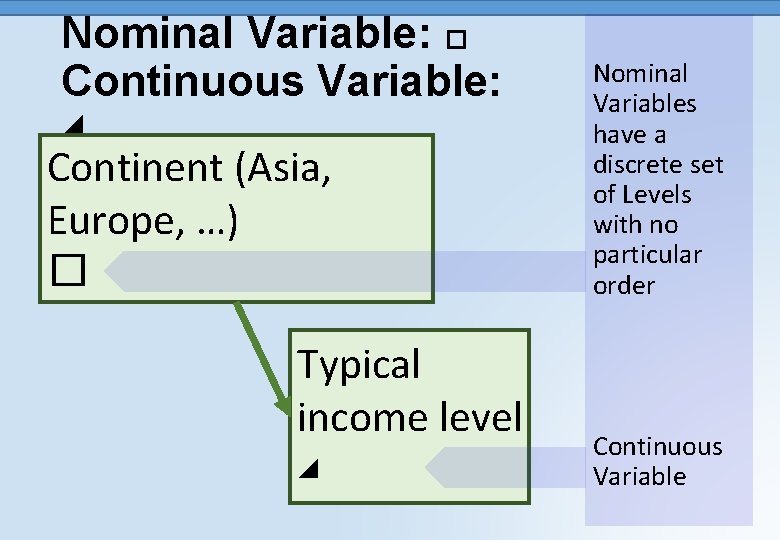
Nominal Variable: � Continuous Variable: ◢ Continent (Asia, Europe, …) � Typical income level ◢ Nominal Variables have a discrete set of Levels with no particular order Continuous Variable

Ordinal Variable: � Alert level (green < orange < red) � Threat assessment ◪ Ordinal Variables have a discrete set of Levels in a fixed order
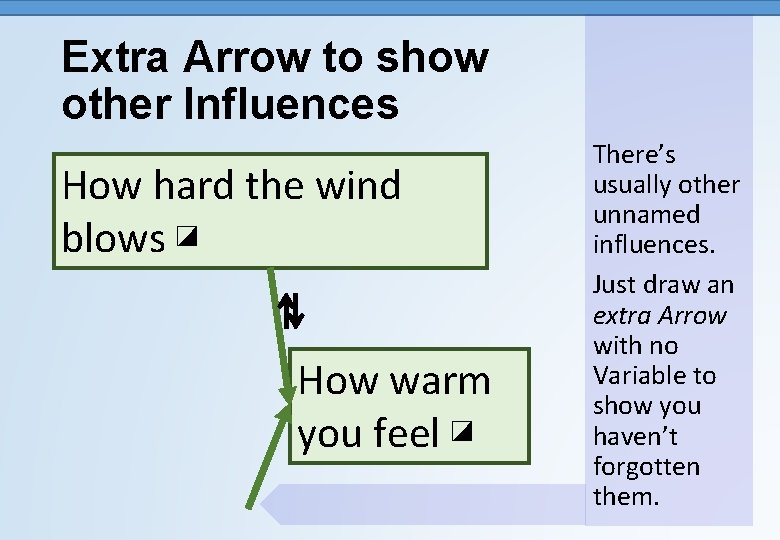
Extra Arrow to show other Influences How hard the wind blows ◪ ⇅ How warm you feel ◪ There’s usually other unnamed influences. Just draw an extra Arrow with no Variable to show you haven’t forgotten them.
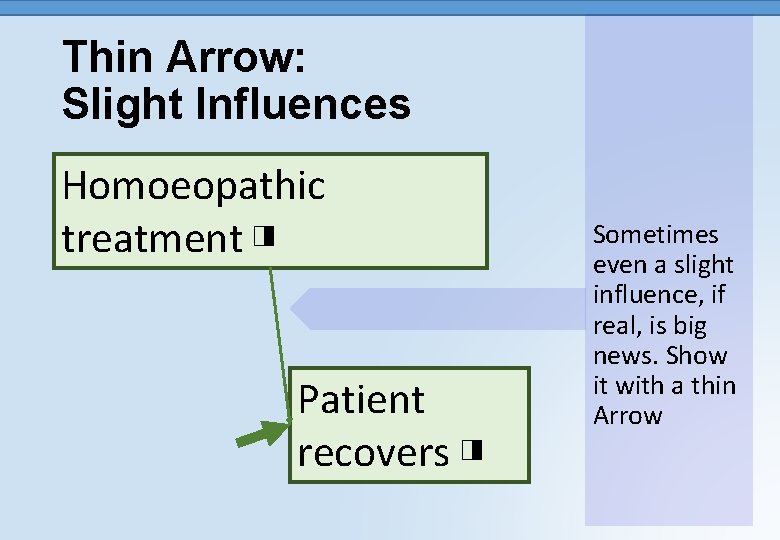
Thin Arrow: Slight Influences Homoeopathic treatment ◨ Patient recovers ◨ Sometimes even a slight influence, if real, is big news. Show it with a thin Arrow

Keep it Simple! Most Variables are ◪ “lo-hi” Most Rules are ⇈ same direction. So leave these symbols out if possible. You can also usually leave out *yes--no*: Program launched = Program launched *yes--no* (“the program was launched, rather than not being launched”)
Keep it simple: Assume influences are “collectively same-direction” When a Variable has more than one influencing Variable, we assume that the influences are not only all “same direction” but that they are “collectively same direction”: for each influencing Variable, more of it means more of the consequence Variable, regardless of the other influencing Variables…. Note: the other influencing Variables may affect the exact extent of each other’s influence, interact with each other, as long as each influence is “same-direction”.
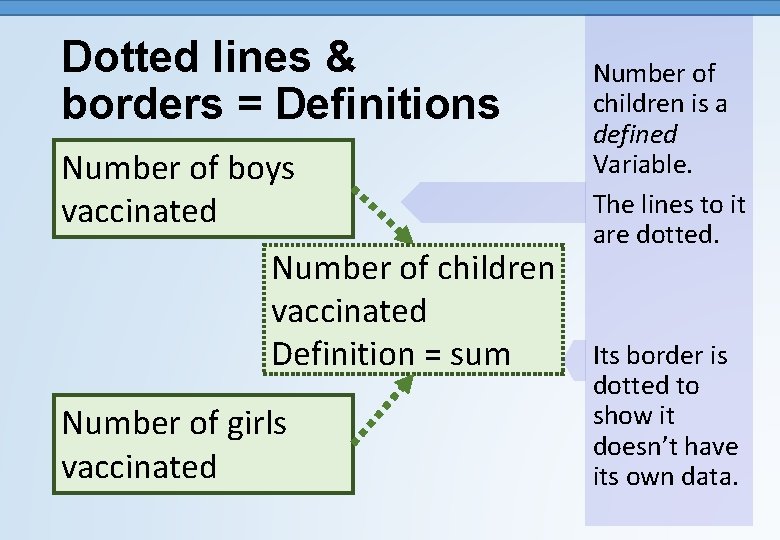
Dotted lines & borders = Definitions Number of boys vaccinated Number of children vaccinated Definition = sum Number of girls vaccinated Number of children is a defined Variable. The lines to it are dotted. Its border is dotted to show it doesn’t have its own data.
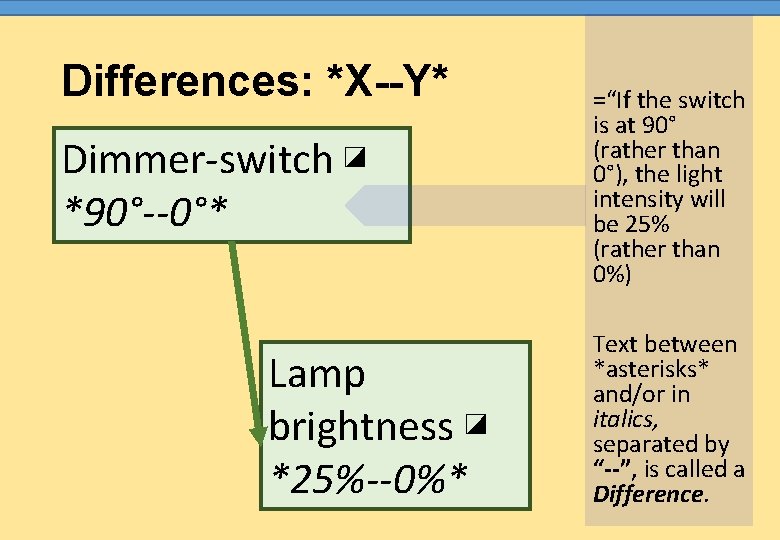
Differences: *X--Y* Dimmer-switch ◪ *90°--0°* Lamp brightness ◪ *25%--0%* =“If the switch is at 90° (rather than 0°), the light intensity will be 25% (rather than 0%) Text between *asterisks* and/or in italics, separated by “--”, is called a Difference.
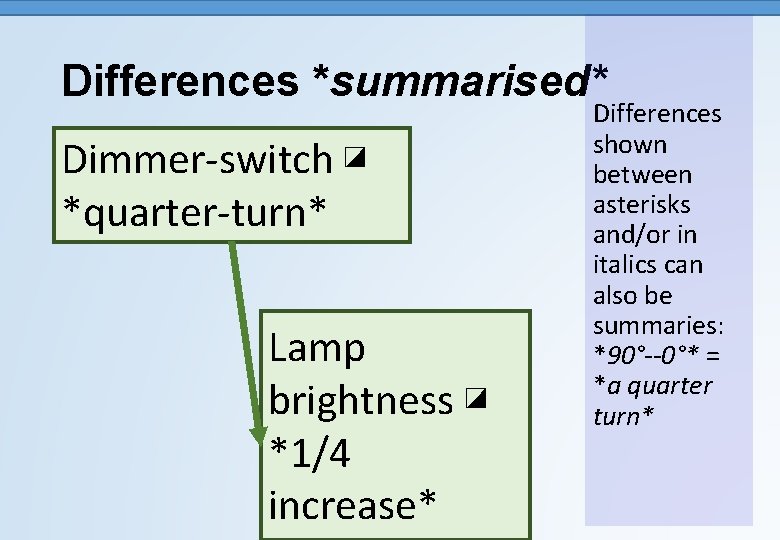
Differences *summarised* Dimmer-switch ◪ *quarter-turn* Lamp brightness ◪ *1/4 increase* Differences shown between asterisks and/or in italics can also be summaries: *90°--0°* = *a quarter turn*
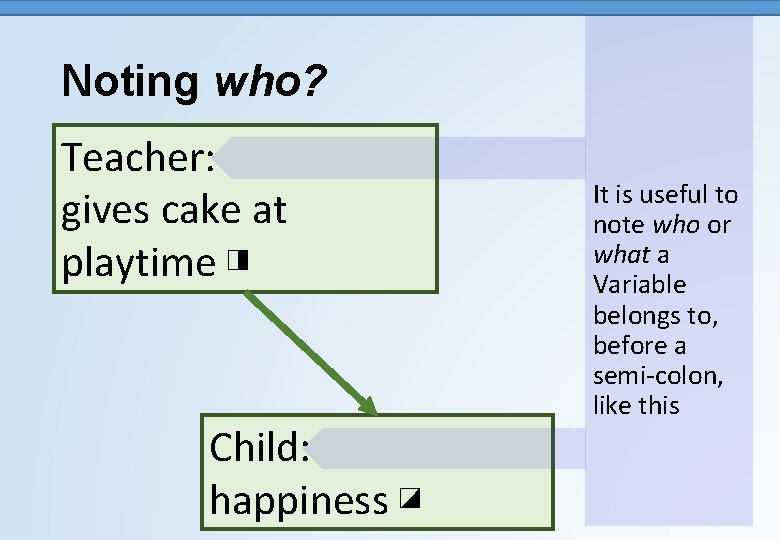
Noting who? Teacher: gives cake at playtime ◨ Child: happiness ◪ It is useful to note who or what a Variable belongs to, before a semi-colon, like this

For-each Variables Teacher: gives cake at playtime ◨ For-each child: happiness ◪ There are 30 children, so this rectangle actually shows 30 Variables, one for-each child
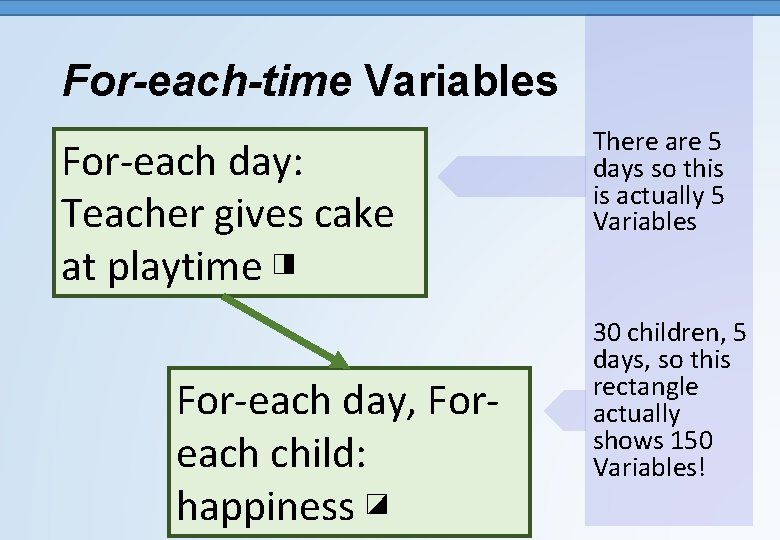
For-each-time Variables For-each day: Teacher gives cake at playtime ◨ For-each day, Foreach child: happiness ◪ There are 5 days so this is actually 5 Variables 30 children, 5 days, so this rectangle actually shows 150 Variables!
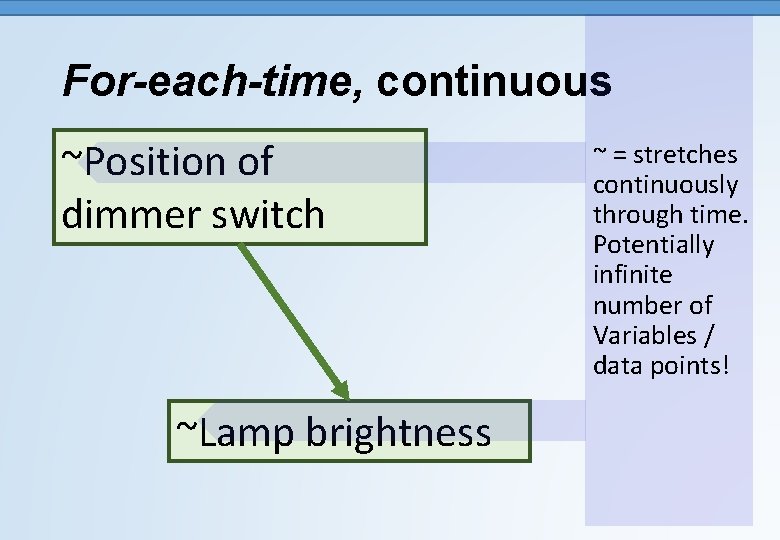
For-each-time, continuous ~Position of dimmer switch ~Lamp brightness ~ = stretches continuously through time. Potentially infinite number of Variables / data points!
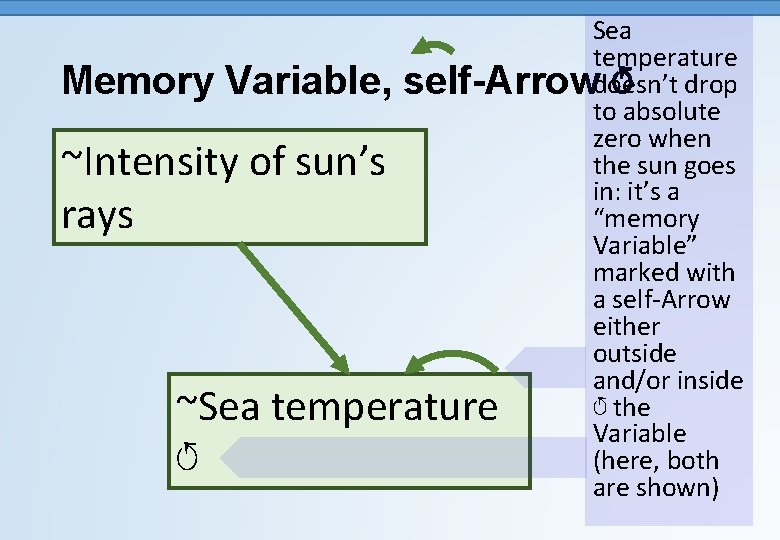
Sea temperature Memory Variable, self-Arrowdoesn’t ↺ drop to absolute zero when the sun goes ~Intensity of sun’s in: it’s a “memory rays Variable” marked with a self-Arrow either outside and/or inside ↺ the ~Sea temperature Variable (here, both ↺ are shown)
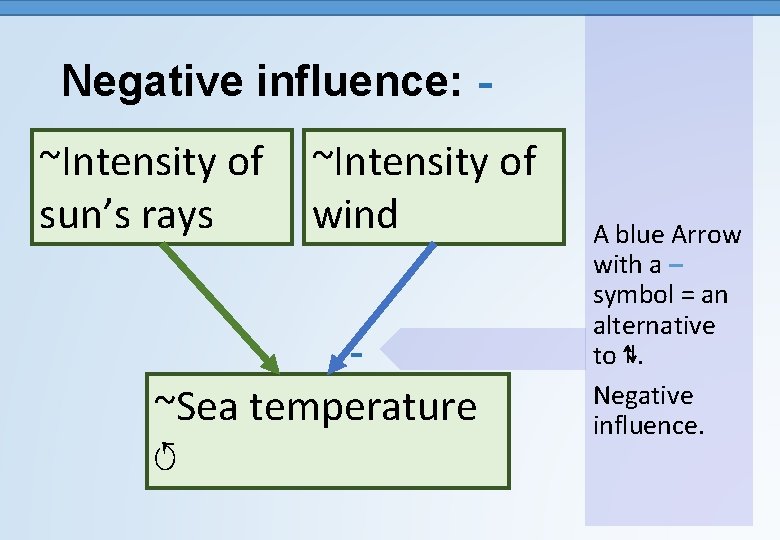
Negative influence: ~Intensity of sun’s rays ~Intensity of wind ~Sea temperature ↺ A blue Arrow with a – symbol = an alternative to ⇅. Negative influence.

For-each-time, intermittent ^ Exposure to racist ^= Intermittent behaviour Variable. ~ Racist beliefs Discrete, not continuous Variable, active some times and not others.
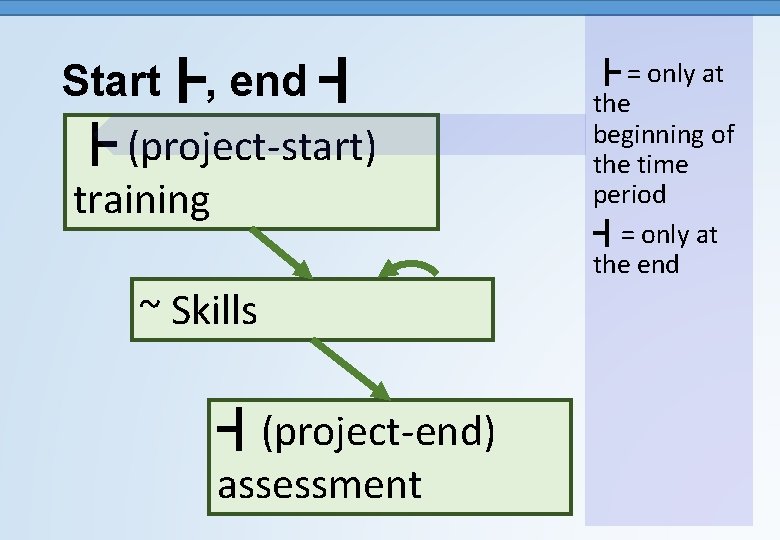
Start┣, end ┫ ┣ (project-start) training ~ Skills ┫(project-end) assessment ┣ = only at the beginning of the time period ┫= only at the end

Interaction: arrowheads touch ~Intensity of sun’s rays ~Amount of sunscreen - ~Amount of sunburn ↺ Sunscreen doesn’t do much on a cloudy day: sunscreen and sun’s rays interact: Arrowheads touch

Boxes to group Variables Grouping belonging to same personboxes Child A ~exposure to noise ~ stress level ↺ surround Variables which belong to the same person or set of people (or have other things in common) They are a shortcut to save writing the same details for each Variable inside
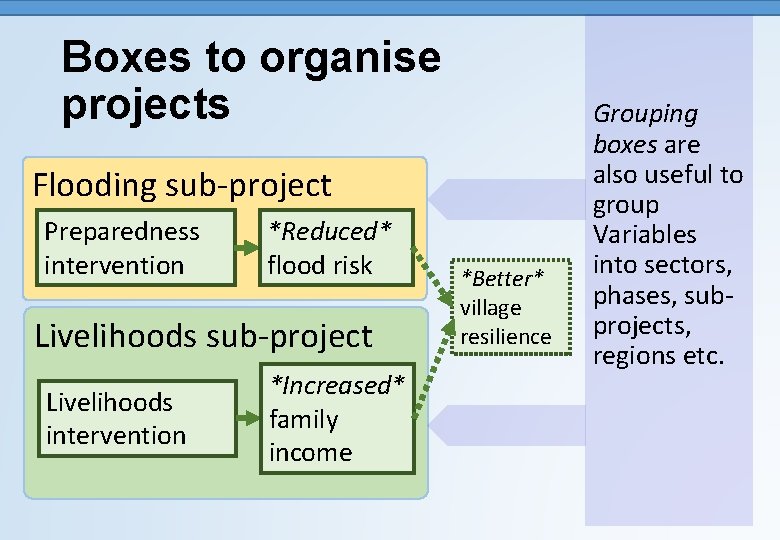
Boxes to organise projects Flooding sub-project Preparedness intervention *Reduced* flood risk Livelihoods sub-project Livelihoods intervention *Increased* family income *Better* village resilience Grouping boxes are also useful to group Variables into sectors, phases, subprojects, regions etc.
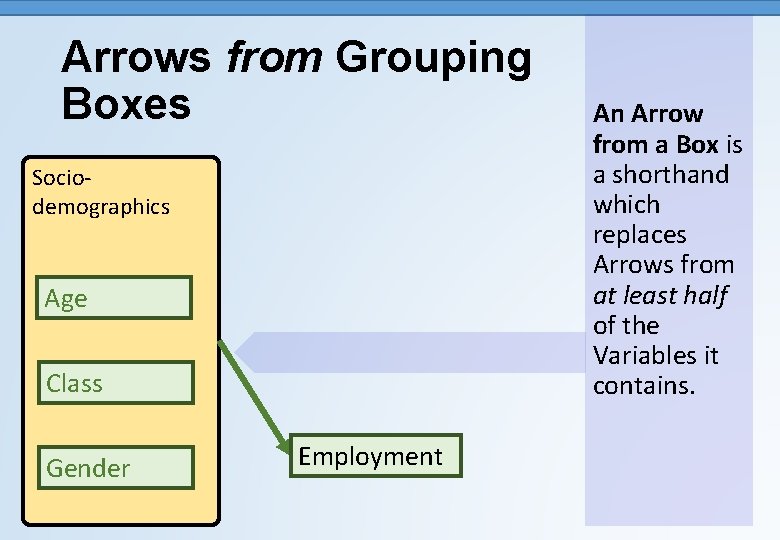
Arrows from Grouping Boxes Sociodemographics Age Class Gender Employment An Arrow from a Box is a shorthand which replaces Arrows from at least half of the Variables it contains.

Arrows to Grouping Boxes Employment Adult outcomes Income Status Life expectancy An Arrow to a Box is a shorthand which replaces Arrows to at least half of the Variables it contains.

Intersubjective Variables ֎ Standardised creativity training ◪ Student creativity ֎ We can’t completely specify in advance what creativity looks like, but we can recognise it when we see it: an intersubjective Variable ֎
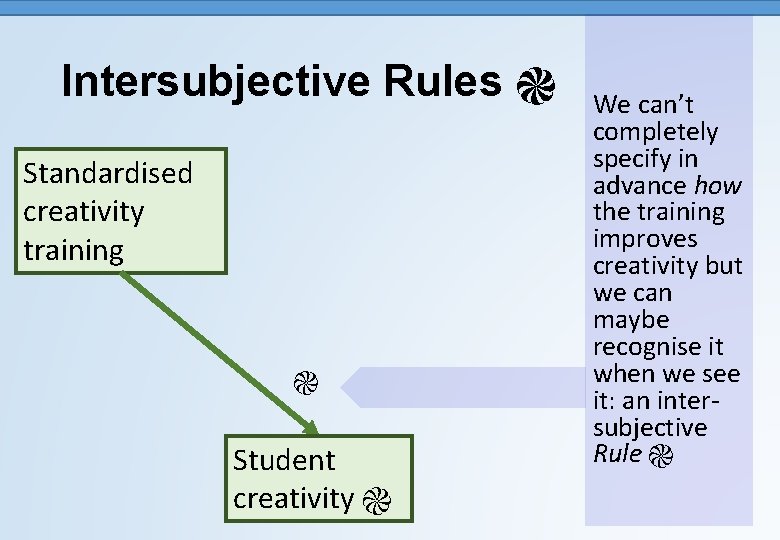
Intersubjective Rules ֎ Standardised creativity training ֎ Student creativity ֎ We can’t completely specify in advance how the training improves creativity but we can maybe recognise it when we see it: an intersubjective Rule ֎

Potentially intersubjective Variables & Rules ֎֎ Students make innovative projects ֎֎ ֎֎ Unpredictable positive developments ֎֎ ֎֎ Sustainable Development goals Even when we see the innovative projects, we have to argue before we can agree about their key features or which are most innovative – or about how this leads to valuable outcomes.

Feedback, optimisation ~Student’s level of concentration ◪ ~Teacher behaviour ֎֎ Rule: optimise The teacher gets information about student concentration level …. … and modifies her behaviour to maintain an optimum.

Part 2: Theories of Change Steve Powell | steve@pogol. net | i. theorymaker. info
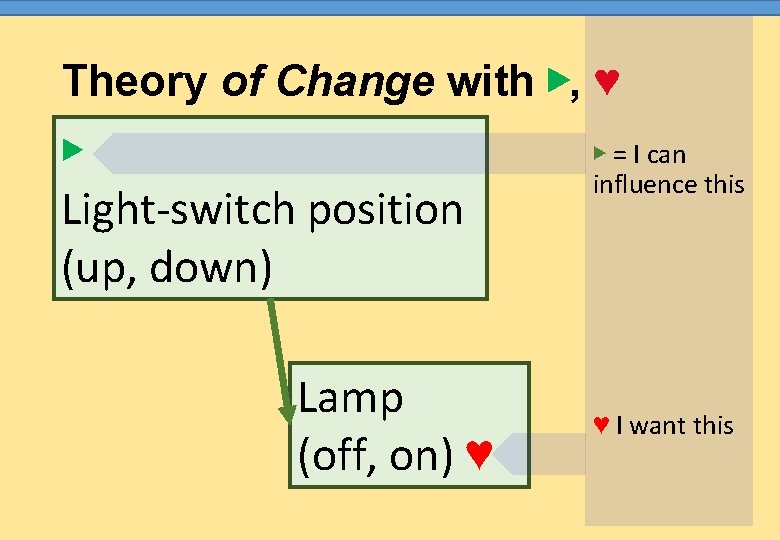
Theory of Change with ▶, ♥ ▶ Light-switch position (up, down) Lamp (off, on) ♥ ▶ = I can influence this ♥ I want this
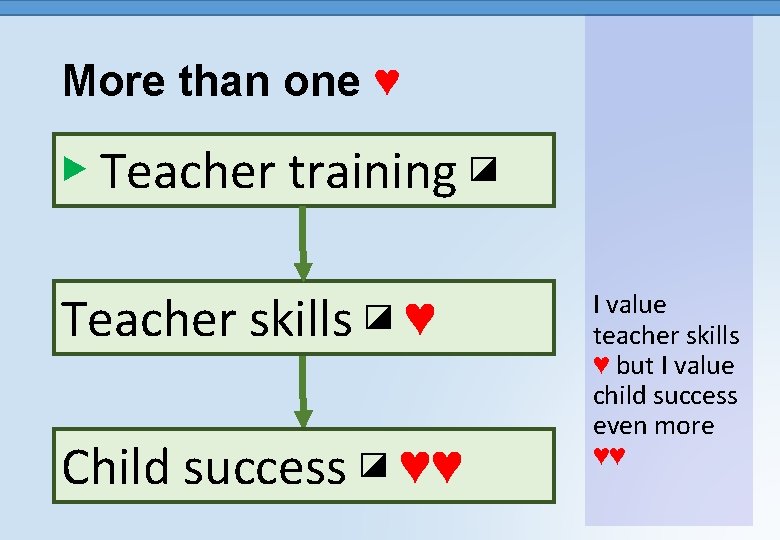
More than one ♥ ▶ Teacher training ◪ ⇈ ◪♥ Teacher skills Child success ◪ ♥♥ I value teacher skills ♥ but I value child success even more ♥♥

Theory of Change with �� , �� ▶ I buy a bike? ◨ I have less money ◨ �� I get fit ◨ �� �� = alternative to ♥ = I want this �� = I don’t want this

Theories of Change can help define evaluation questions • Effect of purchase = I’m very fit -- quite fit ++ I have $55 -- $85 • We can continue to do this even as our Theories become more “wicked” … combining Differences using “Soft Arithmetic” – here, “soft subtraction” (--) and “soft addition” (++) “Soft division” (key ratios) also possible
Making theories about theories • To plan how the plan may change • To visualise how different actors’ Theories of Change overlap
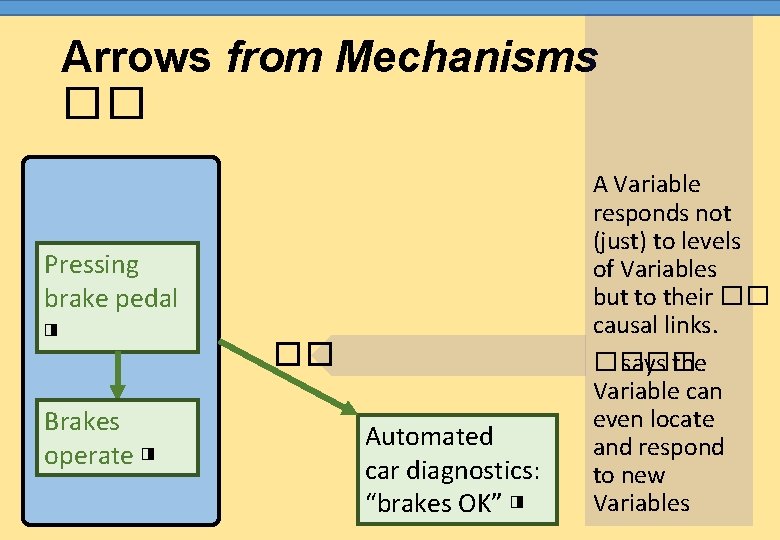
Arrows from Mechanisms �� Pressing brake pedal ◨ Brakes operate ◨ �� Automated car diagnostics: “brakes OK” ◨ A Variable responds not (just) to levels of Variables but to their �� causal links. ���� says the Variable can even locate and respond to new Variables
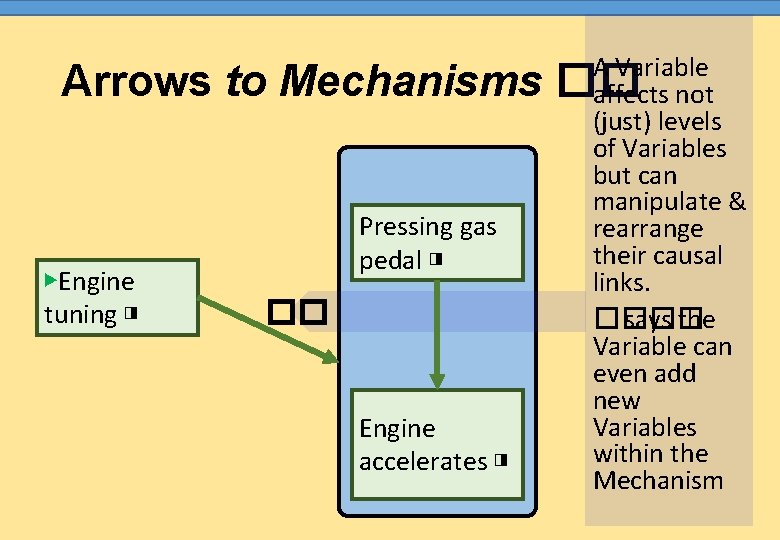
Arrows to Mechanisms ▶Engine tuning ◨ Pressing gas pedal ◨ �� Engine accelerates ◨ A Variable �� affects not (just) levels of Variables but can manipulate & rearrange their causal links. ���� says the Variable can even add new Variables within the Mechanism

Symbolic Variables Thermometer �� Temperature A “symbolic” Variable represents (�� )(red arrow with �� icon) another Variable (or group of Variables in a Box). The red �� arrow is not causal. It says “X means, represents Y”. Hopefully, the symbolic Variable is updated by information from the surroundings.

Theories about To. Cs: A To. C as a symbolic Variable ~Student’s level of concentration ♥ ◪ ▶ ~Teacher behaviour Rule: optimise �� The teacher’s behaviour is modified according to her own Theory of Change - a cognitive picture, and/or a plan, way of working … This is itself a “symbolic” Variable which represents �� the actual Variables in the blue box.
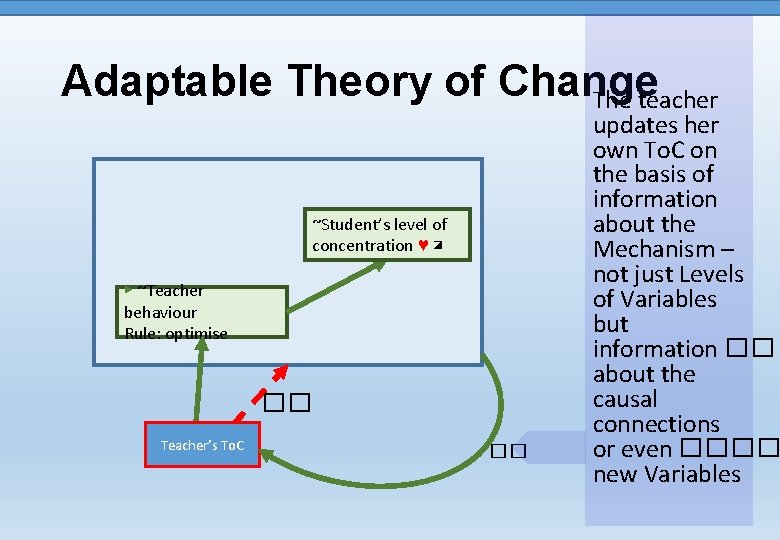
Adaptable Theory of Change The teacher ~Student’s level of concentration ♥ ◪ ▶ ~Teacher behaviour Rule: optimise �� Teacher’s To. C �� updates her own To. C on the basis of information about the Mechanism – not just Levels of Variables but information �� about the causal connections or even ���� new Variables

Observation Rule �� , Hand rule�� In this quite general case, = Adaptive Management a manager ~ Outcome(s) ♥ ▶ ~ Intervention(s) �� Manager’s Real To. C �� �� monitors not only levels of Variables but �� what is causing what, and intervenes not only in a planned way but to �� change the links in the Mechanism
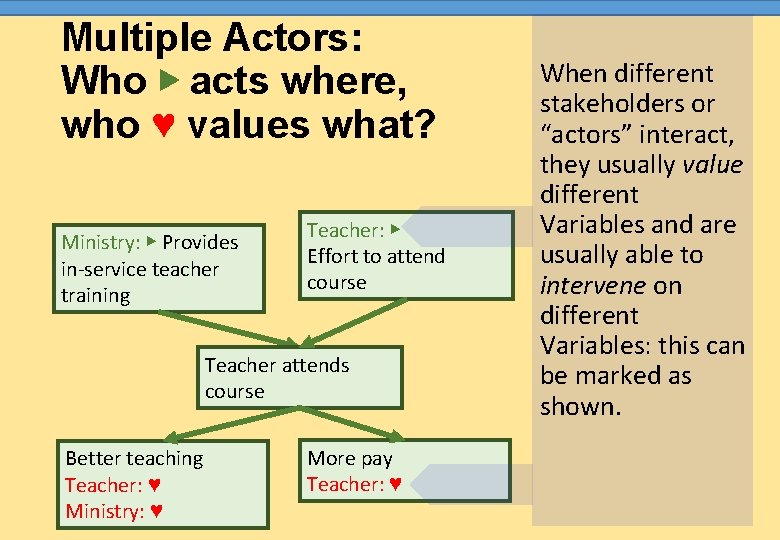
Multiple Actors: Who ▶ acts where, who ♥ values what? Ministry: ▶ Provides in-service teacher training Teacher: ▶ Effort to attend course Teacher attends course Better teaching Teacher: ♥ Ministry: ♥ More pay Teacher: ♥ When different stakeholders or “actors” interact, they usually value different Variables and are usually able to intervene on different Variables: this can be marked as shown.
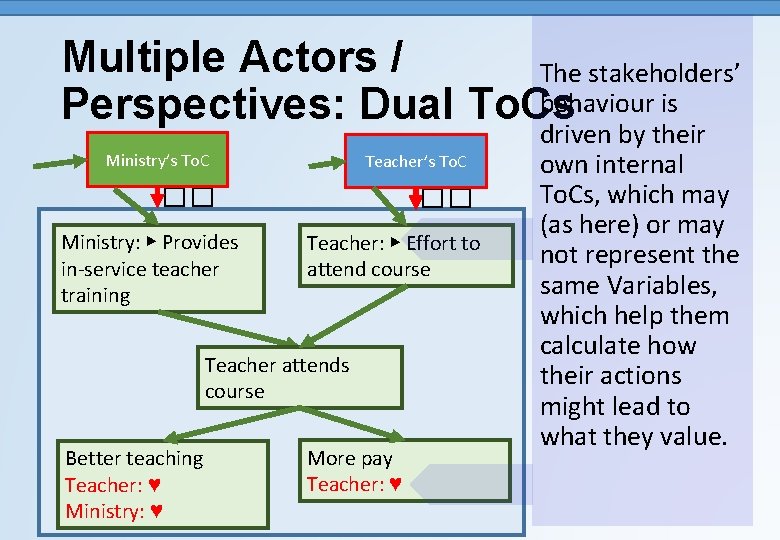
Multiple Actors / The stakeholders’ behaviour is Perspectives: Dual To. Cs Ministry’s Teacher’s To. C �� Ministry: ▶ Provides in-service teacher training �� Teacher: ▶ Effort to attend course Teacher attends course Better teaching Teacher: ♥ Ministry: ♥ More pay Teacher: ♥ driven by their own internal To. Cs, which may (as here) or may not represent the same Variables, which help them calculate how their actions might lead to what they value.

Making theories about evaluations Cost-effectiveness Rule: Outcomes / Inputs ratio Donor: ♥ ▶ Inputs Outcomes NGO: ♥ To plan how an evaluation responds to the evaluand To display different evaluation approaches
Theorymaker Resources Free, open-source web apps: - drag& drop app: i. theorymaker. info - text-based app: theorymaker. info These slides: bit. do/Cheat. Sheet More info: pogol. net/public/slides. html Contact: steve@pogol. net

theorymaker. info (text-based app) (not all the features in these slides available yet)

i. theorymaker. info (drag & drop app) (not all the features in these slides available yet)
- Slides: 54