
Theory Research CHAPTER 2 Copyright 2015 Mc GrawHill


























- Slides: 56
Theory & Research CHAPTER 2 Copyright © 2015 Mc. Graw-Hill Education. All rights reserved. No reproduction or distribution without the prior written consent of Mc. Graw-Hill Education.
Learning Objectives 2. 1 Describe the purpose of a theory in research and two theoretical issues on which developmental scientists differ. 2. 2 Summarize the main theories of human development. 2. 3 Describe the methods of developmental research used to collect data and the advantages and disadvantages of each. 2. 4 Explain ethical guidelines for researchers who study people. © 2015 Mc. Graw-Hill Education
Basic Theoretical Terms Theory A set of logically related concepts that seek to describe and explain development and to predict the kinds of behavior might occur under certain conditions Help us see connections between isolated pieces of data Hypotheses Explanations that can be tested by further research © 2015 Mc. Graw-Hill Education
Issue 1: Is Development Active or Reactive? ● Mechanistic Model: Passive Locke: tabula rasa Children are “blank slates on which society writes” People are like machines that react to environmental input © 2015 Mc. Graw-Hill Education
Issue 1: Is Development Active or Reactive? ● Organismic Model: Active Rousseau: “noble savages” Children set their own development in motion People initiate events, don’t just react © 2015 Mc. Graw-Hill Education
Issue 2: Continuous or Discontinuous? Mechanistic Theories: Continuous Focus on quantitative change Same processes are involved © 2015 Mc. Graw-Hill Education
Issue 2: Continuous or Discontinuous? Organismic Theories: discontinuous Focus on qualitative change Different processes involved © 2015 Mc. Graw-Hill Education
Five Major Perspectives Psychoanalytic Learning Cognitive Contextual Evolutionary/Sociobiological © 2015 Mc. Graw-Hill Education
Perspective 1: Psychoanalytic Theory Psychoanalytic Unconscious forces motivate human behavior Psychoanalysis: Therapy that gives insight into unconscious emotional conflicts © 2015 Mc. Graw-Hill Education
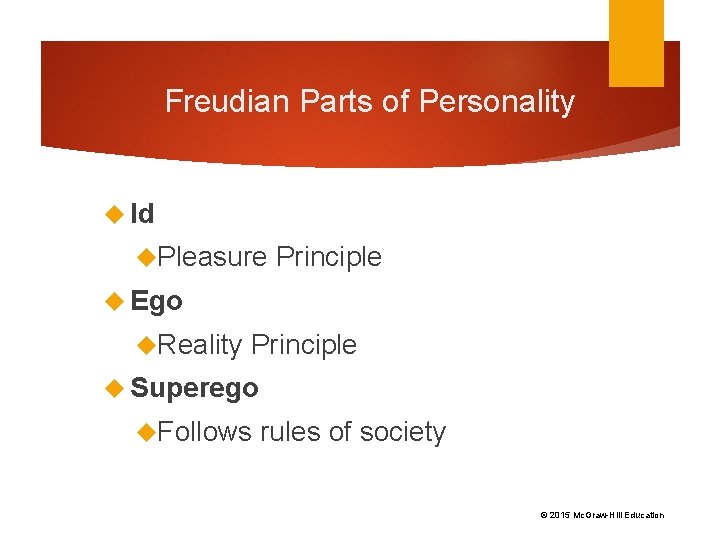
Freudian Parts of Personality Id Pleasure Principle Ego Reality Principle Superego Follows rules of society © 2015 Mc. Graw-Hill Education
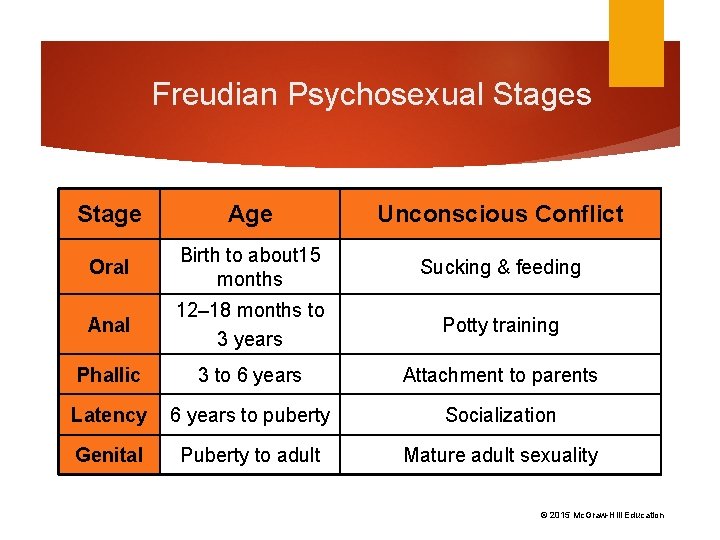
Freudian Psychosexual Stages Stage Age Unconscious Conflict Oral Birth to about 15 months Sucking & feeding Anal 12– 18 months to 3 years Potty training Phallic 3 to 6 years Attachment to parents Latency 6 years to puberty Socialization Genital Puberty to adult Mature adult sexuality © 2015 Mc. Graw-Hill Education
Erickson’s Psychosocial Theory Emphasized influence of society Development is lifelong, not just during childhood • Each of eight stages of development involves a “crisis” • Crisis resolution gains a “virtue” • Infancy: trust vs. mistrust © 2015 Mc. Graw-Hill Education
Perspective 2: Learning Long-lasting change in behavior, based on experience adaptation to the environment © 2015 Mc. Graw-Hill Education
Learning: Behaviorism Associative learning We respond based on whether the situation is: Painful or Threatening Pleasurable © 2015 Mc. Graw-Hill Education
Behaviorism: Classical Conditioning Ivan Pavlov: stimulus and response John Watson: Conditioning of Fear Orphan boy “Little Albert” © 2015 Mc. Graw-Hill Education
Behaviorism: Operant Conditioning Individual learns the consequences of “operating” on the environment Learned relationship between behavior and its consequences B. F. Skinner formulated original ideas by working with animals, then applied them to humans © 2015 Mc. Graw-Hill Education
Operant Conditioning: Reinforcement Increases likelihood of behavior reoccurring Positive: Candy Giving a reward for finishing a task Negative: No Removing something aversive chores for getting an A+ on homework © 2015 Mc. Graw-Hill Education
Operant Conditioning: Punishment Decreases likelihood of behavior reoccurring Positive: Getting Adding something aversive scolded Negative: Removing something pleasant Taking away car keys Getting a “time-out” © 2015 Mc. Graw-Hill Education
Social Learning Theory Albert Bandura: Development is “bidirectional” Reciprocal determinism—person acts on world as the world acts on the person Observational Learning or Modeling Children choose models to imitate © 2015 Mc. Graw-Hill Education
Social Cognitive Theory: An Update to Modeling Emphasizes cognitive processes as central to development Beginning of “self-efficacy” People observe models and learn “chunks” of behavior § Imitating dance steps of teacher and fellow students to develop new individual style © 2015 Mc. Graw-Hill Education
Perspective 3: Cognitive Focuses on thought processes and behavior that reflects those processes Includes organismic and mechanistic theories © 2015 Mc. Graw-Hill Education
Piaget: Cognitive Stage Theory Clinical Method Combining observation with questioning Development begins with an inborn ability to adapt Rooting for a nipple, feeling for a pebble © 2015 Mc. Graw-Hill Education
Piaget: Organization =A tendency to create complex cognitive structures, or “schemes” = Schemes =Organized patterns of behavior used to think and act in a situation =Infants suck bottles AND thumbs © 2015 Mc. Graw-Hill Education
Piaget: Adaptation How children handle familiar information Two processes: Assimilation: Incorporating new information into existing schemes Accommodation: Changing structures to include new information These steps are balanced through equilibration © 2015 Mc. Graw-Hill Education
Vygotsky’s Sociocultural Theory Stresses children’s active interaction with social environments Zone of proximal development (ZPD) Scaffolding © 2015 Mc. Graw-Hill Education
Information Processing Approach Analyzes processes involved in making sense of incoming information Helps children be aware of their own mental strategies … and strategies for improvement! © 2015 Mc. Graw-Hill Education
Information-Processing Approach: Computer-Based Models Infers what happens between stimulus and response Often uses flowcharts to define steps of processing that people use Unlike Piaget, views development as continuous © 2015 Mc. Graw-Hill Education
Perspective 4: Contextual Development can be understood only in its social contexts Urie Bronfenbrenner: bioecological theory Describes range of interacting influences that affect development Identifies contexts that stifle or promote growth Home, classroom, neighborhood © 2015 Mc. Graw-Hill Education
Bronfenbrenner’s Five Contextual Systems © 2015 Mc. Graw-Hill Education
Perspective 5: Evolutionary/Sociobiological Uses Darwin’s evolutionary theory Survival of the fittest Animals These Natural with traits suited to environment survive adaptive traits are passed on to offspring selection As environments change, traits change in adaptiveness © 2015 Mc. Graw-Hill Education
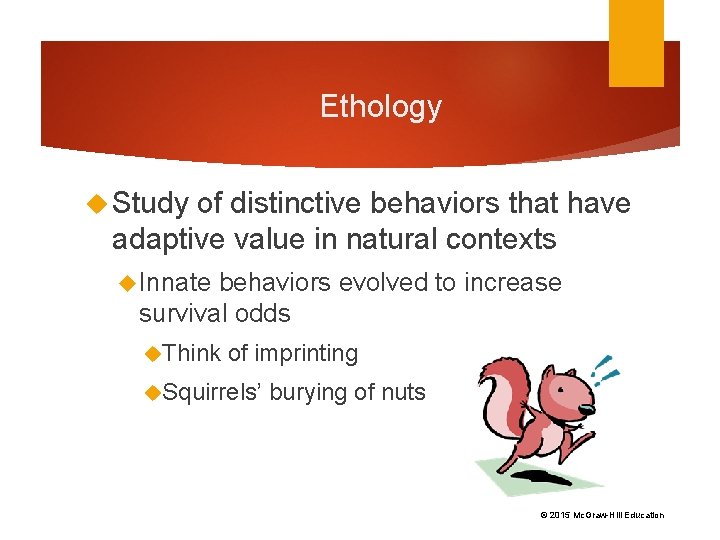
Ethology Study of distinctive behaviors that have adaptive value in natural contexts Innate behaviors evolved to increase survival odds Think of imprinting Squirrels’ burying of nuts © 2015 Mc. Graw-Hill Education
Evolutionary Psychology How biology and environment interact to produce behavior and development Humans unconsciously strive for personal survival and genetic legacy Result: A development of mechanisms that evolved to solve problems Morning sickness actually protects fetuses © 2015 Mc. Graw-Hill Education
Research Methods Quantitative Objectively measurable data, often numerical Standardized tests Physiological changes Qualitative Non-numerical data often focuses on how and why of behavior Feelings Beliefs © 2015 Mc. Graw-Hill Education
Scientific Method: Quantitative Research 1. Identification of a problem 2. Formulation of hypotheses 3. Collection of data 4. Statistical analysis of the data 5. Formation of tentative conclusions 6. Dissemination of findings © 2015 Mc. Graw-Hill Education
Sampling Sample A smaller group within the population Studying the entire population is inefficient Random Selection Each person in population has an equal chance of being in sample Result is “random sample” © 2015 Mc. Graw-Hill Education
Forms of Data Collection: Self-Reports Diaries Visual techniques Interviews Questionnaires Structured Open-ended © 2015 Mc. Graw-Hill Education
Data Collection: Naturalistic Observation “People watching” Behavior is observed in natural settings, without interfering Limitations Can not inform causes of behavior Researcher cannot know all possible influences on behavior © 2015 Mc. Graw-Hill Education
Data Collection: Laboratory Observation Behavior observed and recorded in controlled environment More likely to identify and control causal influences Limitation: Observer Bias: A researcher’s tendency to interpret data to fit expectations © 2015 Mc. Graw-Hill Education
Behavioral and Performance Measures Objective measures Mechanical and electronic devices Assessing skills, knowledge, and abilities Heart rate Brain activity Intelligence tests © 2015 Mc. Graw-Hill Education
Meaningful Measures Reliable Results are consistent from time to time Valid The test actually measures what it claims to measure © 2015 Mc. Graw-Hill Education
Measures: Operational Definitions Defining abstract ideas in objective terms and specifics used to measure a phenomenon What A Are is intelligence? score on a test there different kinds of intelligence? Emotional intelligence Academic intelligence © 2015 Mc. Graw-Hill Education
Cognitive Neuroscience Emerging Bridges Uses field mind, brain, and behavior data from: Cognitive Social neuroscience psychology Info-processing approaches © 2015 Mc. Graw-Hill Education
Basic Research Designs Type Characteristics Pros Cons Case Study of individuals Flexibility Reduced generalizability Ethnographic Study of cultures Universality of phenomena Observer bias Correlational Positive or negative relationships Enables prediction Cannot establish cause and effect Experiment Controlled procedures Establishes cause and effect Reduced generalizability © 2015 Mc. Graw-Hill Education
Case Studies Study Offer of an individual (such as Genie) useful in-depth information Shortcomings Not No generalizable way to test conclusions © 2015 Mc. Graw-Hill Education
Ethnographic studies Describe patterns that make up a society’s way of life Relationships, Participant Subject Useful customs, beliefs, arts, traditions observation to observer bias in cross-cultural research © 2015 Mc. Graw-Hill Education
Correlational Studies Seeks to determine whether a relationship exists between variables Expressed in terms of direction and magnitude © 2015 Mc. Graw-Hill Education
Experiments Controlled procedure where experimenter manipulates variables to learn how one affects the other Must be done so they can be replicated © 2015 Mc. Graw-Hill Education
Experiments: Groups Experimental People who are exposed to the treatment Control Similar to the experimental group but do NOT receive the treatment © 2015 Mc. Graw-Hill Education
Experiments: Variables Independent Experimenter has direct control over Dependent Something that may or may not change as result of changes in independent variable © 2015 Mc. Graw-Hill Education
Experiments: Random Assignment Participants have an equal chance of placement in experimental or control group(s) Helps avoid unintentional differences between groups © 2015 Mc. Graw-Hill Education
Window on the World: Purposes of cross cultural research Explores ways in which development is universal Motor development may be culture specific Examines Use biases in Western theories of observational studies © 2015 Mc. Graw-Hill Education
Experiments: Location Control over cause and effect varies, depending on location: Laboratory Field – most control – controlled Everyday Home settings or school Natural – least control © 2015 Mc. Graw-Hill Education
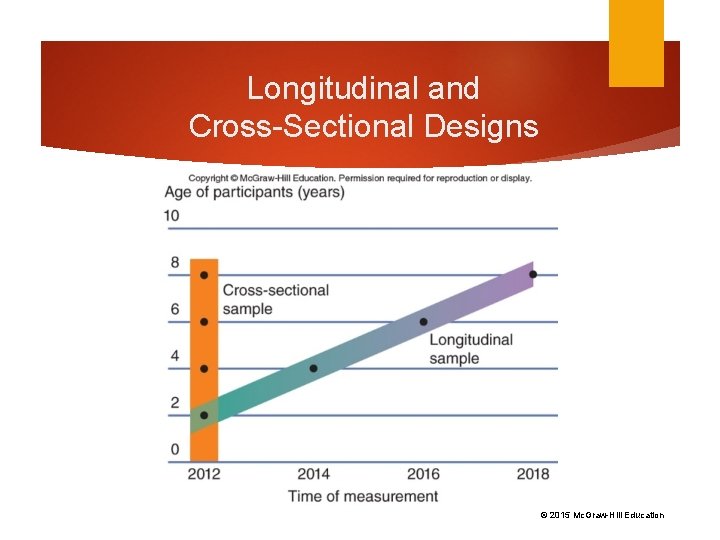
Research Designs Cross sectional People assessed at one point in time Same people studied more than Longitudinal once Sequential • Complex combination of crosssectional and longitudinal • Adds more data than either design alone © 2015 Mc. Graw-Hill Education
Longitudinal and Cross-Sectional Designs © 2015 Mc. Graw-Hill Education
Ethics Balancing benefits or research against mental and physical risks to participants Considerations Right to informed consent Avoidance Right of deception to privacy Confidentiality Right to decline or withdraw © 2015 Mc. Graw-Hill Education
Ethics Researchers are guided by Beneficence Respect Justice Researchers should be sensitive to participants’ developmental needs and cultural issues and values © 2015 Mc. Graw-Hill Education