
Theory Practice of Argument Week 11 Conditional Enumerative
- Slides: 19
Theory & Practice of Argument Week 11: Conditional, Enumerative, Analogy & Metaphor
Conditional Arguments Another term for this is “hypothetical syllogism” Common form for syllogism: “All A is C; all B is A; therefore all B is C. ” an argument built around an “if-then” statement or an equivalent. VERY similar to the fundamentals of how computer programming is written “If value returned is 5 or less, then display value in right column, not left. ”
Conditional Arguments cont. Conditional statement: the if-then statement Premises: reasons in conditional, enumerative, and categorical arguments Antecedent (if clause) and consequent (then clause)
Conditional Arguments cont. Structure of a Conditional Argument: 1. conditional statement (if, then) “If we increase the number of guns available, then the lethality of crimes will increase. ” 2. second reason The number of guns has increased. 3. conclusion The number of lethal crimes has increased.
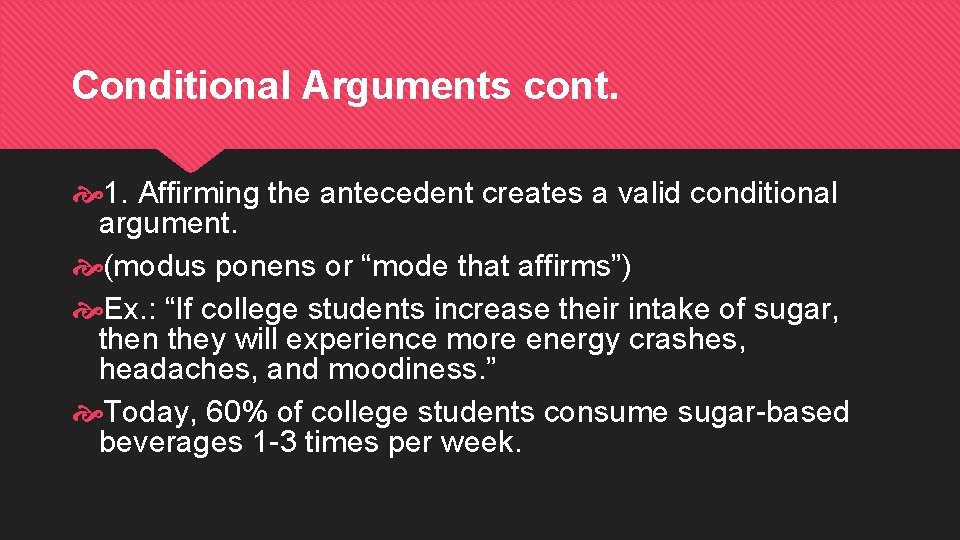
Conditional Arguments cont. 1. Affirming the antecedent creates a valid conditional argument. (modus ponens or “mode that affirms”) Ex. : “If college students increase their intake of sugar, then they will experience more energy crashes, headaches, and moodiness. ” Today, 60% of college students consume sugar-based beverages 1 -3 times per week.
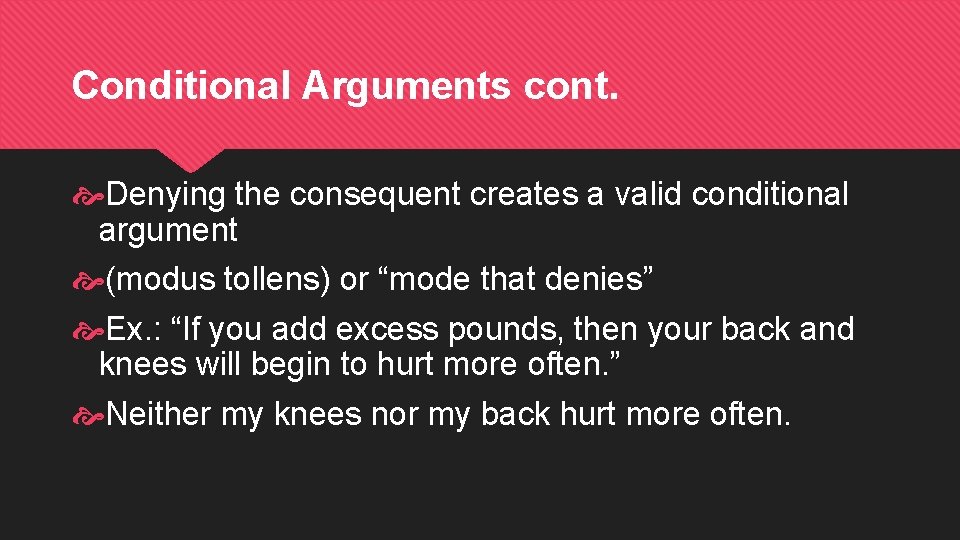
Conditional Arguments cont. Denying the consequent creates a valid conditional argument (modus tollens) or “mode that denies” Ex. : “If you add excess pounds, then your back and knees will begin to hurt more often. ” Neither my knees nor my back hurt more often.
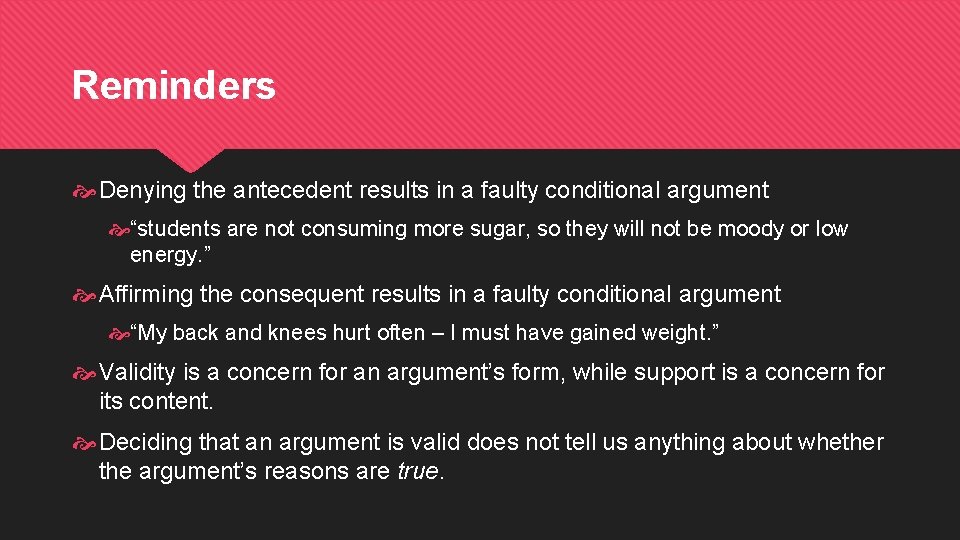
Reminders Denying the antecedent results in a faulty conditional argument “students are not consuming more sugar, so they will not be moody or low energy. ” Affirming the consequent results in a faulty conditional argument “My back and knees hurt often – I must have gained weight. ” Validity is a concern for an argument’s form, while support is a concern for its content. Deciding that an argument is valid does not tell us anything about whether the argument’s reasons are true.
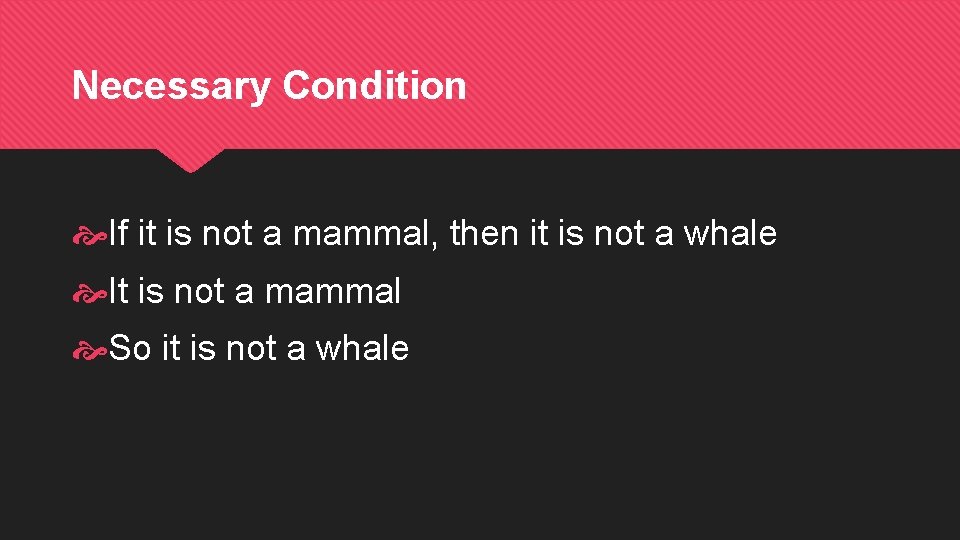
Necessary Condition If it is not a mammal, then it is not a whale It is not a mammal So it is not a whale
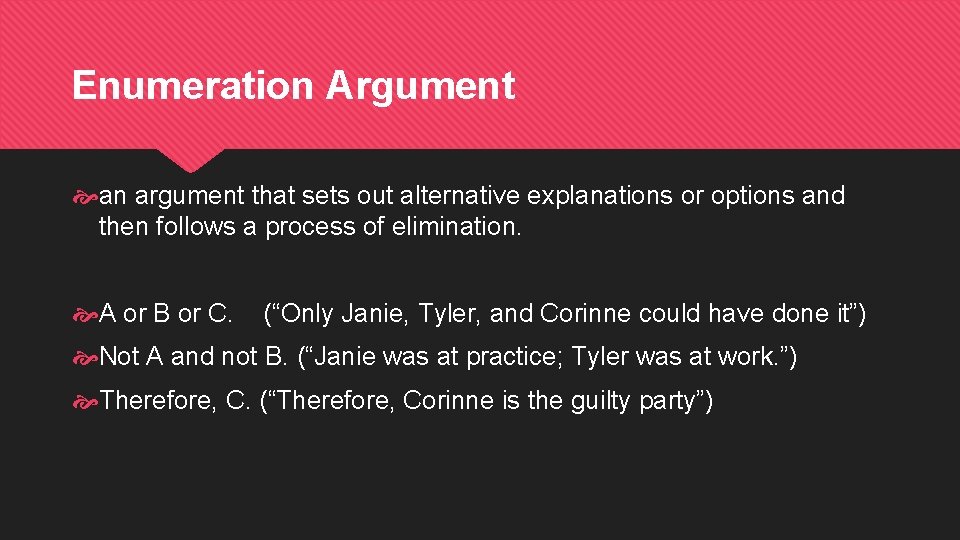
Enumeration Argument an argument that sets out alternative explanations or options and then follows a process of elimination. A or B or C. (“Only Janie, Tyler, and Corinne could have done it”) Not A and not B. (“Janie was at practice; Tyler was at work. ”) Therefore, C. (“Therefore, Corinne is the guilty party”)
Testing Enumerative Arguments 1. Have all of the plausible options been identified? 2. Have all rejected options been convincingly eliminated?
Disjunctive Argument presents limited options: two enumerated alternatives or disjuncts, often marked by an “either/or” statement. Disjuncts can be either inclusive (both might be true at same time) or exclusive (two can not be true at same time)
Disjunctive Argument Inclusive example (might both be true at the same time): My theory about why there are no towels: The kids just got back from swimming and used them all Your mother was dyeing and styling her hair Exclusive example (cannot both be true at the same time): The reason our local river’s water is polluted is because: The local factory illegally dumps its waste The toxicity levels measured point to an organic source or mutation
Dilemnas Dilemma – forces a choice between limited and undesirable options. “Look, I know nobody wants more corporate sponsorship on campus. However, it is either that, and the money it brings in, or closing down this campus. ” False dilemma – artificially limited options to mislead an audience. “If you’re not first, you’re last. We have to approve this new policy NOW before anyone else does!”
Analogies a comparison of something with which we are familiar to something with which we are less familiar or about which we have some questions. Literal analogy: a direct comparison between two allegedly similar items or cases “Refining corn starch into high fructose corn syrup is no different than refining raw sugar into white granulated sugar. ”
Analogies cont. Basic structure for literal analogies: 1. evidence (connected to conclusion in at least one way) 2. connective (presence of some similarities between any two cases suggests likelihood of other similarities 3. conclusion (likely to be similar to evidence in other important respects)
Analogies Cont. How to Test Literal Analogies 1. Are the cases being compared dissimilar in some critical respect? 2. Are the cases presented accurately? 3. Is a better analogy available?
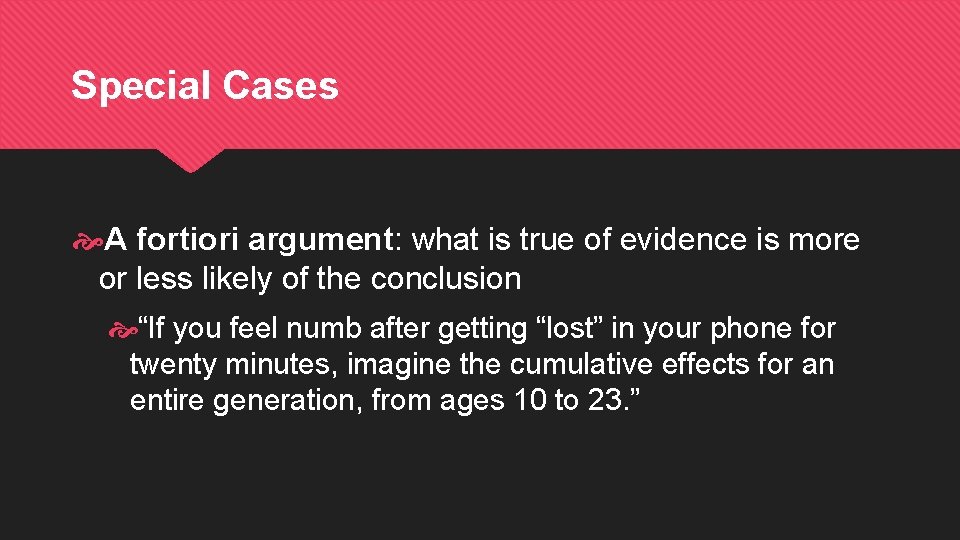
Special Cases A fortiori argument: what is true of evidence is more or less likely of the conclusion “If you feel numb after getting “lost” in your phone for twenty minutes, imagine the cumulative effects for an entire generation, from ages 10 to 23. ”
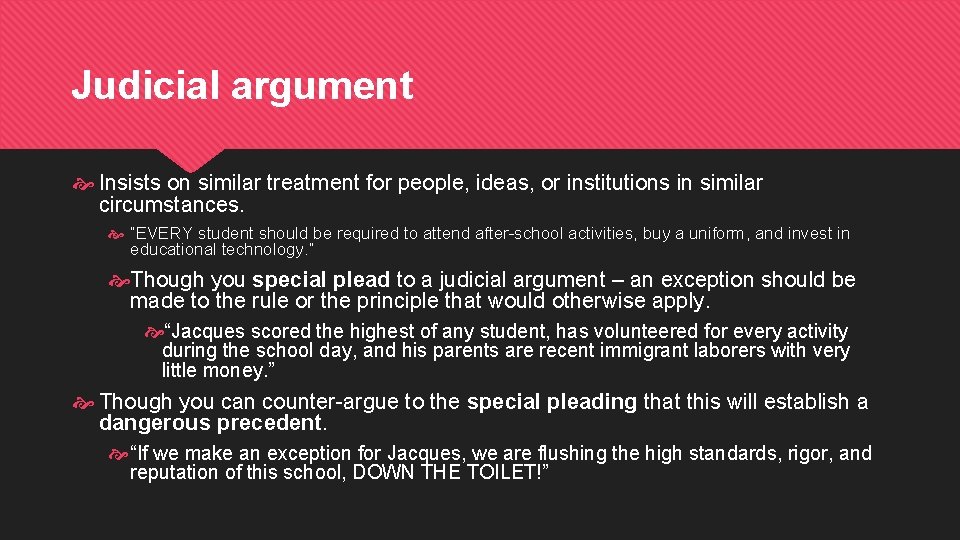
Judicial argument Insists on similar treatment for people, ideas, or institutions in similar circumstances. “EVERY student should be required to attend after-school activities, buy a uniform, and invest in educational technology. ” Though you special plead to a judicial argument – an exception should be made to the rule or the principle that would otherwise apply. “Jacques scored the highest of any student, has volunteered for every activity during the school day, and his parents are recent immigrant laborers with very little money. ” Though you can counter-argue to the special pleading that this will establish a dangerous precedent. “If we make an exception for Jacques, we are flushing the high standards, rigor, and reputation of this school, DOWN THE TOILET!”
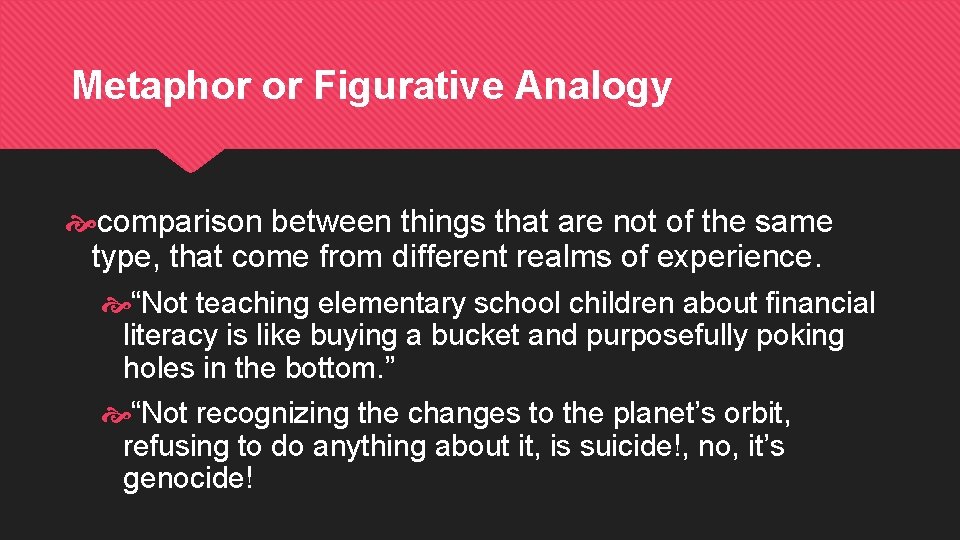
Metaphor or Figurative Analogy comparison between things that are not of the same type, that come from different realms of experience. “Not teaching elementary school children about financial literacy is like buying a bucket and purposefully poking holes in the bottom. ” “Not recognizing the changes to the planet’s orbit, refusing to do anything about it, is suicide!, no, it’s genocide!