
Theory Practice of Argument Week 02 Argument Types
- Slides: 17
Theory & Practice of Argument Week 02: Argument Types & Tools
I Know It Is Work, but We Need a System… � “We desire to approach arguments systematically. ” (Herrick, 2015, p. 30)
Our Democratic Project (1776 -present) �What are we asked to accept? And on what basis? �Some people choose to reason from moral principles, while others from practical consequences.
What Argumentation is NOT �Reports �Explanations �Unsubstantiated assertions
When We Expect Arguments � 1. an assertion seems to require reasoned support; � 2. In the context of controversy or disagreement; � 3. Many statements of personal opinion are accompanied by arguments; � 4. Inferences and predictions based on observations are also arguments.
Something to Remember: �A claim or assertion + reasons does not automatically = a good argument.
Deductive Arguments �Deductive arguments: arguments that lead to necessary conclusions when their reasons are true �Premises: what we call reasons in a deductive argument.
Deductive Arguments �Flow of a deductive argument: �“major premise” (general principles) then “minor premise” (more specific observation) then a conclusion that applies the major premise to a particular case. � Think of it as “Top down”
Inductive Arguments �Inductive arguments: arguments whose reasons lead to probable conclusions �Probable conclusion: a conclusion that can be shown to be more or less likely, but not necessary. �Typically moves from specific observations to a general conclusion
Inductive Arguments �Think of them as “bottom up” �Inductive arguments involve an inductive leap or a reasoning process in which the conclusion of an inductive argument moves beyond its stated evidence.
3 Tools You Can Use to Help Yourself Follow, Understand, and Check an Argument �Scanning �Standardizing �Diagramming
Scanning �identifying and marking the statements in an argument, as well as underlining indicators and cues. �[marking the cues helps reveal the statements]
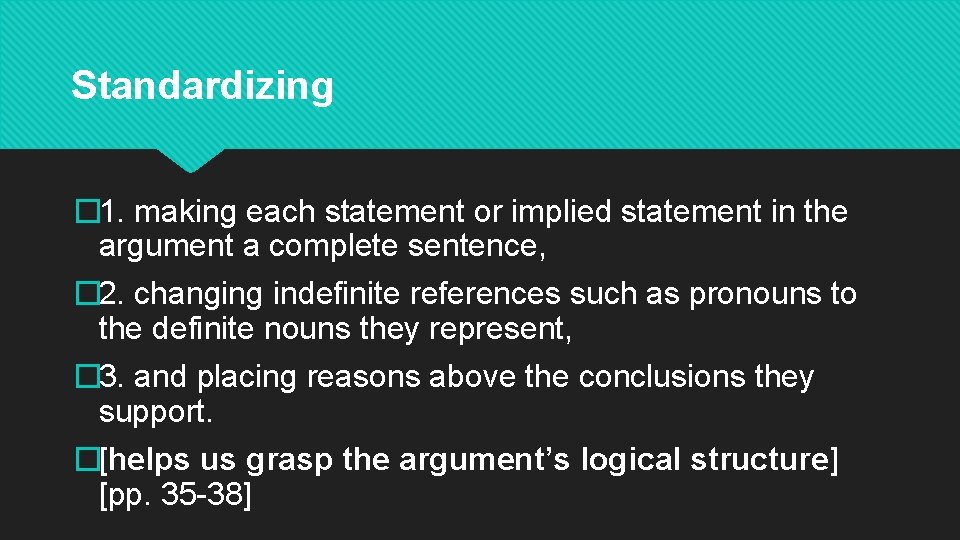
Standardizing � 1. making each statement or implied statement in the argument a complete sentence, � 2. changing indefinite references such as pronouns to the definite nouns they represent, � 3. and placing reasons above the conclusions they support. �[helps us grasp the argument’s logical structure] [pp. 35 -38]
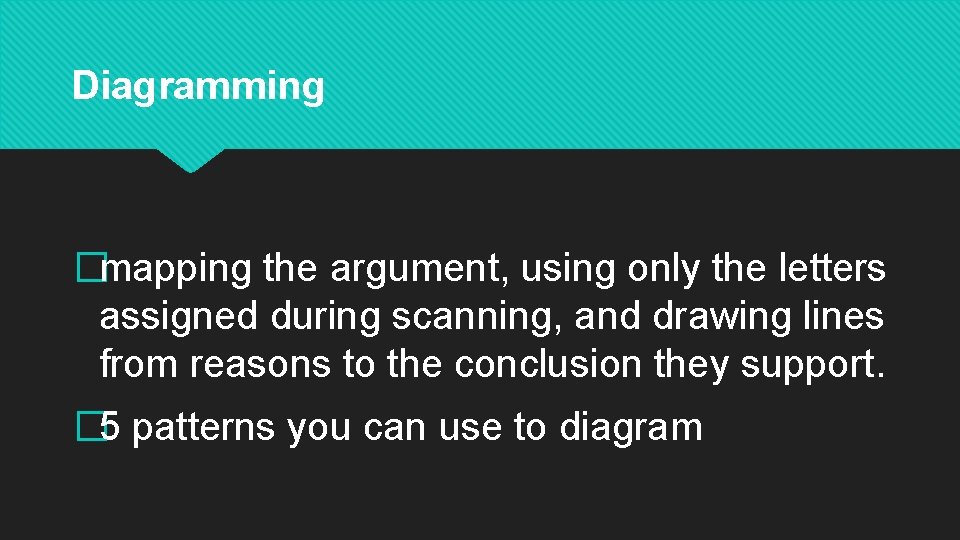
Diagramming �mapping the argument, using only the letters assigned during scanning, and drawing lines from reasons to the conclusion they support. � 5 patterns you can use to diagram
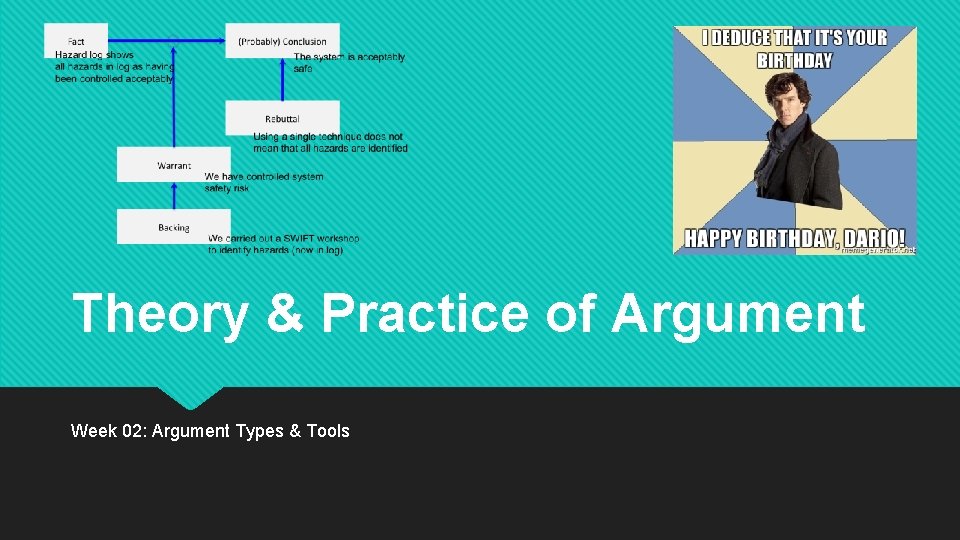
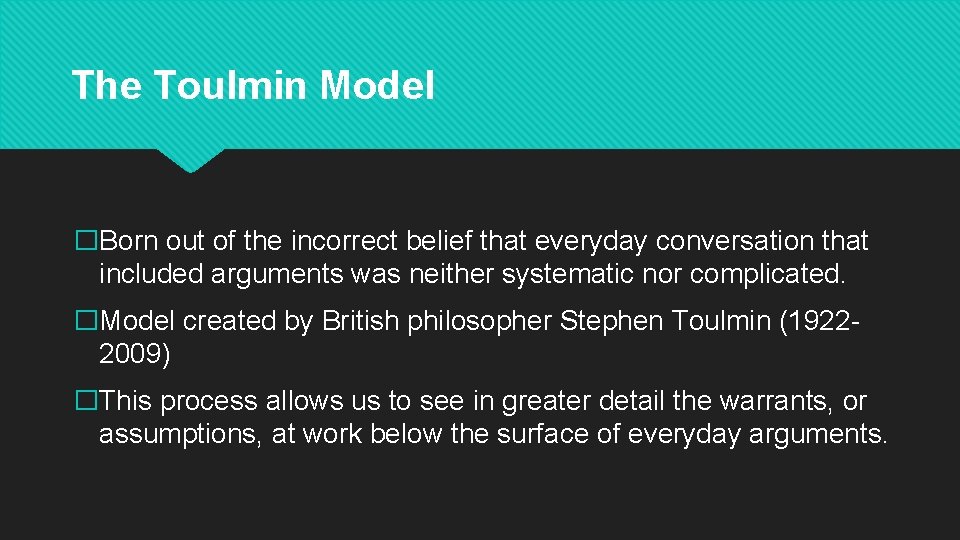
The Toulmin Model �Born out of the incorrect belief that everyday conversation that included arguments was neither systematic nor complicated. �Model created by British philosopher Stephen Toulmin (19222009) �This process allows us to see in greater detail the warrants, or assumptions, at work below the surface of everyday arguments.
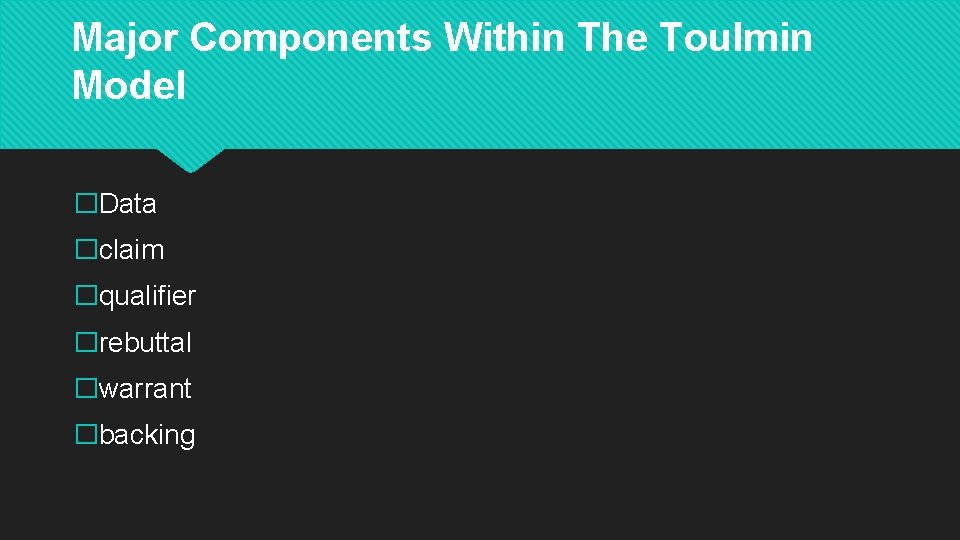
Major Components Within The Toulmin Model �Data �claim �qualifier �rebuttal �warrant �backing
Some Guidance for Adding Elements to Another’s Argument �Only add statements that seem to be part of the argument as the author intended. �Attempt to give the argument a strong reading �Avoid straw man arguments: you weaken or simplify someone’s argument so that it is easier to refute.