
Theory of Work Performance in Education Setting A
- Slides: 11
Theory of Work Performance in Education Setting: A Research Framework Sharul Effendy Janudin Universiti Pendidikan Sultan Idris, Malaysia sharul@fpe. upsi. edu. my Ruhanita Maelah Universiti Kebangsaan Malaysia, Malaysia ruhanita@ukm. my
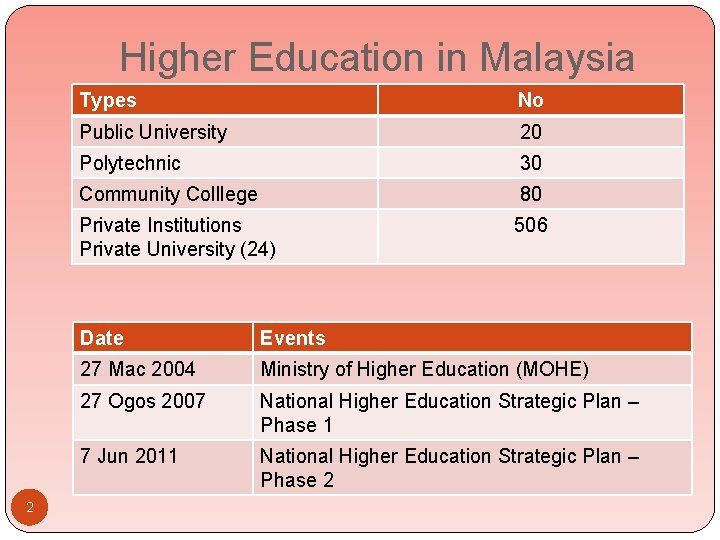
Higher Education in Malaysia 2 Types No Public University 20 Polytechnic 30 Community Colllege 80 Private Institutions Private University (24) 506 Date Events 27 Mac 2004 Ministry of Higher Education (MOHE) 27 Ogos 2007 National Higher Education Strategic Plan – Phase 1 7 Jun 2011 National Higher Education Strategic Plan – Phase 2
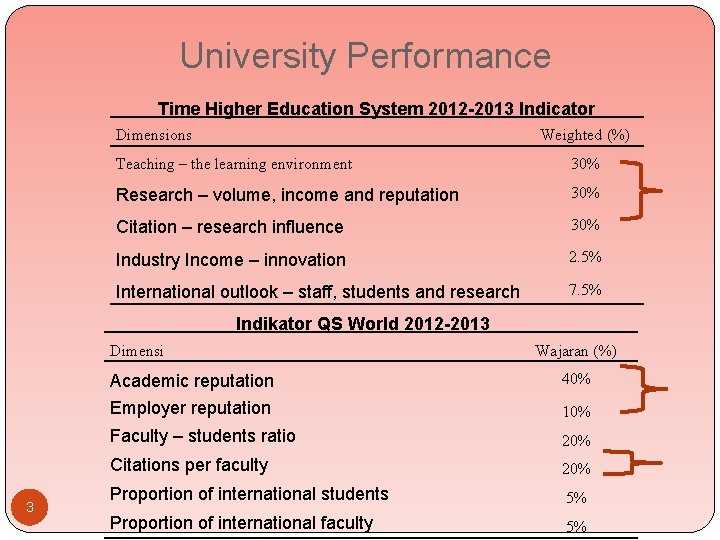
University Performance Time Higher Education System 2012 -2013 Indicator Dimensions Weighted (%) Teaching – the learning environment 30% Research – volume, income and reputation 30% Citation – research influence 30% Industry Income – innovation 2. 5% International outlook – staff, students and research 7. 5% Indikator QS World 2012 -2013 Dimensi 3 Wajaran (%) Academic reputation Employer reputation 40% Faculty – students ratio 20% Citations per faculty 20% Proportion of international students 5% Proportion of international faculty 5% 10%
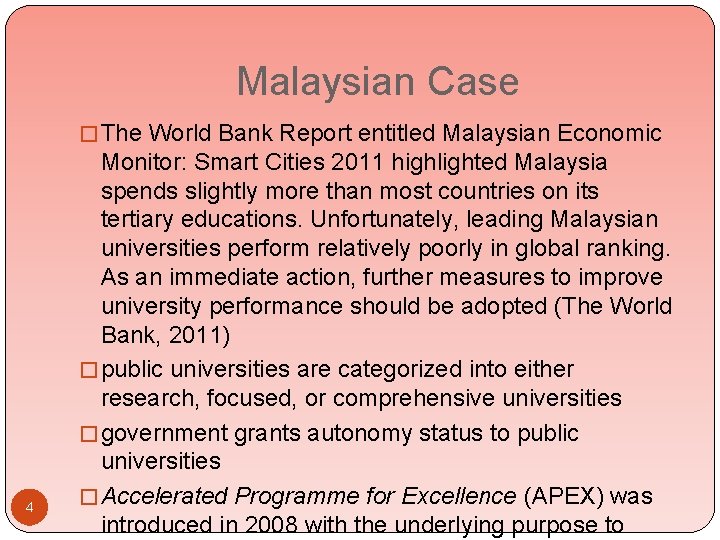
Malaysian Case � The World Bank Report entitled Malaysian Economic 4 Monitor: Smart Cities 2011 highlighted Malaysia spends slightly more than most countries on its tertiary educations. Unfortunately, leading Malaysian universities perform relatively poorly in global ranking. As an immediate action, further measures to improve university performance should be adopted (The World Bank, 2011) � public universities are categorized into either research, focused, or comprehensive universities � government grants autonomy status to public universities � Accelerated Programme for Excellence (APEX) was introduced in 2008 with the underlying purpose to
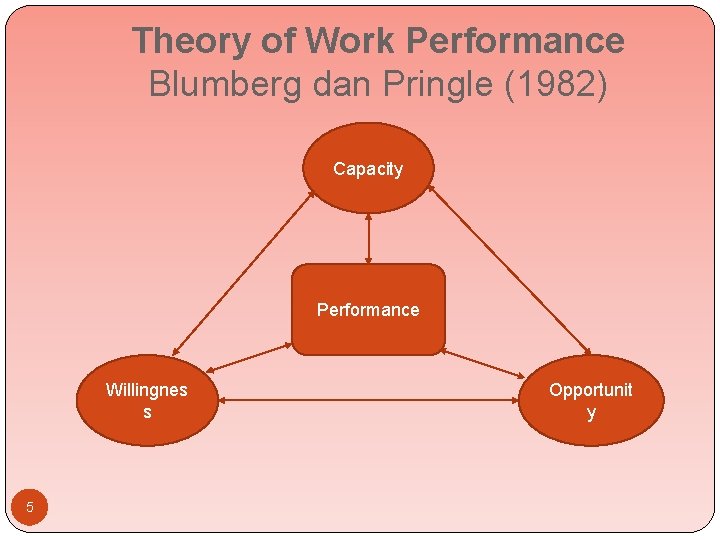
Theory of Work Performance Blumberg dan Pringle (1982) Capacity Performance Willingnes s 5 Opportunit y
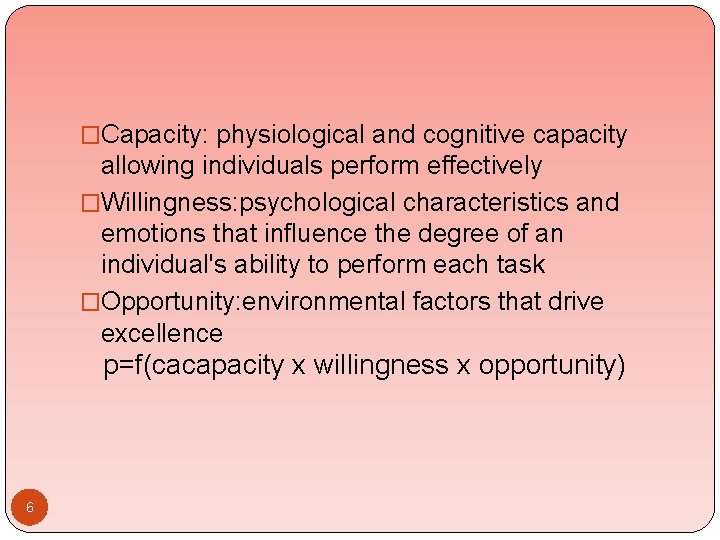
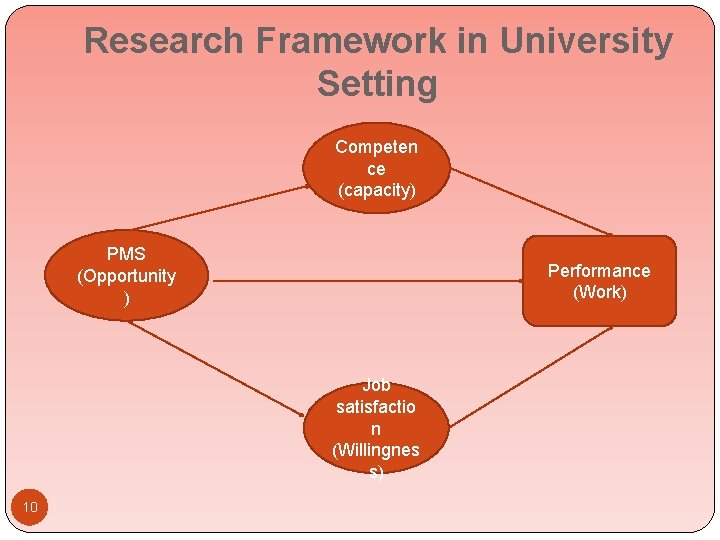
�Capacity: physiological and cognitive capacity allowing individuals perform effectively �Willingness: psychological characteristics and emotions that influence the degree of an individual's ability to perform each task �Opportunity: environmental factors that drive excellence p=f(cacapacity x willingness x opportunity) 6
Performance Measurement System, Job Satisfaction and Competency �There are studies with respect to allocation of 7 resources and the accounting system at the University level, but a study of the effect of resources, performance measurement and management of individual departments and staff at the University still in lacking (Bogt & Scapens, 2009) �There is the difficulty of measuring University performance as realized in the form of products and services based on (Zangoueinezhad & Moshabaki, 2011) �The most significant effect university corporatization is the basis of defining the university administration style, mission, shared
�Hall (2011) defines comprehensive PMS as the 8 ability of the system to supply enhanced performance information that links performance and individual role through providing a broad set of measures related to the importance of the organization, the integration of measures with strategy and valued organizational outcomes, and the integration of measures across functional boundaries and the value chain �Previous studies on PMS focus on a single dimension. This study fills the gap by examining PMS through three constructs, comprehensive (Hall, 2008; Chenhall, 2005); strategic (Burney & Widener, 2007; Gimbert, Bisbe, & Mendoza, 2010); and dynamic (Henri, 2010).
�Various studies have shown job satisfaction 9 influence work performance of academics but further study found there are several dimensions need to be improved such as salary and promotions (Chen, Yang, Shiau, & Wang, 2006), job enrichment (Rashid & Rashid, 2011) and the supervisory (Khalid, Zohaib Irshad, & Mahmood, 2011). In addition, the findings have shown different level of job satisfaction among academics; low (Machado et al. , 2011; Mangi et al. , 2011); and medium (Paul & Phua, 2011; Pop. Vasileva et al, 2011) �Nature of working as academic requires teaching competence, competency inquiry, social competence and personal competence (Shavaran
Research Framework in University Setting Competen ce (capacity) PMS (Opportunity ) Performance (Work) Job satisfactio n (Willingnes s) 10
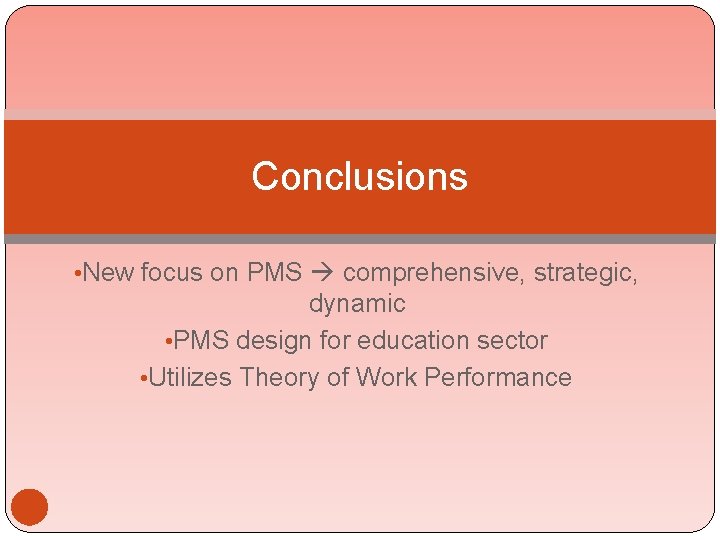
Conclusions • New focus on PMS comprehensive, strategic, dynamic • PMS design for education sector • Utilizes Theory of Work Performance