
Theory of the Firm Production Production Function Short

- Slides: 21
Theory of the Firm : Production
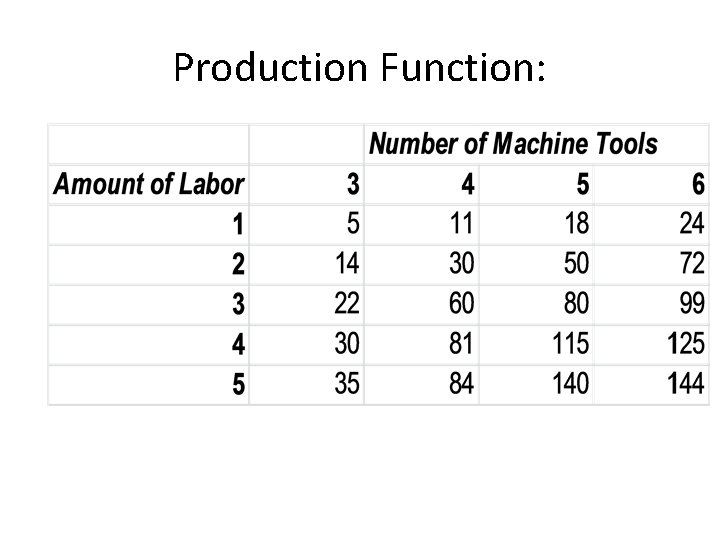
Production Function- Short Run • Production is the process of combining inputs to make goods and services. – Physical goods: cars, planes, bread, ice cream etc – Services: banking and investment services, services provided by lawyers, doctors etc. • Production function is a table, equation or graph showing the maximum amount of goods and services that can be achieved/ produced from using alternate combinations of inputs
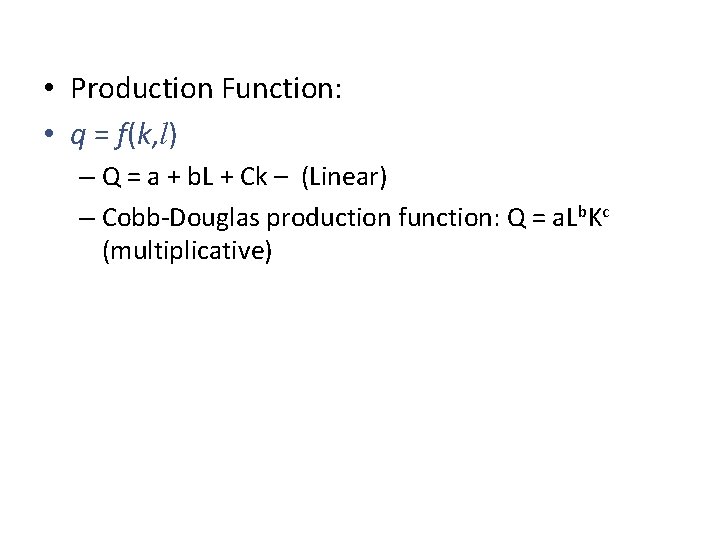
• Production Function: • q = f(k, l) – Q = a + b. L + Ck – (Linear) – Cobb-Douglas production function: Q = a. Lb. Kc (multiplicative)
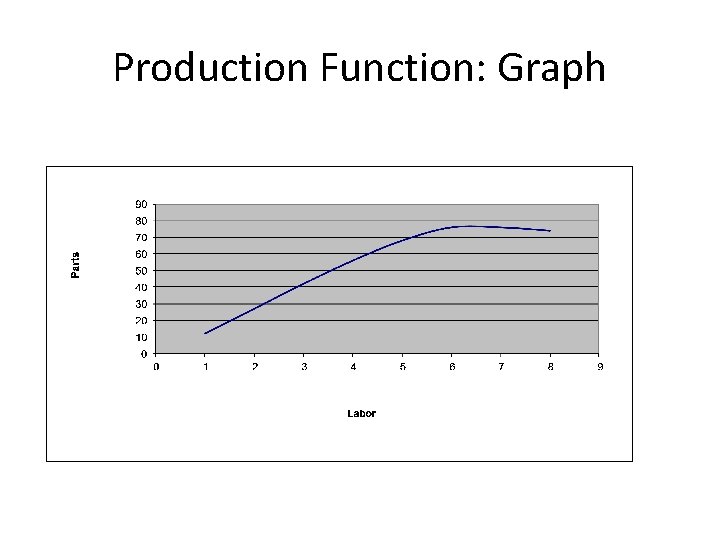
Production Function: Graph
Production Function:
• Inputs: These are the factors of production that are combined to produce the goods and services. • The main resources used in the production process include: Land; Labour; Capital and Entrepreneurship. • Technology: This refers to the methods the firm can use to turn inputs into outputs
Input Types • Variable Inputs: These refer to inputs that can be adjusted up or down as the quantity of output changes within a particular time span. • Eg: labour ( mostly unskilled); raw materials etc. • Fixed Inputs: These are inputs that cannot be adjusted easily over time as output level changes. • Eg: plant and equipment, land, services of management or the supply of skilled labour
Short run and Long run Decisions • Short-run Production: This is a time period during which at least one of the firm’s inputs is fixed. – Duration not the same for all industries – Eg. Power industry and food industry • Long-run Production: This is a time period long enough for a firm to change the quantity of all of its inputs. – Basic technology remains the same • Eg. How would Apple respond to an increase in the demand for Iphone 6 in the short run and in the long run?
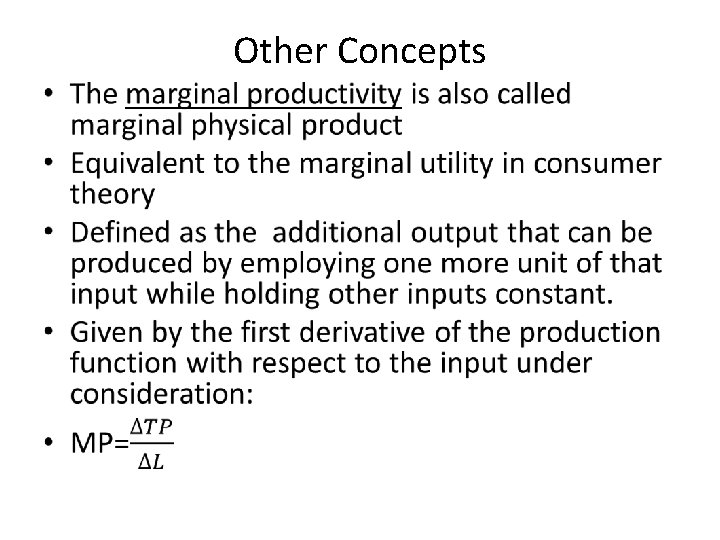
Other Concepts •
Other Concepts •
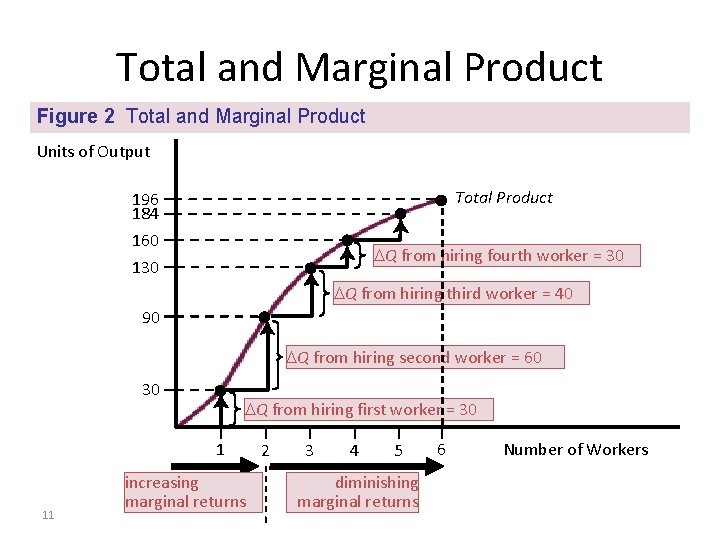
Total and Marginal Product Figure 2 Total and Marginal Product Units of Output Total Product 196 184 160 DQ from hiring fourth worker = 30 130 DQ from hiring third worker = 40 90 DQ from hiring second worker = 60 30 DQ from hiring first worker = 30 1 11 increasing marginal returns 2 3 4 5 diminishing marginal returns 6 Number of Workers
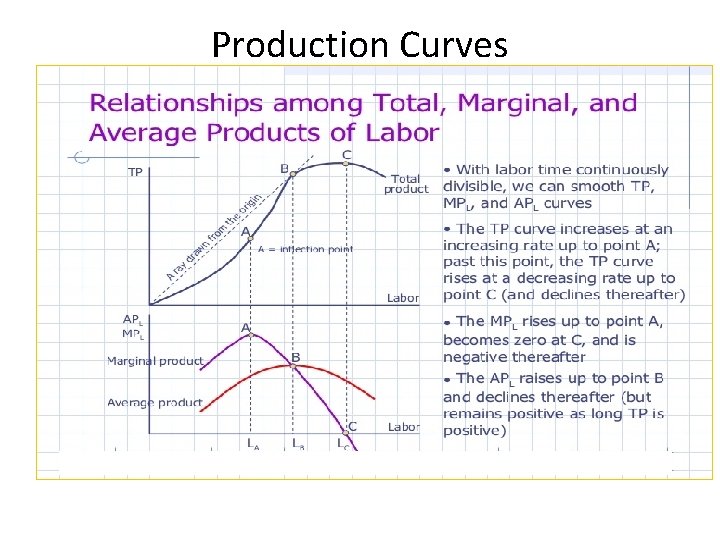
Marginal Returns to Labour • When the marginal product of labour rises as more workers are hired, there are increasing returns to labour. • This may be as a result of specialization of labour which makes each labour unit more efficient. • Diminishing Marginal Returns: This occurs when the marginal product of labour is decreasing as more workers are being hired. Total output still rises but the rise in output is smaller and smaller with each successive worker. • Gains from specialization may become harder and harder to achieve and each worker will have less and less of the fixed input to work.
The Law of Diminishing Returns • The law of diminishing returns states that if increasing quantities of a variable factor are applied to a given quantity of a fixed factor, the marginal product and the average product of the variable factor will eventually decrease. • Were it not for the law of returns there will be no need to fear that the world’s population explosion will cause a food crisis. True/ False? Discuss
• If the marginal product of additional workers applied to a fixed quantity of agricultural land were constant, the world food production could be expanded by increasing the proportion of workers on the land assuming technology does not change. • Unless there is continual and rapidly accelerating improvement in the techniques of production, the population explosion will cause food crises due to the principle of diminishing marginal returns.
Production Curves
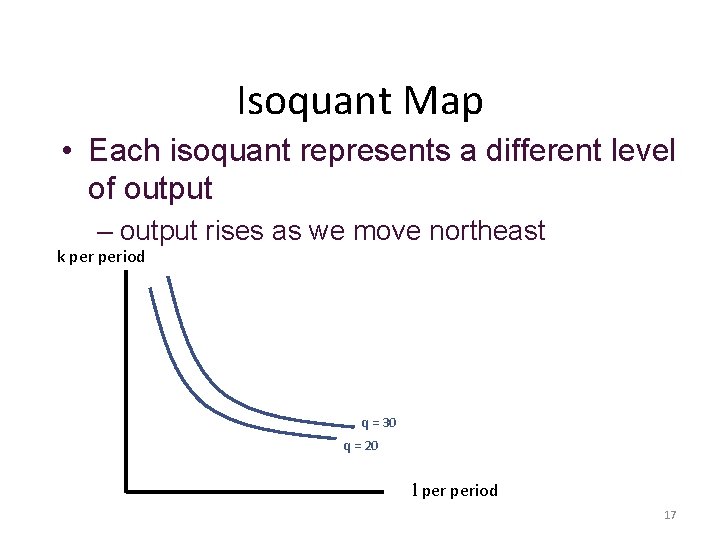
Isoquants and Isoquant Maps • An isoquant shows the combination of labour and capital that can produce a given level of output. Example: f(k, l) = q 0 • Every point on an isoquant represents an input mix that produces the same quantity of output. • An increase in one input requires the decrease in the other input to keep the total output unchanged. This is why the isoquant always slopes downwards. • Higher isoquants represent greater levels of output than lower isoquants.
Isoquant Map • Each isoquant represents a different level of output – output rises as we move northeast k period q = 30 q = 20 l period 17
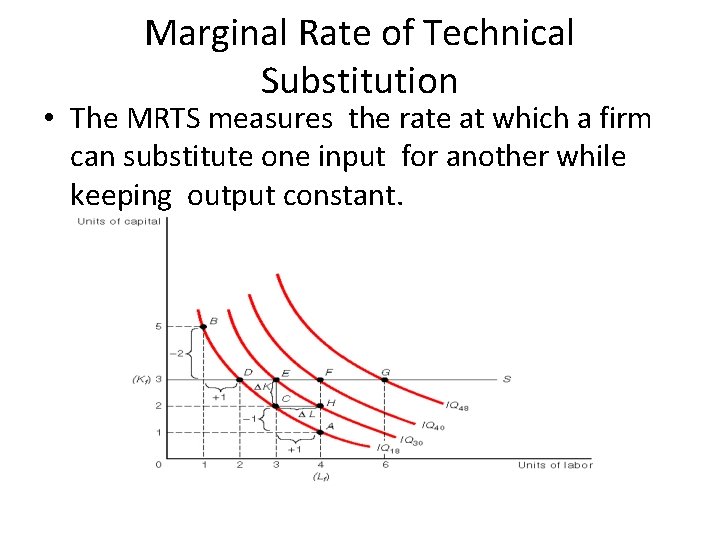
Marginal Rate of Technical Substitution • The MRTS measures the rate at which a firm can substitute one input for another while keeping output constant.
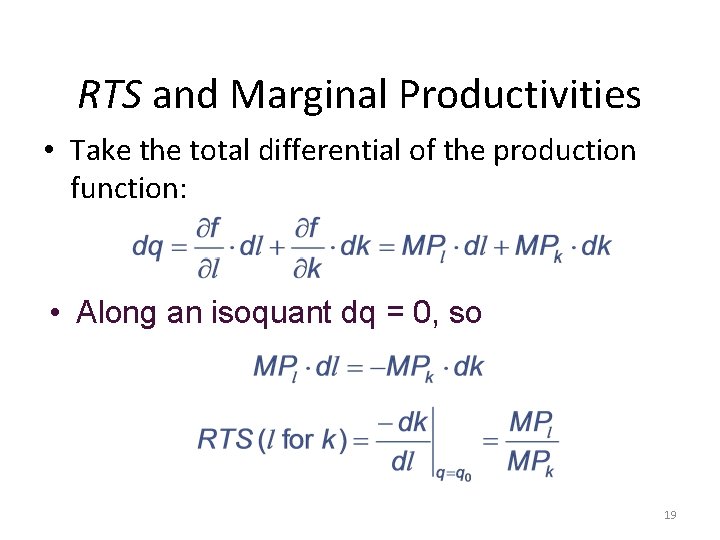
RTS and Marginal Productivities • Take the total differential of the production function: • Along an isoquant dq = 0, so 19
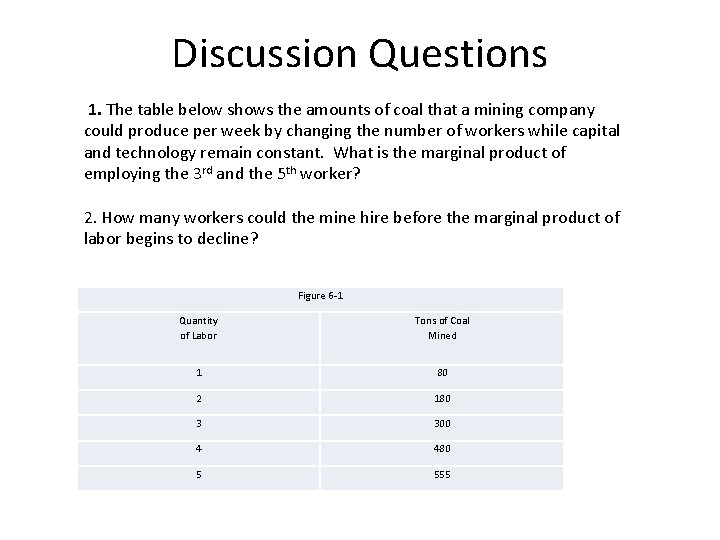
Discussion Questions 1. The table below shows the amounts of coal that a mining company could produce per week by changing the number of workers while capital and technology remain constant. What is the marginal product of employing the 3 rd and the 5 th worker? 2. How many workers could the mine hire before the marginal product of labor begins to decline? Figure 6 -1 Quantity of Labor Tons of Coal Mined 1 80 2 180 3 300 4 480 5 555
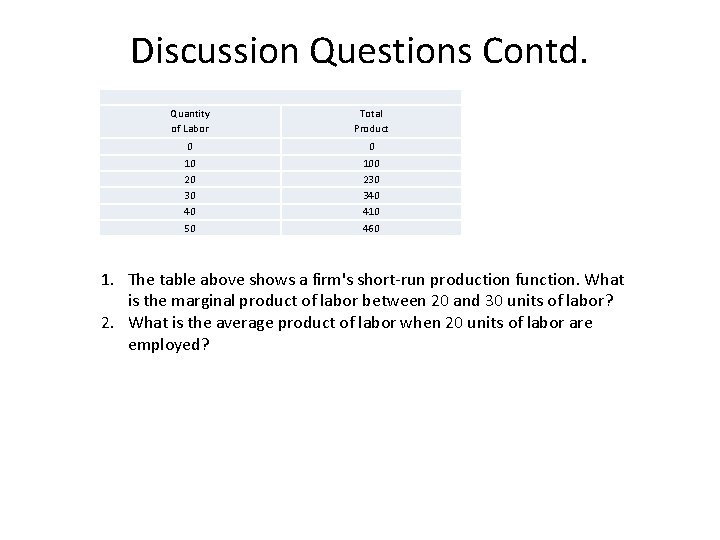
Discussion Questions Contd. Quantity of Labor Total Product 0 10 20 30 40 50 0 100 230 340 410 460 1. The table above shows a firm's short-run production function. What is the marginal product of labor between 20 and 30 units of labor? 2. What is the average product of labor when 20 units of labor are employed?