
Theory of Regulation Week 2 Historical development 1

- Slides: 17
Theory of Regulation Week 2
Historical development 1. 2. 3. 4. 5. Structure – Conduct - Performance paradigm Chicago School of Political Economy Virginia School of Public Choice Contestable market theory Rate of return
SCP paradigm • Normative theory of regulation: market fails => state interference needed • Concentrated market => suboptimal outcomes • State should attempt to lower the market concentration • Today presented by neoclassical microeconomic models – Gravelle, H. - Rees, R. : Microeconomics. Second Edition, London New. York, Longman 1992 Kreps, David M. : A Course in Microeconomic Theory. Princeton, Princeton University Press 1990. Chapters 11 +
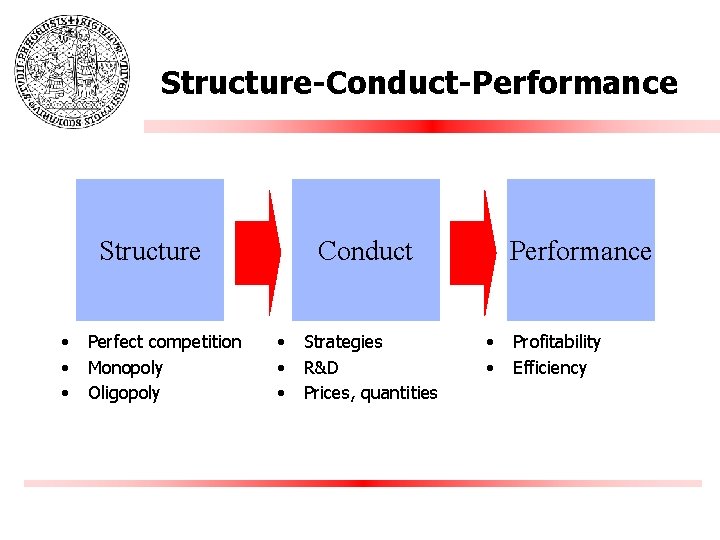
Structure-Conduct-Performance Structure • • • Perfect competition Monopoly Oligopoly Conduct • • • Strategies R&D Prices, quantities Performance • • Profitability Efficiency
Structure–Conduct–Performance (SCP) • Harvard School, 50 s. and 60 s • Exogenous market structure (oligopolies) determine market behavior (collusion) a it determines the performance (high profit) • Market structure : measured by concentration index • Performance: difference between MC and P • Policy implication: The concentrated market fails => scope for regulatory intervention of state
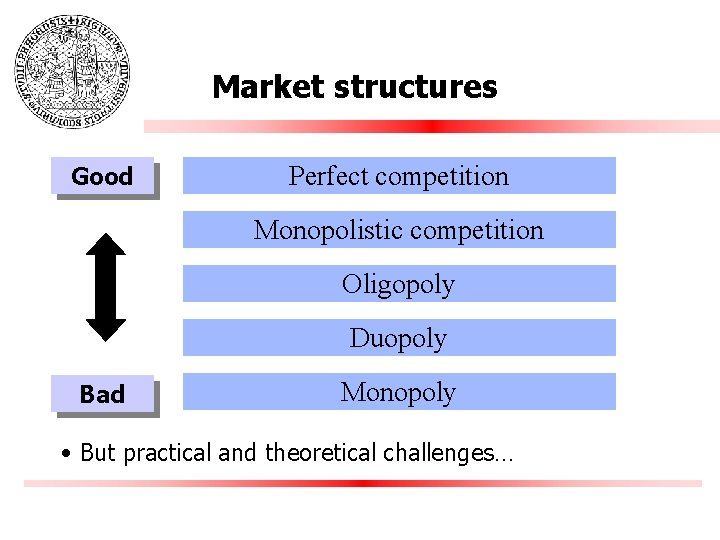
Market structures Good Perfect competition Monopolistic competition Oligopoly Duopoly Bad Monopoly • But practical and theoretical challenges…
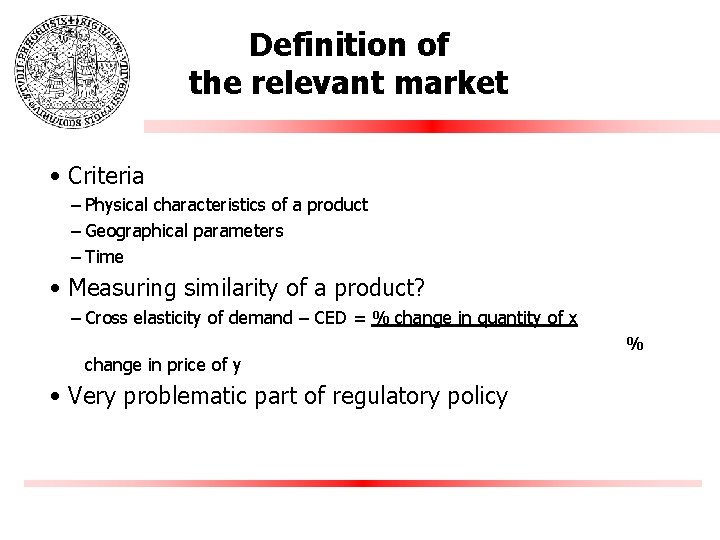
Definition of the relevant market • Criteria – Physical characteristics of a product – Geographical parameters – Time • Measuring similarity of a product? – Cross elasticity of demand – CED = % change in quantity of x change in price of y • Very problematic part of regulatory policy %
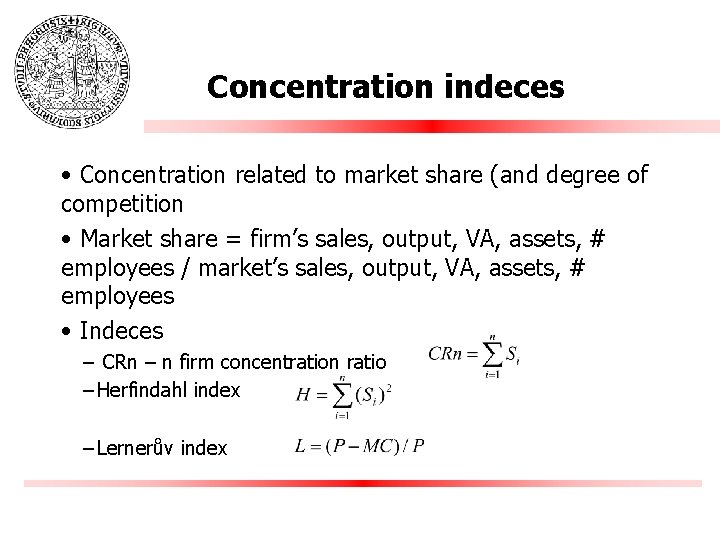
Concentration indeces • Concentration related to market share (and degree of competition • Market share = firm’s sales, output, VA, assets, # employees / market’s sales, output, VA, assets, # employees • Indeces – CRn – n firm concentration ratio – Herfindahl index – Lernerův index
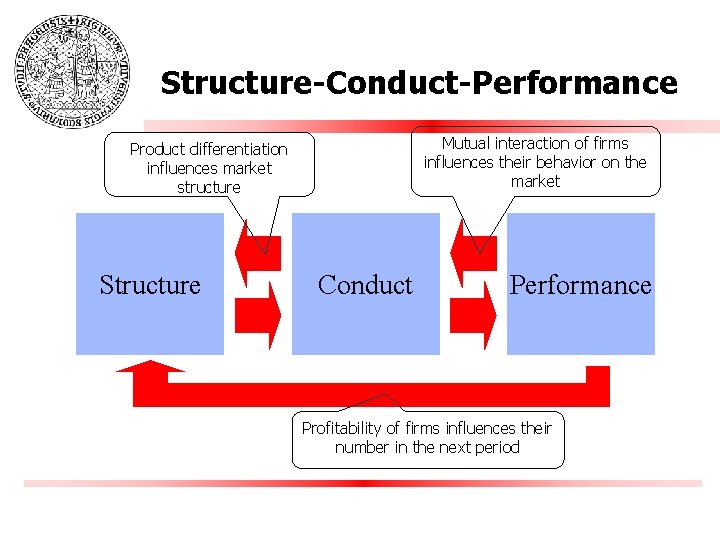
Structure-Conduct-Performance Mutual interaction of firms influences their behavior on the market Product differentiation influences market structure Structure Conduct Performance Profitability of firms influences their number in the next period
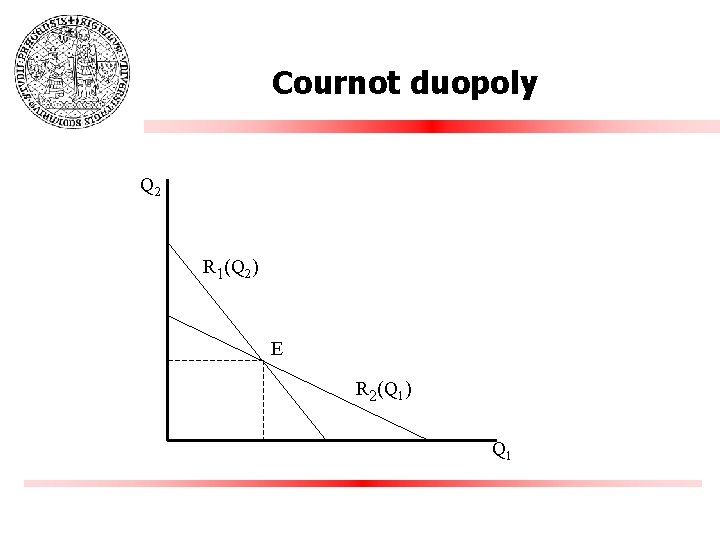
Cournot duopoly Q 2 R 1(Q 2) E R 2(Q 1) Q 1
Chicago School of Political Economy • Positive theory of regulation: costs determine structure, conduct determined by incentives • characteristics of the individual firm (rather than industry as a whole) are important • Literature – Stigler, G. J. : Chicago Studies in Political Economy, pp. 85 -105, The University of Chicago Press, Chicago and London 1988 – Becker, G. S. : A Theory Of Competition Among Pressure Groups For Political Influence – Peltzman, S. : Toward a More General Theory of Regulation – Stigler, G. J. : Theory of Economic Regulation
Virginia School of Public Choice • Theory of capture • Strong positive theory of regulation: the regulator has come into existence to serve interest of the captured • Weak positive theory of regulation: once regulation has come to existence (for whatever reason), it is captured by interest of the regulated • Rational choice models applied to regulators • Literature – Tollison, R. D. (1985) “Public Choice and Antirust. ” Cato Journal 4: 905– 16. – Buchanan‘s and Tullock‘s work
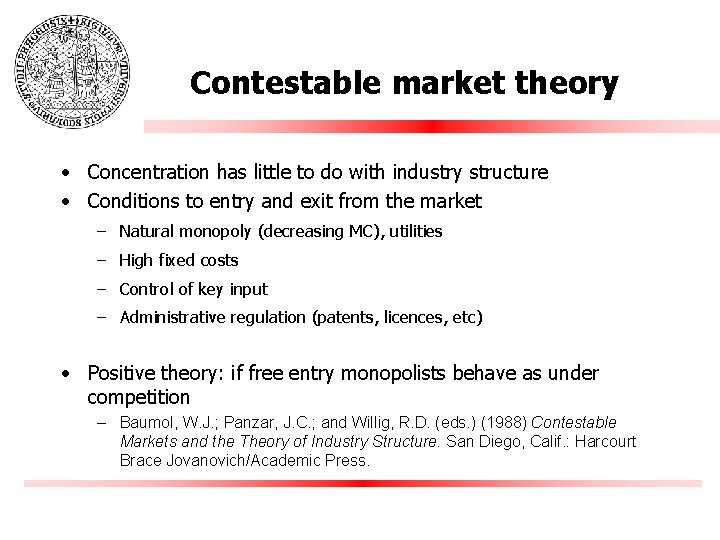
Contestable market theory • Concentration has little to do with industry structure • Conditions to entry and exit from the market – Natural monopoly (decreasing MC), utilities – High fixed costs – Control of key input – Administrative regulation (patents, licences, etc) • Positive theory: if free entry monopolists behave as under competition – Baumol, W. J. ; Panzar, J. C. ; and Willig, R. D. (eds. ) (1988) Contestable Markets and the Theory of Industry Structure. San Diego, Calif. : Harcourt Brace Jovanovich/Academic Press.
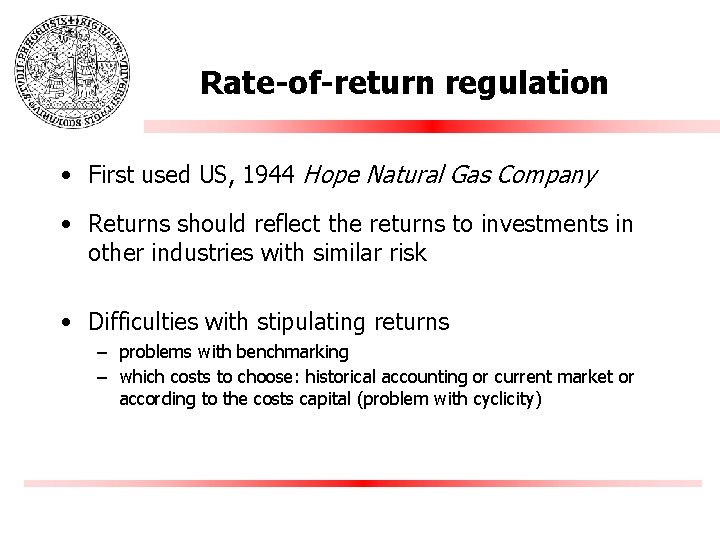
Rate-of-return regulation • First used US, 1944 Hope Natural Gas Company • Returns should reflect the returns to investments in other industries with similar risk • Difficulties with stipulating returns – problems with benchmarking – which costs to choose: historical accounting or current market or according to the costs capital (problem with cyclicity)
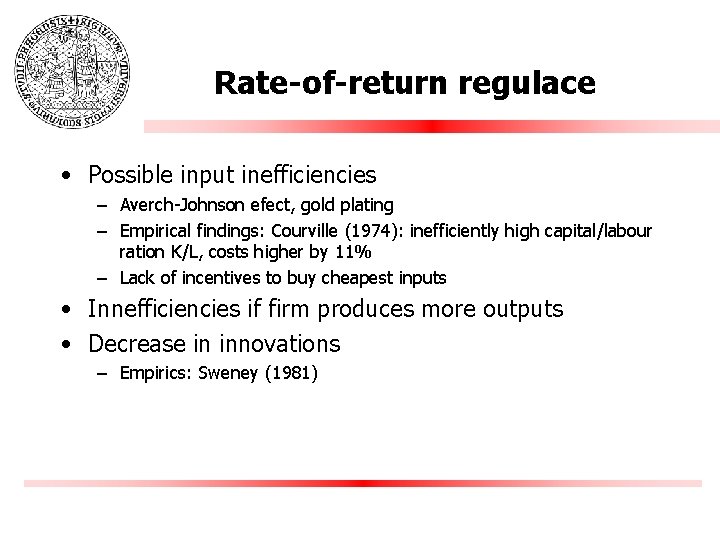
Rate-of-return regulace • Possible input inefficiencies – Averch-Johnson efect, gold plating – Empirical findings: Courville (1974): inefficiently high capital/labour ration K/L, costs higher by 11% – Lack of incentives to buy cheapest inputs • Innefficiencies if firm produces more outputs • Decrease in innovations – Empirics: Sweney (1981)
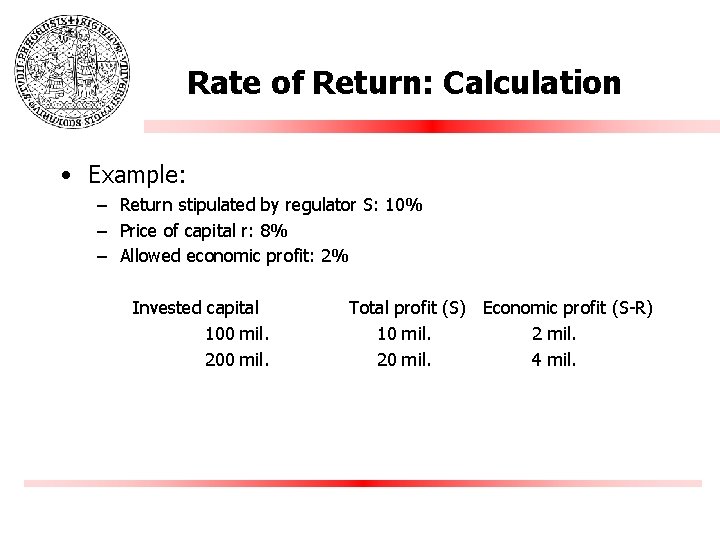
Rate of Return: Calculation • Example: – Return stipulated by regulator S: 10% – Price of capital r: 8% – Allowed economic profit: 2% Invested capital 100 mil. 200 mil. Total profit (S) Economic profit (S-R) 10 mil. 2 mil. 20 mil. 4 mil.
Literature • López, E. J. (2001): New Anti-merger theories: A Critique, Cato Journal, Vol. 20, Number 3 (Winter 2001) - in library