
THEORY OF PLANNED BEHAVIOR Health Belief Model Habit
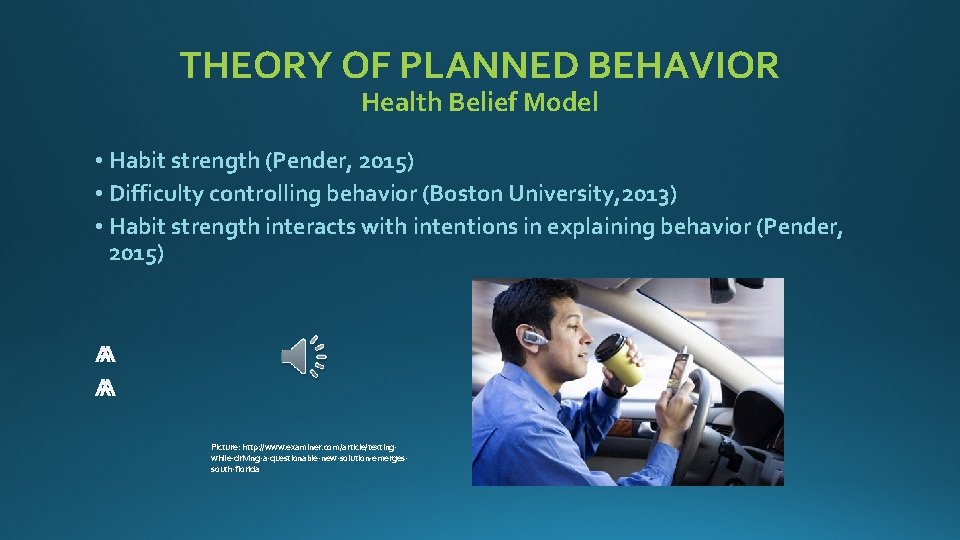
THEORY OF PLANNED BEHAVIOR Health Belief Model • Habit strength (Pender, 2015) • Difficulty controlling behavior (Boston University, 2013) • Habit strength interacts with intentions in explaining behavior (Pender, 2015) Picture: http: //www. examiner. com/article/textingwhile-driving-a-questionable-new-solution-emergessouth-florida
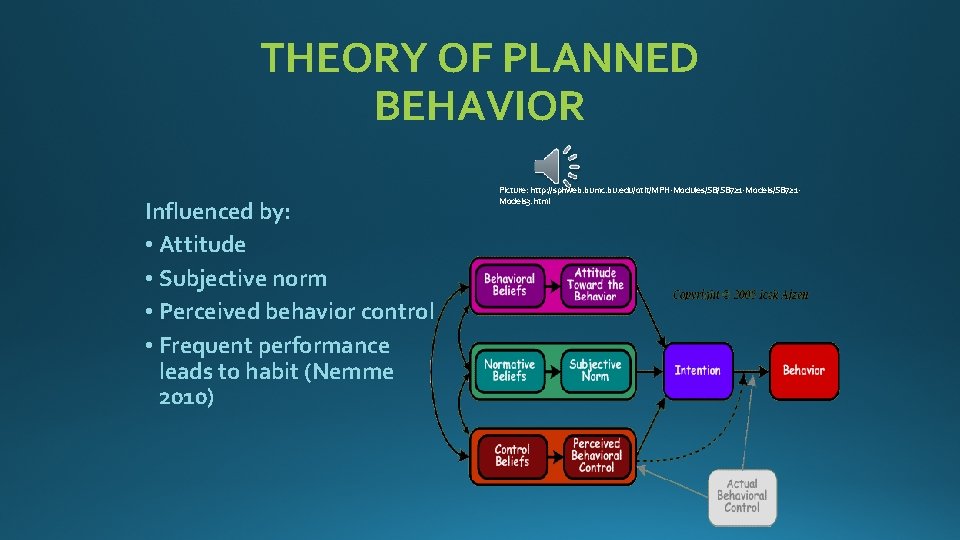
THEORY OF PLANNED BEHAVIOR Influenced by: • Attitude • Subjective norm • Perceived behavior control • Frequent performance leads to habit (Nemme 2010) Picture: http: //sphweb. bumc. bu. edu/otlt/MPH-Modules/SB/SB 721 -Models/SB 721 Models 3. html
HEALTHY PEOPLE 2020 • Injury & Violence Prevention Objective (Office of disease prevention and health (2015) • Reduce motor vehicle crash-related deaths • Reduce non-fatal motor vehicle crash related injuries • Our objectives: Educate on the risks of texting and driving (students and parents) Reduce the amount of teens texting while driving • Achieving objectives: pre and post survey responses
HALEY’S LITERATURE REVIEW • Distracted driving fatalities caused by texting and driving from 1999 -2008 • After 2005 distracted driving increased 28% • That in numbers is 4, 572 fatalities to 5, 870 fatalities • 16, 000 more additional road fatalities from 2001 -2007 are from texting and driving • Alliance of Automobile and The American Automobile Association join legislation bans supporting texting and driving (Wilson & Stimpson, 2010)
JESSI’S LITERATURE REVIEW • Texting slows the reaction time by 37. 4% • Using a smartphone while driving for social media, email or texting is more dangerous than drunk driving. • 24% of 17 -24 year olds admit to using smartphone while driving. • Young drivers are more willing to text than experienced drivers (Yannis et al. , 2014).
JENN’S LITERATURE REVIEW • Students who engage in texting and driving were more likely to engage in other dangerous behaviors, even though they recognize the behaviors as unsafe • Teens text and drive as often as adult drivers • Teens are not as experienced and may not have the skills necessary to handle driving hazards • Parents are the primary enforcers of the law and parental supervision may be the most effective strategy in prevention of texting and driving (Olsen et al. , 2013)
REFERENCES http: //www. healthypeople. gov/2020/topics-objectives/topic/injuryand-violence-prevention/objectives
- Slides: 7