
THEORY OF METAL MACHINING 1 2 3 4

- Slides: 47
THEORY OF METAL MACHINING 1. 2. 3. 4. 5. Overview of Machining Technology Theory of Chip Formation in Metal Machining Force Relationships and the Merchant Equation Power and Energy Relationships in Machining Cutting Temperature © 2013 John Wiley & Sons, Inc. M P Groover, Principles of Modern Manufacturing 5/e
Material Removal Processes § A family of shaping operations, the common feature of which is removal of material from a starting work part so the remaining part has the desired geometry § Machining – material removal by a sharp cutting tool, e. g. , turning, milling, drilling § Abrasive processes – material removal by hard, abrasive particles, e. g. , grinding § Nontraditional processes - various energy forms other than sharp cutting tool to remove material © 2013 John Wiley & Sons, Inc. M P Groover, Principles of Modern Manufacturing 5/e
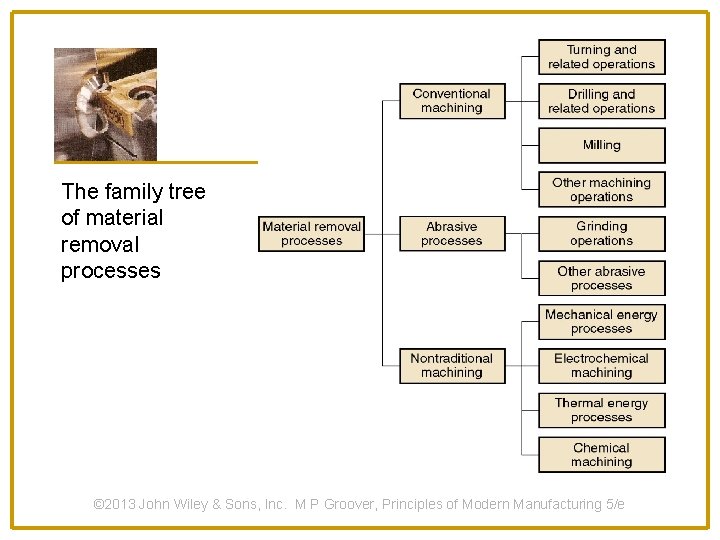
The family tree of material removal processes © 2013 John Wiley & Sons, Inc. M P Groover, Principles of Modern Manufacturing 5/e
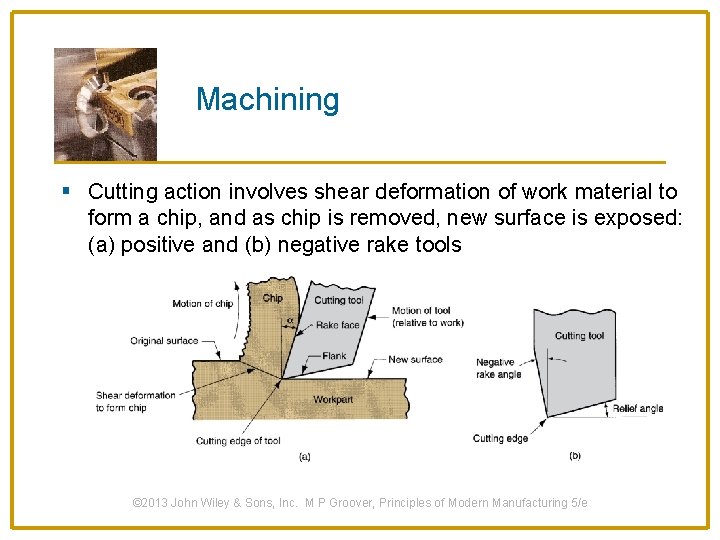
Machining § Cutting action involves shear deformation of work material to form a chip, and as chip is removed, new surface is exposed: (a) positive and (b) negative rake tools © 2013 John Wiley & Sons, Inc. M P Groover, Principles of Modern Manufacturing 5/e
Why Machining is Important § § § Variety of work materials can be machined § Most frequently used to cut metals Variety of part shapes and special geometric features possible: § Screw threads § Accurate round holes § Very straight edges and surfaces Good dimensional accuracy and surface finish © 2013 John Wiley & Sons, Inc. M P Groover, Principles of Modern Manufacturing 5/e
Disadvantages of Machining § Wasteful of material § Chips generated in machining are wasted material § At least in the unit operation § Time consuming § A machining operation generally takes longer to shape a given part than alternative shaping processes © 2013 John Wiley & Sons, Inc. M P Groover, Principles of Modern Manufacturing 5/e
Machining in the Manufacturing Sequence § Generally performed after other basic manufacturing processes, such as casting, forging, and bar drawing § Other processes create the general shape of the starting work part § Machining provides the final shape, dimensions, finish, and special geometric details that other processes cannot create © 2013 John Wiley & Sons, Inc. M P Groover, Principles of Modern Manufacturing 5/e
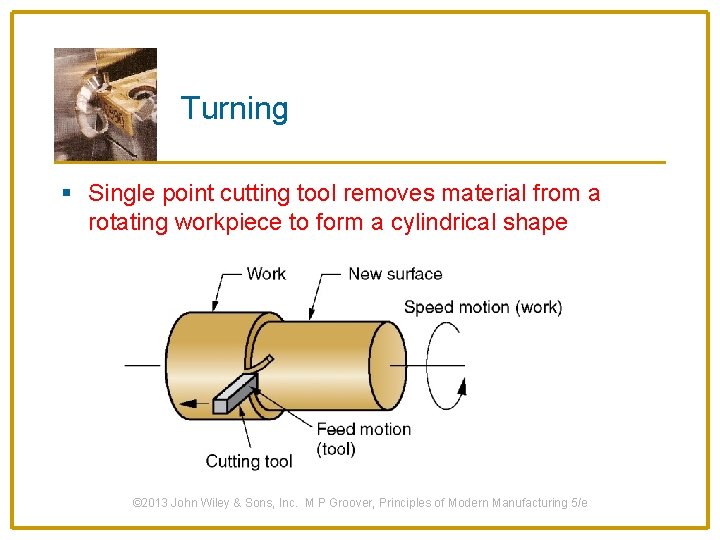
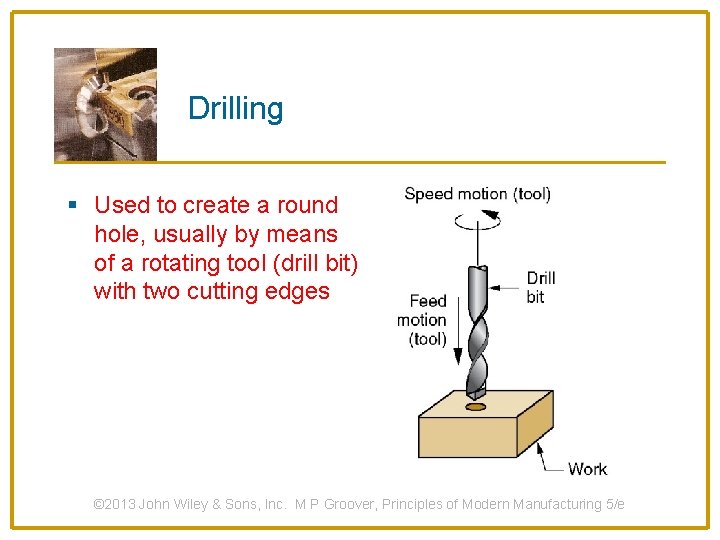
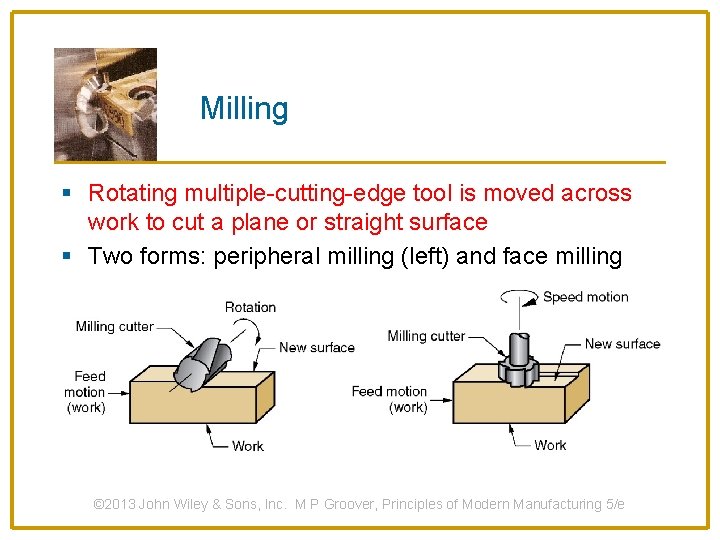
Machining Operations § Most important machining operations: § Turning § Drilling § Milling § Other machining operations: § Shaping and planing § Broaching § Sawing © 2013 John Wiley & Sons, Inc. M P Groover, Principles of Modern Manufacturing 5/e
Turning § Single point cutting tool removes material from a rotating workpiece to form a cylindrical shape © 2013 John Wiley & Sons, Inc. M P Groover, Principles of Modern Manufacturing 5/e
Drilling § Used to create a round hole, usually by means of a rotating tool (drill bit) with two cutting edges © 2013 John Wiley & Sons, Inc. M P Groover, Principles of Modern Manufacturing 5/e
Milling § Rotating multiple-cutting-edge tool is moved across work to cut a plane or straight surface § Two forms: peripheral milling (left) and face milling © 2013 John Wiley & Sons, Inc. M P Groover, Principles of Modern Manufacturing 5/e
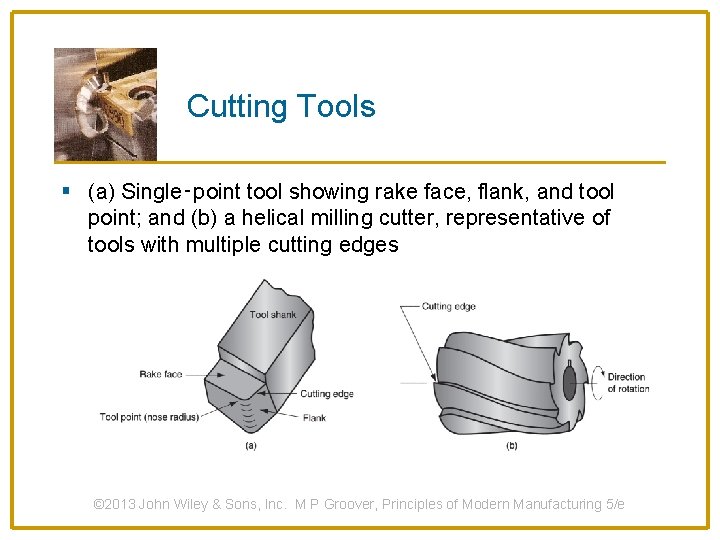
Cutting Tool Classification 1. Single-Point Tools § One dominant cutting edge § Point is usually rounded to form a nose radius § Turning uses single point tools 2. Multiple Cutting Edge Tools § More than one cutting edge § Motion relative to work achieved by rotating § Drilling and milling use rotating multiple cutting edge tools © 2013 John Wiley & Sons, Inc. M P Groover, Principles of Modern Manufacturing 5/e
Cutting Tools § (a) Single‑point tool showing rake face, flank, and tool point; and (b) a helical milling cutter, representative of tools with multiple cutting edges © 2013 John Wiley & Sons, Inc. M P Groover, Principles of Modern Manufacturing 5/e
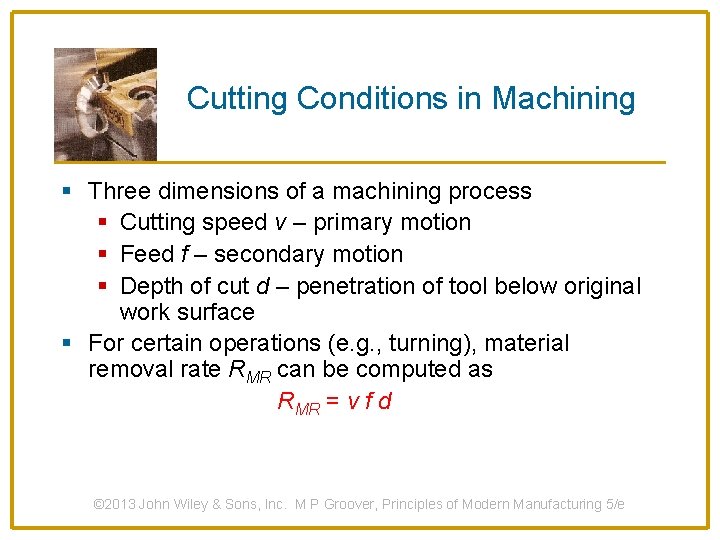
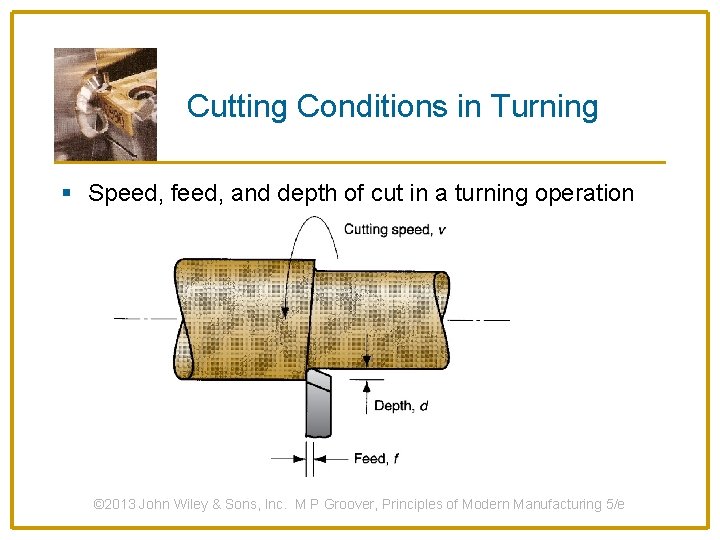
Cutting Conditions in Machining § Three dimensions of a machining process § Cutting speed v – primary motion § Feed f – secondary motion § Depth of cut d – penetration of tool below original work surface § For certain operations (e. g. , turning), material removal rate RMR can be computed as RMR = v f d © 2013 John Wiley & Sons, Inc. M P Groover, Principles of Modern Manufacturing 5/e
Cutting Conditions in Turning § Speed, feed, and depth of cut in a turning operation © 2013 John Wiley & Sons, Inc. M P Groover, Principles of Modern Manufacturing 5/e
Roughing vs. Finishing Cuts § In production, several roughing cuts are usually taken on a part, followed by one or two finishing cuts § Roughing - removes large amounts of material from starting work part § Some material remains for finish cutting § High feeds and depths, low speeds § Finishing - completes part geometry § Final dimensions, tolerances, and finish § Low feeds and depths, high cutting speeds © 2013 John Wiley & Sons, Inc. M P Groover, Principles of Modern Manufacturing 5/e
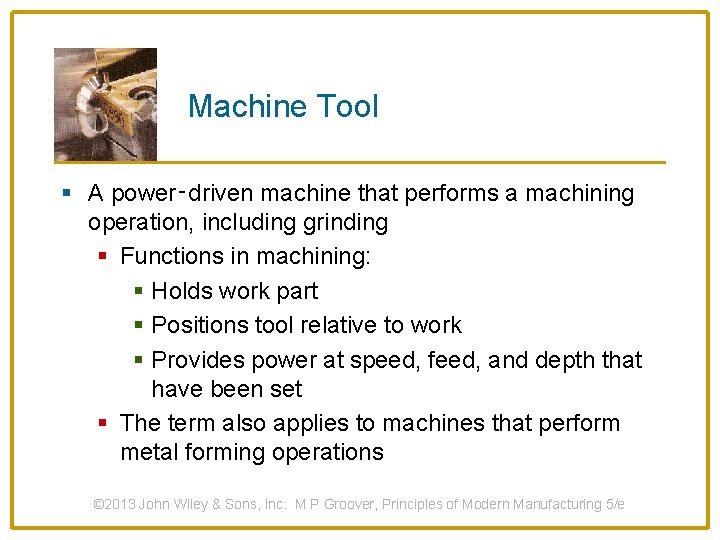
Machine Tool § A power‑driven machine that performs a machining operation, including grinding § Functions in machining: § Holds work part § Positions tool relative to work § Provides power at speed, feed, and depth that have been set § The term also applies to machines that perform metal forming operations © 2013 John Wiley & Sons, Inc. M P Groover, Principles of Modern Manufacturing 5/e
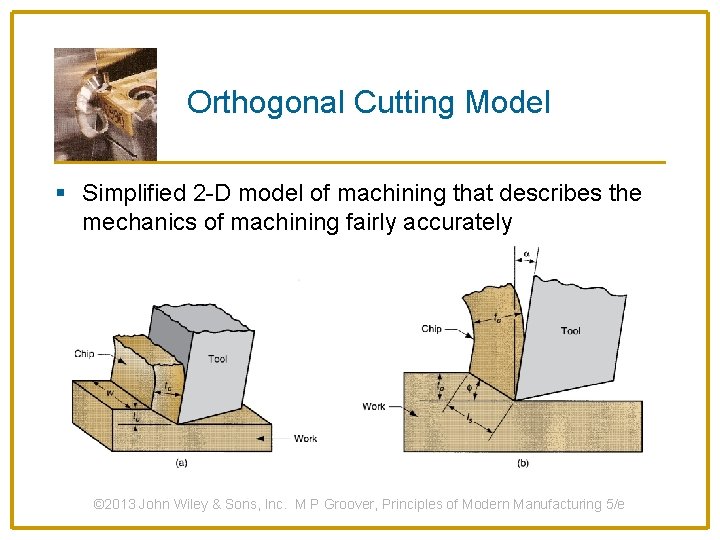
Orthogonal Cutting Model § Simplified 2 -D model of machining that describes the mechanics of machining fairly accurately © 2013 John Wiley & Sons, Inc. M P Groover, Principles of Modern Manufacturing 5/e
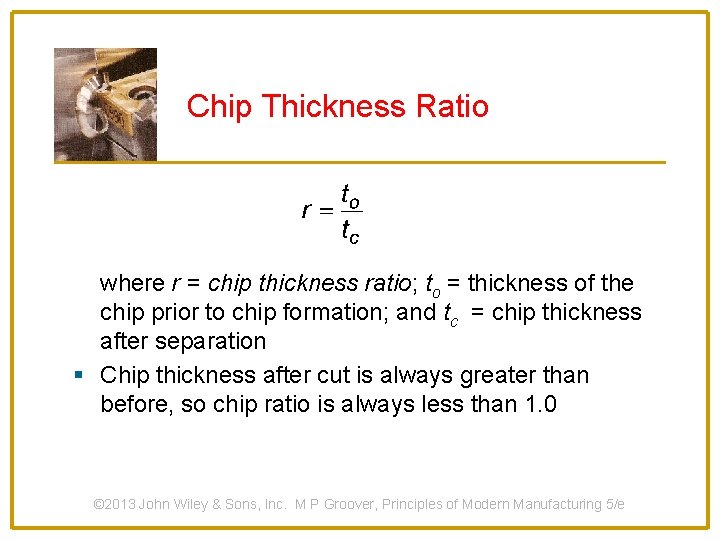
Chip Thickness Ratio where r = chip thickness ratio; to = thickness of the chip prior to chip formation; and tc = chip thickness after separation § Chip thickness after cut is always greater than before, so chip ratio is always less than 1. 0 © 2013 John Wiley & Sons, Inc. M P Groover, Principles of Modern Manufacturing 5/e
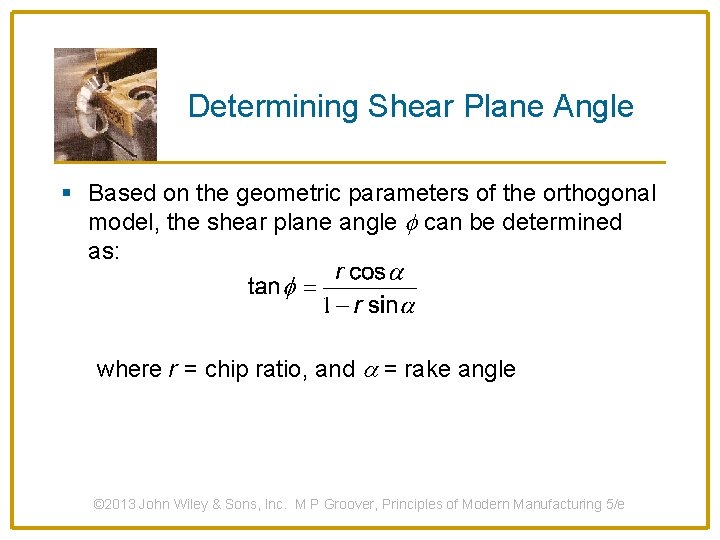
Determining Shear Plane Angle § Based on the geometric parameters of the orthogonal model, the shear plane angle can be determined as: where r = chip ratio, and = rake angle © 2013 John Wiley & Sons, Inc. M P Groover, Principles of Modern Manufacturing 5/e
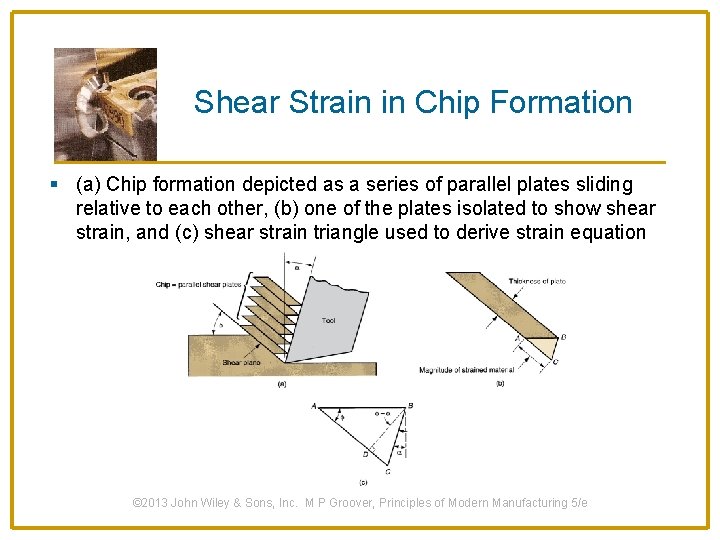
Shear Strain in Chip Formation § (a) Chip formation depicted as a series of parallel plates sliding relative to each other, (b) one of the plates isolated to show shear strain, and (c) shear strain triangle used to derive strain equation © 2013 John Wiley & Sons, Inc. M P Groover, Principles of Modern Manufacturing 5/e
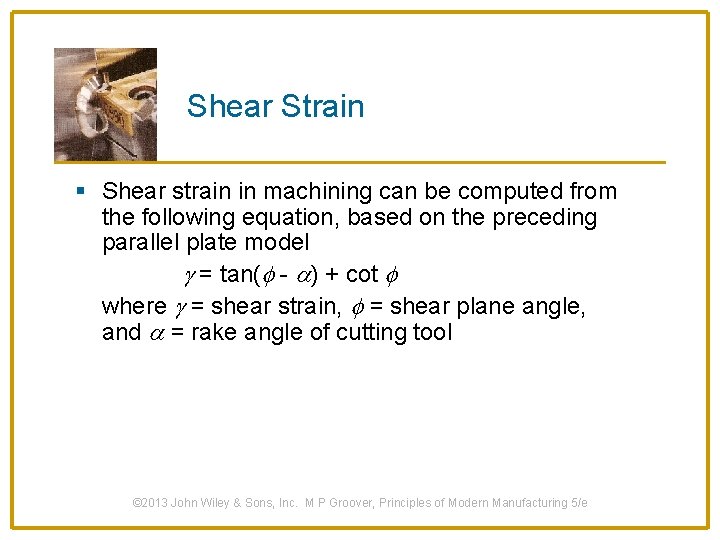
Shear Strain § Shear strain in machining can be computed from the following equation, based on the preceding parallel plate model = tan( - ) + cot where = shear strain, = shear plane angle, and = rake angle of cutting tool © 2013 John Wiley & Sons, Inc. M P Groover, Principles of Modern Manufacturing 5/e
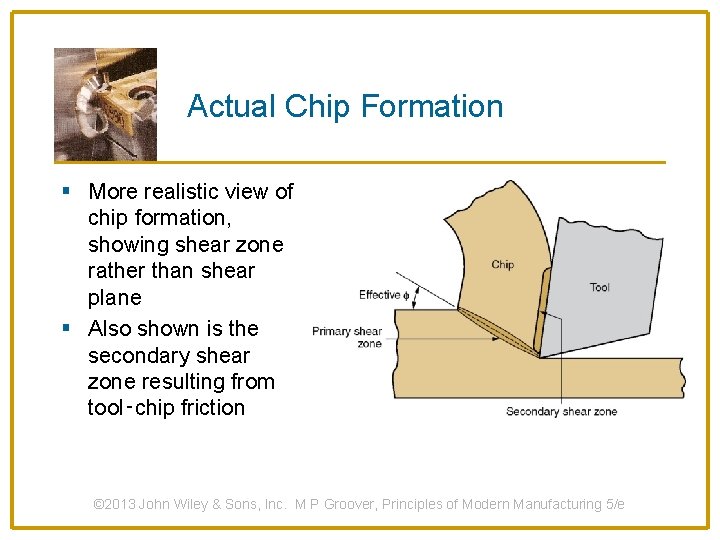
Actual Chip Formation § More realistic view of chip formation, showing shear zone rather than shear plane § Also shown is the secondary shear zone resulting from tool‑chip friction © 2013 John Wiley & Sons, Inc. M P Groover, Principles of Modern Manufacturing 5/e
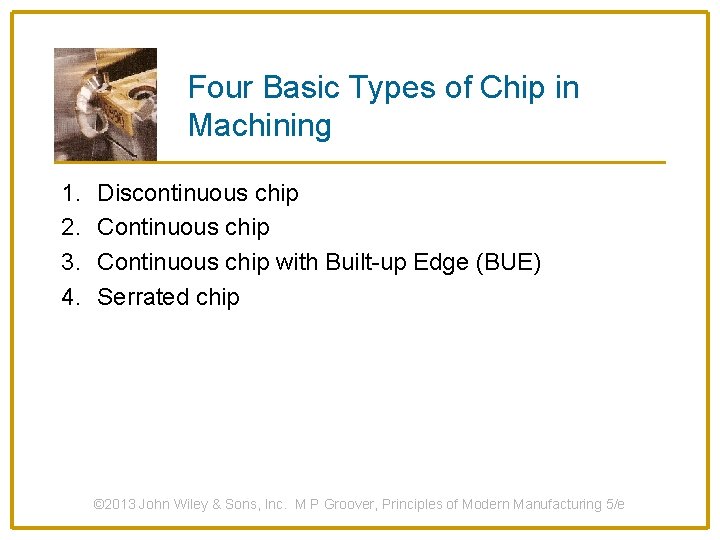
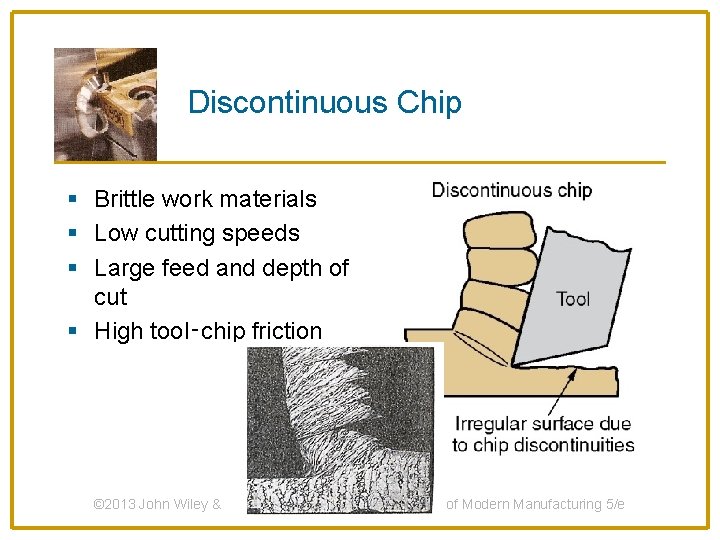
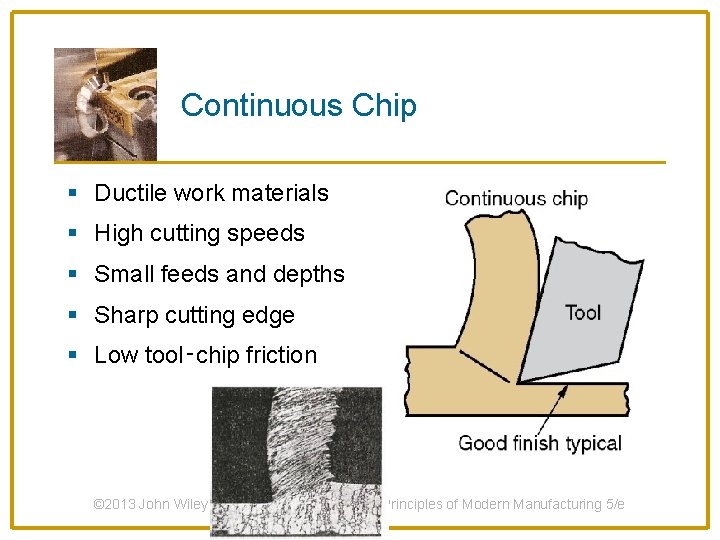
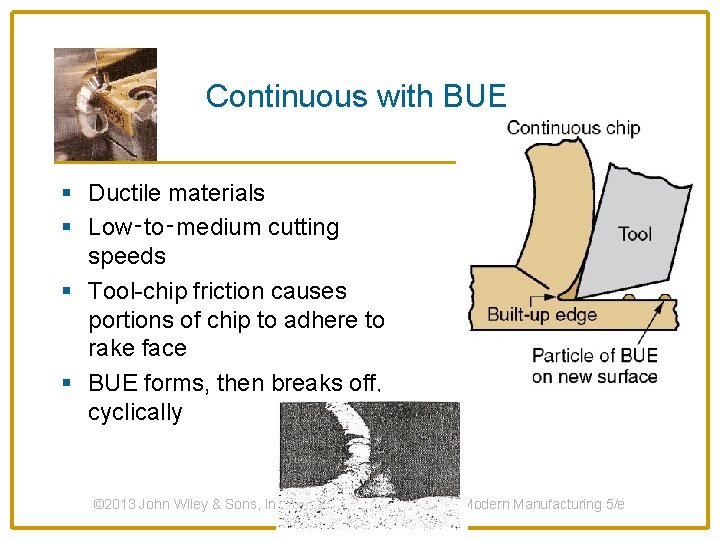
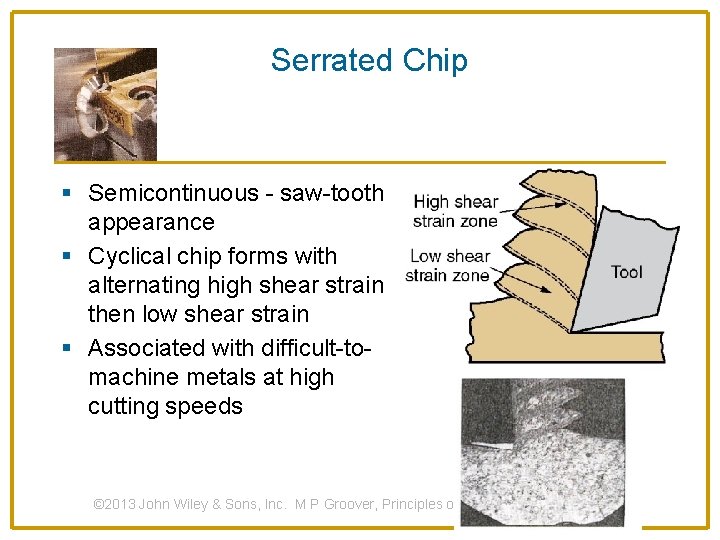
Four Basic Types of Chip in Machining 1. 2. 3. 4. Discontinuous chip Continuous chip with Built-up Edge (BUE) Serrated chip © 2013 John Wiley & Sons, Inc. M P Groover, Principles of Modern Manufacturing 5/e
Discontinuous Chip § Brittle work materials § Low cutting speeds § Large feed and depth of cut § High tool‑chip friction © 2013 John Wiley & Sons, Inc. M P Groover, Principles of Modern Manufacturing 5/e
Continuous Chip § Ductile work materials § High cutting speeds § Small feeds and depths § Sharp cutting edge § Low tool‑chip friction © 2013 John Wiley & Sons, Inc. M P Groover, Principles of Modern Manufacturing 5/e
Continuous with BUE § Ductile materials § Low‑to‑medium cutting speeds § Tool-chip friction causes portions of chip to adhere to rake face § BUE forms, then breaks off, cyclically © 2013 John Wiley & Sons, Inc. M P Groover, Principles of Modern Manufacturing 5/e
Serrated Chip § Semicontinuous - saw-tooth appearance § Cyclical chip forms with alternating high shear strain then low shear strain § Associated with difficult-tomachine metals at high cutting speeds © 2013 John Wiley & Sons, Inc. M P Groover, Principles of Modern Manufacturing 5/e
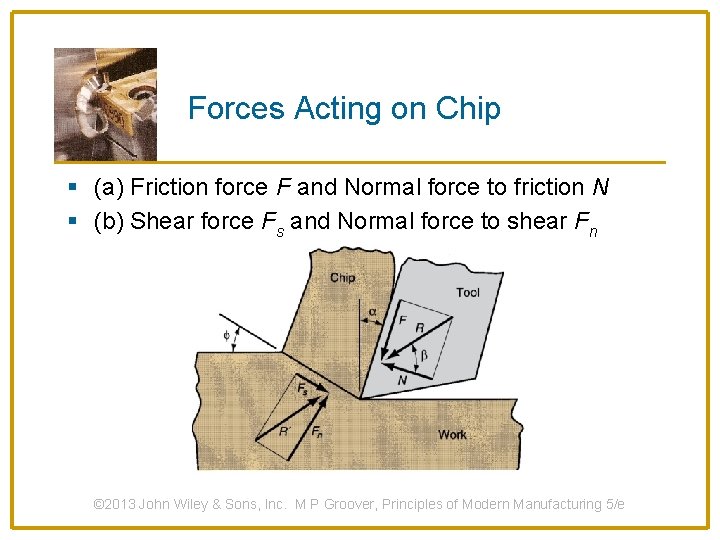
Forces Acting on Chip § (a) Friction force F and Normal force to friction N § (b) Shear force Fs and Normal force to shear Fn © 2013 John Wiley & Sons, Inc. M P Groover, Principles of Modern Manufacturing 5/e
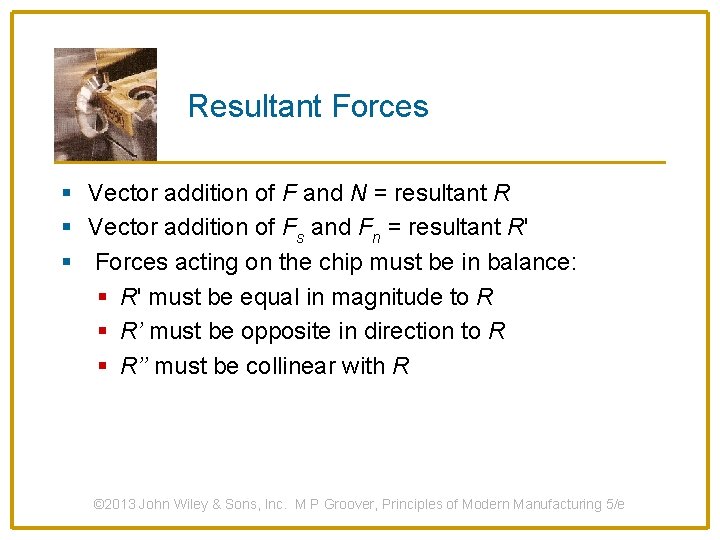
Resultant Forces § Vector addition of F and N = resultant R § Vector addition of Fs and Fn = resultant R' § Forces acting on the chip must be in balance: § R' must be equal in magnitude to R § R’ must be opposite in direction to R § R’’ must be collinear with R © 2013 John Wiley & Sons, Inc. M P Groover, Principles of Modern Manufacturing 5/e
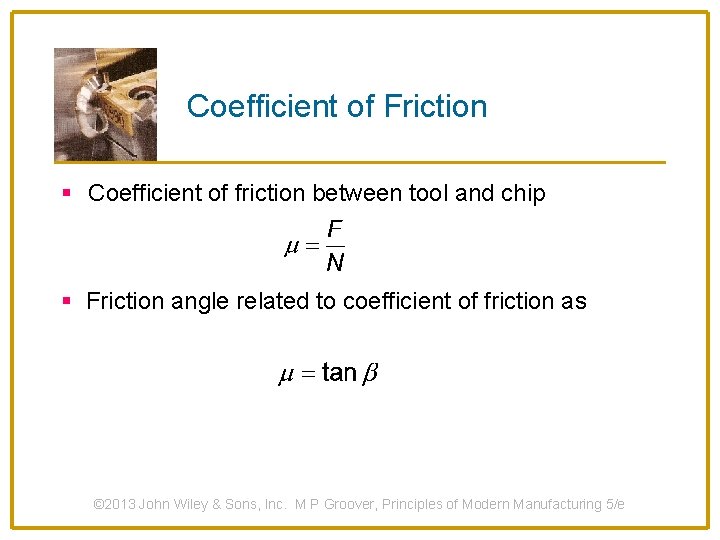
Coefficient of Friction § Coefficient of friction between tool and chip § Friction angle related to coefficient of friction as © 2013 John Wiley & Sons, Inc. M P Groover, Principles of Modern Manufacturing 5/e
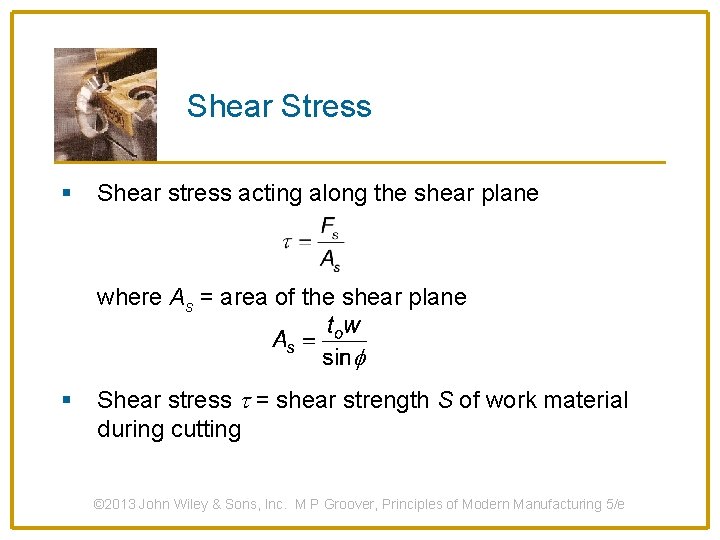
Shear Stress § Shear stress acting along the shear plane where As = area of the shear plane § Shear stress = shear strength S of work material during cutting © 2013 John Wiley & Sons, Inc. M P Groover, Principles of Modern Manufacturing 5/e
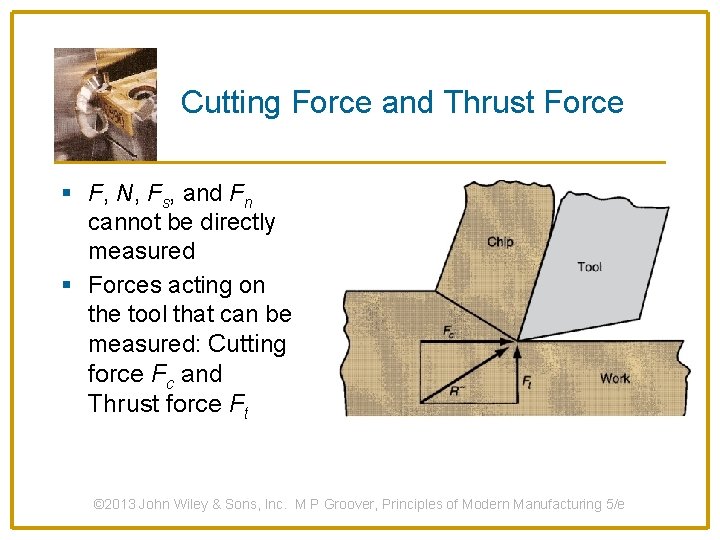
Cutting Force and Thrust Force § F, N, Fs, and Fn cannot be directly measured § Forces acting on the tool that can be measured: Cutting force Fc and Thrust force Ft © 2013 John Wiley & Sons, Inc. M P Groover, Principles of Modern Manufacturing 5/e
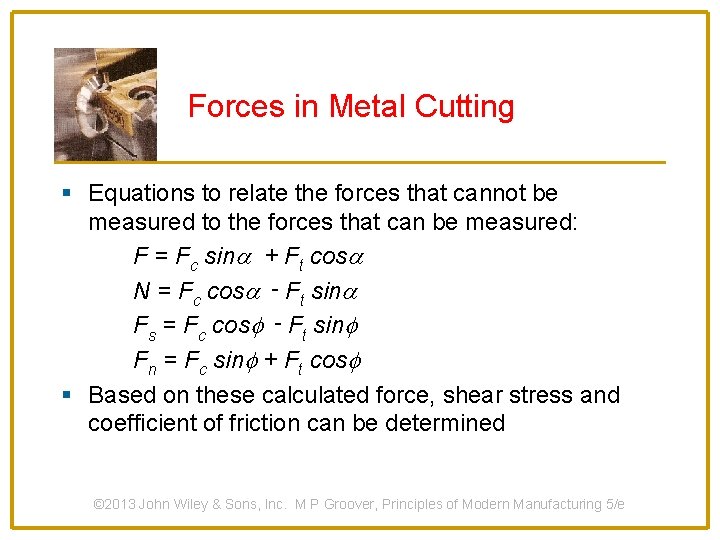
Forces in Metal Cutting § Equations to relate the forces that cannot be measured to the forces that can be measured: F = Fc sin + Ft cos N = Fc cos ‑ Ft sin Fs = Fc cos ‑ Ft sin Fn = Fc sin + Ft cos § Based on these calculated force, shear stress and coefficient of friction can be determined © 2013 John Wiley & Sons, Inc. M P Groover, Principles of Modern Manufacturing 5/e
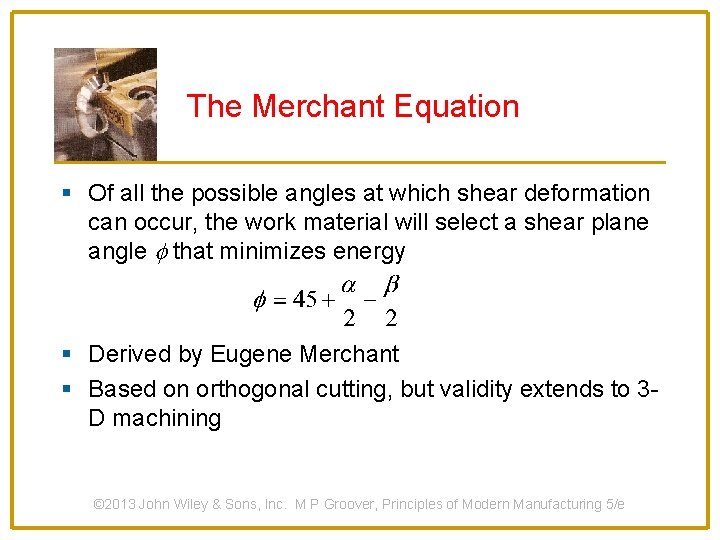
The Merchant Equation § Of all the possible angles at which shear deformation can occur, the work material will select a shear plane angle that minimizes energy § Derived by Eugene Merchant § Based on orthogonal cutting, but validity extends to 3 D machining © 2013 John Wiley & Sons, Inc. M P Groover, Principles of Modern Manufacturing 5/e
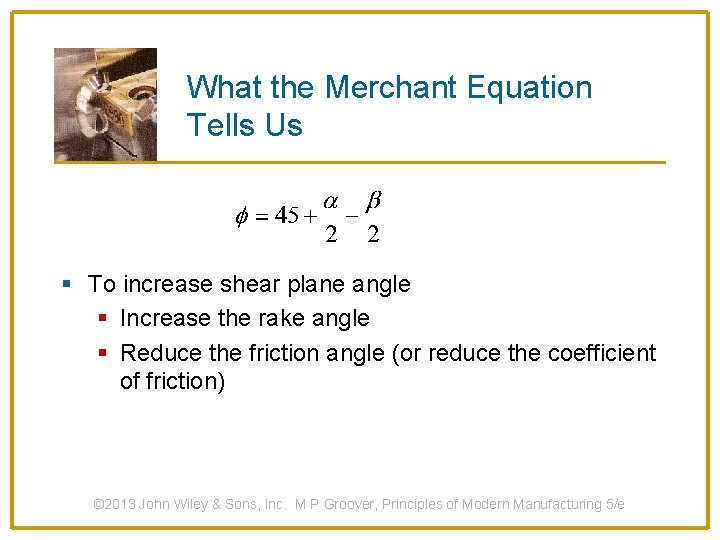
What the Merchant Equation Tells Us § To increase shear plane angle § Increase the rake angle § Reduce the friction angle (or reduce the coefficient of friction) © 2013 John Wiley & Sons, Inc. M P Groover, Principles of Modern Manufacturing 5/e
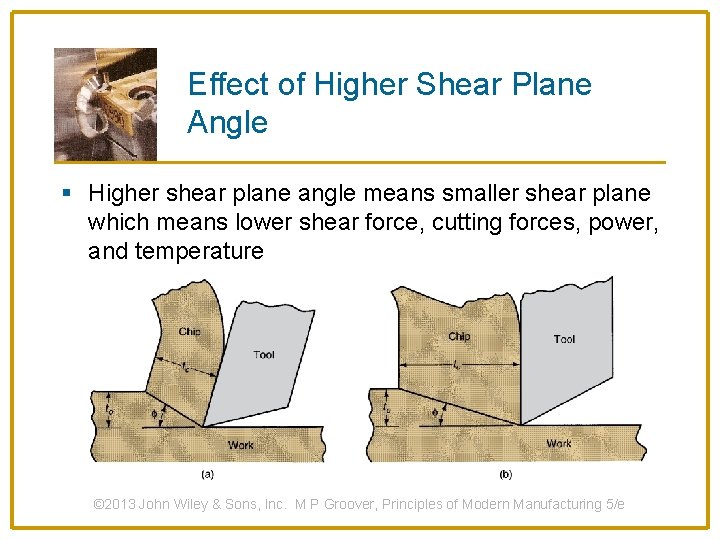
Effect of Higher Shear Plane Angle § Higher shear plane angle means smaller shear plane which means lower shear force, cutting forces, power, and temperature © 2013 John Wiley & Sons, Inc. M P Groover, Principles of Modern Manufacturing 5/e
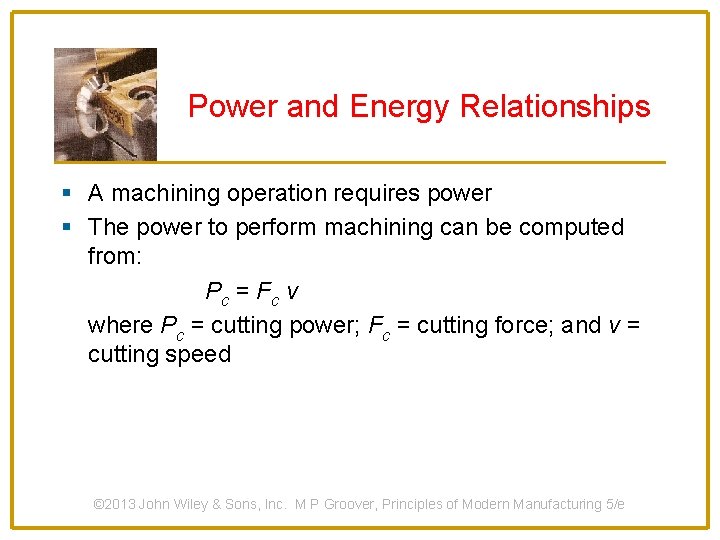
Power and Energy Relationships § A machining operation requires power § The power to perform machining can be computed from: Pc = Fc v where Pc = cutting power; Fc = cutting force; and v = cutting speed © 2013 John Wiley & Sons, Inc. M P Groover, Principles of Modern Manufacturing 5/e
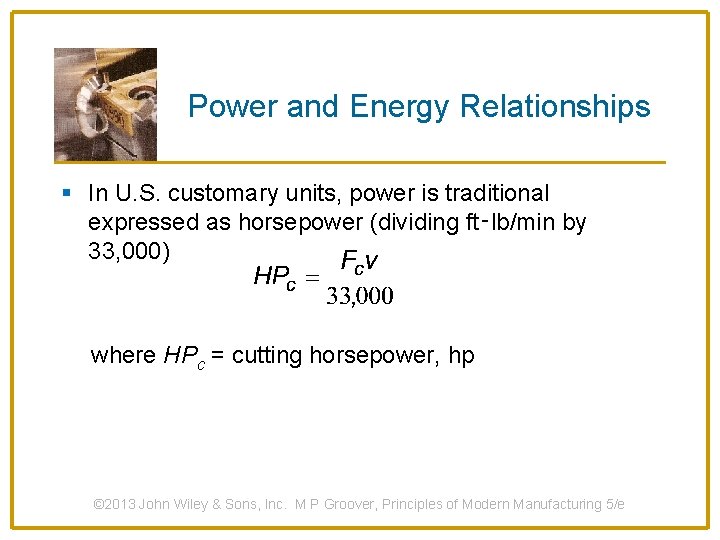
Power and Energy Relationships § In U. S. customary units, power is traditional expressed as horsepower (dividing ft‑lb/min by 33, 000) where HPc = cutting horsepower, hp © 2013 John Wiley & Sons, Inc. M P Groover, Principles of Modern Manufacturing 5/e
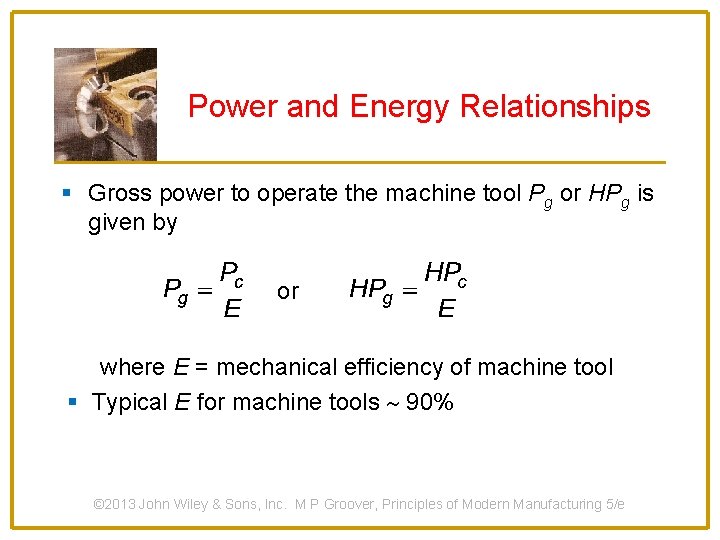
Power and Energy Relationships § Gross power to operate the machine tool Pg or HPg is given by or where E = mechanical efficiency of machine tool § Typical E for machine tools 90% © 2013 John Wiley & Sons, Inc. M P Groover, Principles of Modern Manufacturing 5/e
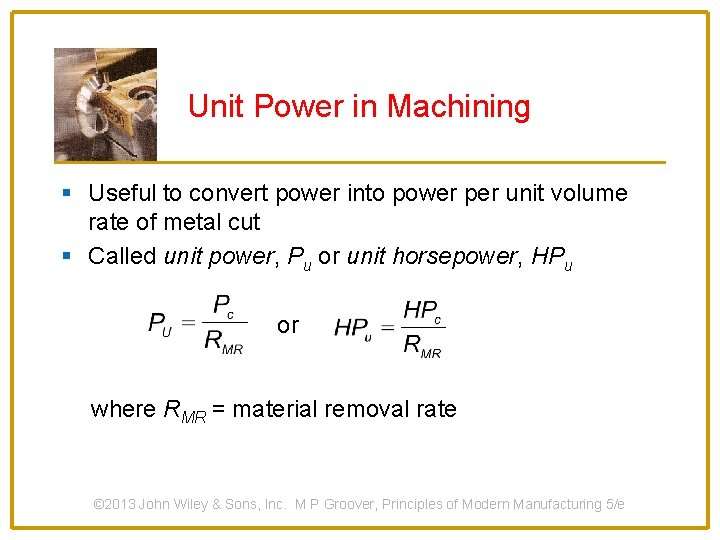
Unit Power in Machining § Useful to convert power into power per unit volume rate of metal cut § Called unit power, Pu or unit horsepower, HPu or where RMR = material removal rate © 2013 John Wiley & Sons, Inc. M P Groover, Principles of Modern Manufacturing 5/e
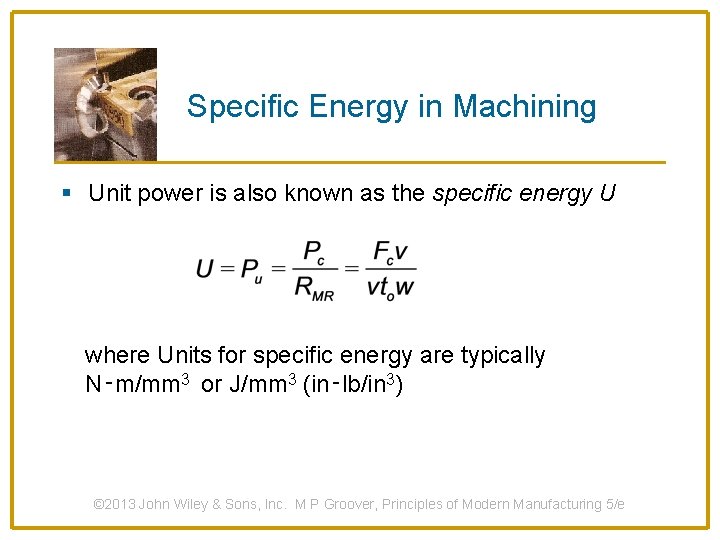
Specific Energy in Machining § Unit power is also known as the specific energy U where Units for specific energy are typically N‑m/mm 3 or J/mm 3 (in‑lb/in 3) © 2013 John Wiley & Sons, Inc. M P Groover, Principles of Modern Manufacturing 5/e
Cutting Temperature § Approximately 98% of the energy in machining is converted into heat § This can cause temperatures to be very high at the tool‑chip § The remaining energy (about 2%) is retained as elastic energy in the chip © 2013 John Wiley & Sons, Inc. M P Groover, Principles of Modern Manufacturing 5/e
Cutting Temperatures are Important § High cutting temperatures result in the following: § Reduce tool life § Produce hot chips that pose safety hazards to the machine operator § Can cause inaccuracies in part dimensions due to thermal expansion of work material © 2013 John Wiley & Sons, Inc. M P Groover, Principles of Modern Manufacturing 5/e
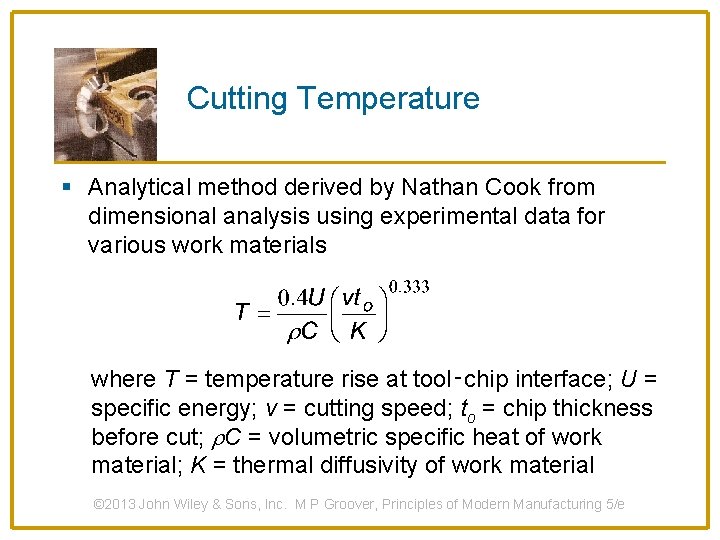
Cutting Temperature § Analytical method derived by Nathan Cook from dimensional analysis using experimental data for various work materials where T = temperature rise at tool‑chip interface; U = specific energy; v = cutting speed; to = chip thickness before cut; C = volumetric specific heat of work material; K = thermal diffusivity of work material © 2013 John Wiley & Sons, Inc. M P Groover, Principles of Modern Manufacturing 5/e
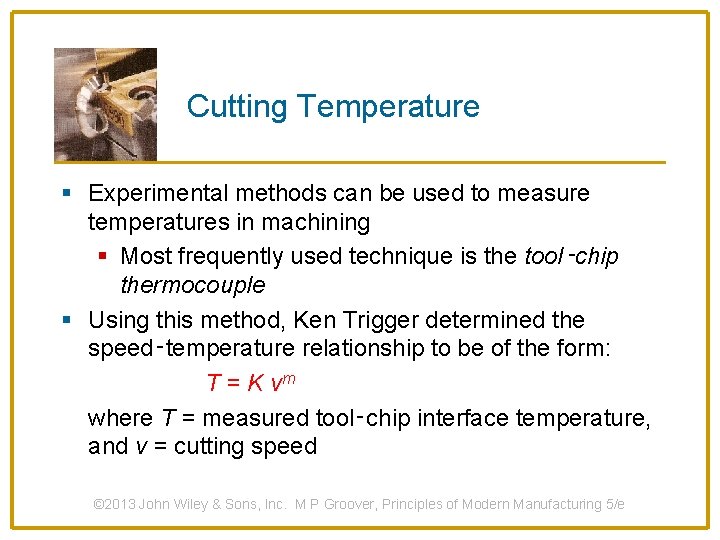
Cutting Temperature § Experimental methods can be used to measure temperatures in machining § Most frequently used technique is the tool‑chip thermocouple § Using this method, Ken Trigger determined the speed‑temperature relationship to be of the form: T = K vm where T = measured tool‑chip interface temperature, and v = cutting speed © 2013 John Wiley & Sons, Inc. M P Groover, Principles of Modern Manufacturing 5/e
§ https: //youtu. be/m. Ru. SYQ 5 Npek § https: //youtu. be/8 Sb. BC 5 UWe. NI © 2013 John Wiley & Sons, Inc. M P Groover, Principles of Modern Manufacturing 5/e