
Theory of Machining Mechanics of Chip Formation Topic

- Slides: 49
Theory of Machining Mechanics of Chip Formation Topic 2
2 -2 Objectives • Define the mechanics of chip formation that apply to metal cutting • Classify types of chips produced from cutting operations and identify the conditions affecting the chip formation • Analyze the forces in metal cutting using Merchant diagram
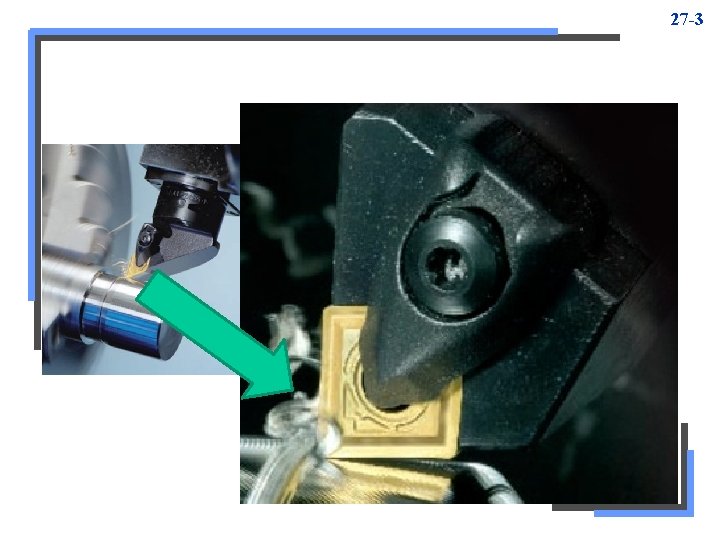
27 -3
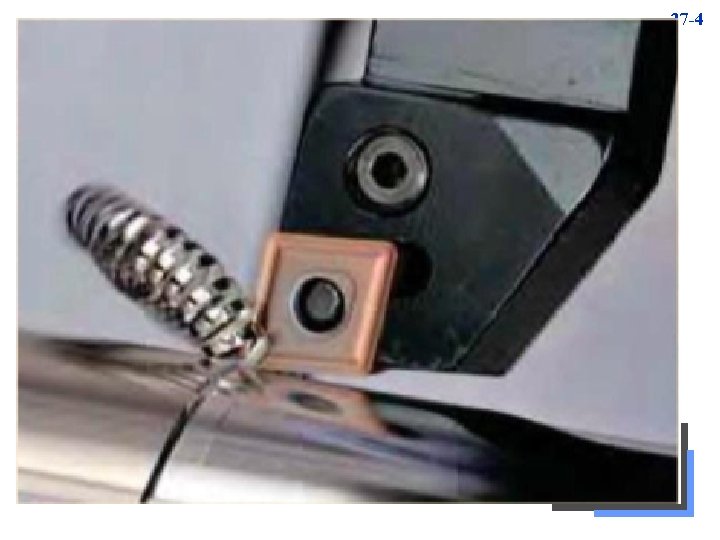
27 -4
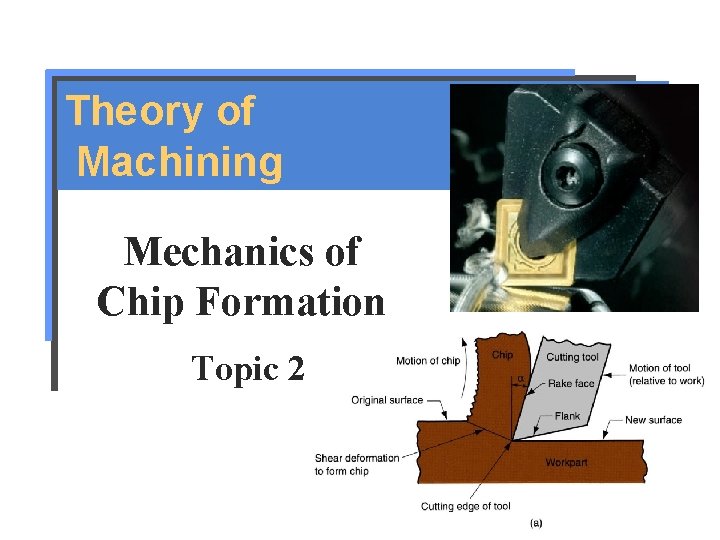
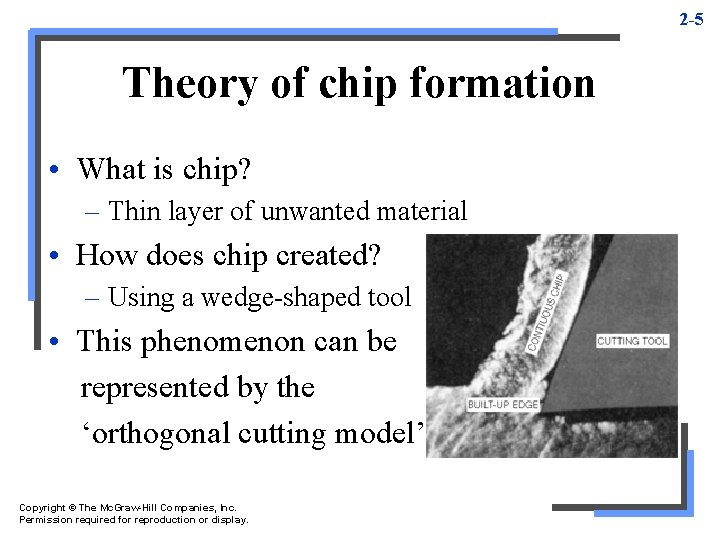
2 -5 Theory of chip formation • What is chip? – Thin layer of unwanted material • How does chip created? – Using a wedge-shaped tool • This phenomenon can be represented by the ‘orthogonal cutting model’ Copyright © The Mc. Graw-Hill Companies, Inc. Permission required for reproduction or display.
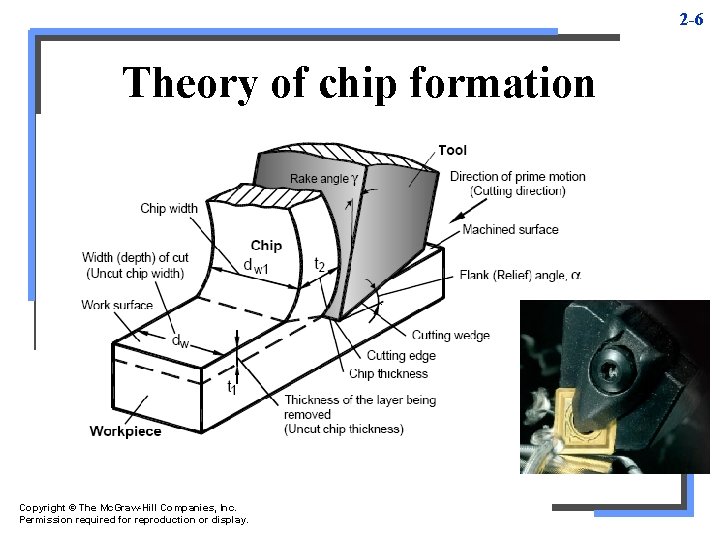
2 -6 Theory of chip formation Copyright © The Mc. Graw-Hill Companies, Inc. Permission required for reproduction or display.
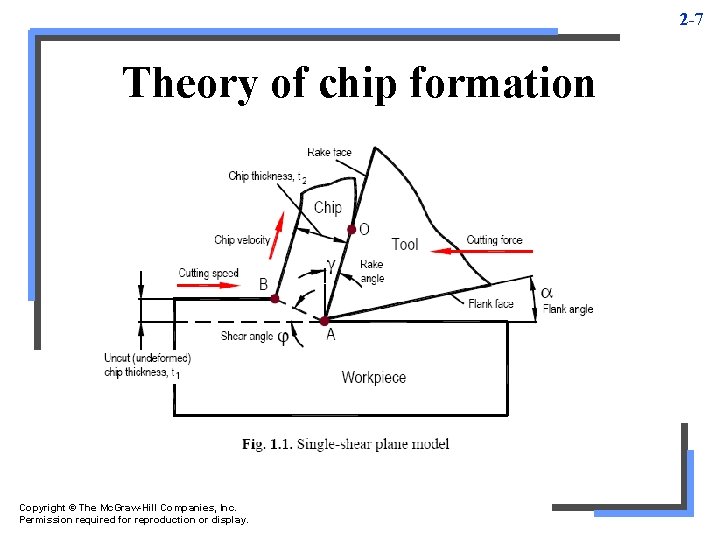
2 -7 Theory of chip formation Copyright © The Mc. Graw-Hill Companies, Inc. Permission required for reproduction or display.
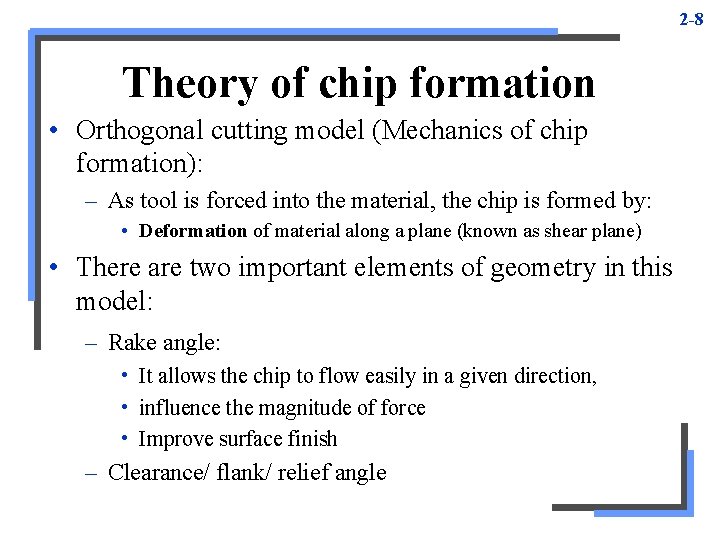
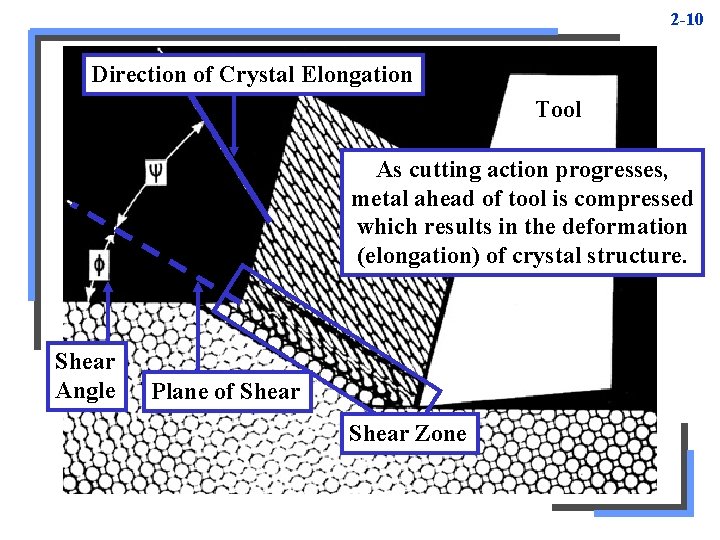
2 -8 Theory of chip formation • Orthogonal cutting model (Mechanics of chip formation): – As tool is forced into the material, the chip is formed by: • Deformation of material along a plane (known as shear plane) • There are two important elements of geometry in this model: – Rake angle: • It allows the chip to flow easily in a given direction, • influence the magnitude of force • Improve surface finish – Clearance/ flank/ relief angle
2 -9 When Cutting Tool Engages Workpiece • Compression occurs in work material because of forces exerted by cutting tool • Internal stresses are created • Concentration of stresses causes chip to shear (cut-off) from material and flow along the tool -chip interface – Since most metals are ductile (to some degree), plastic deformation occurs • Determines type of chip produced
2 -10 Direction of Crystal Elongation Tool As cutting action progresses, metal ahead of tool is compressed which results in the deformation (elongation) of crystal structure. Shear Angle Plane of Shear Zone
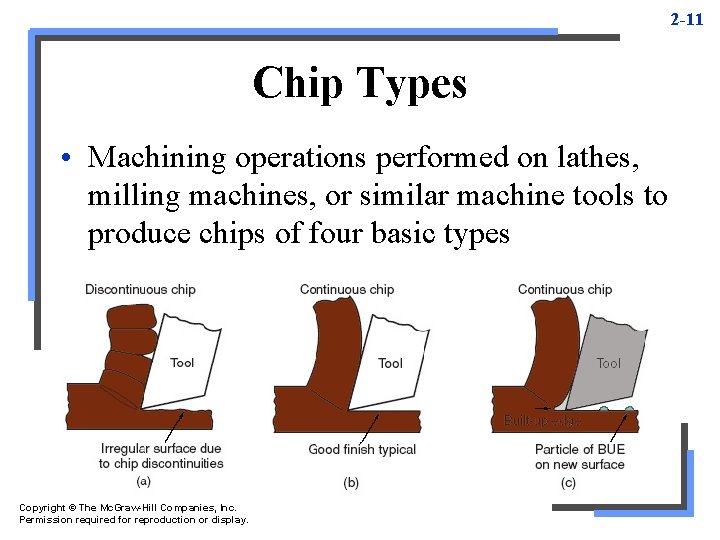
2 -11 Chip Types • Machining operations performed on lathes, milling machines, or similar machine tools to produce chips of four basic types Copyright © The Mc. Graw-Hill Companies, Inc. Permission required for reproduction or display.
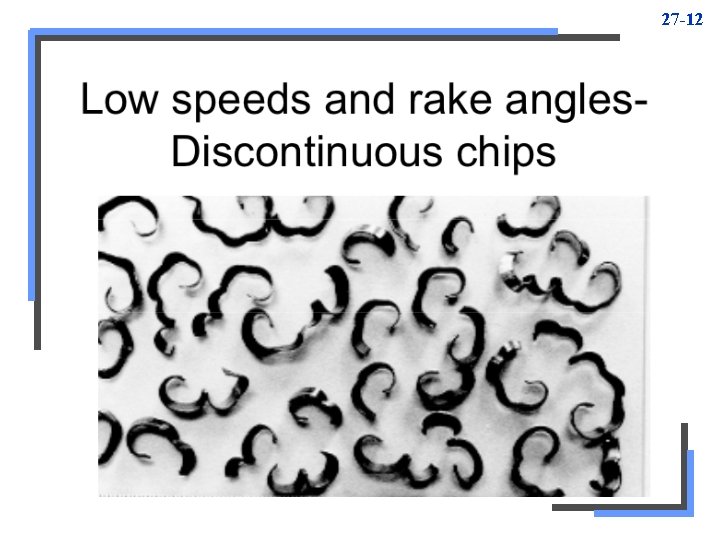
27 -12
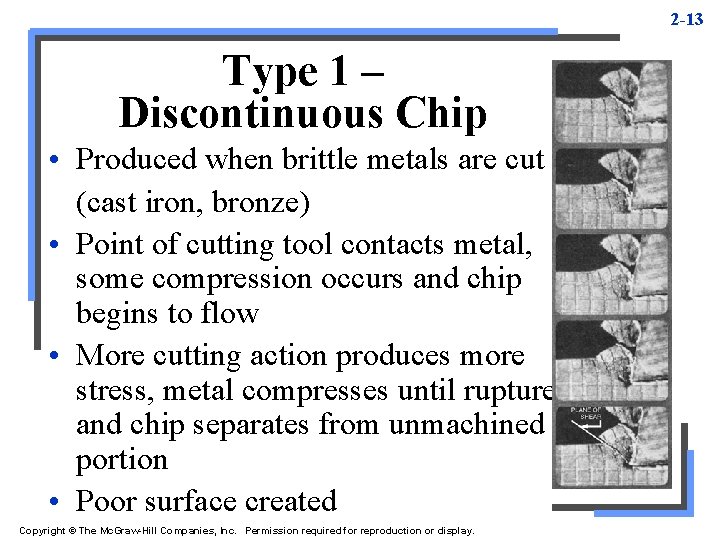
2 -13 Type 1 – Discontinuous Chip • Produced when brittle metals are cut (cast iron, bronze) • Point of cutting tool contacts metal, some compression occurs and chip begins to flow • More cutting action produces more stress, metal compresses until rupture, and chip separates from unmachined portion • Poor surface created Copyright © The Mc. Graw-Hill Companies, Inc. Permission required for reproduction or display.
2 -14 Conditions that produced Type 1 Discontinuous Chip • Conditions – Brittle work material – Small rake angle on the cutting tool – Large chip thickness – Low cutting speed – Excessive machine chatter
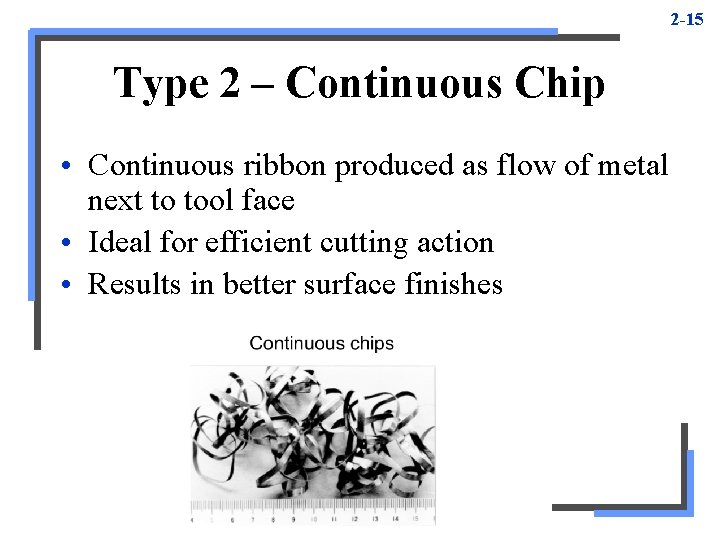
2 -15 Type 2 – Continuous Chip • Continuous ribbon produced as flow of metal next to tool face • Ideal for efficient cutting action • Results in better surface finishes
2 -16 Conditions Favorable to Producing Type 2 Chip • • • Ductile work material Small chip thickness Sharp cutting-tool edge Large rake angle on cutting tool High cutting speeds • Disadvantage:
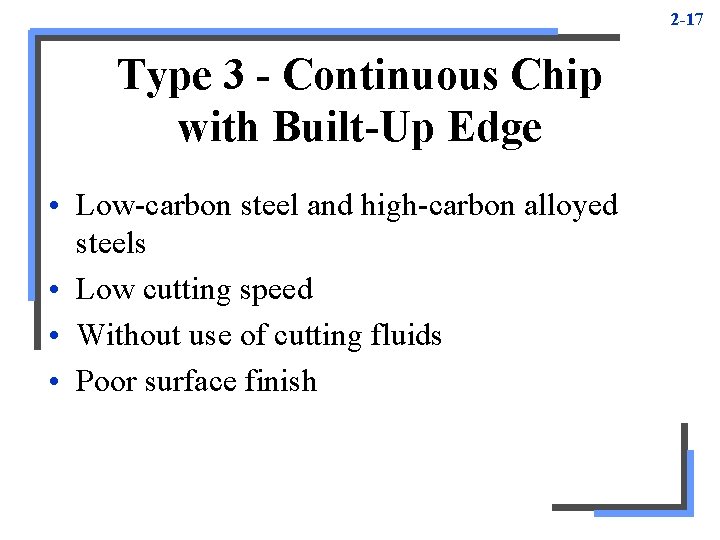
2 -17 Type 3 - Continuous Chip with Built-Up Edge • Low-carbon steel and high-carbon alloyed steels • Low cutting speed • Without use of cutting fluids • Poor surface finish
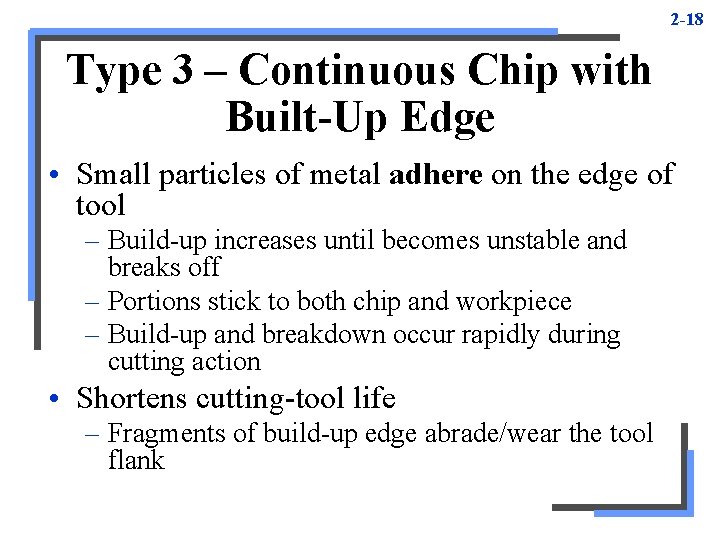
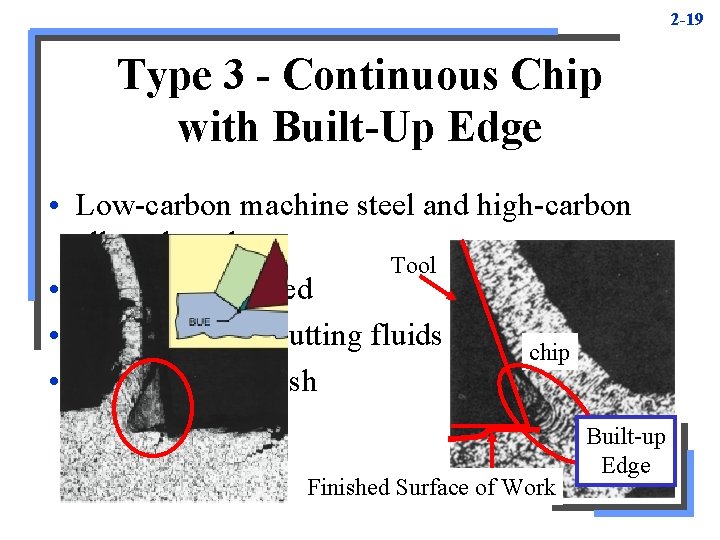
2 -18 Type 3 – Continuous Chip with Built-Up Edge • Small particles of metal adhere on the edge of tool – Build-up increases until becomes unstable and breaks off – Portions stick to both chip and workpiece – Build-up and breakdown occur rapidly during cutting action • Shortens cutting-tool life – Fragments of build-up edge abrade/wear the tool flank
2 -19 Type 3 - Continuous Chip with Built-Up Edge • Low-carbon machine steel and high-carbon alloyed steels Tool • Low cutting speed • Without use of cutting fluids chip • Poor surface finish Finished Surface of Work Built-up Edge
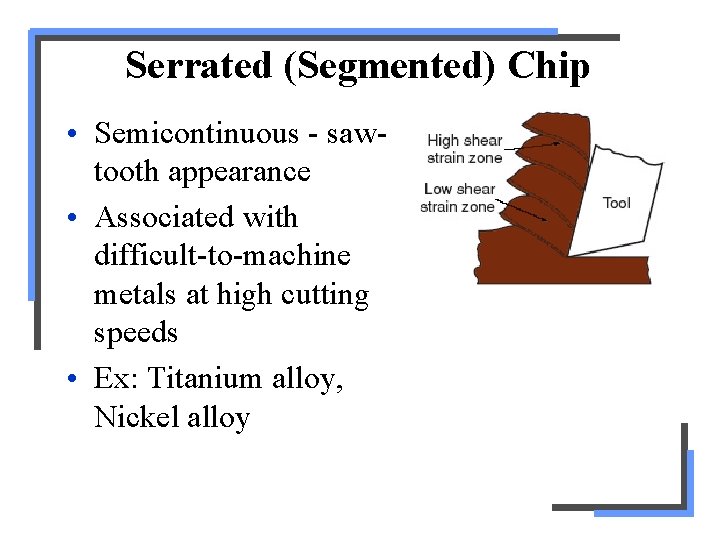
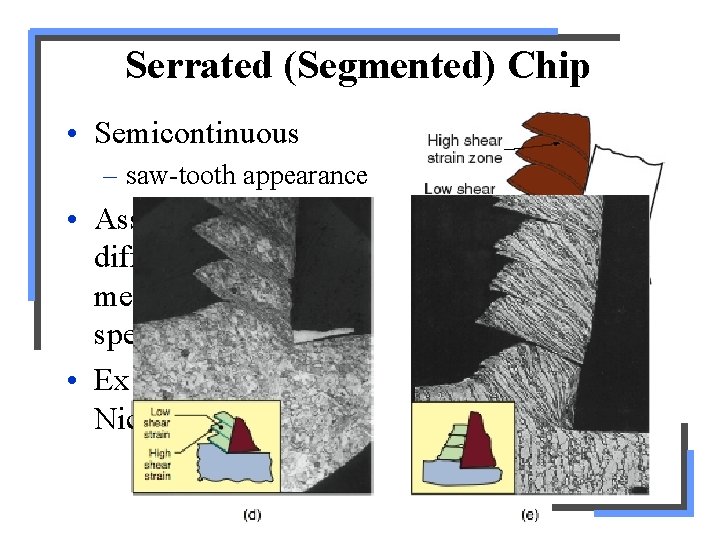
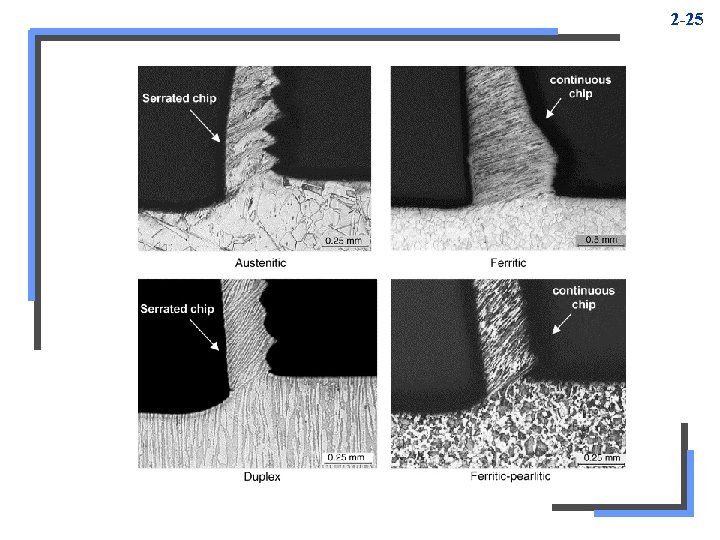
Serrated (Segmented) Chip • Semicontinuous - sawtooth appearance • Associated with difficult-to-machine metals at high cutting speeds • Ex: Titanium alloy, Nickel alloy
Serrated (Segmented) Chip • Semicontinuous – saw-tooth appearance • Associated with difficult-to-machine metals at high cutting speeds • Ex: Titanium alloy, Nickel alloy
2 -22 Why study the chip formation • The form of chips indicates: – nature and behavior of work material under machining – energy requirement to perform machining – nature and degree of interaction at the toolworkpiece interface
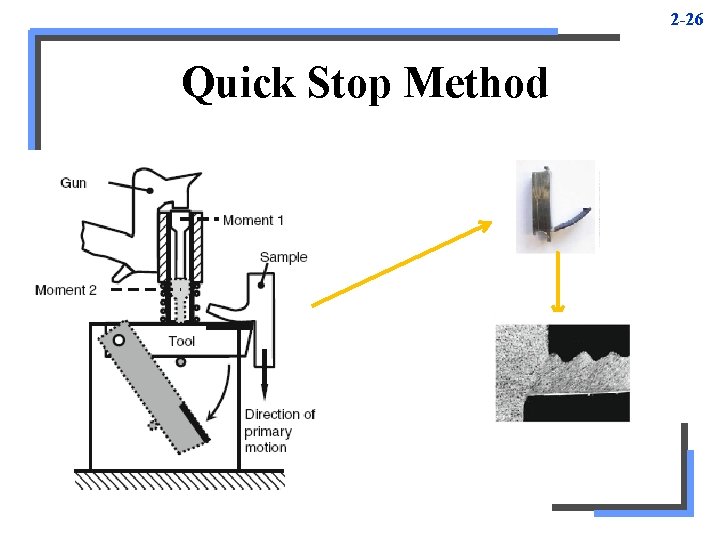
2 -23 How to perform the chip formation study • Mainly through: • Experimental methods using: – High speed video camera: study of running chips – Quick stop device: study of frozen chip/ analysis of chip root • Simulation methods – Finite element analyses (FEA): Computer simulations
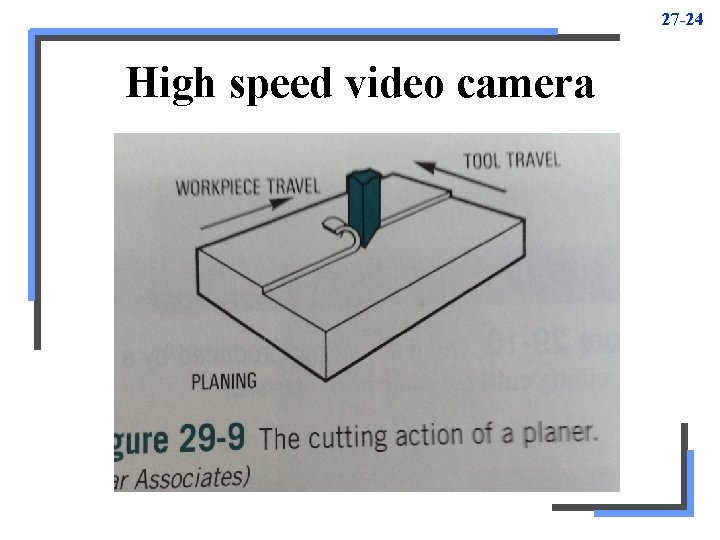
27 -24 High speed video camera
2 -25
2 -26 Quick Stop Method
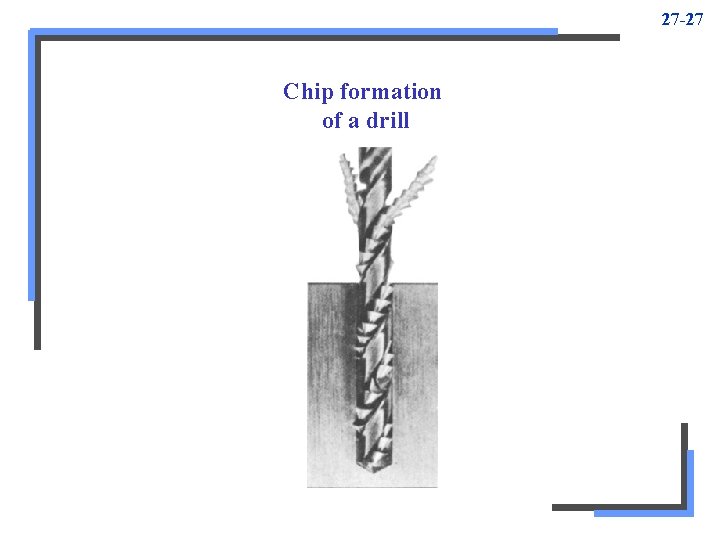
27 -27 Chip formation of a drill
2 -28 FORCE RELATIONSHIPS AND MERCHANT EQUATION
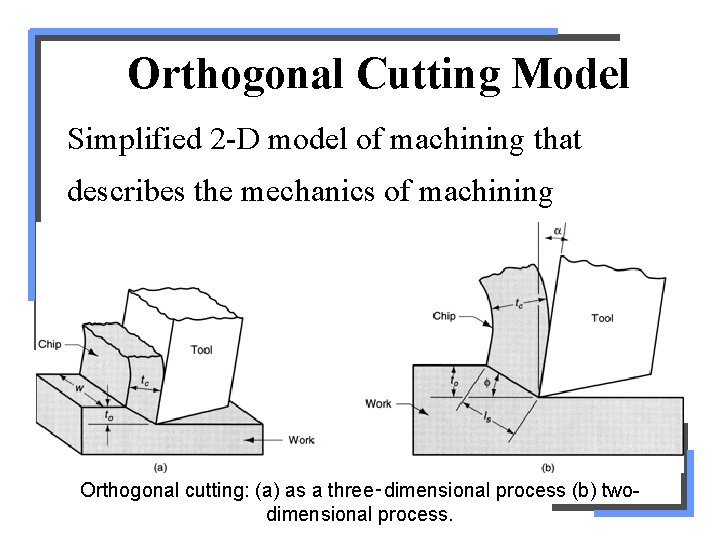
Orthogonal Cutting Model Simplified 2 -D model of machining that describes the mechanics of machining Orthogonal cutting: (a) as a three‑dimensional process (b) twodimensional process.
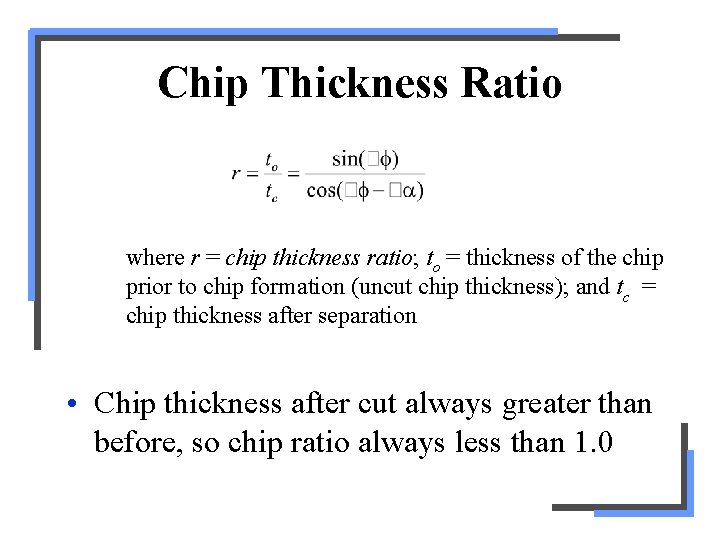
Chip Thickness Ratio where r = chip thickness ratio; to = thickness of the chip prior to chip formation (uncut chip thickness); and tc = chip thickness after separation • Chip thickness after cut always greater than before, so chip ratio always less than 1. 0
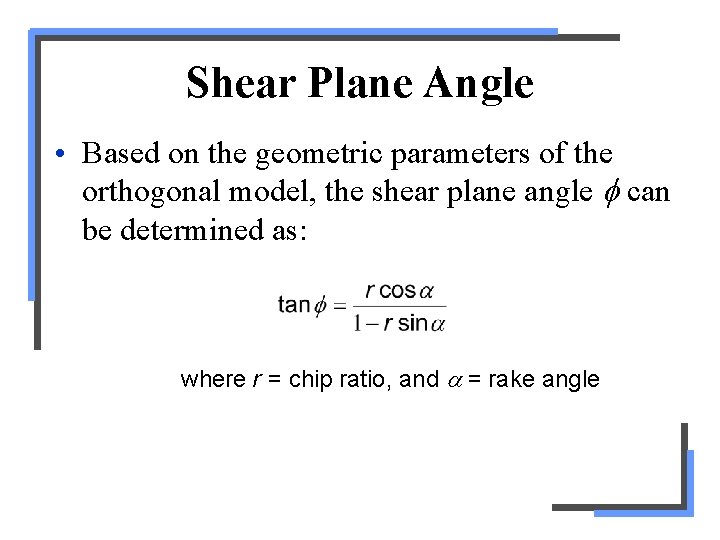
Shear Plane Angle • Based on the geometric parameters of the orthogonal model, the shear plane angle can be determined as: where r = chip ratio, and = rake angle
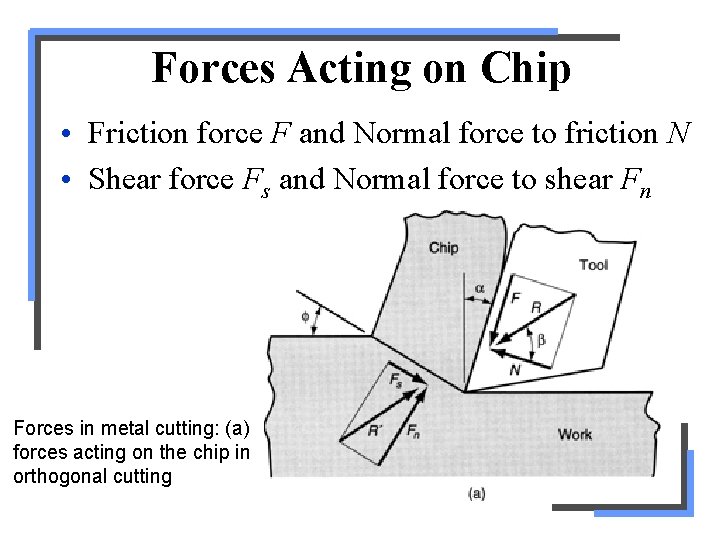
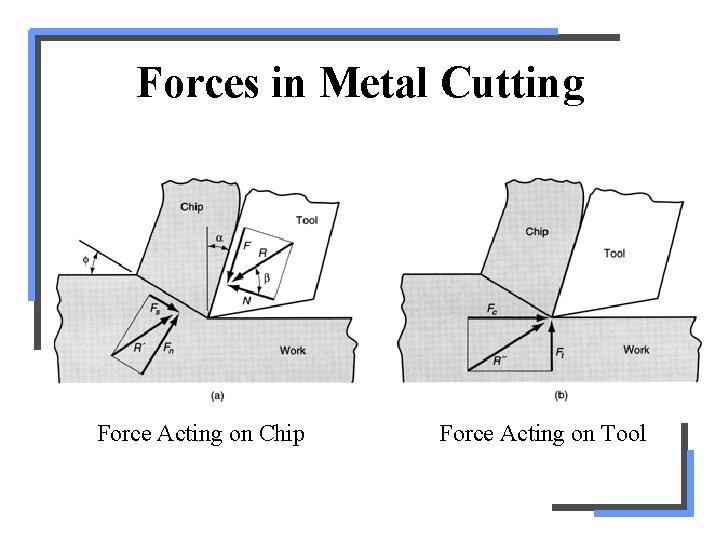
Forces Acting on Chip • Friction force F and Normal force to friction N • Shear force Fs and Normal force to shear Fn Forces in metal cutting: (a) forces acting on the chip in orthogonal cutting
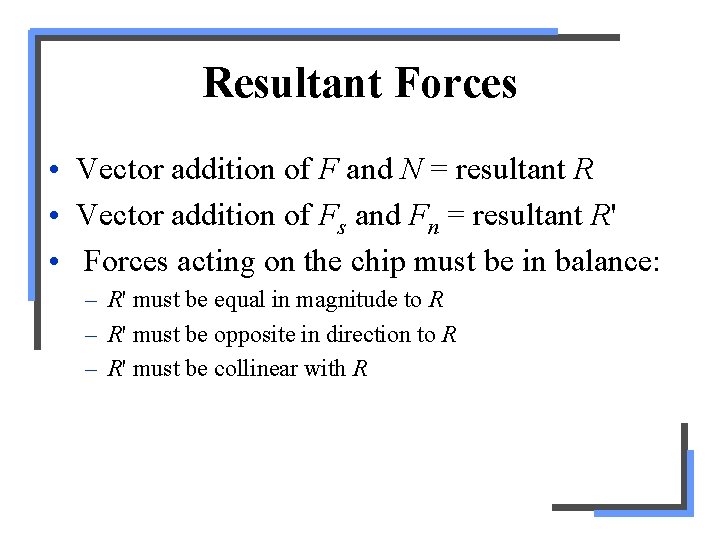
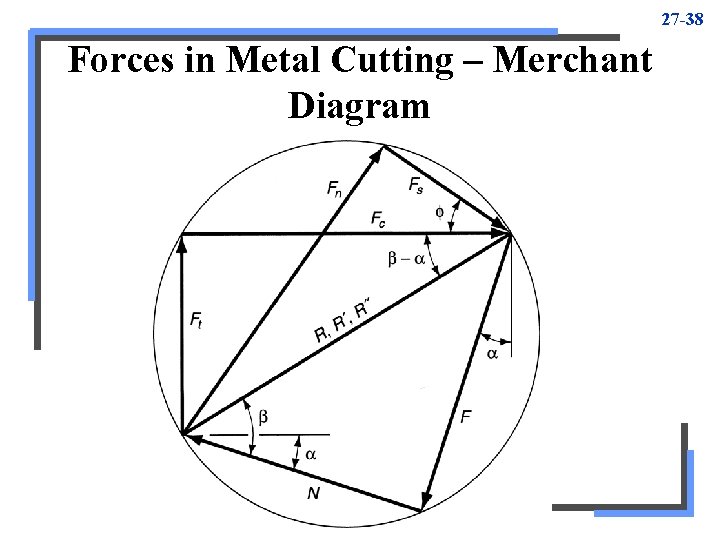
Resultant Forces • Vector addition of F and N = resultant R • Vector addition of Fs and Fn = resultant R' • Forces acting on the chip must be in balance: – R' must be equal in magnitude to R – R' must be opposite in direction to R – R' must be collinear with R
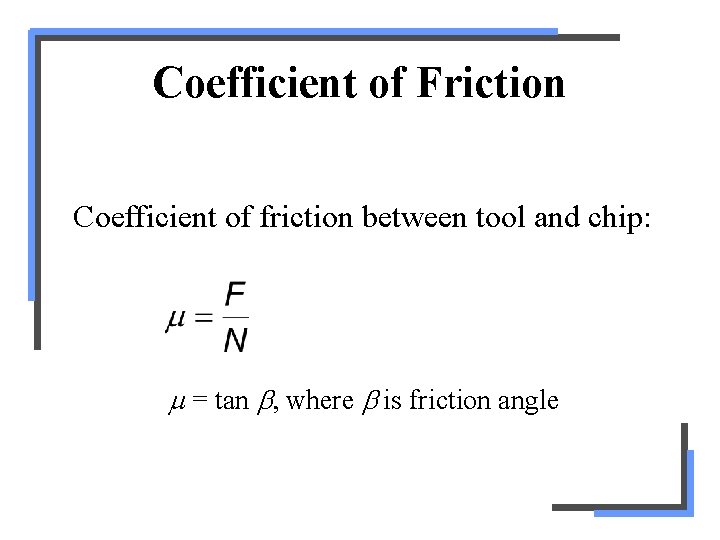
Coefficient of Friction Coefficient of friction between tool and chip: m = tan b, where b is friction angle
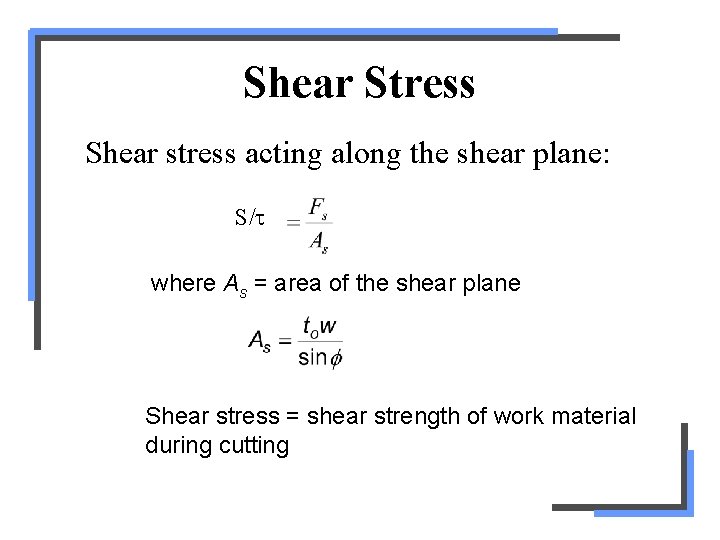
Shear Stress Shear stress acting along the shear plane: S/t where As = area of the shear plane Shear stress = shear strength of work material during cutting
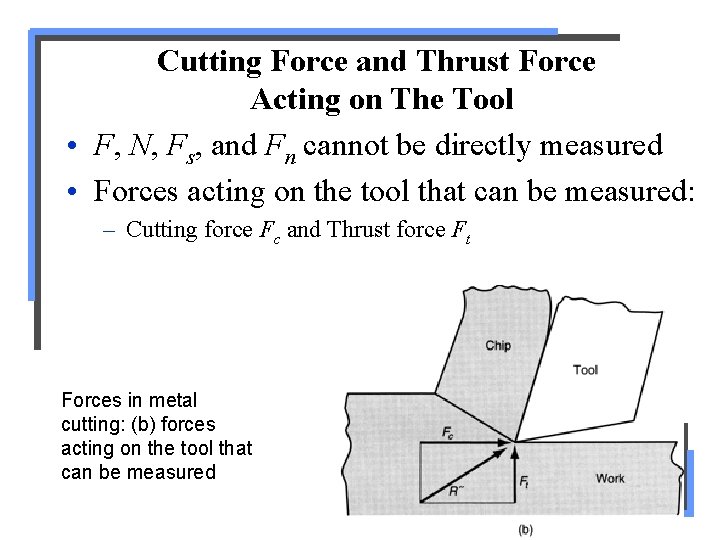
Cutting Force and Thrust Force Acting on The Tool • F, N, Fs, and Fn cannot be directly measured • Forces acting on the tool that can be measured: – Cutting force Fc and Thrust force Ft Forces in metal cutting: (b) forces acting on the tool that can be measured
Forces in Metal Cutting Force Acting on Chip Force Acting on Tool
27 -38 Forces in Metal Cutting – Merchant Diagram
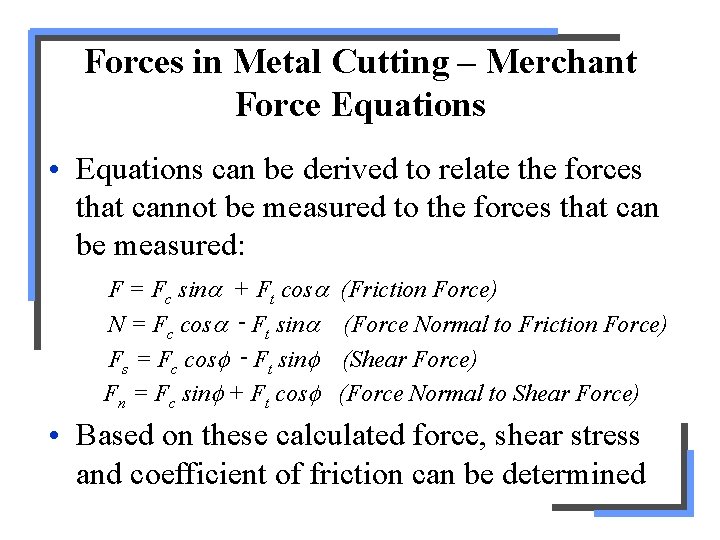
Forces in Metal Cutting – Merchant Force Equations • Equations can be derived to relate the forces that cannot be measured to the forces that can be measured: F = Fc sin + Ft cos N = Fc cos ‑ Ft sin Fs = Fc cos ‑ Ft sin Fn = Fc sin + Ft cos (Friction Force) (Force Normal to Friction Force) (Shear Force) (Force Normal to Shear Force) • Based on these calculated force, shear stress and coefficient of friction can be determined
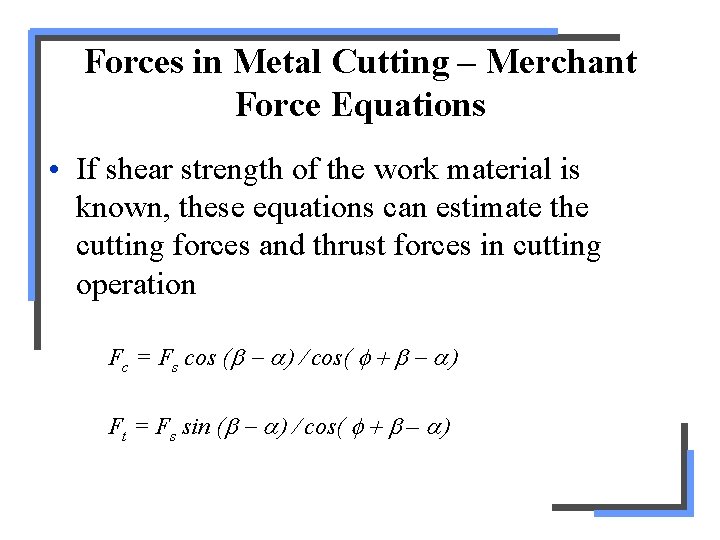
Forces in Metal Cutting – Merchant Force Equations • If shear strength of the work material is known, these equations can estimate the cutting forces and thrust forces in cutting operation Fc = Fs cos (b - ) / cos( + b - ) Ft = Fs sin (b - ) / cos( + b – )
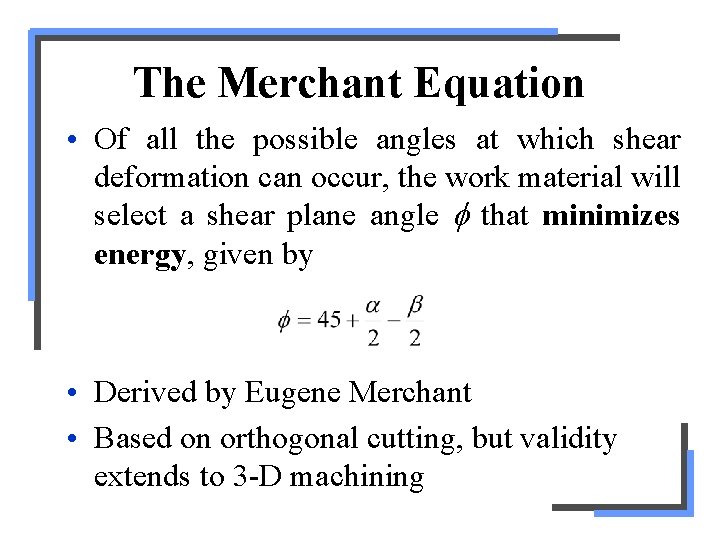
The Merchant Equation • Of all the possible angles at which shear deformation can occur, the work material will select a shear plane angle that minimizes energy, given by • Derived by Eugene Merchant • Based on orthogonal cutting, but validity extends to 3 -D machining
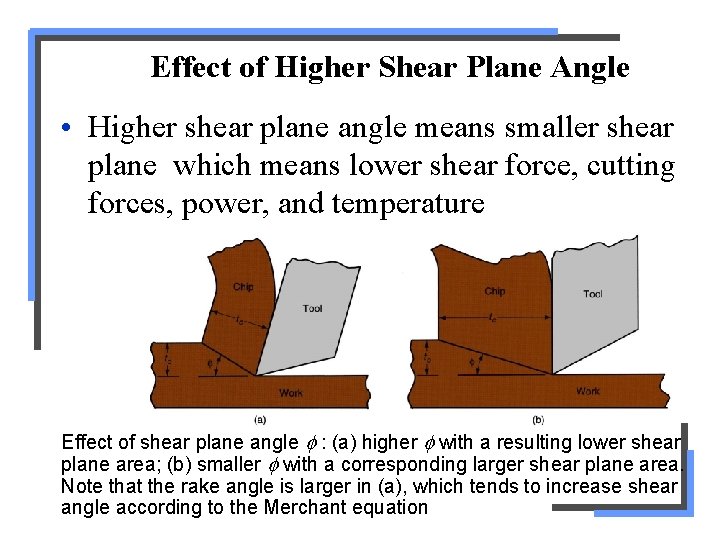
Effect of Higher Shear Plane Angle • Higher shear plane angle means smaller shear plane which means lower shear force, cutting forces, power, and temperature Effect of shear plane angle : (a) higher with a resulting lower shear plane area; (b) smaller with a corresponding larger shear plane area. Note that the rake angle is larger in (a), which tends to increase shear angle according to the Merchant equation
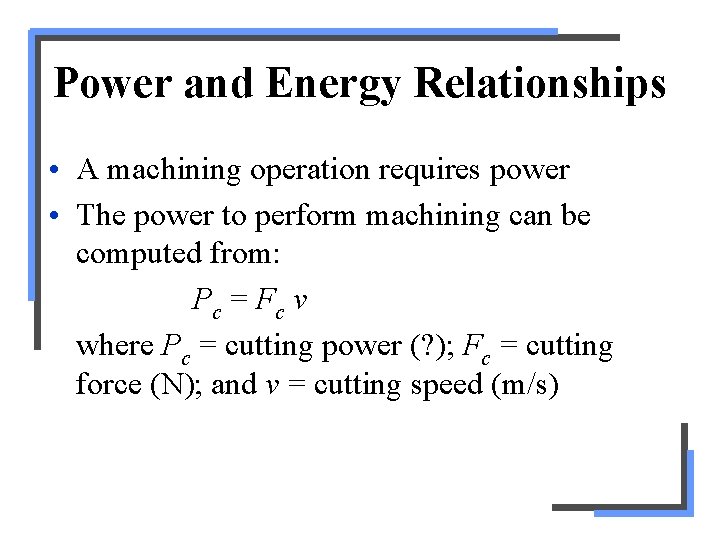
Power and Energy Relationships • A machining operation requires power • The power to perform machining can be computed from: Pc = Fc v where Pc = cutting power (? ); Fc = cutting force (N); and v = cutting speed (m/s)
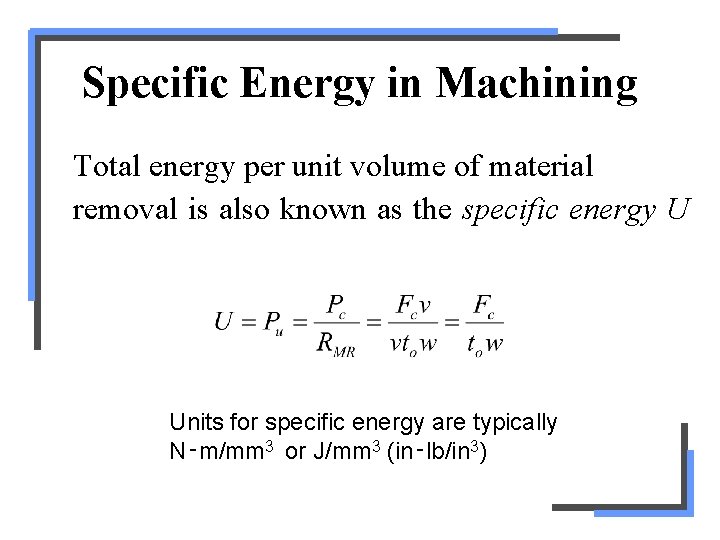
Specific Energy in Machining Total energy per unit volume of material removal is also known as the specific energy U Units for specific energy are typically N‑m/mm 3 or J/mm 3 (in‑lb/in 3)
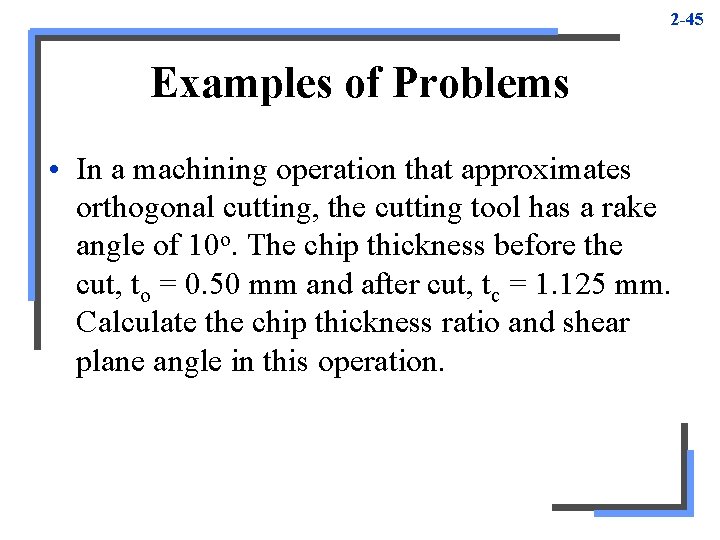
2 -45 Examples of Problems • In a machining operation that approximates orthogonal cutting, the cutting tool has a rake angle of 10 o. The chip thickness before the cut, to = 0. 50 mm and after cut, tc = 1. 125 mm. Calculate the chip thickness ratio and shear plane angle in this operation.
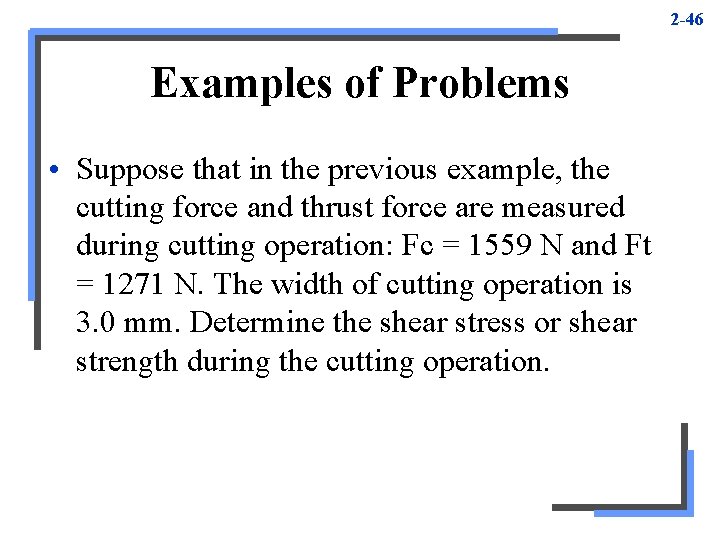
2 -46 Examples of Problems • Suppose that in the previous example, the cutting force and thrust force are measured during cutting operation: Fc = 1559 N and Ft = 1271 N. The width of cutting operation is 3. 0 mm. Determine the shear stress or shear strength during the cutting operation.
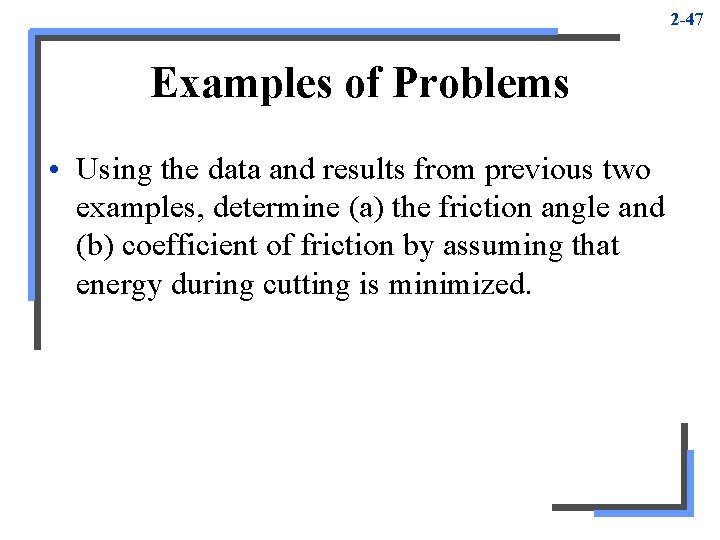
2 -47 Examples of Problems • Using the data and results from previous two examples, determine (a) the friction angle and (b) coefficient of friction by assuming that energy during cutting is minimized.
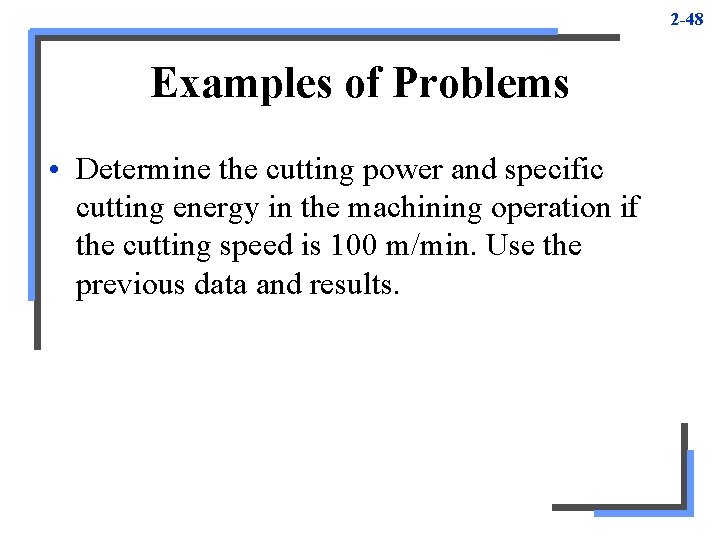
2 -48 Examples of Problems • Determine the cutting power and specific cutting energy in the machining operation if the cutting speed is 100 m/min. Use the previous data and results.
2 -49 END – THANK YOU