
Theory of Knowledge TOK Lecture 4 The nature

- Slides: 13
Theory of Knowledge TOK Lecture 4: The nature and value of truth
What is truth? �Like the questions “What is knowledge? ” and “What turns a true belief into knowledge? ” asked in lectures 2 & 3, the question “What is truth? ” is a conceptual question. �We can’t answering it by drawing up a list of truths. �Rather, we need to work out what conditions need to be met for a statement or belief to count as true.
The democratic theory of truth � The democratic theory says that a statement or belief is true if and only if everyone (or at least the majority of people) take it to be true. � Problems with the democratic theory: � Couldn’t everyone believe something that was false? � Might this theory lead to relativism? � Relativism about truth is the idea that a statement could be true for one individual (or the members of one group) but false for another individual (or the members of another group). � Do we want to say that a statement is true for the members of a given cultural group if and only if all (or the majority of the) the members of that group take it to be true?
The pragmatic theory of truth � The pragmatic theory of truth says that a statement is true if and only if a person’s believing it helps them to achieve one or more of their goals. � Leads to relativism: the idea that statements could be true for one person but not for another. � Problematic for other reasons too – there seem to be many false statements such that believing them will help someone achieve one of their goals. � For example: � A belief that “The job interview is at 10 am” when it is really at 10: 30 am, and the bus that would get me to the interview by 10: 20 am has broken down. � A belief that “There are no cigarettes in the glove-box of my car” when there are cigarettes in the glove-box of my car, and I want to quit smoking.
The coherence theory of truth � The coherence theory of truth says that a belief is true if and only if it coheres with (fits into) a coherent system of belief. � Like the pragmatic theory, the coherence theory of truth seems to lead to relativism. � Couldn’t my belief system be just as coherent as yours despite the fact that we believe different things? � This may be seen as an advantage or a disadvantage depending on where you stand vis-à-vis relativism. � The coherence theory is also susceptible to the “coherent fairy story” objection. � Couldn’t my beliefs cohere with each other despite the fact that my belief system as a whole bears no (or very little) relation to reality?
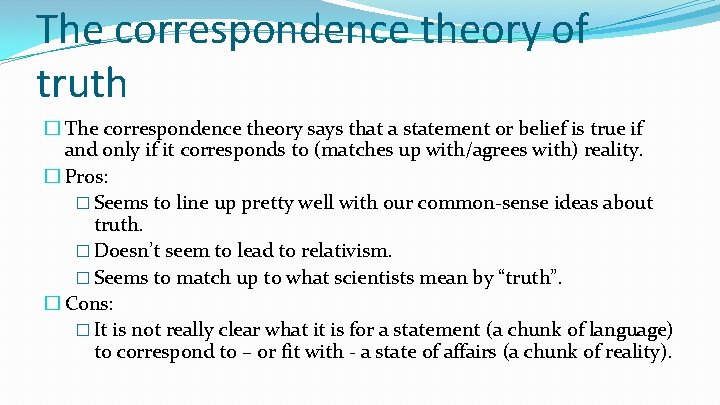
The correspondence theory of truth � The correspondence theory says that a statement or belief is true if and only if it corresponds to (matches up with/agrees with) reality. � Pros: � Seems to line up pretty well with our common-sense ideas about truth. � Doesn’t seem to lead to relativism. � Seems to match up to what scientists mean by “truth”. � Cons: � It is not really clear what it is for a statement (a chunk of language) to correspond to – or fit with - a state of affairs (a chunk of reality).
The value of truth � According the late 19 th Century German philosopher Friedrich Nietzsche, truth has become something of a religion for modern, western man. � Nietzsche claims that modern man has killed God (that’s OK, we created him anyway) and erected truth in the place of God. � Nietzsche is at least right about our placing great value on truth. � But, isn’t Nietzsche wrong about our love for truth being akin to a religion? � Calling it a religion makes it sound irrational. � But isn’t the value we place on truth completely rational?
Truths that are clearly valuable �A true belief about the location of one’s car keys is clearly better than a false one. �A true belief about the location of the ATM machine is clearly better than a false one. �A true belief about the weather is clearly better than a false one.
Truths that are clearly detrimental �But hang on, doesn’t it depend on the context? �A true belief about the location of one’s car keys could be worse than a false one if you are drunk. �A true belief about the location of the ATM machine could be worse than a false one if you are a compulsive gambler on a gambling binge. �Could a false belief about the weather ever be better than a true one?
The Oppenheimer problem �Science seems to be very good at uncovering truths about the natural world. �Sometimes we assume that scientific truths are so valuable that uncovering them has to be a good thing. �Oppenheimer, the scientist whose work made nuclear weapons possible, came to doubt this idea. �What do you think?
Journal entries for this week �Which theory of truth do you think is the best, and why?
Discussion questions for this week �Is the fact that a theory of truth leads to relativism an advantage or a disadvantage of that theory? �Can you think of another case in which a false belief is more advantageous than a true one? �Should scientists think about the possible consequences of their work? Or, should scientists be motivated solely by a desire to uncover truths about the workings of the natural world?
Reading for next week �Dombrowski et al, Theory of Knowledge Course Companion … � Read from the beginning of chapter 2, How do we know? (page 31), to the end of the section on sense perception (top of page 32)