
Theory of Inventive Problem Solving TRIZ Genrich Altshuller
Theory of Inventive Problem Solving TRIZ (Genrich Altshuller) v There are universal principles of invention that are the basis for creative innovation that advance technology. v These principles can be codified, taught and used to make innovation more predictable. v Three primary findings: • Problems and solutions were repeated across industries and sciences • Patterns of of technical evolution were repeated across industries and sciences • Innovations used scientific effects outside the fields in which they were developed © Peter Dominick, Michael R. Ryan 2007 1
Degree of Inventiveness v Level 1: 32% of patents employ obvious solutions (e. g. increase thickness of walls for more insulation) v Level 2: 45% small improvements to existing system, solution required knowledge of only a single field of technology (e. g. adjustable steering columns in cars) v Level 3: 18% an inventive contradiction resolved through the introduction of some useful new element (e. g. the automatic transmission, solutions uses technology from another industry/field) v Level 4: 4% are solutions found in science, use a completely different technology or paradigm to solve a problem (e. g. using materials with thermal memory) v Level 5: <1% are solutions that exist outside the confines of contemporary scientific knowledge. True discovery of a new phenomenon and the application of it (e. g the laser) © Peter Dominick, Michael R. Ryan 2007 2
TRIZ: Some Key Findings v Inventions involving levels 1, 2, 3 are usually transferable from one discipline to another. 95% of the inventive problems in any particular field have already been solved in another field. What do bell peppers and diamonds have in common? • Same principle used to extract seeds from a pepper before canning is used to split a gem • Increasing air pressure, then quickly reducing it causes an explosion which splits an object v TRIZ accumulates inventive experiences and then provides access to the most effective solutions independent of industry © Peter Dominick, Michael R. Ryan 2007 3

TRIZ: Systematic Innovation v 39 potentially conflicting design parameters • Weight of a moving object; weight of a non-moving object; Volume; Shape; Energy; Power, etc. v 40 principles that are repeatedly used to solve most design problems • Multiplication/Duplication • Division/Segmentation • Unification v TRIZ table specifies which principle(s) most likely to be helpful for each of the 1521 potential design contradictions © Peter Dominick, Michael R. Ryan 2007 4

TRIZ: Some Examples v Multiplication polio vaccine v Segmentation/Division multi-stage rocket v Unification Using exhaust fumes to cool an airplane engine © Peter Dominick, Michael R. Ryan 2007 5
Lateral Thinking and TRIZ v Both concerned with the generation of new ideas v Both stress looking at problems from new perspectives • Restructuring existing information within the problem • Using existing information that is seemingly unrelated • Create new patterns not necessarily new concepts v Both require divergence (lateral) combined with convergence (vertical) in order to solve problems v Both techniques benefit from collaborative team dynamics that facilitate open information exchange and development. © Peter Dominick, Michael R. Ryan 2007 6

Structured Thinking v We can move beyond just simplifying and breaking down our problems v We can structure the way we think about our problems v Understand the difference • In one, we break down or structure the problem about which we are thinking into more manageable pieces • In the other, we break down or structure how we think about a problem into useful segments • Both are extremely useful and can be used in combination © Peter Dominick, Michael R. Ryan 2007 7
Intention v If you intend to be a thinker and go through the motions – you will become a thinker • The deliberate intention and deliberate act together starts us on the road – produces performance • It helps to have props to reinforce our intentions • Intentions without the actions doesn’t accomplish anything © Peter Dominick, Michael R. Ryan 2007 8
Role Playing in Thinking v Role playing is a prop to reinforce our intentions and provides for the action v Role playing frees us to become fully absorbed into a particular way of thinking v Role playing allows us to play the fool without our ego getting in the way v Our role playing with thinking is to “put on our thinking hat? © Peter Dominick, Michael R. Ryan 2007 9
Our Thinking Hats v When we want to think in this structured way, we will put on one of our six thinking hats v We can wear only one hat at a time and we want to force ourselves to think in only one way at a time v We play the role of a thinker of that type © Peter Dominick, Michael R. Ryan 2007 10
Purpose of the Thinking Hats v Defined role playing v Directs our attention to the different aspects of thinking v Convenience – symbolism provides easy way of directing someone or your self to switch gears to a different way of thinking v Establishes rules of the game – which we typically find easy to follow v Stimulate brain chemistry? © Peter Dominick, Michael R. Ryan 2007 11
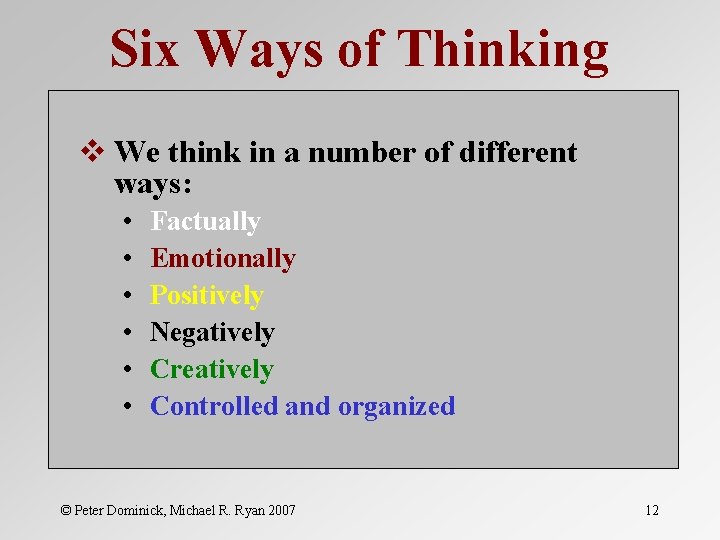
Six Ways of Thinking v We think in a number of different ways: • • • Factually Emotionally Positively Negatively Creatively Controlled and organized © Peter Dominick, Michael R. Ryan 2007 12
Factual Thinking White Thinking Hat v Facts, figures and objective information v No interpretation, no consequences, no judgments v Western thought sometimes has difficulty with this because we are trained to argue our conclusion and support with facts v Need to distinguish between “checked facts” and “perceived or believed facts” © Peter Dominick, Michael R. Ryan 2007 13
Emotional Thinking Red Hat Thinking v Emotions and feelings • “This is how I feel about the matter” v Also hunches and intuition v Legitimizes ours and others feelings and emotions which we fight otherwise exclude v Never attempt to justify or provide logical basis for the feelings when wearing the red hat © Peter Dominick, Michael R. Ryan 2007 14
Negative Thinking Black Hat Thinking v Concerned with negative assessment v Points out what is wrong, incorrect, or in error v Explores risks and dangers v Points out why something will not work, does not fit with past experience, problems that it will cause, faults in the design v Don’t let negative emotions become part of the black hat thinking, that is for red hat thinking © Peter Dominick, Michael R. Ryan 2007 15
Positive Thinking Yellow Hat Thinking v Concerned with thinking that is positive and constructive v Positive assessment v Explores for value and benefits and strives for logical support for these v Generative with concrete proposals and suggestions coming forth v Not positive emotion or creating new ideas © Peter Dominick, Michael R. Ryan 2007 16
Creative Thinking Green Hat Thinking v The output of green hat thinking needs to be treated as creative output, suspending judgment v Searching for alternatives is a fundamental part of this v Movement instead of judgment © Peter Dominick, Michael R. Ryan 2007 17
Control Thinking Blue Hat Thinking v This thinking organizes the thinking itself v Facilitator in a group will wear the blue hat most of the time v Defines what it is about which we want to think v Defines the problem, organizes and monitors the thinking v Helps pull the results of the different types of thinking together © Peter Dominick, Michael R. Ryan 2007 18
Summary v. Sounds and feels artificial but that is part of its purpose v. Structuring our thinking has very real benefits both in our individual as well as our group thinking © Peter Dominick, Michael R. Ryan 2007 19
- Slides: 19