
Theory of Games and Bargaining Theoretical Part of
Theory of Games and Bargaining Theoretical Part of Negotiation(ii)
Cooperative Games It seems that threats actually work in many instances, but theory says they may not work. True in theory, but not in practice? If the game is not played just once, but repeated over time as in repeated Prisoner’s Dilemma, threats may work. In labor disputes, breakdown of negotiation does not mean closing down the factory. Just a loss of one week’s operation. Can we assume that commitments are actually carried out? Or what if we allow side-payment? If they work together to find a better solution, and commit themselves to implement the solution, we may end up better solutions. This leads us to cooperative solution. TPN by KJ Sung
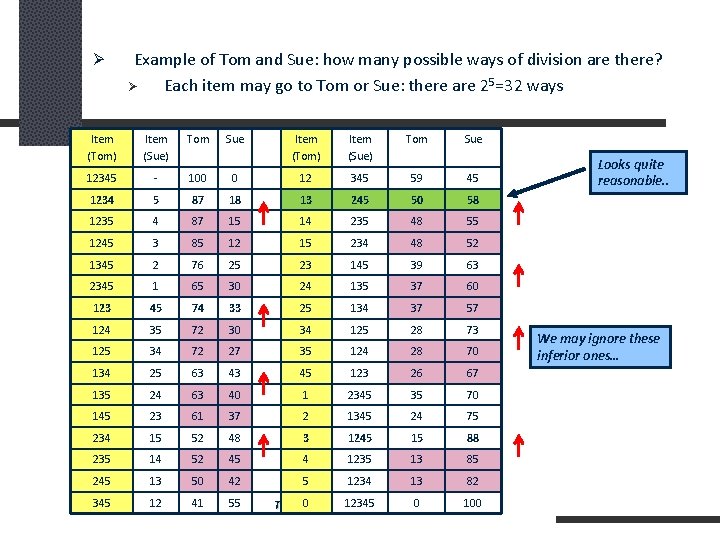
Ø Example of Tom and Sue: how many possible ways of division are there? Ø Each item may go to Tom or Sue: there are 25=32 ways Item (Tom) Item (Sue) Tom Sue 12345 - 100 0 12 345 59 45 1234 5 87 18 13 245 50 58 1235 4 87 15 14 235 48 55 1245 3 85 12 15 234 48 52 1345 2 76 25 23 145 39 63 2345 1 65 30 24 135 37 60 123 45 74 33 25 134 37 57 124 35 72 30 34 125 28 73 125 34 72 27 35 124 28 70 134 25 63 43 45 123 26 67 135 24 63 40 1 2345 35 70 145 23 61 37 2 1345 24 75 234 15 52 48 3 1245 15 88 235 14 52 45 4 1235 13 85 245 13 50 42 5 1234 13 82 345 12 41 55 TPN by 0 KJ Sung 12345 0 100 Looks quite reasonable. . We may ignore these inferior ones…
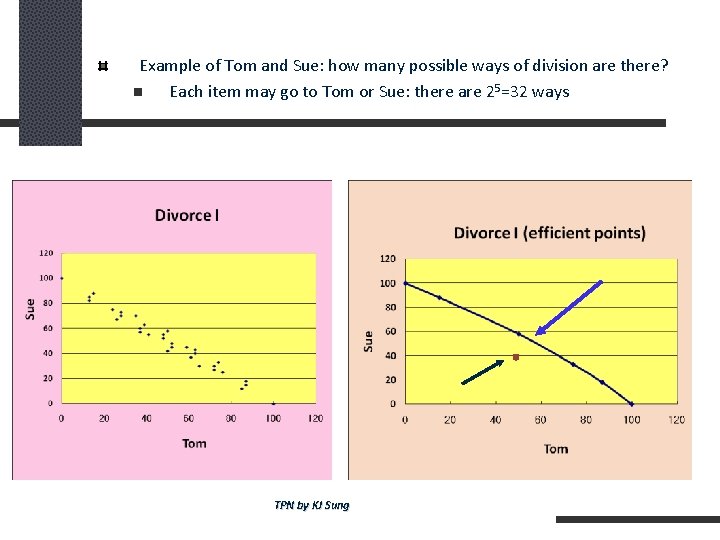
Example of Tom and Sue: how many possible ways of division are there? n Each item may go to Tom or Sue: there are 25=32 ways TPN by KJ Sung
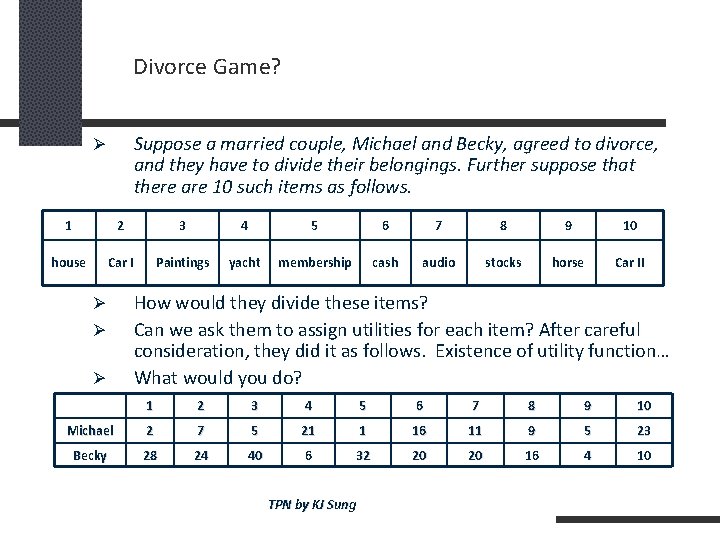
Divorce Game? Suppose a married couple, Michael and Becky, agreed to divorce, and they have to divide their belongings. Further suppose that there are 10 such items as follows. Ø 1 2 3 4 5 6 7 8 9 10 house Car I Paintings yacht membership cash audio stocks horse Car II Ø Ø Ø How would they divide these items? Can we ask them to assign utilities for each item? After careful consideration, they did it as follows. Existence of utility function… What would you do? 1 2 3 4 5 6 7 8 9 10 Michael 2 7 5 21 1 16 11 9 5 23 Becky 28 24 40 6 32 20 20 16 4 10 TPN by KJ Sung
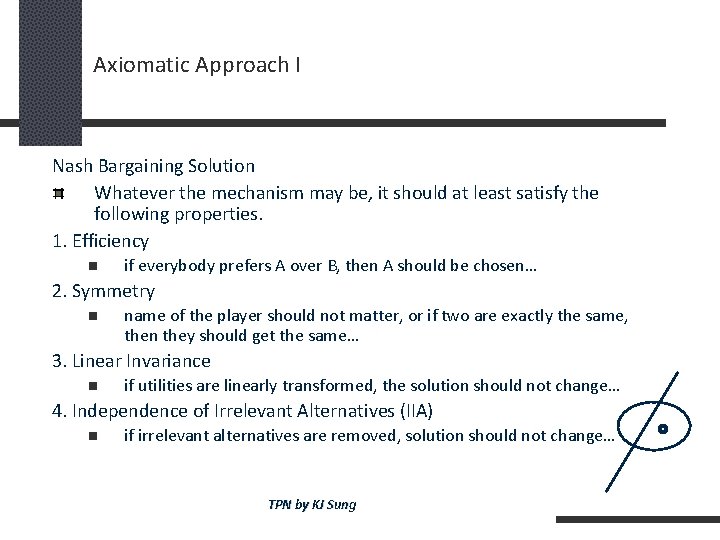
Axiomatic Approach I Nash Bargaining Solution Whatever the mechanism may be, it should at least satisfy the following properties. 1. Efficiency n if everybody prefers A over B, then A should be chosen… 2. Symmetry n name of the player should not matter, or if two are exactly the same, then they should get the same… 3. Linear Invariance n if utilities are linearly transformed, the solution should not change… 4. Independence of Irrelevant Alternatives (IIA) n if irrelevant alternatives are removed, solution should not change… TPN by KJ Sung
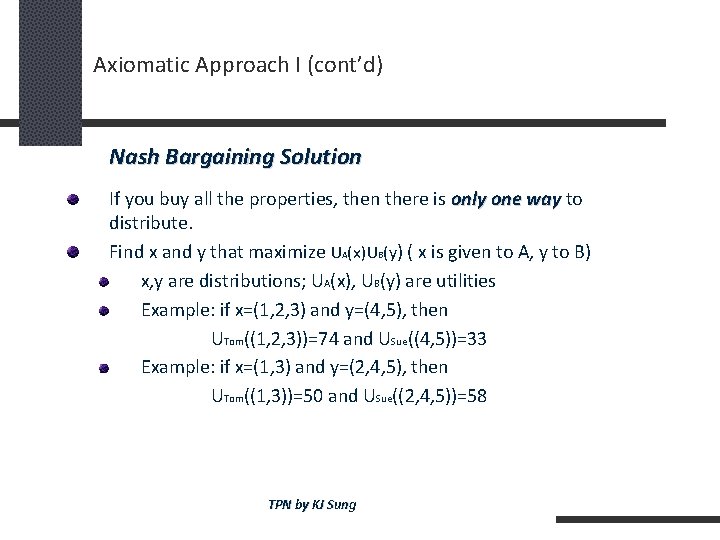
Axiomatic Approach I (cont’d) Nash Bargaining Solution If you buy all the properties, then there is only one way to distribute. Find x and y that maximize UA(x)UB(y) ( x is given to A, y to B) x, y are distributions; UA(x), UB(y) are utilities Example: if x=(1, 2, 3) and y=(4, 5), then UTom((1, 2, 3))=74 and USue((4, 5))=33 Example: if x=(1, 3) and y=(2, 4, 5), then UTom((1, 3))=50 and USue((2, 4, 5))=58 TPN by KJ Sung
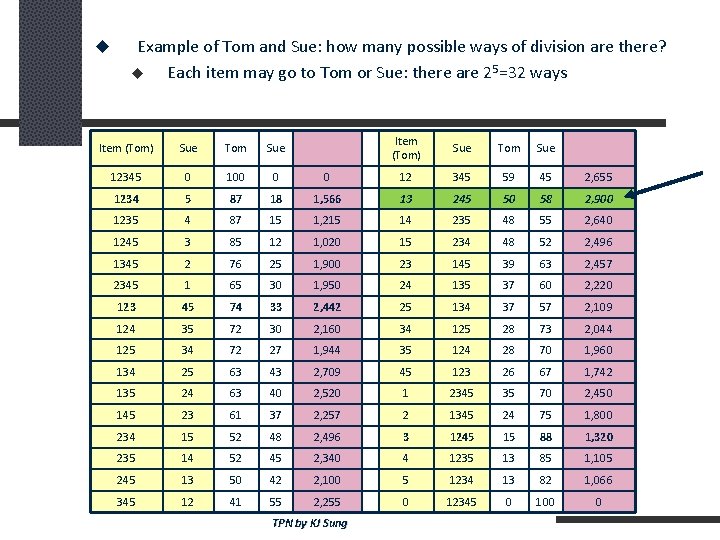
u Example of Tom and Sue: how many possible ways of division are there? u Each item may go to Tom or Sue: there are 25=32 ways Item (Tom) Sue Tom Sue 0 12 345 59 45 2, 655 18 1, 566 13 245 50 58 2, 900 87 15 1, 215 14 235 48 55 2, 640 3 85 12 1, 020 15 234 48 52 2, 496 1345 2 76 25 1, 900 23 145 39 63 2, 457 2345 1 65 30 1, 950 24 135 37 60 2, 220 123 45 74 33 2, 442 25 134 37 57 2, 109 124 35 72 30 2, 160 34 125 28 73 2, 044 125 34 72 27 1, 944 35 124 28 70 1, 960 134 25 63 43 2, 709 45 123 26 67 1, 742 135 24 63 40 2, 520 1 2345 35 70 2, 450 145 23 61 37 2, 257 2 1345 24 75 1, 800 234 15 52 48 2, 496 3 1245 15 88 1, 320 235 14 52 45 2, 340 4 1235 13 85 1, 105 245 13 50 42 2, 100 5 1234 13 82 1, 066 345 12 41 55 2, 255 0 12345 0 100 0 Item (Tom) Sue Tom Sue 12345 0 100 0 1234 5 87 1235 4 1245 TPN by KJ Sung
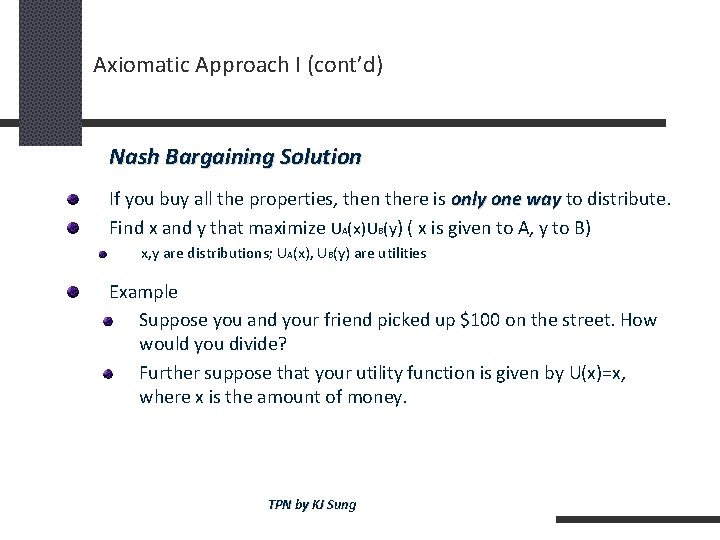
Axiomatic Approach I (cont’d) Nash Bargaining Solution If you buy all the properties, then there is only one way to distribute. Find x and y that maximize UA(x)UB(y) ( x is given to A, y to B) x, y are distributions; UA(x), UB(y) are utilities Example Suppose you and your friend picked up $100 on the street. How would you divide? Further suppose that your utility function is given by U(x)=x, where x is the amount of money. TPN by KJ Sung
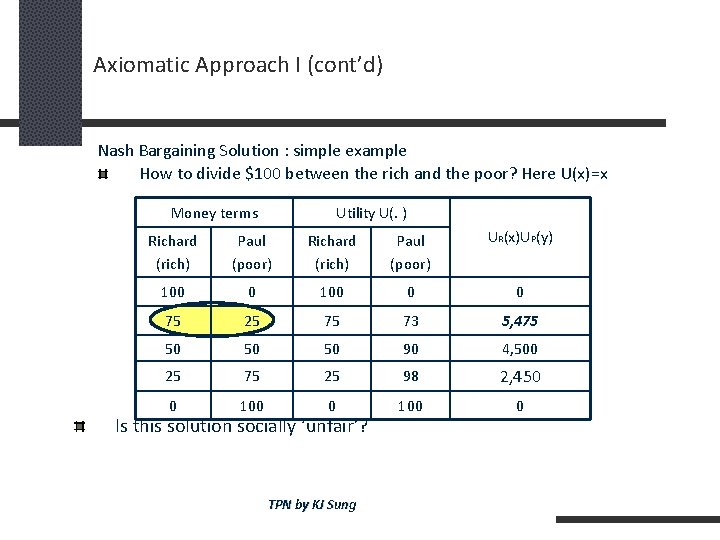
Axiomatic Approach I (cont’d) Nash Bargaining Solution : simple example How to divide $100 between the rich and the poor? Here U(x)=x Money terms Utility U(. ) Richard (rich) Paul (poor) UR(x)UP(y) 100 0 0 75 25 75 73 5, 475 50 50 50 90 4, 500 25 75 25 98 2, 450 0 100 0 Is this solution socially ‘unfair’? TPN by KJ Sung
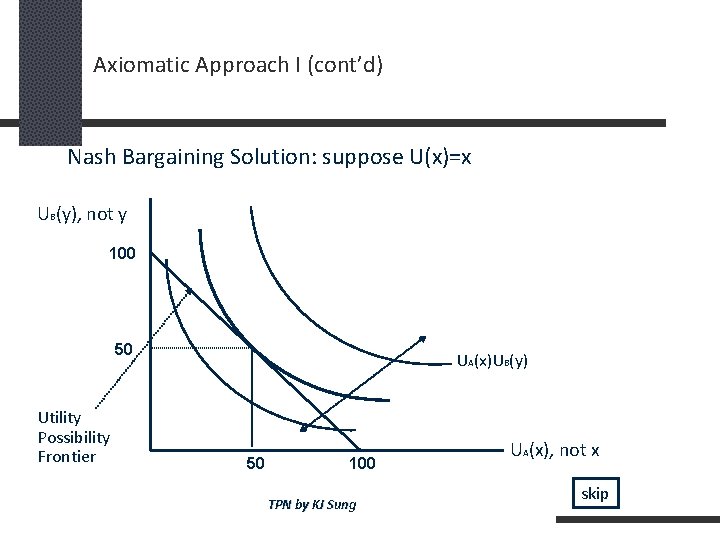
Axiomatic Approach I (cont’d) Nash Bargaining Solution: suppose U(x)=x UB(y), not y 100 50 Utility Possibility Frontier UA(x)UB(y) 50 100 TPN by KJ Sung UA(x), not x skip
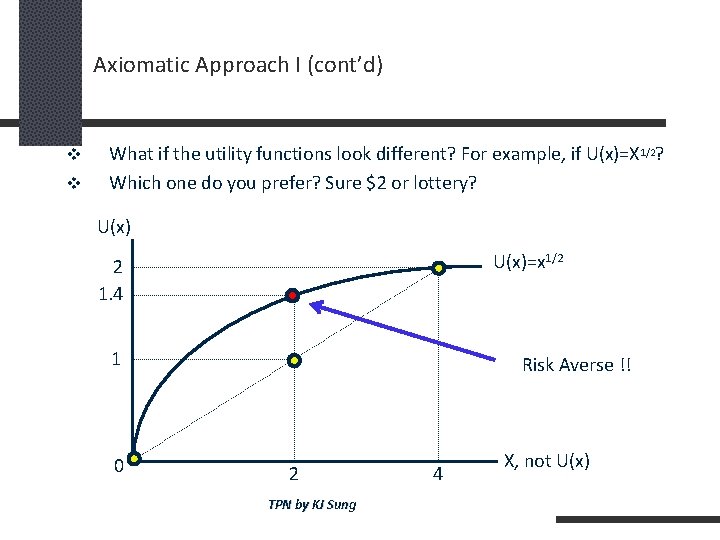
Axiomatic Approach I (cont’d) v v What if the utility functions look different? For example, if U(x)=X 1/2? Which one do you prefer? Sure $2 or lottery? U(x)=x 1/2 2 1. 4 1 0 Risk Averse !! 2 TPN by KJ Sung 4 X, not U(x)
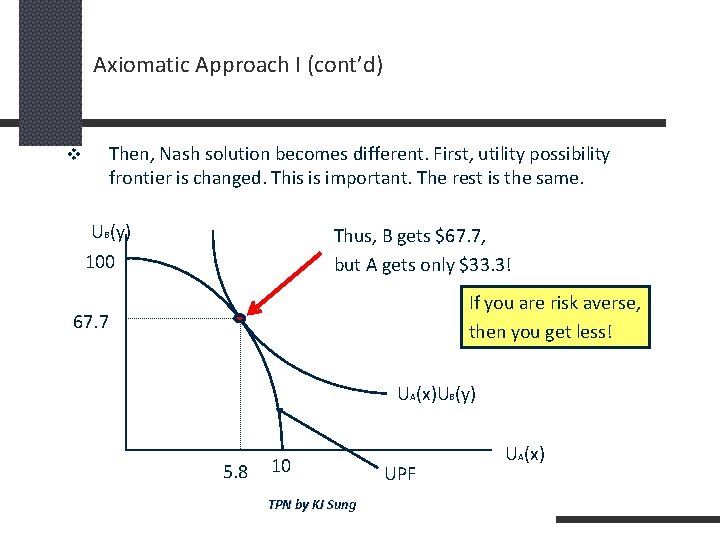
Axiomatic Approach I (cont’d) Then, Nash solution becomes different. First, utility possibility frontier is changed. This is important. The rest is the same. v UB(y) Thus, B gets $67. 7, but A gets only $33. 3! 100 If you are risk averse, then you get less! 67. 7 UA(x)UB(y) 5. 8 10 TPN by KJ Sung UPF UA(x)
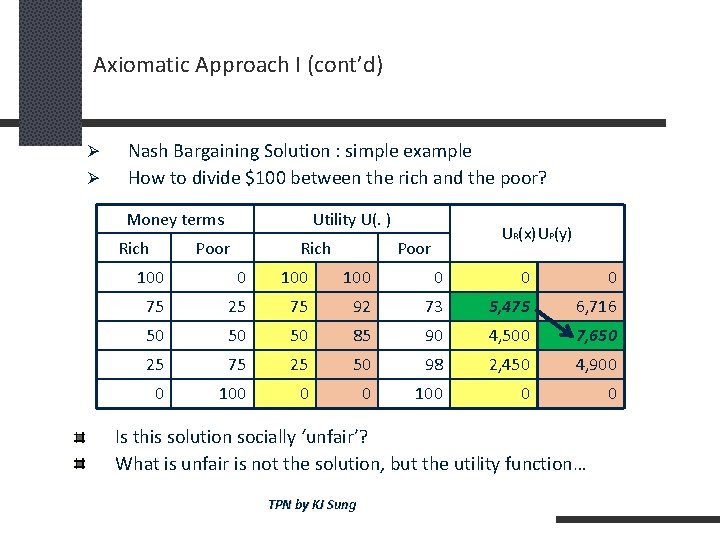
Axiomatic Approach I (cont’d) Ø Ø Nash Bargaining Solution : simple example How to divide $100 between the rich and the poor? Money terms Rich Utility U(. ) Poor Rich UR(x)UP(y) Poor 100 0 75 25 75 92 73 5, 475 6, 716 50 50 50 85 90 4, 500 7, 650 25 75 25 50 98 2, 450 4, 900 0 100 0 0 Is this solution socially ‘unfair’? What is unfair is not the solution, but the utility function… TPN by KJ Sung
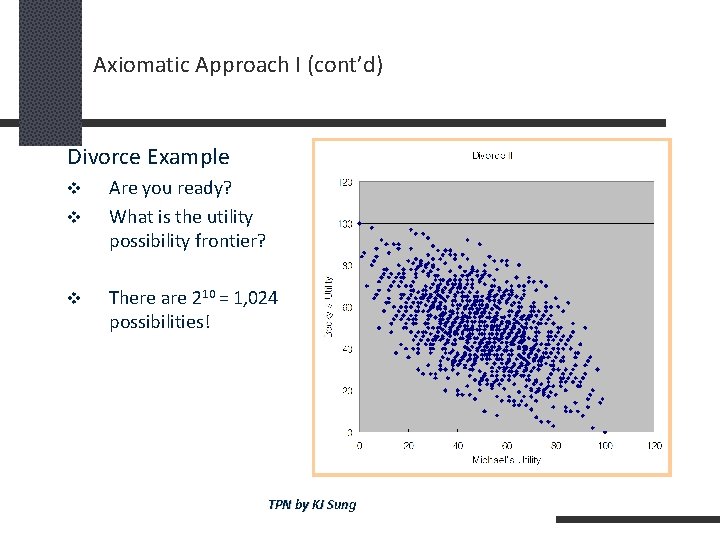
Axiomatic Approach I (cont’d) Divorce Example v v v Are you ready? What is the utility possibility frontier? There are 210 = 1, 024 possibilities! TPN by KJ Sung
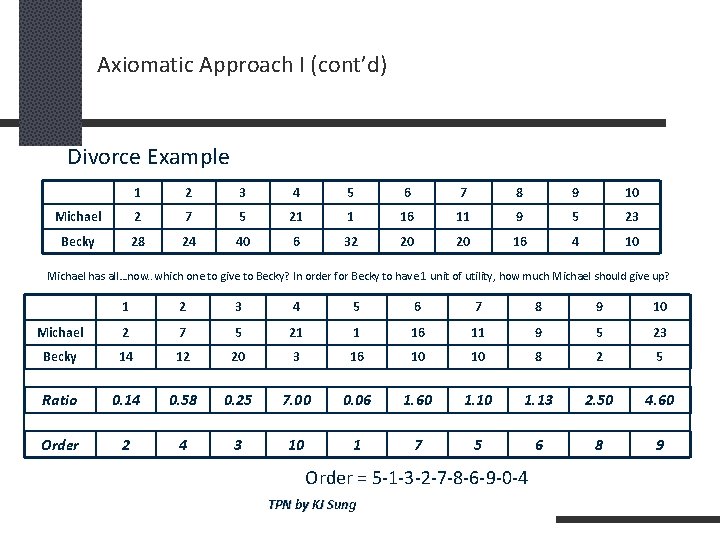
Axiomatic Approach I (cont’d) Divorce Example 1 2 3 4 5 6 7 8 9 10 Michael 2 7 5 21 1 16 11 9 5 23 Becky 28 24 40 6 32 20 20 16 4 10 Michael has all…now. . which one to give to Becky? In order for Becky to have 1 unit of utility, how much Michael should give up? 1 2 3 4 5 6 7 8 9 10 Michael 2 7 5 21 1 16 11 9 5 23 Becky 14 12 20 3 16 10 10 8 2 5 Ratio 0. 14 0. 58 0. 25 7. 00 0. 06 1. 60 1. 13 2. 50 4. 60 Order 2 4 3 10 1 7 5 6 8 9 Order = 5 -1 -3 -2 -7 -8 -6 -9 -0 -4 TPN by KJ Sung
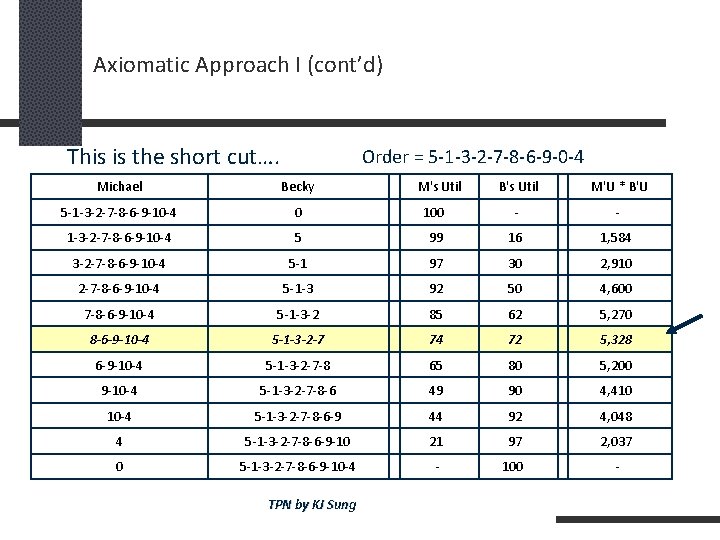
Axiomatic Approach I (cont’d) This is the short cut…. Order = 5 -1 -3 -2 -7 -8 -6 -9 -0 -4 Michael Becky 5 -1 -3 -2 -7 -8 -6 -9 -10 -4 0 100 - - 1 -3 -2 -7 -8 -6 -9 -10 -4 5 99 16 1, 584 3 -2 -7 -8 -6 -9 -10 -4 5 -1 97 30 2, 910 2 -7 -8 -6 -9 -10 -4 5 -1 -3 92 50 4, 600 7 -8 -6 -9 -10 -4 5 -1 -3 -2 85 62 5, 270 8 -6 -9 -10 -4 5 -1 -3 -2 -7 74 72 5, 328 6 -9 -10 -4 5 -1 -3 -2 -7 -8 65 80 5, 200 9 -10 -4 5 -1 -3 -2 -7 -8 -6 49 90 4, 410 10 -4 5 -1 -3 -2 -7 -8 -6 -9 44 92 4, 048 4 5 -1 -3 -2 -7 -8 -6 -9 -10 21 97 2, 037 0 5 -1 -3 -2 -7 -8 -6 -9 -10 -4 - 100 - TPN by KJ Sung M's Util B's Util M'U * B'U
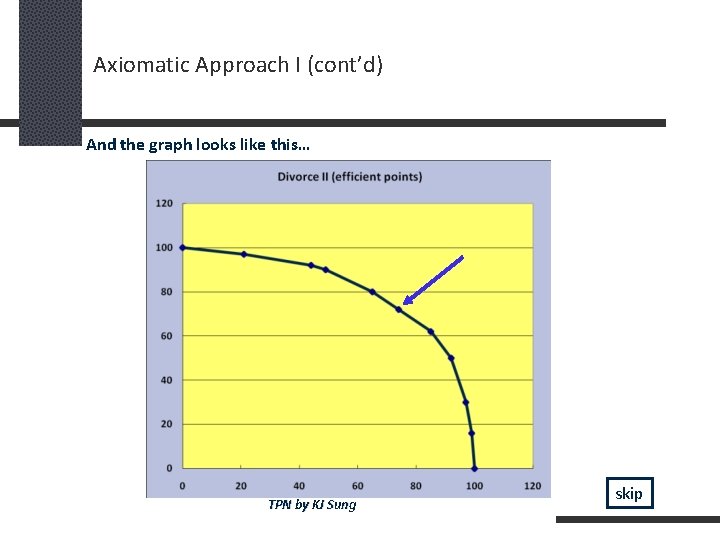
Axiomatic Approach I (cont’d) And the graph looks like this… TPN by KJ Sung skip
Axiomatic Approach II Kalai-Smorodinski Solution v v v Suppose your friend cannot take more than $60. What would be your suggestion? According to Nash, still both get $50. What if we introduce the concept “monotonicity”? That is, I should be better of if UPP expands to my favor…. Then, again, there is only one solution… It is the intersection between UPP, and the line from the origin to (max UA(x), max UB(y)) TPN by KJ Sung
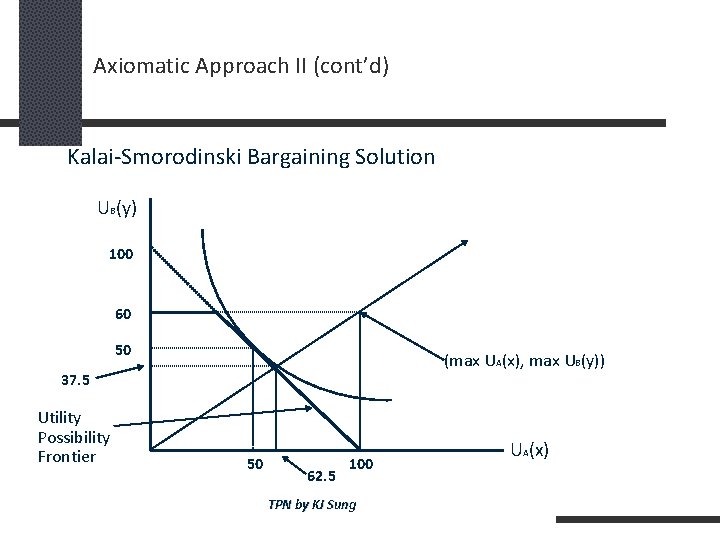
Axiomatic Approach II (cont’d) Kalai-Smorodinski Bargaining Solution UB(y) 100 60 50 (max UA(x), max UB(y)) 37. 5 Utility Possibility Frontier 50 62. 5 100 TPN by KJ Sung UA(x)
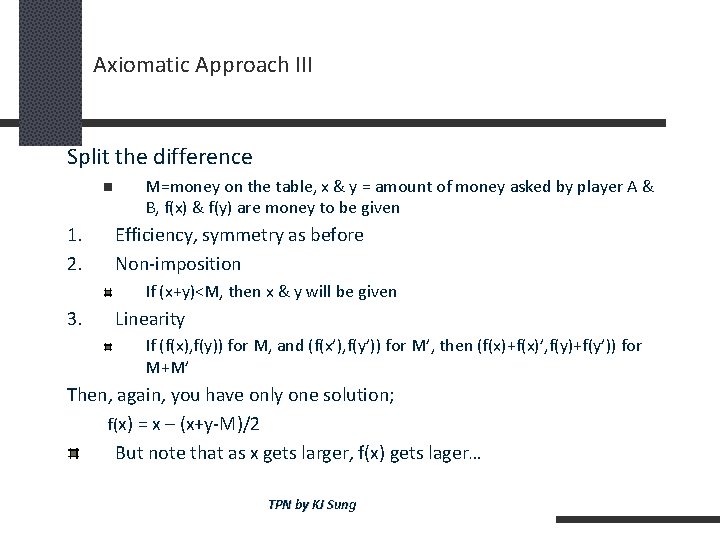
Axiomatic Approach III Split the difference n 1. 2. M=money on the table, x & y = amount of money asked by player A & B, f(x) & f(y) are money to be given Efficiency, symmetry as before Non-imposition If (x+y)<M, then x & y will be given 3. Linearity If (f(x), f(y)) for M, and (f(x’), f(y’)) for M’, then (f(x)+f(x)’, f(y)+f(y’)) for M+M’ Then, again, you have only one solution; f(x) = x – (x+y-M)/2 But note that as x gets larger, f(x) gets lager… TPN by KJ Sung
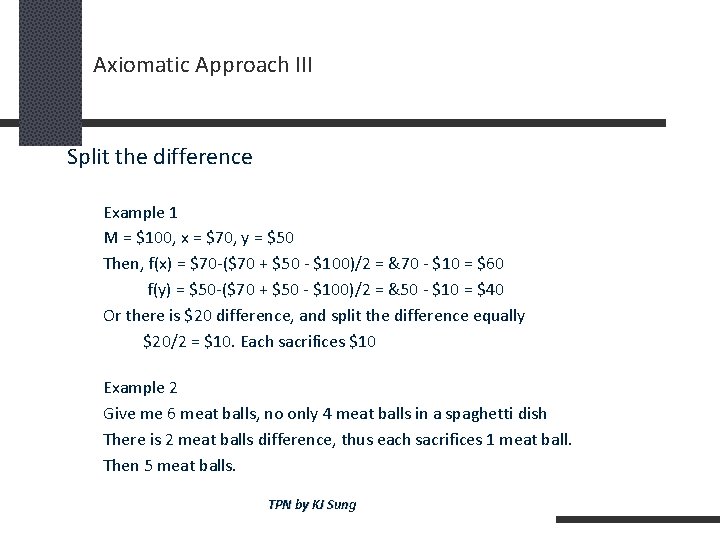
Axiomatic Approach III Split the difference Example 1 M = $100, x = $70, y = $50 Then, f(x) = $70 -($70 + $50 - $100)/2 = &70 - $10 = $60 f(y) = $50 -($70 + $50 - $100)/2 = &50 - $10 = $40 Or there is $20 difference, and split the difference equally $20/2 = $10. Each sacrifices $10 Example 2 Give me 6 meat balls, no only 4 meat balls in a spaghetti dish There is 2 meat balls difference, thus each sacrifices 1 meat ball. Then 5 meat balls. TPN by KJ Sung
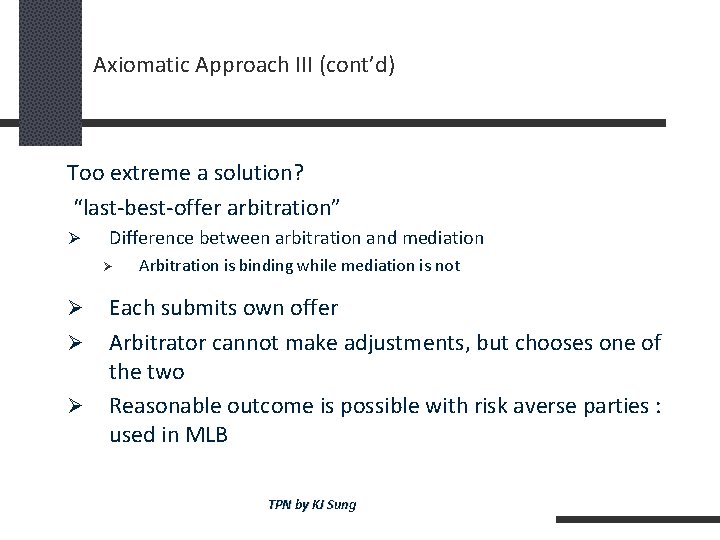
Axiomatic Approach III (cont’d) Too extreme a solution? “last-best-offer arbitration” Ø Difference between arbitration and mediation Ø Ø Arbitration is binding while mediation is not Each submits own offer Arbitrator cannot make adjustments, but chooses one of the two Reasonable outcome is possible with risk averse parties : used in MLB TPN by KJ Sung
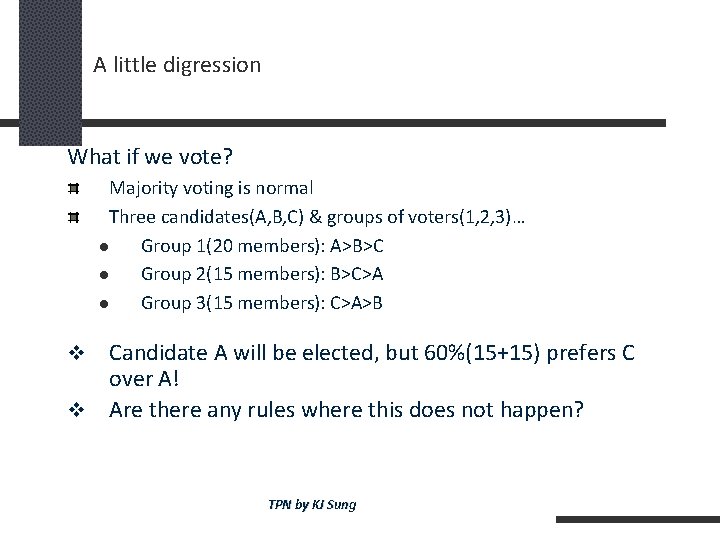
A little digression What if we vote? Majority voting is normal Three candidates(A, B, C) & groups of voters(1, 2, 3)… l Group 1(20 members): A>B>C l Group 2(15 members): B>C>A l Group 3(15 members): C>A>B Candidate A will be elected, but 60%(15+15) prefers C over A! v Are there any rules where this does not happen? v TPN by KJ Sung
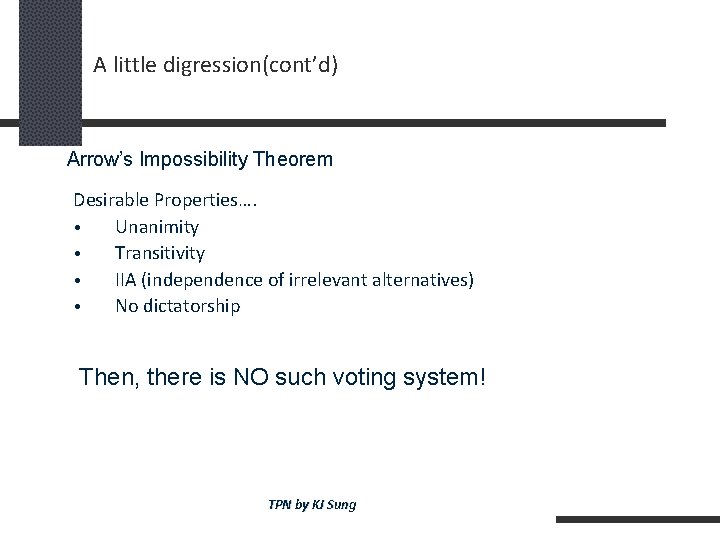
A little digression(cont’d) Arrow’s Impossibility Theorem Desirable Properties…. • Unanimity • Transitivity • IIA (independence of irrelevant alternatives) • No dictatorship Then, there is NO such voting system! TPN by KJ Sung
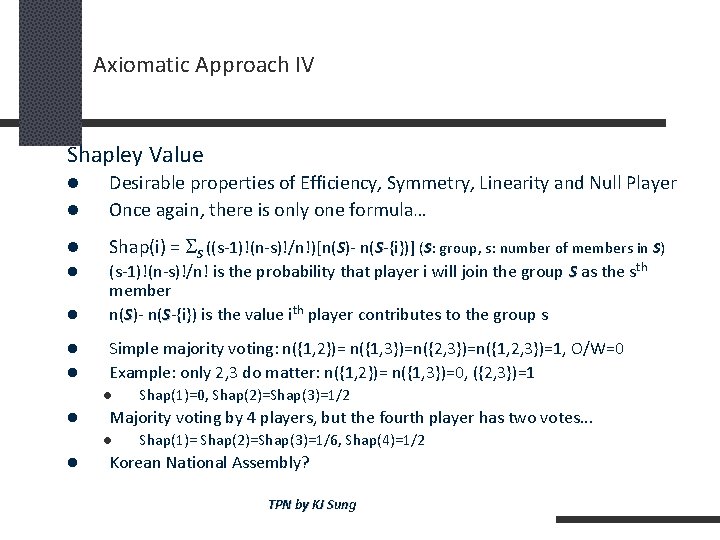
Axiomatic Approach IV Shapley Value l Desirable properties of Efficiency, Symmetry, Linearity and Null Player Once again, there is only one formula… l Shap(i) = SS ((s-1)!(n-s)!/n!)[n(S)- n(S-{i})] (S: group, s: number of members in S) l l l (s-1)!(n-s)!/n! is the probability that player i will join the group S as the sth member n(S)- n(S-{i}) is the value ith player contributes to the group s Simple majority voting: n({1, 2})= n({1, 3})=n({2, 3})=n({1, 2, 3})=1, O/W=0 Example: only 2, 3 do matter: n({1, 2})= n({1, 3})=0, ({2, 3})=1 l l Majority voting by 4 players, but the fourth player has two votes. . . l l Shap(1)=0, Shap(2)=Shap(3)=1/2 Shap(1)= Shap(2)=Shap(3)=1/6, Shap(4)=1/2 Korean National Assembly? TPN by KJ Sung
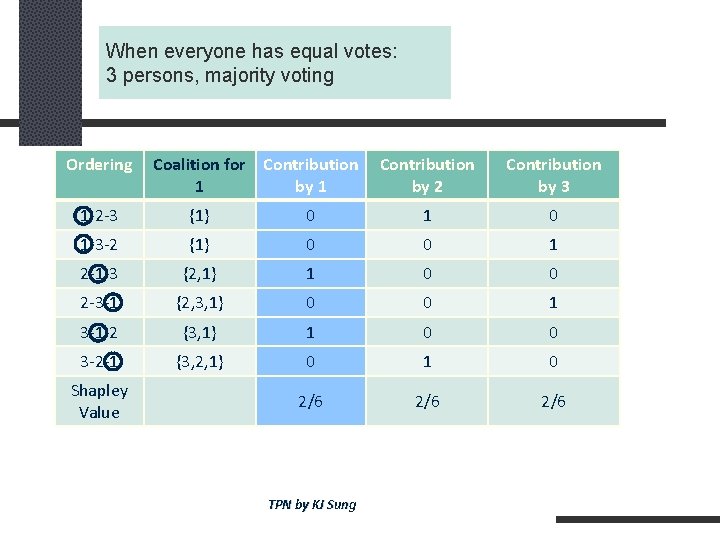
When everyone has equal votes: 3 persons, majority voting Ordering Coalition for Contribution 1 by 1 Contribution by 2 Contribution by 3 1 -2 -3 {1} 0 1 -3 -2 {1} 0 0 1 2 -1 -3 {2, 1} 1 0 0 2 -3 -1 {2, 3, 1} 0 0 1 3 -1 -2 {3, 1} 1 0 0 3 -2 -1 {3, 2, 1} 0 1 0 2/6 2/6 Shapley Value TPN by KJ Sung
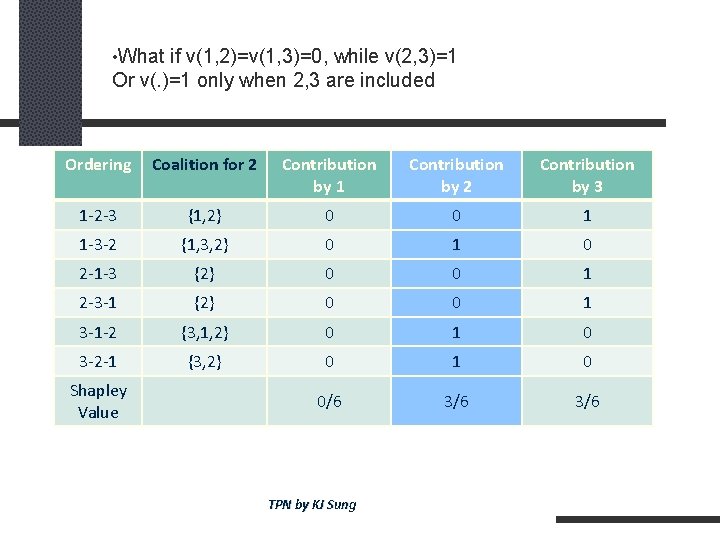
• What if v(1, 2)=v(1, 3)=0, while v(2, 3)=1 Or v(. )=1 only when 2, 3 are included Ordering Coalition for 2 Contribution by 1 Contribution by 2 Contribution by 3 1 -2 -3 {1, 2} 0 0 1 1 -3 -2 {1, 3, 2} 0 1 0 2 -1 -3 {2} 0 0 1 2 -3 -1 {2} 0 0 1 3 -1 -2 {3, 1, 2} 0 1 0 3 -2 -1 {3, 2} 0 1 0 0/6 3/6 Shapley Value TPN by KJ Sung
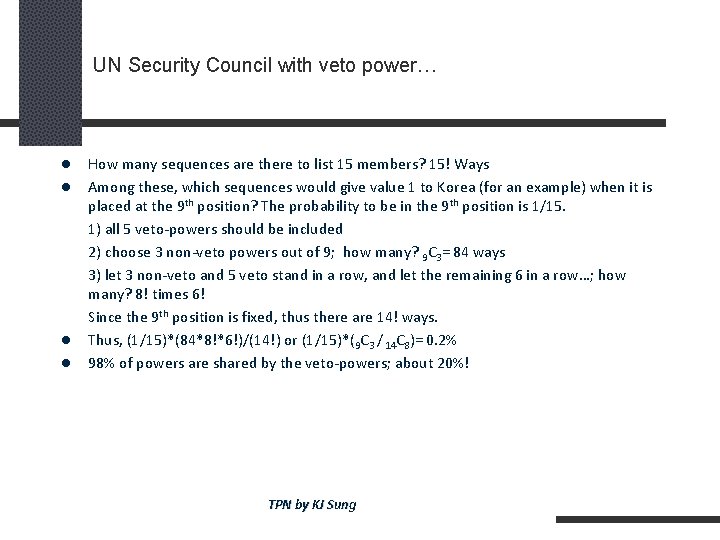
UN Security Council with veto power… l l How many sequences are there to list 15 members? 15! Ways Among these, which sequences would give value 1 to Korea (for an example) when it is placed at the 9 th position? The probability to be in the 9 th position is 1/15. 1) all 5 veto-powers should be included 2) choose 3 non-veto powers out of 9; how many? 9 C 3= 84 ways 3) let 3 non-veto and 5 veto stand in a row, and let the remaining 6 in a row…; how many? 8! times 6! Since the 9 th position is fixed, thus there are 14! ways. Thus, (1/15)*(84*8!*6!)/(14!) or (1/15)*(9 C 3 / 14 C 8)= 0. 2% 98% of powers are shared by the veto-powers; about 20%! TPN by KJ Sung
Thank you for your cooperation… Was the confusion worthwhile? TPN by KJ Sung
- Slides: 30