
Theory of evolution Tania Dentampol ID25152141 WHO INVENTED


- Slides: 10
Theory of evolution Tania Dentampol ID-25152141
WHO INVENTED THEORY OF EVOLUTION
CHARLES DARWIN The theory of evolution was first published by an English naturalist called Charles Darwin first started thinking of evolution when he started observing different plants that he found and then collecting evidence to build up a research. This process has taken him a lot of time, as he needed to ensure that his ideas were credible and so he needed to collect enough evidence that would back it up from science views. Additionally there was delays to his publishing as he realised that some people would not be happy about his idea. It was during the revolution of France when Darwin first published his book called “Descendent of Man”. He then sold lots of booksand that money has been added to his wealth.
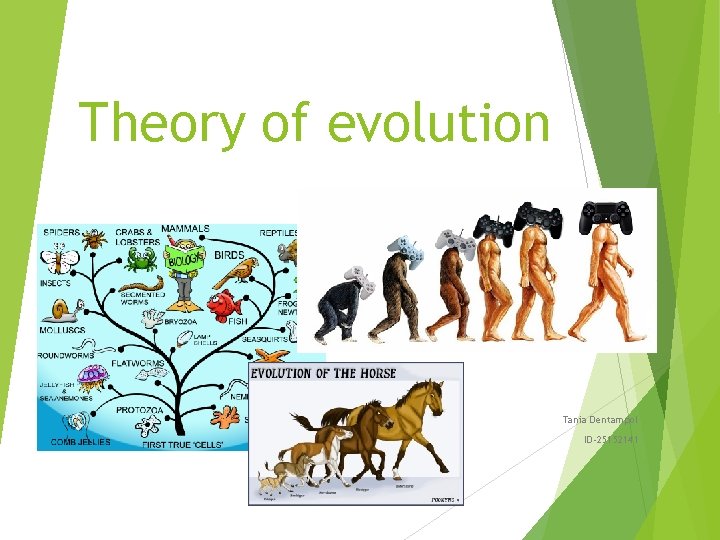
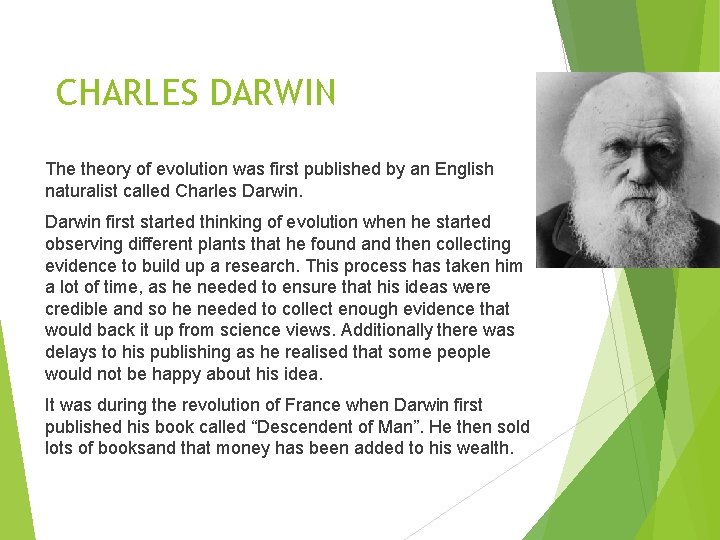
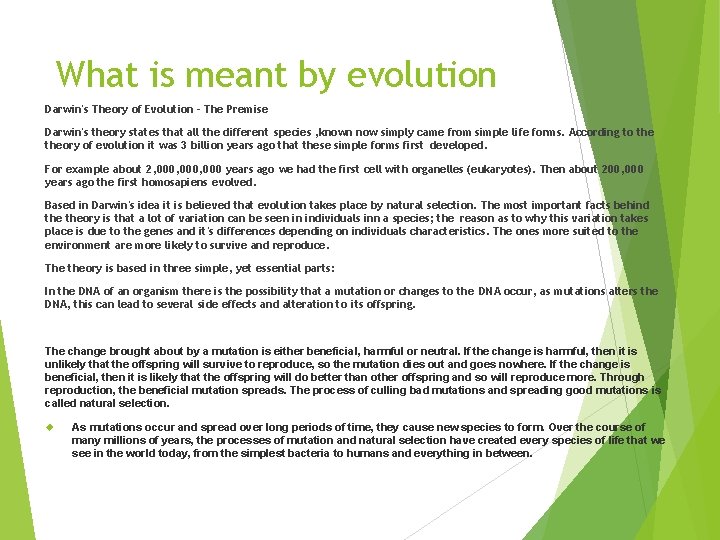
What is meant by evolution Darwin's Theory of Evolution - The Premise Darwin's theory states that all the different species , known now simply came from simple life forms. According to theory of evolution it was 3 billion years ago that these simple forms first developed. For example about 2, 000, 000 years ago we had the first cell with organelles (eukaryotes). Then about 200, 000 years ago the first homosapiens evolved. Based in Darwin's idea it is believed that evolution takes place by natural selection. The most important facts behind theory is that a lot of variation can be seen in individuals inn a species; the reason as to why this variation takes place is due to the genes and it's differences depending on individuals characteristics. The ones more suited to the environment are more likely to survive and reproduce. The theory is based in three simple, yet essential parts: In the DNA of an organism there is the possibility that a mutation or changes to the DNA occur, as mutations alters the DNA, this can lead to several side effects and alteration to its offspring. The change brought about by a mutation is either beneficial, harmful or neutral. If the change is harmful, then it is unlikely that the offspring will survive to reproduce, so the mutation dies out and goes nowhere. If the change is beneficial, then it is likely that the offspring will do better than other offspring and so will reproduce more. Through reproduction, the beneficial mutation spreads. The process of culling bad mutations and spreading good mutations is called natural selection. As mutations occur and spread over long periods of time, they cause new species to form. Over the course of many millions of years, the processes of mutation and natural selection have created every species of life that we see in the world today, from the simplest bacteria to humans and everything in between.
What were the processes involved in this theory ? To gather enough information and evidence to support this theory, Darwin collected and documented plants and animals from all around the world. This has lead the naturalist to discover the processes of natural selection.
Processes of natural selection Variation Inheritance Looking at the organisms within this population Darwin realized that each organism would display an individual variation in either the behavior or the appearance, This changes could be on the color of the hair, properties of the voice, size of the body or the number of offspring. However in some organisms there is no noticeable variations, for instance the number of eyes in which a vertebrates have, didn't change. From parent to offspring there are traits that even with the generations, are constantly passed on. Those traits which are passed on from one parent to the offspring are believed to be heritable, however other traits believed to be influenced due to various environmental circumstances and therefore show a low heritability.
Processes of natural selection High rate of population growth Differential survival and reproduction The rate in which the population is reproducing is relatively high in comparison with the resources (for example food) available to them, this then leads to struggle of resources. Therefore each offspring in a generation will experience mortality. Those organisms retaining characteristics in which are suitable to the struggle of resources are more likely to survive and pass on more offspring for the next generation.
Arguments against theory of evolution Fossils are the evidence in which show little or how long and organism has previously lived from. The peppered moths show this theory is credible, this is because it show us that the only reason why there is so much variation is due to the selection made by nature DNA is another proof. Nowadays scientists are able to examine DNA and determine the how closely related two species can be. The results had again supported theory of evolution
References http: //www. darwins-theory-of-evolution. com/ http: //science. howstuffworks. com/life/evolution 1. htm https: //www. google. co. uk/search? q=theory+of+evolution&espv=2& biw=1366&bih=667&source=lnms&tbm=isch&sa=X&ei=ll 09 VKHm. O 4 e E 7 gbc 6 ICYCA&sqi=2&ved=0 CAYQ_AUo. AQ#tbm=isch&q=charles+darw in&facrc=_&imgdii=_&imgrc=y 9 Qfe. Dxe. HWH 0 k. M%253 A%3 BWOv. Ca. LPl_7 Tm. M%3 Bhttp%253 A%252 Fa 4. files. biography. com%252 Fimag e%252 Fupload%252 Fc_fill%252 Cdpr_1. 0%252 Cg_face%252 Ch_300%25 2 Cq_80%252 Cw_300%252 FMTE 5 NDg 0 MDU 0 OTM 4 Nj. E 3 Mz. U 5. jpg%3 Bhtt p%253 A%252 Fwww. biography. com%252 Fpeople%252 Fcharlesdarwin-9266433%3 B 300 https: //www. youtube. com/watch? v=Uf-m. OCN 7 r. UU http: //www. bbc. co. uk/schools/gcsebitesize/science/21 c_pre_201 1/evolution/theoryevolutionrev 7. shtml